Aphids on Cannabis: Identification and Treatment
Aphids on cannabis: how to identify and eliminate them with biological methods. Guide for Quebec growers.
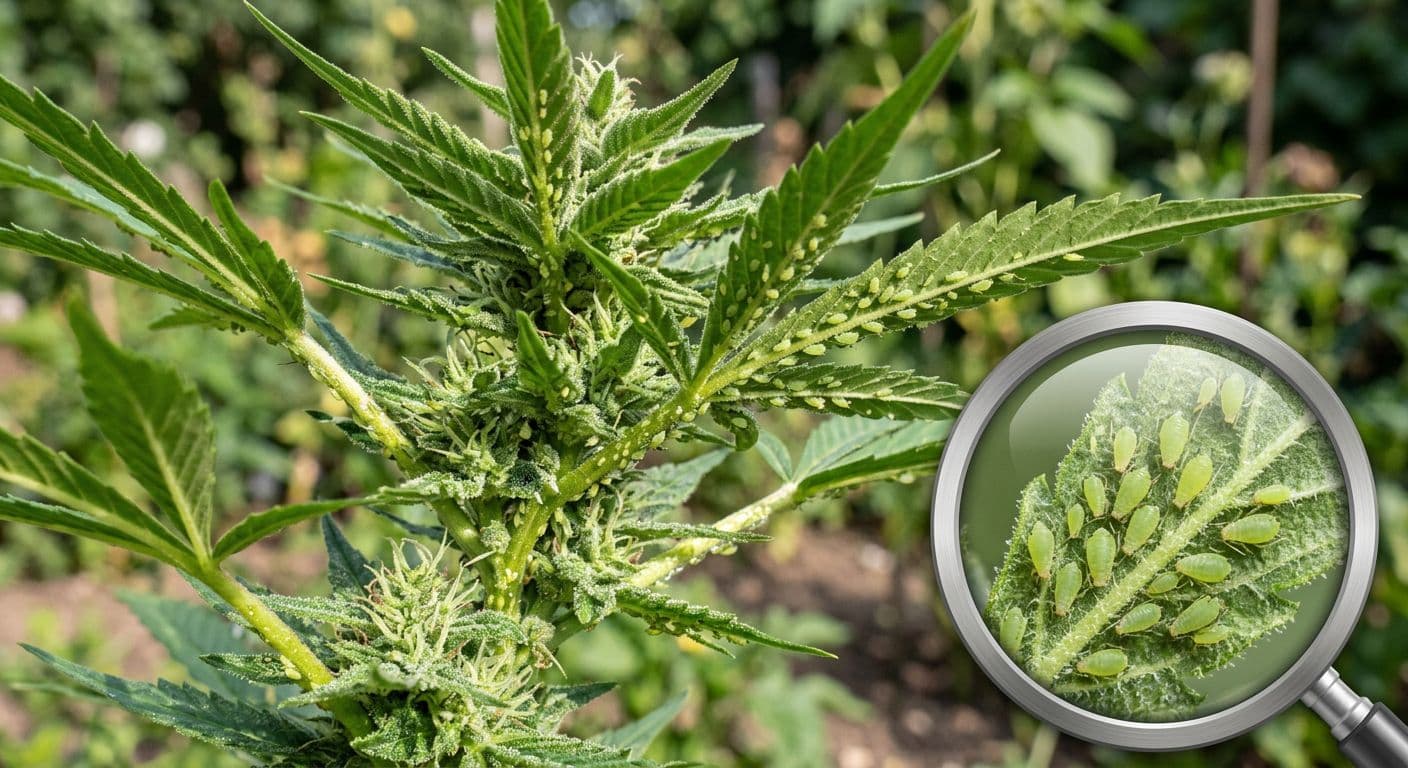
Aphids form visible colonies under the leaves and produce sticky honeydew, often first signaled by the presence of ants. Black soap, neem oil, and ladybugs remain the most effective treatments.
Key takeaways
- An aphid colony can double in 24 hours under favorable conditions.
- Ants on your plants are often the first warning sign, even before you spot the aphids themselves.
- Diluted black soap remains one of the most effective and safest treatments.
- A single ladybug larva eats up to 100 aphids a day.
- Aphids stay active all season, but the tender new growth of early flowering stretch (mid-August in Quebec) is especially attractive to colonies.
- What is the cannabis aphid?
- What damage do they cause on cannabis?
- What are the 6 methods to eliminate aphids?
- How do you prevent an aphid infestation?
- FAQ — Aphids on cannabis
Aphids are among the most common pests in cannabis growing, both indoors and outdoors. A colony can double in 24 hours under the right conditions. This guide gives you the tools to identify them quickly, stop the infestation, and protect your harvest without compromising flower quality.
What is the cannabis aphid?
Several aphid species attack cannabis, including the cannabis aphid (Phorodon cannabis), a species specific to the plant. These are sap-sucking insects that feed directly on your plants' sap.
How do you identify them?
- Size: 1 to 3 mm — visible to the naked eye.
- Color: pale green, yellow, black, or brown depending on the species.
- Shape: pear-shaped body, with two characteristic siphons (cornicles) at the rear.
- Location: under the leaves, on stems, at nodes, and on flower buds.
- Behavior: immobile in colonies, constant producers of sticky honeydew.
What damage do they cause on cannabis?
Aphids cause direct damage through their feeding, and indirect damage through the consequences of their honeydew — a combination that worsens quickly without intervention.
Direct damage
- Sap-sucking causes general weakening and slowed growth.
- Leaf deformation, yellowing, wilting.
- In heavy infestations: leaf drop and bud death.
- The honeydew they produce creates a favorable substrate for sooty mold.
- Aphids can act as vectors for plant viruses.
- Contamination of flowers during flowering compromises resin quality.
What are the 6 methods to eliminate aphids?
Combining an immediate treatment with a lasting biological solution gives the best results against this fast-multiplying pest.
- Water rinse — the first response. At the first signs, rinse your plants with lukewarm water under the leaves; a moderate spray dislodges colonies. Simple, residue-free, and effective early in an infestation. Repeat every 2 days, in the evening to avoid sunburn on wet leaves, and inspect carefully after each treatment.
- Black soap or insecticidal soap — the classic. A dilution of 2 to 3 tablespoons in 1 liter of lukewarm water is among the most effective and safest anti-aphid treatments; it works by clogging the insects' breathing pores. Spray on all surfaces, especially under the leaves, repeat every 5 to 7 days, and stop 10 days before harvest.
- Neem oil — a systemic treatment. The azadirachtin it contains disrupts aphids' reproductive cycle and prevents normal feeding. Dilute to 2–5 ml/L with a few drops of soap as emulsifier, spray in the evening to avoid direct sunlight — it remains effective against eggs and young larvae too. Stop application 2 weeks before harvest to avoid any residue on the flowers.
- Nettle manure — natural repellent and fertilizer. Fermented, it acts as a natural repellent while also strengthening the plant's immune defenses. Dilute to 10% for foliar spraying, or to 20% for a root drench — effective both as prevention and as a light curative treatment.
- Natural predators — biological control. Adult ladybugs and their larvae are among the most effective hunters against aphids; a single ladybug larva eats up to 100 aphids a day. Lacewings and parasitic wasps are also highly effective — pair them with attractive companion plants like fennel, dill, or cilantro.
- Garlic decoction — a preventive repellent. Soak several garlic cloves in water for 24 hours, strain, then spray; the released allicin repels aphids. Use it mainly as prevention, before colonies appear — it pairs well with black soap, and should be reapplied after every rain.
How do you prevent an aphid infestation?
Correcting the conditions that favor aphids significantly reduces the risk, often more effectively than treatment once an infestation is already established.
- Inspect your plants 2 to 3 times a week, especially under the leaves.
- Encourage biodiversity — flowers and aromatic herbs — to attract natural predators.
- Avoid excess nitrogen: over-fertilized plants attract more aphids.
- Control ant populations, which protect aphid colonies from their natural predators.
- Indoors, maintain good air circulation and avoid excessively high temperatures.
- Quarantine any new plant before introducing it into your growing space.
FAQ
How do you identify aphids on your cannabis plants?
Aphids are recognized by their colonies clustered under the leaves and on the stems. They measure 1 to 3 mm, are usually green or black, and leave a sticky residue, honeydew. Ants on the plant often remain the first warning sign.
What damage do aphids cause on cannabis?
Aphids suck the plant's sap, causing yellowing and deformation of the leaves, slowed growth, and black sooty mold on the honeydew they produce. During flowering, they can compromise resin quality and contaminate the flowers.
Is black soap effective against aphids on cannabis?
Yes, it's one of the most effective and safest treatments. Dissolve 2 to 3 tablespoons of liquid black soap in 1 liter of lukewarm water and spray on all infested surfaces, repeating every 5 to 7 days.
Can aphids kill my cannabis plants?
A light to moderate infestation won't kill a healthy plant, but it weakens it and can open the door to fungal disease. A severe untreated infestation can cause serious wilting, especially on young plants.
Can you use neem oil against aphids?
Absolutely. Neem oil is a highly effective biological treatment — it disrupts their feeding and reproduction. Dilute to 2–5 ml/L with an emulsifier and spray in the evening, stopping application 2 weeks before harvest.
Can I still smoke my buds if they had aphids on them?
It's not recommended, even after washing the buds. Rinsing with water removes some insects and honeydew on the surface, but not all of it — a stronger hose spray works better than a simple dip. If the infestation was severe at harvest, it's better to turn the most affected flowers into extracts (oil, tincture) rather than smoking them as-is, or set them aside from your final harvest entirely.
How do you tell aphids apart from thrips on cannabis?
Aphids form visible colonies and leave sticky honeydew, while [thrips](/en/articles/cannabis-pests-practical-guide) instead leave silvery streaks and small black droppings, without forming colonies visible to the naked eye. Both cause general weakening of the plant.
When are aphids most active in Quebec?
Aphids stay active all season and proliferate especially in hot, dry weather. In Quebec outdoor grows, two windows carry the highest risk: the vegetative stage (May-June) and the early flowering stretch (typically mid-August), when the plant pushes out tender new growth while stacking nodes — a real feast for aphid colonies.
Where can you buy ladybugs or lacewings in Quebec?
Since these are living organisms, ladybugs and lacewings aren't sold directly in garden centers — they're purchased online and shipped by express courier, either as eggs on a hanging strip or as larvae in a box. Anatis Bioprotection, a Quebec-based company, raises insects native to Quebec (better adapted to the local climate than imported species) and ships across the province. Live ladybugs are generally available from June through late September for an outdoor release, and year-round for indoor use.
How do you get rid of ants to protect my plants from aphids?
Ants protect aphid colonies from their natural predators. Set up ant traps around the perimeter of your grow, or wrap the stems with a band of sticky glue available at garden centers — removing ants directly exposes aphids to their natural predators. To repel aphids right from planting, also check out our dedicated guide to [companion plants against aphids](/en/articles/companion-plants-aphids). For an overview of all cannabis pests, our [practical guide to the cluster](/en/articles/cannabis-pests-practical-guide) covers every parasite in detail.
19+ | Educational horticulture only.