Caterpillars on Cannabis: Practical Guide to Identify Damage and Protect Your Harvest
Caterpillars and budworms on cannabis: identify the damage and apply the right biological treatments before flowering.
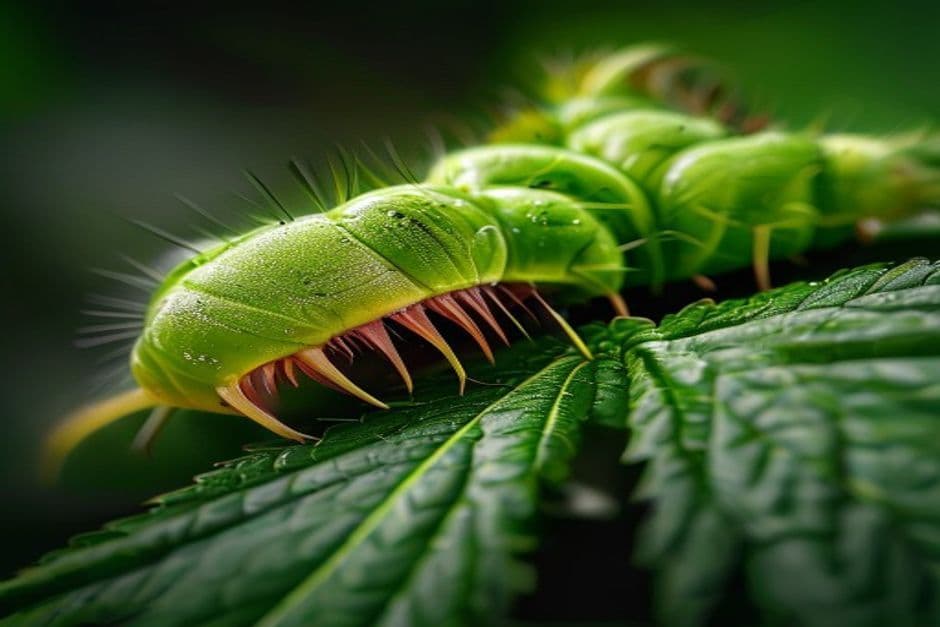
Caterpillars chew leaves into large irregular chunks, leaving cylindrical green or black droppings. The more fearsome budworm burrows into flowering buds. BTk remains the go-to biological treatment.
Key takeaways
- Caterpillars chew leaves into large irregular chunks, unlike the Japanese beetle's skeletonization.
- Budworms burrow directly into flowering buds — damage that's often invisible until harvest.
- BTk (Bacillus thuringiensis kurstaki) remains the go-to biological treatment, safe for humans and bees.
- Cutworms cut stems at the base and can kill a young plant almost instantly.
- Insect netting prevents female moths from laying eggs, especially useful in July–August.
- What are the main caterpillar species to know?
- What specific damage do they cause on cannabis?
- What are the 5 methods to eliminate caterpillars?
- FAQ — Caterpillars on cannabis
Caterpillars are the most voracious defoliators that can attack your outdoor cannabis. And the budworm is particularly fearsome: it burrows directly into the flowering buds.
Here's how to identify them, treat them, and keep them away.
What are the main caterpillar species to know?
Three groups of caterpillars threaten cannabis, each with a distinct attack pattern and risk period.
**Budworm (Choristoneura spp.)** This green or reddish-brown larva, 2 to 3 cm at maturity, burrows into flower buds and heads — internal damage that's very hard to detect from the outside. It leaves silky webbing inside the flowers, and its most critical damage remains the risk of rot in infested buds.
**Cannabis cutworm (Agrotis spp.)** This thick, gray or brown, nocturnal larva cuts stems at the base — causing seedling collapse. It remains mainly a problem for plants still in the vegetative stage.
**Various caterpillars (Spodoptera spp., Helicoverpa spp.)** Their body color — green, yellow, or multicolored depending on the species — varies, but their signature stays the same: defoliation in large chunks, quite different from skeletonization, accompanied by bulky cylindrical droppings, a telltale sign.
How do you identify their damage?
- Large sections of leaves eaten — not a lace of veins, but entire chunks missing.
- Cylindrical droppings (frass), green or black, on the leaves and on the ground.
- Silky webbing in the buds, the budworm's signature.
- Stems cut cleanly at the base, the cutworm's signature.
What specific damage do they cause on cannabis?
Caterpillars strike differently depending on your plant's growth stage — flowering represents by far the most critical risk period.
Vegetative stage A large caterpillar can devour several big leaves in a single night, causing significant stress on young plants. Cuts at the base from cutworms often result in total loss of the affected plant.
Flowering stage — critical risk The budworm burrows into the buds and devours them from the inside. The droppings and moisture it leaves behind create ideal conditions for botrytis, gray mold. The damage often stays invisible from the outside — discovered only at harvest, once it's too late to act.
What are the 5 methods to eliminate caterpillars?
Combining nighttime monitoring, targeted biological treatment, and physical barriers gives the best results against this particularly voracious pest.
- Hand-picking — effective and residue-free. Go out in the evening or early morning with a flashlight, since caterpillars are nocturnal. Inspect the underside of leaves, stems, and buds, drop them into a container of soapy water, and also check the soil around your plants for cutworms. Repeat every 2 to 3 days during the season.
- **BTk (Bacillus thuringiensis var. kurstaki) — the go-to biopesticide. This natural bacterium produces toxic proteins specific to lepidopteran larvae (caterpillars), safe for humans, bees, and natural predators. Products like DiPel, Thuricide, or Foray are available in Canada. Spray on the foliage and into the buds — the caterpillar must ingest it to die, with action within 24 to 48 hours. Repeat every 5 to 7 days, since BTk degrades under UV light, and respect a withdrawal period of 3 to 7 days before harvest depending on the product (Jardinage PagesJaunes). Note that it only works on larvae — never on eggs or adults.
- Neem oil. The azadirachtin it contains inhibits larval molting and disrupts their development. Less effective than BTk on large, already-established caterpillars, but useful as a preventive measure and on young larvae.
- Insect netting — a physical barrier. Outdoors, fine-mesh netting can prevent female moths from laying eggs on your plants — particularly useful during adult emergence periods, in July–August. Just be sure to maintain good air circulation under the netting.
- Natural predators.** In Quebec outdoor grows, encourage caterpillars' natural predators: parasitic wasps, which lay their eggs inside caterpillars, lacewings and ladybugs, which consume their eggs, and bats, which hunt adult moths at night.
FAQ
How do you get rid of caterpillars on cannabis plants?
Combine three actions. Hand-pick in the evening or early morning with a flashlight — caterpillars are nocturnal, and large ones resist treatment, so manual removal is the only reliable method for those. Spray BTk (Bacillus thuringiensis kurstaki) on foliage and into the buds every 5 to 7 days: the caterpillar has to ingest it, and it acts within 24 to 48 hours. Then hang insect netting in July-August to stop moths laying eggs.
How do you know if your cannabis has caterpillars?
Look for the droppings before the caterpillar itself: small cylindrical green or black pellets on leaves and soil give them away, and the caterpillar is almost always nearby. Other signs are large sections of leaf eaten in irregular chunks, and silky webbing inside buds — the budworm's signature. Inspect at night with a flashlight, since they stay camouflaged by day.
When should you start spraying BTk?
Before buds form — this is critical. Once larvae have worked their way inside a bud, they feed sheltered from the spray, which can no longer reach them. Starting in early summer and reapplying regularly prevents them establishing at all. The caterpillar life cycle runs 35 to 40 days, meaning 3 to 4 generations a year: the first causes little damage, the later ones are far more numerous.
Does BTk work during flowering, and is it safe?
Yes, and flowering is when it matters most, especially against budworms — BT is the only treatment generally recommended once plants are in flower. BTk is a natural bacterium approved for organic farming: its proteins are toxic only to lepidopteran larvae, harmless to humans, bees, and beneficial predators. Respect the withdrawal period on the label, typically 3 to 7 days before harvest depending on the product.
What is the budworm and why is it so dangerous?
It's a caterpillar — usually a corn earworm or tobacco budworm — that bores directly into flowers and eats them from the inside. The danger is invisibility: damage doesn't show from the outside, often until harvest. Worse, its droppings and the moisture trapped inside the bud create botrytis conditions, and caterpillar damage turns into bud rot within days.
Why isn't BTk killing my large caterpillars?
Because BTk only affects larvae, and larger ones resist it considerably better. It has no effect at all on eggs or adult moths. On a well-developed caterpillar, hand removal is the only reliable method — drop it into a container of soapy water. BTk keeps its full value preventively and on young larvae.
Can caterpillars kill my cannabis plants?
An adult plant withstands moderate defoliation. But cutworms sever the stem at the base and kill a young plant almost instantly. And an untreated budworm can render an entire harvest unusable by triggering mold inside the buds — the plant survives, the crop doesn't.
How do you tell caterpillar damage apart from Japanese beetle damage?
The Japanese beetle skeletonizes: it eats the tissue between the veins, which stay intact, leaving a lace pattern. Caterpillars chew out large chunks of leaf with irregular edges. The second clue is decisive: caterpillars leave clearly visible cylindrical droppings, Japanese beetles never do.
Is it safe to spray BTk if my grow area is already humid?
Yes — BTk itself doesn't raise mold risk the way a heavier oil spray can, but timing still matters. Spray in the evening so foliage and buds dry before nightfall, and avoid spraying right before a stretch of rain or fog. In consistently humid outdoor conditions the bigger risk is the budworm's own damage, which traps moisture inside the bud, rather than the treatment itself.
19+ | Educational horticulture only.