Whiteflies on Cannabis: Practical Guide to Identify and Eliminate Them
Whiteflies silently weaken your cannabis plants. Identify and eliminate them with effective biological methods.
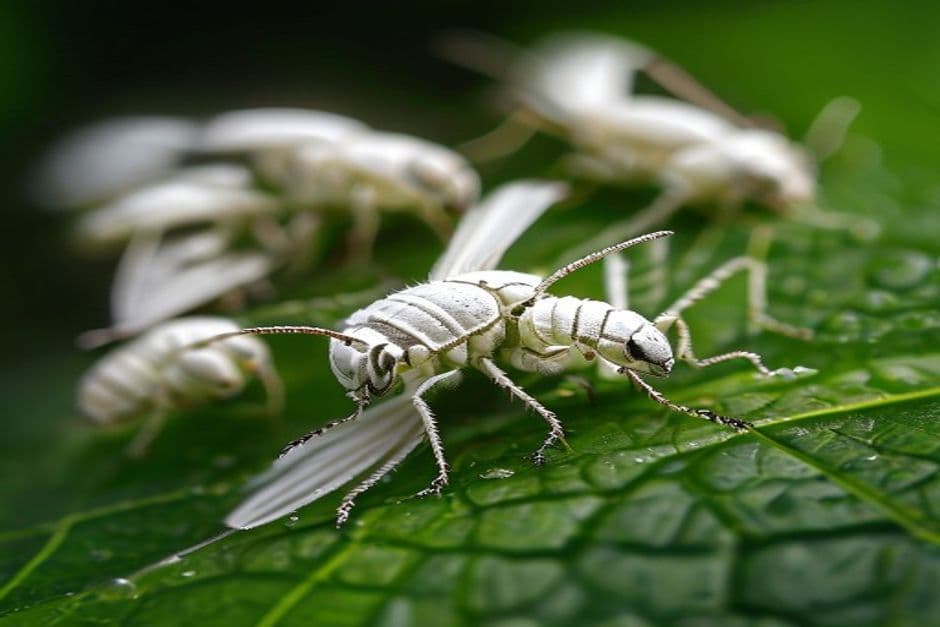
Whiteflies form a visible cloud when you shake the plant, with sticky honeydew under the leaves. Combine yellow traps, neem oil, and the parasitic wasp Encarsia formosa to eliminate them for good.
Key takeaways
- A cloud of white flies taking off when you shake the plant is the most reliable sign of a whitefly infestation.
- Larvae and pupae resist many contact treatments — repeating over several weeks is essential.
- The combination of yellow traps, neem oil, and Encarsia formosa remains the most durable strategy.
- The honeydew they produce promotes sooty mold, which blocks photosynthesis if the infestation progresses.
- Chemical insecticides should be avoided: their residues concentrate in the flowers.
What is a whitefly?
Whiteflies (family Aleyrodidae) are tiny sap-sucking insects, 1 to 2 mm long, covered in a characteristic white waxy powder. The most common species on cannabis is the greenhouse whitefly (Trialeurodes vaporariorum).
How do you identify them?
- Adults: 1 to 2 mm, powdery white, triangular in shape at rest.
- Larvae: translucent, flat, and immobile — they look like tiny scales stuck under the leaves.
- Eggs: microscopic, arranged in an arc under the foliage.
- Telltale sign: a cloud of white flies taking off when the plant is disturbed, combined with sticky honeydew under the leaves.
What damage do they cause on cannabis?
Whiteflies weaken the plant directly by feeding on its sap, and indirectly through the consequences of their honeydew — a double effect that worsens quickly without intervention.
Direct damage:
- General weakening of the plant from sap loss.
- Yellowing and wilting of lower leaves.
- In heavy infestations: progressive defoliation from bottom to top.
- Honeydew promotes sooty mold, a black fungus that blocks photosynthesis.
- The insect can act as a vector for plant viruses.
- If the infestation reaches flowering, the flowers themselves can become contaminated.
What are the 6 methods to eliminate whiteflies?
Whiteflies stand out for their resistant larval stages — combining several complementary methods gives far better results than repeating a single treatment.
- Yellow sticky traps — adults are strongly attracted to yellow. Install one trap per square meter, at foliage height, and replace it once saturated; useful for both detecting AND reducing adult populations.
- Neem oil — acts on larvae and disrupts adult reproduction. Dilute to 5 ml/L with emulsifier, spray generously under the leaves, and treat every 3 to 5 days.
- Insecticidal soap — black soap dissolves the whitefly's protective waxy coating. Effective on adults and young larvae; apply carefully under the leaves and repeat every 3 days.
- Spinosad — a highly effective biopesticide against adults; use it in rotation with neem to avoid resistance buildup.
- ***Encarsia formosa* (parasitic wasp) — this tiny wasp parasitizes whitefly larvae by laying its eggs directly inside their bodies, between the 3rd and 4th larval stage. It's most effective between 20 and 25°C, remains viable from 18 to 30°C, and completes its cycle in about 28 days at 21°C (Koppert France). Introduce 1 to 2 individuals per square meter, weekly.
- Nicotiana as a trap plant** — certain ornamental tobacco species attract and trap whiteflies with their sticky trichomes. Place them around the perimeter of your grow as a sacrificial plant.
How do you prevent a whitefly infestation?
Prevention remains more effective and less time-consuming than treating an already established infestation — here are the habits to adopt from the start of your grow.
- Regularly inspect the underside of leaves, 2 to 3 times a week, looking for the first eggs or larvae before they multiply.
- Install yellow sticky traps preventively, right from planting, not just after spotting an infestation.
- Plant repellent species nearby: basil, mint, and marigold disrupt whitefly settlement through their strong scent — see our dedicated guide to companion plants against whiteflies for planting details.
- Avoid over-fertilizing with nitrogen, which produces tender foliage particularly attractive to sap-sucking pests.
- Maintain good air circulation around your plants, since whiteflies prefer humid, stagnant environments.
- Check new plants before introducing them into your grow — a single infested plant can be enough to spread the infestation to the whole area.
FAQ
How do you get rid of whiteflies on cannabis plants?
No single treatment does it alone — you have to combine. Set yellow sticky traps (one per square meter, at foliage height) to catch adults, spray neem oil at 5 ml/L under the leaves every 3 to 5 days to reach the larvae, and introduce the parasitic wasp Encarsia formosa (1 to 2 individuals per square meter, weekly). Keep going at least 4 weeks: pupae resist contact treatments entirely.
How do you identify whiteflies on your cannabis plants?
Shake the plant gently — if what looks like white dust with wings swarms up off the leaves, you have whiteflies. Then check the underside: you'll find flat translucent larvae that look like tiny scales stuck to the leaf, plus sticky honeydew. Adults are under 3 mm and covered in a white waxy powder.
Does insecticidal soap kill whiteflies, and at what dilution?
Yes, on adults and young larvae — but not on pupae. Fatty acid salts weaken the whitefly's outer waxy shell without leaving much residue on the plant. Mix roughly one tablespoon of liquid soap per litre of lukewarm water and spray thoroughly, focusing on leaf undersides. Repeat every 3 days, and pair it with neem oil and yellow traps.
Why aren't my whitefly treatments working?
Because the advanced larval stages — the pupae — resist contact treatments. A single female lays 180 to 200 eggs and generations overlap, so you're killing adults while fresh eggs keep hatching. Repeat every 3 to 5 days for at least 4 weeks to clear every successive generation.
Should you isolate infested plants?
Yes, that's the first move. Move affected plants to a cooler room: whiteflies thrive in heat and stagnant humidity, so cooler conditions slow their reproduction while you treat. Most importantly it stops the spread — one infested plant can seed an entire grow.
Do whiteflies come back after a seemingly successful treatment?
Yes, and it's common. A population that looks eliminated returns if a few pupae survived, or if eggs laid just before you treated hatch days later. That's why treatment should continue at least 4 weeks after symptoms appear to vanish — not just until you stop seeing flies.
Can whiteflies contaminate my cannabis flowers?
Yes. In a heavy untreated infestation, whiteflies and their honeydew reach the flowers. The honeydew promotes sooty mold, a black fungus that blocks photosynthesis and ruins resin quality. Whiteflies also act as vectors, spreading plant viruses from plant to plant as they move.
What's the difference between whiteflies and thrips?
Whiteflies swarm up in a visible cloud when you disturb the plant. Thrips are smaller, stay hidden, don't form a cloud, and leave silvery streaks on the leaves instead. Both produce honeydew, which is why they're often confused at first glance.
Can you use chemical insecticides against whiteflies?
Strongly discouraged on cannabis. Chemical residues concentrate in the flowers and resin, compromising the quality and safety of a product meant to be inhaled. The biological options — neem, insecticidal soap, spinosad, Encarsia formosa, and predators like ladybugs and lacewings — are just as effective with consistency.
19+ | Educational horticulture only.