Companion Plants Against Aphids: Protect Your Cannabis Plants Naturally
Repel aphids naturally with lavender, chives, and nasturtium. Protect your cannabis plants without insecticidal soap.
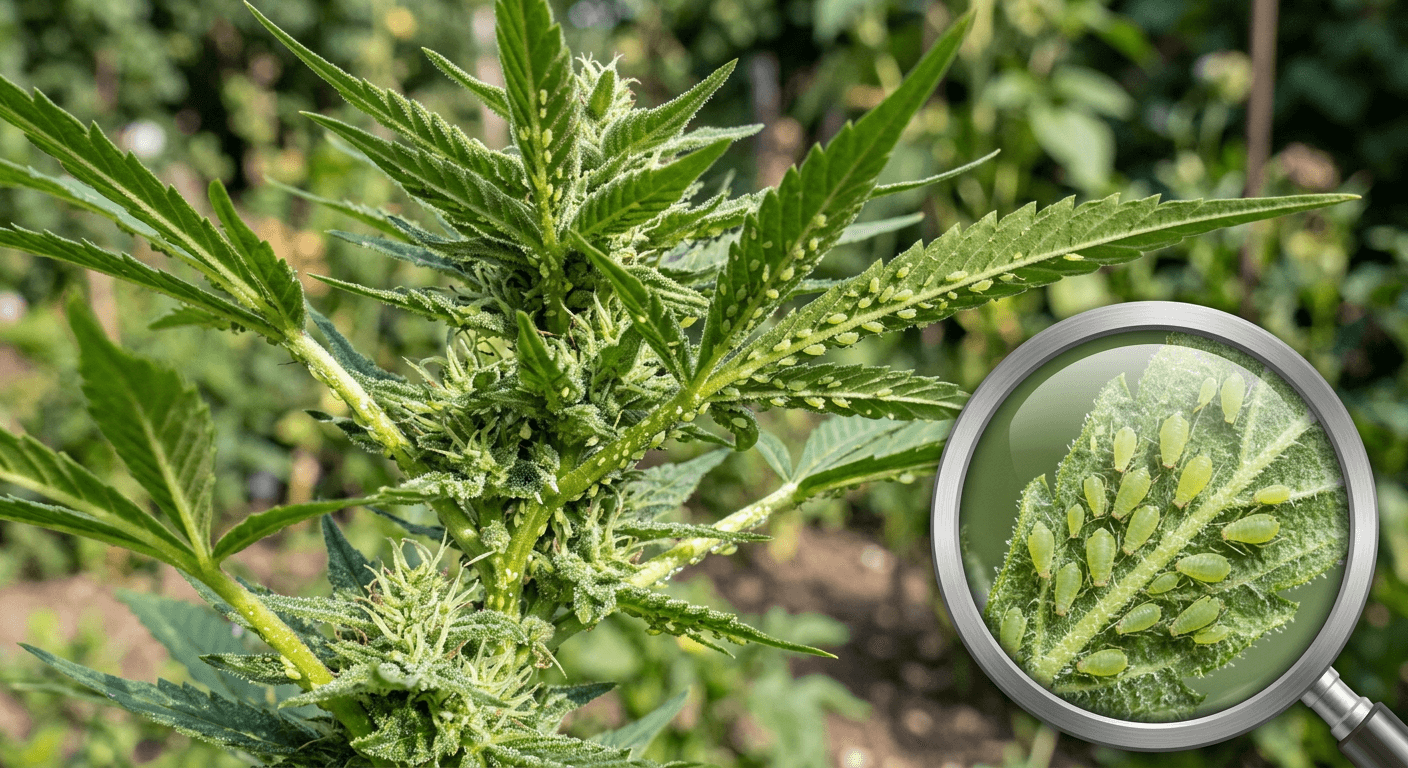
Lavender, chives, and basil repel aphids through their strong scent, while nasturtium draws aphids away from your cannabis as a sacrificial plant. Combine repulsion and attraction for complete protection.
Key takeaways
- Lavender and chives are among the most well-documented repellents against aphids.
- Nasturtium works differently: it draws aphids away from your cannabis as a "trap plant."
- Fennel, dill, and cilantro also attract ladybugs and other natural aphid predators.
- Combining repulsion and attraction gives more complete protection than either strategy alone.
- These plants reduce pressure but don't replace black soap during an active infestation.
Why do these plants repel aphids?
Aphids dislike strong scents, and aromatic plants happen to have exactly that advantage — a pronounced fragrance. Lavender, for example, releases essential oils whose scent particularly displeases these insects, while garlic and chives, from the allium family, give off sulfur compounds with the same repellent effect documented elsewhere in this cluster.
Which companion plants should you use against aphids?
Five plants stand out for their documented repellent effect, plus nasturtium, which plays a different role.
1. Lavender (Lavandula angustifolia)
Mode of action: its essential oils give off a scent aphids dislike, the same mechanism already used against the Japanese beetle. How to use it: as a continuous border, at a rate of one plant per meter of perimeter.
2. Chives (Allium schoenoprasum)
Mode of action: its sulfur compounds, from the allium family, effectively repel aphids. How to use it: interplanted between cannabis plants. Bonus: edible and already useful against spider mites.
3. Basil (Ocimum basilicum)
Mode of action: its strong scent disrupts aphid orientation — the same principle works against several other soft-bodied sap-suckers. How to use it: interplanted nearby, pinched regularly to keep its foliage active.
4. Fennel, dill, and cilantro
Mode of action: rather than directly repelling aphids, these plants attract ladybugs, lacewings, and parasitic wasps — the most effective natural aphid predators. How to use them: as a border or mass planting, letting some plants flower to attract as many beneficials as possible.
5. Nasturtium (Tropaeolum majus) — the trap plant
Mode of action: unlike the other plants on this list, nasturtium doesn't act as a repellent but as a living trap — it draws aphids away from your cannabis by becoming their preferred target. How to use it: plant it at a moderate distance from your cannabis, never right against it, to effectively divert colonies without bringing them closer to your main crop.
How do you use nasturtium as a trap plant?
This strategy works opposite to repellent plants — it exploits aphids' attraction rather than countering it.
- Plant nasturtium a few meters from your cannabis, never in an immediate border.
- Monitor it regularly: it will attract aphid colonies before they reach your main crop.
- Once infested, remove and destroy the most affected parts to prevent the population from exploding and later migrating.
- Combine this strategy with repellent plants (lavender, chives) in a close perimeter around your cannabis, for a double barrier.
FAQ
What plants repel aphids from cannabis?
Three families work. Strongly scented aromatics — lavender, basil — disrupt aphid orientation. Alliums — chives, garlic — give off repellent sulfur compounds. And umbellifers — fennel, dill, cilantro — don't repel at all but attract ladybugs, lacewings and parasitic wasps, the most effective aphid predators. Nasturtium plays the opposite role: a trap plant.
Are companion plants enough to eliminate an active aphid infestation?
No, and it matters to know that before relying on them. They reduce pressure and the risk of colonies settling, but an established infestation needs direct treatment: a water rinse, insecticidal soap, neem oil. Think of companion plants as permanent prevention, not a cure.
How do you use nasturtium as a trap plant?
Plant it a few meters from your cannabis, never in an immediate border — too close, it would bring colonies toward your crop instead of away from it. Monitor it regularly: it attracts aphids first. As soon as it's well infested, remove and destroy the worst-affected parts before the population explodes and migrates.
Won't nasturtium attract more aphids to my garden overall?
That's precisely the intended effect, but at a controlled distance. The trap-plant principle is to offer a more attractive target than your cannabis. The risk only exists if you plant it right against your plants — a few meters away it intercepts; in an immediate border it becomes a springboard.
Can you combine repellent plants and a trap plant?
Yes, and it's the most effective approach, because the two mechanisms complement each other instead of overlapping. Lavender and chives in a close perimeter discourage direct settlement on the cannabis; nasturtium further out intercepts the colonies that push through anyway. A double barrier, two different logics.
Where should you plant lavender and chives relative to the cannabis?
Lavender as a continuous border, one plant per meter of perimeter — it's a scent barrier, so it has to be unbroken. Chives and basil interplanted, directly between the cannabis plants. Pinch the basil regularly: young active foliage gives off far more aroma than a plant that has bolted to seed.
Is mint a good companion plant against aphids?
Its scent works, but plant it in a pot without exception, never in open ground. Mint spreads aggressively by rhizome and will compete with your cannabis at the root within a single season. A pot sunk to its rim gives you the repellent effect without the problem.
19+ | Educational horticulture only.