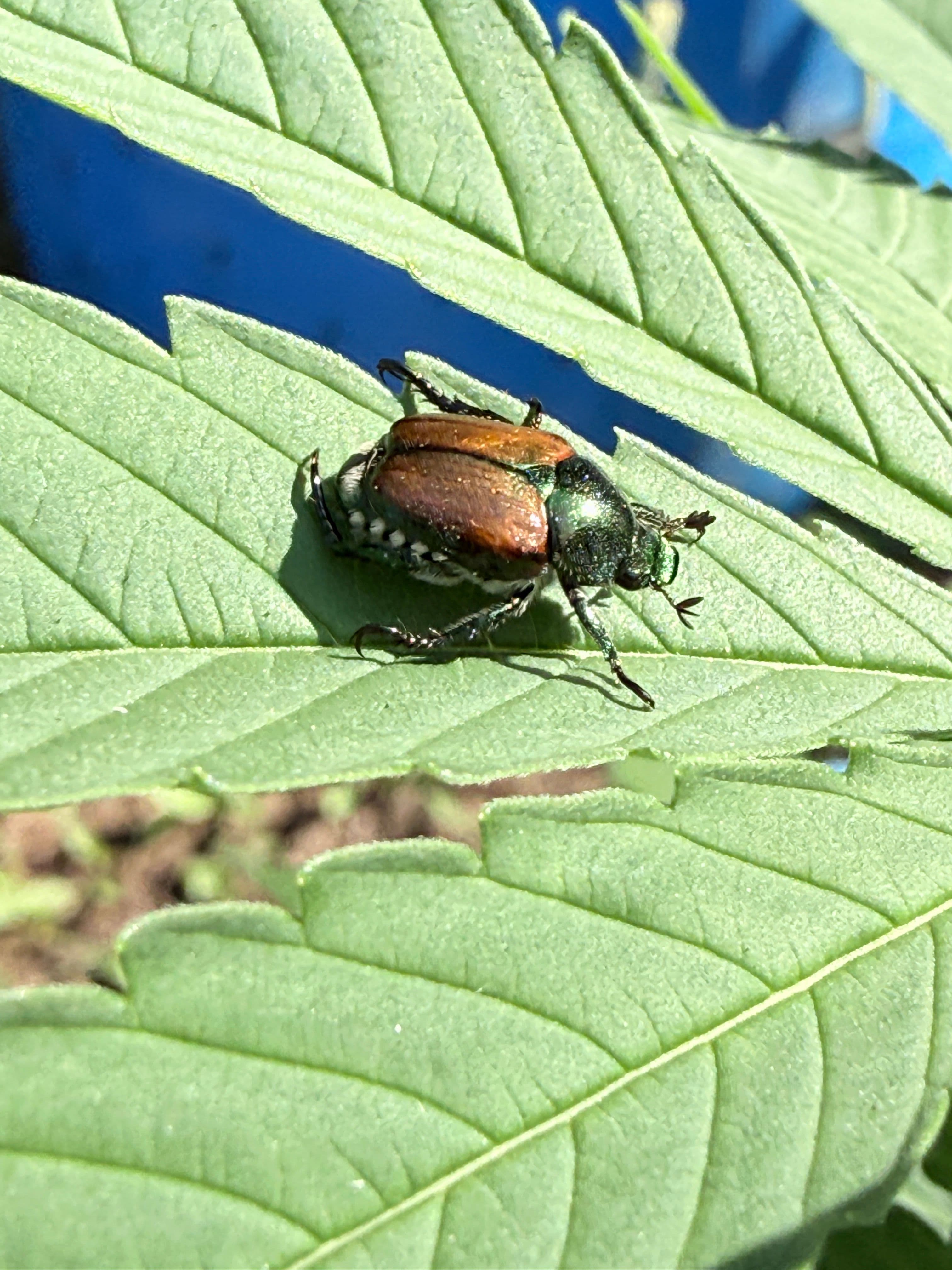
Identify, Prevent, Treat
Pest & Insect Control
7 Companion Plants to Repel the Japanese Beetle from Your Cannabis Plants
Repel the Japanese beetle naturally with 7 companion plants. Garlic, lavender, and marigold protect your cannabis plants without chemical insecticides.

Garlic, lavender, marigold, and scented geranium form a natural scent barrier that discourages the Japanese beetle. Plant them in a perimeter starting in May-June, combined with hand-picking for complete protection.
Key takeaways
- The Japanese beetle locates its host plants by scent — companion plants disrupt this detection.
- Garlic and marigold offer double action: repelling adults and affecting larvae in the soil.
- Planting in a "triple perimeter" (outer, intermediate, interplanted) maximizes protection.
- Companion plants alone aren't enough during a heavy infestation — combine them with hand-picking and neem oil.
- Plant as early as May-June so the scent biomass is effective before the July-August peak.
- Why do companion plants work against the Japanese beetle?
- What are the 7 recommended companion plants?
- What planting strategy should you use?
- What mistakes should you avoid with companion plants?
- FAQ — Companion plants and the Japanese beetle
Here are the 7 most effective plants — all available in Quebec — along with how they work and how to integrate them into your grow.
Why do companion plants work against the Japanese beetle?
The Japanese beetle locates its host plants mainly through smell — this is exactly the mechanism companion plants disrupt. Certain volatile compounds released by repellent plants (organic sulfur, camphor, terpenes) confuse or inhibit this chemical detection.
By creating a "scent perimeter" around your cannabis, you make the area less attractive to females looking to feed and lay eggs — a natural complement to direct protection methods like neem oil or nematodes.
What are the 7 recommended companion plants?
Each plant works through a slightly different mechanism — combining them in a perimeter provides broader protection than a single species planted alone.
1. Garlic (Allium sativum) — the best option
Mode of action: garlic releases sulfur compounds (allicin) that are highly repellent to the Japanese beetle. How to use it: plant garlic cloves interplanted between your cannabis plants, 30–40 cm apart — count 2 to 3 garlic plants per cannabis plant. Bonus: also repels aphids and mites. Availability: bulbs available starting in April at Quebec garden centers.
2. Lavender (Lavandula angustifolia)
Mode of action: linalool and the terpenes in lavender are natural repellents for many insects, including the Japanese beetle. How to use it: place it along the border of your garden or growing area, at a rate of one plant per meter of perimeter. Bonus: attracts pollinators and beneficial insects. Recommended variety in Quebec: 'Hidcote' or 'Munstead', more cold-resistant.
3. Marigold (Tagetes spp.) — double action
Mode of action: marigolds emit alpha-terthienyl, a compound that repels adult beetles while also affecting larvae present in the soil. How to use it: plant them in a dense border around your cannabis plants — small-flowered varieties (Tagetes patula) are the most effective. Bonus: repels harmful nematodes and is favorable to beneficial insects.
4. Scented geranium (Pelargonium graveolens)
Mode of action: temporary paralyzing effect on adult Japanese beetles — they fall off the plant and become vulnerable to predators. How to use it: place one geranium plant for every 2 to 3 cannabis plants, interplanted. Important: use specifically the scented geranium (rose or citronella variety) — the ordinary garden geranium doesn't have this effect. Availability: at garden centers starting in May in Quebec.
5. Tansy (Tanacetum vulgare)
Mode of action: the essential oils in tansy (thujone, camphor) are strongly repellent to the Japanese beetle. How to use it: as a hedge or border, 50–60 cm from the growing perimeter. Caution: tansy can become invasive — grow it in a pot if space is limited.
6. Catnip (Nepeta cataria)
Mode of action: nepetalactone is an effective repellent against many insects, including the Japanese beetle. How to use it: as a border or in pots around the growing area. Bonus: attracts beneficials like lacewings and ladybugs. Note: keep an eye on neighborhood cats — they love rolling in it.
7. Chrysanthemum (Chrysanthemum spp.)
Mode of action: the natural pyrethrins in chrysanthemums act as a natural insect repellent. How to use it: interplanted or as a decorative hedge around the plants. Bonus: also effective against thrips and whiteflies.
What planting strategy should you use?
A layout of three concentric rings — rather than a single row of companion plants — multiplies the layers of scent repulsion around your plants.
Outer perimeter (1 m from the cannabis plant) Lavender and marigold planted in a continuous hedge.
Intermediate perimeter (50 cm) Scented geranium alternating.
Interplanted (between cannabis plants) Garlic planted 30 cm apart in a staggered pattern, catnip at the corners of the area.
Result: a four-layer scent-repulsion zone, where the concentration of volatile compounds in the growing space becomes hostile to beetles.
What mistakes should you avoid with companion plants?
Even when well chosen, companion plants lose much of their effectiveness if poorly positioned or poorly maintained — here are the most common mistakes among Quebec growers.
- Planting too late: planting in July hasn't had time to develop its scent biomass before the beetles' peak activity. Sow or transplant as early as May-June.
- Confusing varieties: the ordinary decorative garden geranium doesn't have the same effect as the scented geranium — always check the exact botanical name on the label before buying.
- Planting in a single distant row: a single line of companion plants, too far from the cannabis, leaves scent gaps. Favor the triple perimeter strategy presented above.
- Neglecting maintenance: an untended tansy or catnip can become invasive and compete with the cannabis for root space — prune regularly.
- Relying solely on companion plants: they reduce pressure, but don't replace regular inspection or targeted treatments once an infestation is already established. For the full range of options available, see our practical guide to all cannabis pests.
FAQ
Are companion plants alone enough to protect my cannabis plants from the Japanese beetle?
They significantly reduce attacks, but for complete protection, combine them with morning hand-picking and neem oil during peak activity weeks (July to early August) — see our [practical guide on the Japanese beetle](/en/articles/japanese-beetle-cannabis).
When should you plant companion plants for them to be effective by July?
Plant them in May-June, as soon as you put your cannabis in the ground. Companion plants need a few weeks to develop their scent biomass before the beetles' peak activity.
Do companion plants affect the taste or aroma of cannabis?
No, not significantly. Garlic planted 30 cm from a plant isn't absorbed by its roots.
Does an ordinary geranium work like the scented geranium?
No — this is an important distinction. Only the scented geranium (rose, citronella, or mint) contains the active compounds; the decorative garden geranium doesn't have this effect.
Do marigolds attract Japanese beetles?
Some sources mention that beetles can feed on marigolds. In practice, the repellent effect of *Tagetes* on the perimeter outweighs their attractive effect — crops surrounded by *Tagetes patula* show a net reduction in populations.
Can you plant garlic at the same time as cannabis?
Yes. Planted in spring alongside cannabis, garlic will be actively growing during the beetle's key attack months (July-August). Harvesting it in July isn't required if you're using it as a repellent.
19+ | Educational horticulture only.