Identify, Prevent, Treat
Pest & Insect Control
Spider Mites on Cannabis: Practical Guide to Identify, Eliminate, and Prevent Them
Spider mites are one of the most destructive cannabis pests. Identify the symptoms and eliminate them with biological solutions.
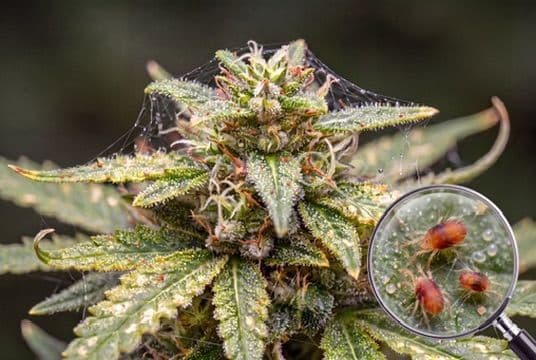
Spider mites leave yellow-silvery stippling, then fine webbing under the leaves. Increase humidity, treat with insecticidal soap and neem oil, and introduce the predator Phytoseiulus persimilis to eliminate them for good.
Key takeaways
- Yellow-silvery stippling on top of the leaves is the first sign of a spider mite infestation.
- These mites thrive in hot, dry conditions (23–30°C, humidity below 50%) — July–August is the critical window in Quebec.
- The full life cycle takes as little as 7 days under ideal conditions — treatments must be repeated for at least 3 weeks to break the cycle.
- Phytoseiulus persimilis, a predatory mite, remains the most effective biological solution once an infestation is established.
- Raising ambient humidity is often the fastest measure you can take.
- What is a spider mite?
- What damage does it cause on cannabis?
- What are the 7 methods to eliminate spider mites?
- How do you prevent an infestation?
- FAQ — Spider mites on cannabis
Here's how to identify it, fight it, and keep it from coming back.
What is a spider mite?
The spider mite (Tetranychus urticae) isn't actually a spider — it's a mite from the Tetranychidae family. It measures 0.3 to 0.5 mm and is almost invisible to the naked eye, but its damage is very visible.
How do you identify it?
- Size: 0.3 to 0.5 mm — a magnifying glass or pocket microscope is recommended.
- Color: yellowish-green in spring and summer, orange-red in fall.
- Location: underside of leaves, between the veins.
- Webbing: fine silky webs under the leaves and between stems, a sign of an advanced stage.
- Early sign: yellow-silvery stippling on the top surface of the leaves.
What damage does it cause on cannabis?
Mites pierce leaf cells to suck out their contents — symptoms progress through three distinct stages, which help gauge how severe the infestation is.
Stage 1 — Early infestation
- Fine yellow or white stippling on the top surface of the leaves.
- Slight overall discoloration.
- Little to no visible webbing.
- Bronzed, silvery, or uniformly yellowed leaves.
- Visible webbing under the leaves and between stems.
- Slowed growth.
- Leaves entirely covered in webbing.
- Defoliation, drying out, death of young shoots.
- Potential contamination of the flowers and resin.
What are the 7 methods to eliminate spider mites?
As with most cannabis pests, combining several complementary approaches speeds up elimination far more than repeating a single method alone.
- Increase humidity — spider mites hate high humidity. Indoors, raise humidity to 60–70%; outdoors, mist the foliage with clean water every 2 days.
- Insecticidal soap (black soap) — a 2–3% solution sprayed over the entire leaf surface, especially underneath, acts on contact and dehydrates the mites. Repeat every 3 days for 3 weeks to break the cycle, and treat on cloudy days or in the evening, never in direct sunlight.
- Neem oil — the azadirachtin it contains inhibits reproduction and disrupts the mites' molting. Dilute to 5 ml/L with emulsifier and treat every 5 days; effective against adults, larvae, and eggs.
- Natural pyrethrin — this insecticide extracted from chrysanthemum flowers (Chrysanthemum cinerariifolium) acts quickly on contact against adults, but has no residual effect — combine it with neem oil to extend the effect.
- Phytoseiulus persimilis — this natural predator, a mite specific to Tetranychidae, remains the most effective biological solution against spider mites. Introduce 50 individuals per square meter at the first signs; it feeds exclusively on spider mites, posing no danger to the plant. For outdoor grows in Quebec, prefer Neoseiulus californicus, which is more tolerant of climate variations.
- Diatomaceous earth — these crushed fossilized algae tear the mites' exoskeletons on contact. Dust it under the leaves and on the soil surface, and reapply after rain; 100% natural, safe for humans and pollinators.
- Intensive rinsing — for light infestations, a strong lukewarm water spray directed under the leaves physically removes mites and their eggs. Repeat every 2 days for 2 weeks.
How do you prevent an infestation?
Spider mites thrive in dry environments and on already-weakened plants — correcting these two factors significantly reduces infestation risk.
- Maintain relative humidity above 50% in indoor grows.
- Avoid water stress — thirsty plants are more vulnerable to mites.
- Inspect the underside of leaves every week, before you even suspect a problem.
- Outdoors, encourage natural predators like lacewings and ladybugs.
- Systematically quarantine any cutting or outdoor plant newly introduced into your grow.
FAQ
How do you know if your cannabis has spider mites?
The first signs are fine yellow or silvery stippling on the top surface of the leaves. Flip the leaf over and you'll see tiny moving dots and, in advanced infestations, fine silky webbing. A magnifying glass is recommended to confirm the diagnosis.
Are spider mites visible to the naked eye?
Barely — they measure only 0.3 to 0.5 mm. You may sometimes spot tiny moving dots under the leaves, but a 10x magnifying glass or a pocket microscope confirms the identification with certainty.
Can spider mites destroy my cannabis harvest?
Yes, if left untreated. At an advanced stage, they cause massive defoliation and can invade the flowers, compromising resin quality. Acting at the first signs remains essential.
Why do spider mites always come back?
Because they lay eggs that resist many treatments. A full cycle takes 7 to 14 days depending on temperature — treatments must be repeated for at least 3 consecutive weeks to truly break the reproduction cycle.
What's the difference between spider mites and thrips?
Spider mites cause yellow-silvery stippling and form webbing; [thrips](/en/articles/cannabis-pests-practical-guide) instead leave silvery streaks and small black droppings, without webbing. Spider mites are 8-legged mites, while thrips are true 6-legged insects.
Is white vinegar effective against spider mites?
Diluted white vinegar can kill mites on contact, but it also risks burning cannabis leaves. Insecticidal soap and neem oil remain safer and more effective options.
At what temperature do spider mites proliferate the most?
Between 23 and 30°C, with low humidity below 50%. In Quebec outdoor grows, July–August is the critical period; indoors, a temperature above 27°C without humidity control creates ideal conditions for a population explosion.
Is Phytoseiulus persimilis available in Quebec?
Yes, several specialized distributors offer predatory mites to Canadian growers. For outdoor grows, prefer *Neoseiulus californicus*, which is more tolerant of temperature variations than *Phytoseiulus persimilis*. To repel spider mites right from planting, also check out our dedicated guide to [companion plants against spider mites](/en/articles/companion-plants-spider-mites). For an overview of all cannabis pests, our [complete practical guide](/en/articles/cannabis-pests-practical-guide) covers every parasite in detail. If you grow outdoors, our [autoflowering strains](/en/shop/autoflowering) with a shorter cycle reduce your exposure window to summer populations.
19+ | Educational horticulture only.