Identify, Prevent, Treat
Pest & Insect Control
Cannabis Pests and Insects: The Practical Guide to Identify and Treat Every Parasite
Practical guide to cannabis pests and insects: identification, damage, and biological treatments for every parasite in Quebec.
Every cannabis pest leaves a unique damage signature — skeletonization, honeydew, webbing, silvery streaks. This pillar guide helps you quickly diagnose the culprit and pick the right biological treatment.
Key takeaways
- The type of damage (skeletonization, honeydew, webbing, silvery streaks) identifies the pest before you even see it.
- In Quebec, the Japanese beetle, aphids, mites, and slugs dominate outdoor grows; fungus gnats and whiteflies dominate indoors.
- Five biological treatments (neem, insecticidal soap, BTk, nematodes, sticky traps) cover the vast majority of cases.
- Chemical insecticides should be avoided: their residues concentrate in the flowers and resin.
- Integrated pest management — prevention, early detection, targeted intervention — remains the most reliable strategy all season long.
- How can you quickly identify the pest attacking your cannabis plants?
- What are the 8 main cannabis pests and insects?
- How do you recognize each pest at a glance?
- What are the 5 universal biological treatments to keep on hand?
- What is integrated pest management for cannabis and how do you apply it?
- FAQ — Cannabis pests and insects
This pillar guide is your central reference for quickly identifying any pest on your cannabis plants and finding the right solution. For each parasite, you'll find a link to our in-depth guide.
How can you quickly identify the pest attacking your cannabis plants?
Three steps are enough to go from observed damage to a targeted treatment: spot the type of damage, confirm with visual identification, then act.
Step 1 — Identify the type of damage:
- Lacy leaves / skeletonization → Japanese beetle
- Yellow-silvery stippling + fine webbing → spider mites
- Silvery streaks + small black droppings → thrips
- Visible colonies + sticky honeydew + ants → aphids
- Cloud of white flies when the plant is disturbed → whiteflies
- Large chunks of leaf eaten + cylindrical droppings → caterpillars
- Black flies at the soil surface + unexplained yellowing → fungus gnats
- Silvery trail + nighttime damage → slugs or snails
What are the 8 main cannabis pests and insects?
Each of these pests has its own damage signature, risk season, and priority treatment — knowing them lets you act within minutes rather than days of uncertainty.
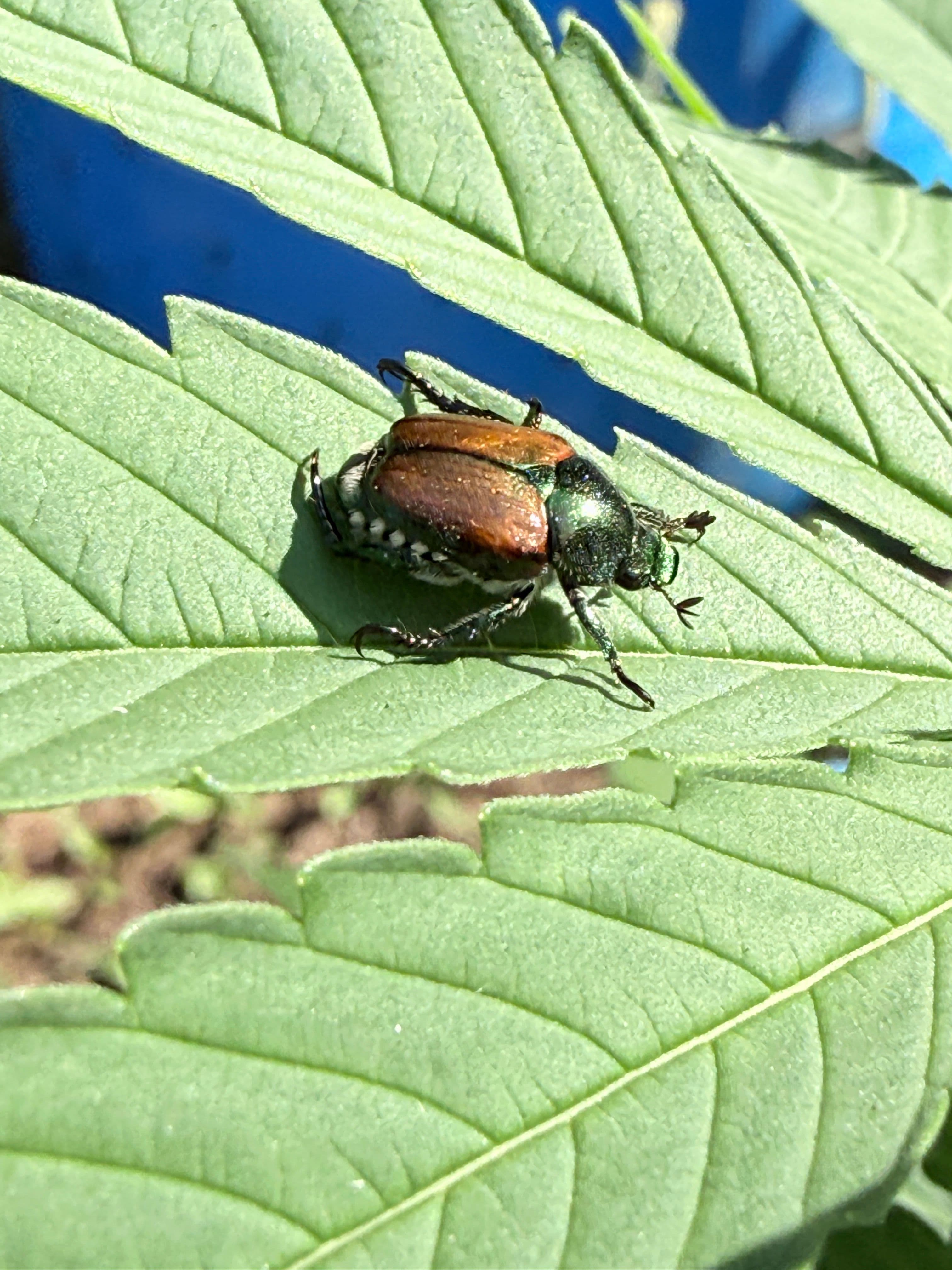
Japanese beetle (Popillia japonica)
Type: beetle · Size: 10 mm · Season: July–August in Quebec Signature damage: skeletonization — leaves reduced to lace, veins intact. Priority treatment: hand-picking, neem oil, H. bacteriophora nematodes, BTG. → Practical guide: Japanese beetle on cannabis → Companion guide: 7 companion plants against the Japanese beetle
Aphids (Phorodon cannabis and others)
Type: sap-sucking insect · Size: 1–3 mm · Season: active all season, highest risk during vegetative growth (May–June) and early flowering stretch (mid-August) Signature damage: green or black colonies under the leaves, sticky honeydew, ants present. Priority treatment: black soap, neem oil, ladybugs. → Practical guide: Aphids on cannabis Companion plants guide coming soon to this cluster.
Spider mites (Tetranychus urticae)
Type: mite · Size: 0.3–0.5 mm · Season: hot, dry summer Signature damage: yellow-silvery stippling and fine webbing under the leaves. Priority treatment: insecticidal soap, Phytoseiulus persimilis, increased ambient humidity. → Practical guide: Spider mites on cannabis → Companion guide: Companion plants against spider mites
Thrips (Frankliniella occidentalis and others)
Type: insect · Size: 1–2 mm · Season: spring–summer Signature damage: silvery streaks and small dash-shaped black droppings. Priority treatment: blue sticky traps, Spinosad, Amblyseius cucumeris. Practical guide coming soon to this cluster.
Caterpillars and budworms (Choristoneura spp., Agrotis spp.)
Type: lepidopteran larva · Size: 2–5 cm · Season: summer Signature damage: large chunks of leaf eaten, visible cylindrical droppings (frass). Priority treatment: nighttime hand-picking, BTk (DiPel, Thuricide), protective netting. Practical guide coming soon to this cluster.
Whiteflies (Trialeurodes vaporariorum)
Type: sap-sucking insect · Size: 1–2 mm · Season: year-round indoors Signature damage: cloud of white flies at the slightest movement, translucent larvae under the leaves, honeydew. Priority treatment: yellow sticky traps, neem oil, Encarsia formosa. Practical guide coming soon to this cluster.
Fungus gnats
Type: fly · Size: 2–4 mm as adults · Season: year-round in humid/indoor settings Signature damage: black flies at the soil surface, white larvae in the substrate, apparent deficiencies. Priority treatment: letting the soil dry between waterings, BTi (Gnatrol), S. feltiae nematodes. Practical guide coming soon to this cluster.
Slugs and snails
Type: mollusk · Size: 2–15 cm · Season: spring in Quebec Signature damage: nighttime damage, silvery mucus trail, entire sections of leaves gone. Priority treatment: nighttime hand-picking, diatomaceous earth, iron phosphate. Practical guide coming soon to this cluster.
How do you recognize each pest at a glance?
What are the 5 universal biological treatments to keep on hand?
Most cannabis infestations, across species, can be treated with a combination of just five biological products — having them on hand before you even see a pest saves you a lot of losses.
- Neem oil — effective against aphids, mites, thrips, whiteflies, and young caterpillars. Dilute 2 to 5 ml/L with emulsifier, apply in the evening; stop 2 weeks before harvest.
- Insecticidal soap (black soap) — against aphids, mites, and whiteflies. Dilute 2 to 3%, apply under the leaves every 3 to 5 days.
- **BTk (Bacillus thuringiensis kurstaki) — exclusively against caterpillars. Common products: DiPel, Thuricide. Apply every 5 to 7 days, very effective.
- Entomopathogenic nematodes** — against larvae living in the soil (beetles, fungus gnats). H. bacteriophora for beetles, S. feltiae for fungus gnats; moist soil and temperature above 10°C.
- Sticky traps (yellow and blue) — yellow for whiteflies, blue for thrips, also useful against fungus gnats. One trap per square meter, at foliage height and at ground level.
What is integrated pest management for cannabis and how do you apply it?
Combining prevention, early detection, and targeted intervention protects your harvest far more effectively than a one-off treatment applied after the fact.
Prevention
- Inspect plants 2 to 3 times a week (underside of leaves, soil, stems)
- Encourage biodiversity around the growing area
- Use repellent companion plants: garlic, lavender, marigold, chrysanthemum
- Avoid excess nitrogen, which attracts sap-sucking insects
- Maintain good hygiene: remove dead leaves and plant debris
- Install permanent sticky traps (yellow and blue) as soon as you start growing
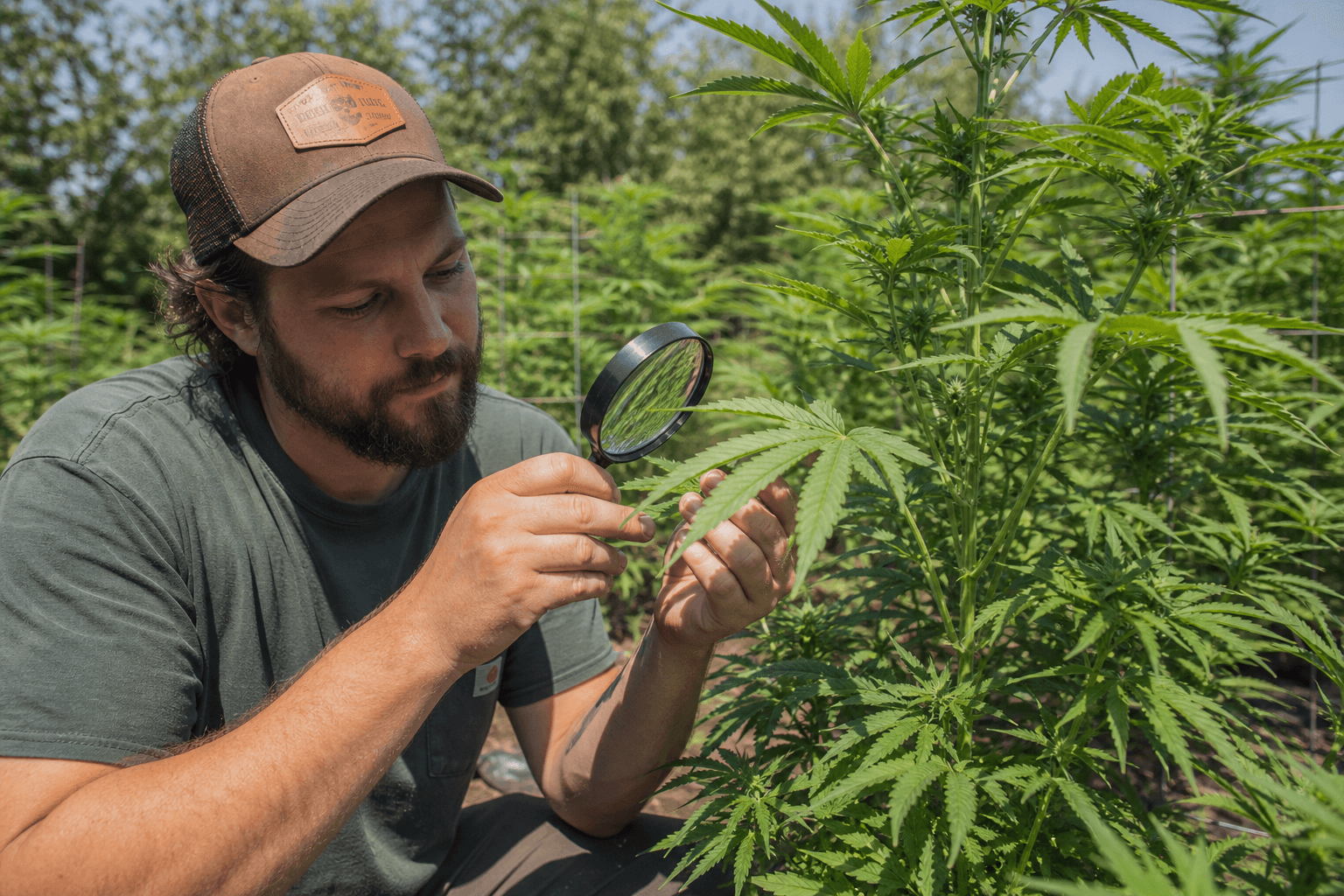
- Regularly inspect the underside of leaves with a magnifying glass
- Learn to recognize the symptoms specific to each pest
- Treat at the first signs, without waiting for a visible infestation
- Always start with the least invasive method
- Repeat treatments according to the targeted pest's life cycle
Which strains should you choose against pest pressure?
Given the pests present in Quebec, short-cycle outdoor strains — especially autoflowers — let you harvest before the peak summer pressure of July–August. Indica-dominant genetics also generally show better overall stress resistance.
Explore our selection of autoflowering strains to choose a short-cycle genetic that reduces your exposure window, whether you grow outdoors or indoors.
FAQ
What are the most common cannabis pests in Quebec?
In Quebec outdoor grows, the most frequent are the Japanese beetle (July–August), aphids (spring), mites (hot dry summer), slugs (humid spring), and caterpillars. Indoors, fungus gnats, mites, and whiteflies dominate.
What insect is eating the leaves of my cannabis plant?
Look at the type of damage, which reveals the culprit even without knowing insects: skeletonization for the beetle, yellow stippling for mites, silvery streaks for thrips, sticky honeydew for aphids and whiteflies, chunks eaten at night for slugs, cylindrical droppings for caterpillars. Every kind of damage is a signature.
Can you use chemical insecticides on cannabis?
Strongly discouraged. Chemical residues concentrate in the flowers and resin, compromising the quality and safety of the final product. Prefer biological solutions: neem, BTk, BTi, BTG, nematodes, and insecticidal soap.
How do you make a homemade insecticide for cannabis?
Garlic spray is the most effective homemade remedy: blend one whole head of garlic with about 235 ml of water, add 30 ml of black soap and 700 ml of water, let it steep overnight, then strain and spray both sides of the leaves. This natural repellent works against aphids, whiteflies, and thrips, without the strict withdrawal periods of commercial products.
How do you prevent pests in outdoor grows in Quebec?
Combine repellent companion plants (garlic, lavender, marigold), sticky traps from the start of the grow, regular inspections 2 to 3 times a week, and avoid over-fertilizing with nitrogen, which attracts sap-sucking insects.
Is neem oil effective against all cannabis pests?
Neem oil covers a broad spectrum — aphids, mites, thrips, whiteflies, young caterpillars — but remains ineffective against slugs and only marginally effective against mature caterpillars or larvae buried deep in the soil.
At what stage of growth are cannabis plants most vulnerable to pests?
Young plants, during their first three weeks, are the most vulnerable. Flowering, however, remains the most critical period for the harvest: an untreated infestation at this stage can significantly reduce flower quality.
Can you treat a cannabis plant for pests during flowering?
Yes, but the options are more limited. Neem oil must be stopped 2 weeks before harvest. Insecticidal soap can be used later but leaves residue on the flowers. BTk remains the safest option against caterpillars during flowering, with a 3-to-7-day withdrawal period before harvest.
How do you tell a nutrient deficiency apart from a pest attack?
Deficiencies cause symmetrical, progressive symptoms — the whole plant changes color uniformly. Pests cause localized, asymmetrical symptoms: spots, holes, or deformities concentrated in specific areas. Always inspect the plant with a magnifying glass before concluding it's a deficiency.
Are natural predators enough to control pests in outdoor grows?
In a well-established outdoor grow with good biodiversity, natural predators — ladybugs, lacewings, parasitic wasps — effectively control aphids and mites. For an invasive pest like the Japanese beetle, active intervention is still necessary.
How do you avoid contaminating your cannabis flowers with the treatments you apply?
Respect each product's withdrawal period: 14 days for neem oil, 7 days for insecticidal soap, 3 to 7 days for BTk. Never apply a foliar treatment in direct sunlight, and prefer soil treatments (nematodes, BTi) once your plants are in late flowering.
19+ | Educational horticulture only.