Identify, Prevent, Treat
Pest & Insect Control
Japanese Beetle and Cannabis: Practical Guide for Quebec Growers
Japanese beetles devour your cannabis plants in days. Identify and eliminate them — a practical guide for Quebec growers.
The Japanese beetle (Popillia japonica) skeletonizes cannabis leaves outdoors, mainly from late June to August. Inspect every morning, and favor hand-picking, neem oil, nematodes, and BTG over chemical insecticides.
Key takeaways
- The Japanese beetle has been established in Quebec since 1939 and keeps expanding its range northward.
- It attacks cannabis on two fronts: adults skeletonize the leaves, larvae feed on the roots.
- The critical window runs from late June to August — that's when daily inspection makes all the difference.
- Biological solutions (neem, nematodes, BTG, hand-picking) protect your harvest without contaminating the resin.
- Chemical insecticides should be avoided: their residues concentrate in the flowers.
- What is the Japanese beetle?
- What specific damage does it cause on cannabis?
- How can I tell if larvae are attacking my plant's roots?
- What are the highest-risk periods for your plants?
- What are the 6 most effective protection methods?
- What factors increase the risk that my plants will be affected?
- FAQ — Japanese beetle and cannabis
Meet the Japanese beetle, one of the most destructive pests for outdoor cannabis cultivation in Quebec and eastern Canada.
What is the Japanese beetle?
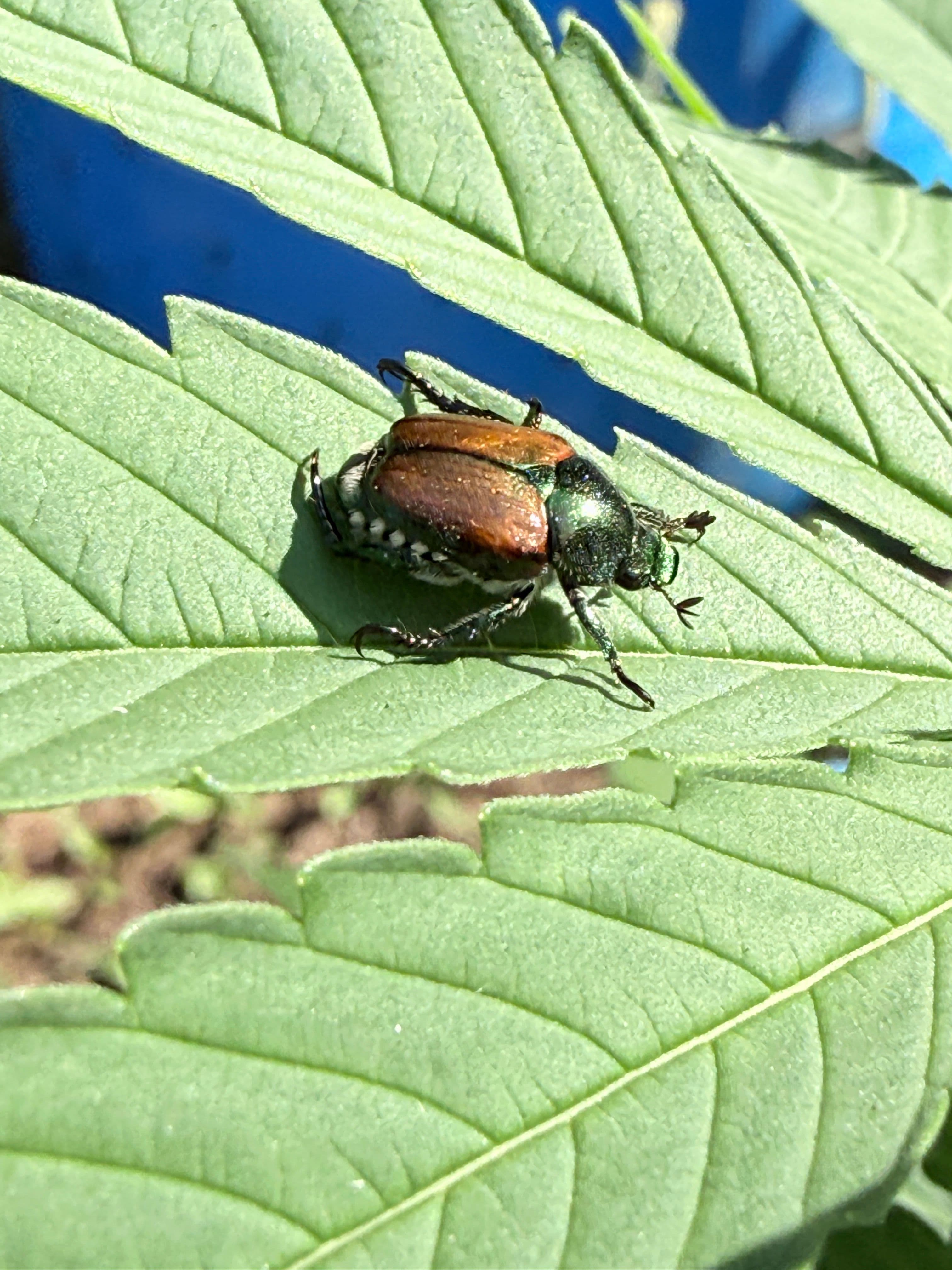
The Japanese beetle (Popillia japonica) is a beetle native to Japan that now attacks cannabis grown outdoors throughout southern Quebec — recognizable by its metallic green thorax and copper-brown wing covers.
Accidentally introduced to North America in the early 20th century, the insect was first detected in Canada in 1939, with captures at Yarmouth (Nova Scotia) and at Lacolle, in Montérégie — so in Quebec — that same year (Canadian Food Inspection Agency). Nearly 90 years later, it is well established across five eastern provinces: Quebec, Ontario, New Brunswick, Nova Scotia, and Prince Edward Island.
How do you identify it?
- Size: about 10 mm (roughly the size of a fingernail)
- Thorax: shiny, iridescent metallic green
- Wing covers (elytra): copper-brown
- Abdomen: 5 tufts of white hair on each side plus 2 tufts at the rear
- Legs: long, with sturdy claws for gripping
What specific damage does it cause on cannabis?
The Japanese beetle hits cannabis on two fronts at once: adults destroy the foliage above ground while larvae attack the roots below — a double assault that can weaken a plant within weeks.
The insect can attack over 300 different plant species, and cannabis, with its tender and abundant foliage, is a prime target.
What do the adults do to your plants?
Adults chew through leaf tissue between the veins, first leaving a translucent membrane, then clean holes — this is "skeletonization," the visual signature of this pest. The consequences add up quickly:
- Reduced photosynthesis, slowing the plant's overall growth
- Increased water stress and an entry point for infections
- Direct impact on trichome and resin production
- During flowering: reduced yield and lower bud density
What do the larvae do below the surface?
Larvae, also called "white grubs," live in the soil and feed on the roots. A severe root attack causes sudden wilting — even in moist soil — and weakens the plant's anchoring against wind, a particular risk for potted or container plants.
How can I tell if larvae are attacking my plant's roots?
Unlike adult damage, which is immediately visible on the leaves, a root attack progresses underground and often goes unnoticed until an advanced stage — here are the signs to watch for and how to confirm the diagnosis.
Warning signs to watch for:
- Yellowing or wilting that persists despite normal watering — a classic sign that roots, not lack of water, are the cause.
- A plant that uproots unusually easily if you gently tug at the base of the stem, with the root ball detaching from the soil like a poorly anchored rug.
- Slowed or uneven growth, with no other visible leaf symptoms.
- In advanced cases, the plant collapsing despite moist soil, as damaged roots can no longer provide anchoring or water absorption.
How do you treat a root larvae infestation?
Once larvae are confirmed, the most reliable biological treatment remains entomopathogenic nematodes Heterorhabditis bacteriophora, which enter the larvae's bodies through natural openings and kill them from within within days.
- Application: water the soil around the base of the plant with the nematode solution, using a watering can or sprayer — they need to reach moist soil to survive and act.
- Soil temperature: application is effective between 12°C and 25°C; outside this range, nematodes lose effectiveness.
- Optimal timing: May-June or late August, when larvae are young, active, and near the surface — not in peak summer, when they burrow deeper to avoid the heat.
- Follow-up: water lightly after application to help nematodes penetrate the soil, and repeat the treatment the following year if the infestation was significant, since the insect's life cycle spans multiple seasons.
What are the highest-risk periods for your plants?
Risk isn't constant year-round: it spikes sharply in late June and peaks in July-August, when active adults and egg-laying overlap.
What are the 6 most effective protection methods?
Growers who best protect their harvest combine several biological methods rather than relying on a single solution — here are the six most reliable approaches, from the most immediate to the most preventive.
- Hand-picking — in the morning before 9 a.m., when beetles are still sluggish; gently shake the stems over a bucket of soapy water.
- Neem oil — 2 to 5 ml per liter, sprayed in the evening to avoid harming pollinators, every 5 to 7 days; stop application 2 weeks before harvest.
- Nematodes Heterorhabditis bacteriophora — applied to the soil in May-June or late August, they attack the larvae directly before they become adults.
- **BTG — Bacillus thuringiensis galleriae (sold as Grub Gone or Grub B Gone) — a targeted bacterium that affects larvae without harming beneficial insects.
- Pheromone traps — placed at least 15 m from your plants, ideally up to 30 m according to many growers' experience; never nearby, as they attract beetles before catching them, which can worsen damage on the closest plants.
- Repellent companion plants** — garlic, lavender, marigold, chrysanthemum, and geranium, planted around the border of the growing area.
What factors increase the risk that my plants will be affected?
The Japanese beetle is no longer an occasional threat but an annual reality for much of Quebec — the real question isn't "if" but "how much" your region and growing methods expose you.
If you grow outdoors in an area where the insect is confirmed (see the question on affected regions below), the risk exists every summer. Three factors increase exposure:
- Bare or grassy soil nearby your plants, the preferred egg-laying ground for females.
- Lack of regular inspection during the late-June-to-August window.
- Young plants or low pots, more vulnerable to root damage from larvae.
The pest doesn't limit itself to cannabis: if you notice similar damage on other plants in your garden, also check our pillar guide on all cannabis pests for an overview of threats to watch for at the same time.
For a genetic edge, some autoflowering strains with a shorter cycle reduce your exposure window to adult populations in July-August, an advantage worth considering if your area is high-risk.
FAQ
Can the Japanese beetle kill a cannabis plant?
A light to moderate infestation won't kill an adult plant but will significantly reduce yield and resin quality. In severe infestations on a young plant, combined adult and larval damage can be fatal.
How do you tell Japanese beetle damage apart from other pests?
Skeletonization — leaves reduced to lace with intact veins — is the Japanese beetle's signature. Aphids leave sticky honeydew instead, spider mites spin fine webs, and caterpillars tear off large chunks of leaf while leaving cylindrical droppings.
Can I use chemical insecticides on my cannabis?
Strongly discouraged: residues concentrate in the flowers and resin, exactly the parts of the plant you consume. Choose the biological solutions above instead — neem, nematodes, BTG, and hand-picking.
When should I watch my plants most closely?
From late June to early August, the period when adults emerge and lay eggs at the same time. Inspect your plants every morning during this window — it's the most cost-effective habit of the whole season.
Do Japanese beetles attack indoor grows?
No. It's strictly an outdoor pest; indoor or enclosed greenhouse crops are safe from it.
Do raised pots protect against larvae?
Yes, partially. Females prefer to lay eggs in lawn grass or bare soil at ground level; a raised pot significantly reduces the risk of larvae developing in it.
Is the Japanese beetle present throughout Quebec?
Its presence is confirmed in southern Quebec — Montreal, Laval, Montérégie, Outaouais, Laurentides, Estrie, and Centre-du-Québec — and the species keeps expanding its range northward year after year. The [Canadian Food Inspection Agency](https://inspection.canada.ca/en/plant-health/invasive-species/insects/japanese-beetle) maintains a trap-based surveillance network to track its spread and has documented its populations since its arrival in 1939.
19+ | Educational horticulture only.