Identify, treat, and prevent every fungal threat to your plants
Cannabis Fungal Diseases
Powdery Mildew on Cannabis: Identification, Treatment and the Science Behind It
Powdery mildew on cannabis: identify the white powder early, understand why it spreads without wet leaves, and treat with sulfur or potassium bicarbonate.
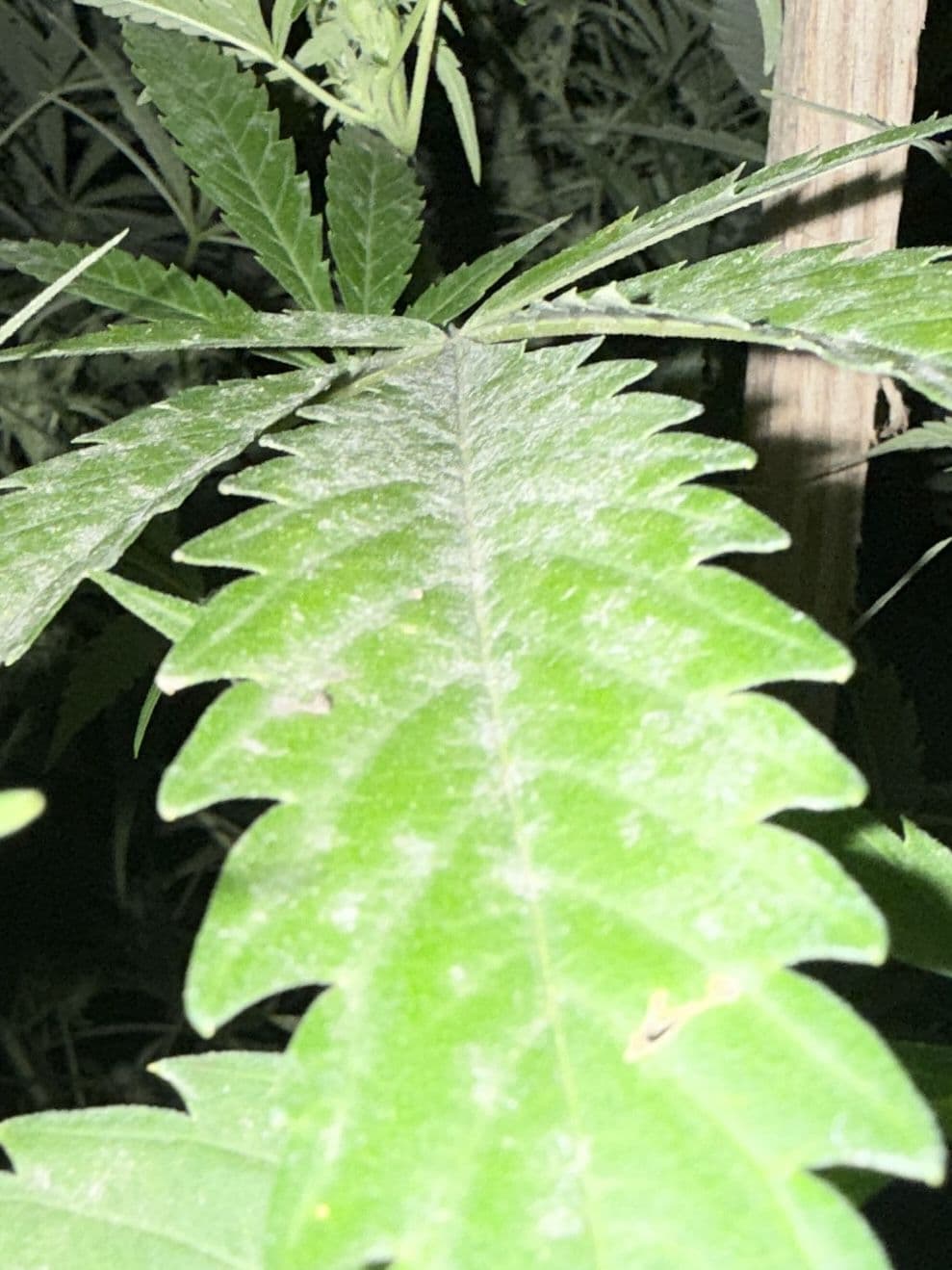
Powdery mildew on cannabis is caused primarily by Golovinomyces ambrosiae, with Podosphaera macularis confirmed as a secondary cause. Unlike most fungal diseases, it spreads from brief humidity spikes rather than sustained leaf wetness — prolonged wetness actually works against it. Preventive treatment (mineral oil, plant extracts) and curative treatment (potassium bicarbonate, sulfur) use different products, and no naturally resistant cannabis cultivar exists yet despite identified candidate genes.
Key takeaways
- Powdery mildew on cannabis is caused primarily by Golovinomyces ambrosiae — a second species, Podosphaera macularis (the hop pathogen), has also been confirmed on cannabis.
- Unlike Botrytis or Septoria, powdery mildew spreads from brief humidity spikes rather than sustained leaf wetness — prolonged surface moisture actually inhibits and can kill its spores.
- Different products work best at different stages: mineral oil or plant-extract sprays preventively, potassium bicarbonate or sulfur curatively once mildew is visible.
- Never combine sulfur with oil-based products (wait at least 2 weeks between applications), and avoid sulfur in late bloom.
- Candidate resistance genes (CsMLO1, CsMLO4) have been identified in cannabis, but no naturally resistant commercial cultivar exists yet.
- What does powdery mildew look like on cannabis?
- What causes it, and why does it behave differently from other fungal diseases?
- What are the 5 steps to treat powdery mildew?
- How do you prevent it from coming back?
- FAQ — Powdery mildew on cannabis
That's powdery mildew, and the "keep it dry" advice that works against most other cannabis fungal diseases doesn't apply the same way here. Here's what it actually is, why it behaves differently, and how to stop it.
What does powdery mildew look like on cannabis?
Powdery mildew on cannabis is caused primarily by the fungus Golovinomyces ambrosiae — a relatively recent taxonomic clarification; the pathogen was previously grouped under the broader G. cichoracearum label. A second species, Podosphaera macularis (better known as the hop powdery mildew pathogen), has also been confirmed naturally infecting cannabis under field conditions, and the two species have been found co-occurring on the same plants.
Early stage Small, circular, white-to-gray powdery patches appear on the upper surface of fan leaves, resembling a light dusting of flour. Easy to miss at first glance, especially under grow lights.
Progressing stage Patches expand and merge into larger powdery coverage, spreading to the underside of leaves, stems, and petioles. Affected leaves begin to yellow and curl.
Advanced stage Heavily coated leaves die and drop. In severe, untreated cases, the mildew can spread onto flowers themselves — a serious problem, since powdery mildew on buds close to harvest is very difficult to fully treat without compromising the crop.
What causes it, and why does it behave differently from other fungal diseases?
This is the single most important thing to understand about powdery mildew, because it inverts the standard fungal-disease advice.
It doesn't need wet leaves — brief humidity spikes are enough. Unlike Botrytis, Septoria, or anthracnose, powdery mildew spores don't require standing water or sustained leaf wetness to germinate. In fact, prolonged surface moisture actually inhibits and can kill most powdery mildew spores. It spreads instead from brief periods of elevated humidity — meaning it can show up even in a grow that looks reasonably dry overall.
Moderate temperature and low light favour it. Development is fastest between roughly 15 and 25°C (59-77°F), and shaded, low-light conditions with reduced airflow create ideal conditions — which is why it commonly appears in the lower, more shaded parts of a canopy first. Outdoors, that puts peak risk in spring and especially autumn, when cool humid nights follow mild days.
Its spores survive dormant between seasons. This is the point most guides leave out, and it explains why powdery mildew "comes back every year" for so many growers. Spores persist in plant debris, on structures, and in growing medium, then reinfect the next crop as soon as conditions turn favourable again. Treating one season without clearing debris at the end of it means starting the next year with the same inoculum load.
It spreads through the air, not primarily through splashing water. Spores are airborne and spread easily on currents, on hands, tools, and clothing — a single infected plant introduced into a room can spread mildew to the whole crop within days.
Why doesn't "keep it dry" work as well here?
Because that advice is tuned against Botrytis, Septoria, and anthracnose — all of which genuinely need surface moisture to germinate. Powdery mildew's real trigger is the humidity spike itself (particularly around lights-off temperature drops), combined with still air and shade, not standing water on the leaf. A grow room can be doing everything right against bud rot and still get hit by mildew if airflow and light penetration into the lower canopy are lacking.
What are the 5 steps to treat powdery mildew?
Treatment product depends heavily on whether you're catching this early (preventive) or dealing with visible mildew already (curative) — using the wrong one for the stage you're at wastes both time and product.
- Remove heavily infected material. Cut away leaves with heavy powdery coverage and dispose of them away from the grow area — don't shake them over healthy plants, since this releases airborne spores directly onto them.
- Potassium bicarbonate, curatively. One of the most effective treatments once mildew is visible. Mix roughly 1 tablespoon of potassium bicarbonate per gallon (about 4 L) of water with a small amount of liquid soap as a surfactant, and spray thoroughly every 3 days until improvement is visible, then weekly through harvest. It works by temporarily raising leaf surface pH, which powdery mildew doesn't tolerate well.
- Sulfur, as an alternative curative/preventive option. Effective against powdery mildew specifically, but with two hard rules: never combine sulfur with any oil-based product (wait at least 2 weeks between the two), and avoid sulfur applications in late bloom — it can affect flavour and is a respiratory irritant around harvest handling.
- Improve airflow and light penetration into the lower canopy. Since powdery mildew favours shaded, still air, opening up the canopy (selective defoliation, wider spacing) does real preventive work alongside any spray.
- Isolate and monitor new plants before introducing them to an existing grow. Because mildew spreads easily through the air, a new plant carrying even a small infection can seed an entire room within days — a brief quarantine and inspection period catches this before it spreads.
How do you prevent it from coming back?
Because powdery mildew's real trigger is a humidity spike rather than standing water, prevention here looks different from most other fungal diseases on this cluster.
- Preventive spray on a schedule, not just reactively. A weekly preventive application of a mild potassium bicarbonate solution, or a mineral oil/plant-extract product, works better against powdery mildew specifically than waiting for symptoms — since the disease establishes fast once conditions favour it.
- Manage the lights-off humidity spike. This is the single most common trigger indoors — a gradual, controlled temperature drop when lights go off, rather than a sharp one, avoids the humidity spike that gives mildew its opening.
- Keep the lower canopy open to light and airflow. Selective defoliation and wider plant spacing address the shaded, still-air conditions mildew favours, independent of any humidity reading.
- Sanitize tools and hands between plants, and quarantine new plants before introducing them to an established grow — airborne spread makes this more important for mildew than for most other diseases on this list.
- Don't rely on "keeping the room dry" alone. It's necessary against Botrytis and Septoria, but it isn't sufficient against mildew — airflow and light penetration matter just as much here.
FAQ
How do you get rid of white powder on weed leaves?
Start by removing the most heavily coated leaves and disposing of them away from the grow — don't shake them over healthy plants. Gently wipe visible deposits with a damp cloth, which physically captures a portion of the spores. Then spray potassium bicarbonate: roughly 1 tablespoon per gallon (about 5 g per litre) of water with a small amount of liquid soap or vegetable oil as a surfactant. Reapply every 5 to 7 days, out of direct sun, until it clears.
How long does it take to get rid of powdery mildew?
With proper treatment and removal of affected fan leaves, expect roughly one to two weeks to clear a visible infection. New growth stays vulnerable, so keep reapplying every 7 to 14 days after symptoms disappear — stopping as soon as it looks clean is the most common mistake growers make.
Is it safe to smoke weed with powdery mildew?
No. Cannabis carrying active, visible powdery mildew — especially once it has reached the buds — shouldn't be consumed. Mould can release mycotoxins, and inhaling spores poses a genuine respiratory risk, particularly for anyone immunocompromised. Affected flower is also lower quality even in areas that look only lightly coated.
Can powdery mildew spread even in a dry grow room?
Yes — this is the key difference from most other cannabis fungal diseases. Powdery mildew doesn't need standing water or wet leaves to germinate; brief humidity spikes, especially around lights-off temperature drops, are enough. A room reading reasonably dry overall can still develop mildew if airflow and light penetration into the lower canopy are lacking.
Does powdery mildew come back every year?
Often, yes. Spores survive dormant in the environment — plant debris, structures, growing medium — and reinfect the next crop once conditions turn favourable again. Outdoors the risk is seasonal, peaking in spring and autumn when humidity climbs above 70% and temperatures sit between 15 and 25°C (59-77°F). Clearing debris at season's end and sanitizing equipment meaningfully reduces recurrence.
Can I use sulfur and oil-based treatments together?
No — never combine them. Wait at least 2 weeks between a sulfur application and any oil-based product, since the combination can burn foliage. Sulfur should also be avoided in late bloom close to harvest: flowers can retain residual aroma and flavour, and it's a respiratory irritant during harvest handling.
What's the difference between treating powdery mildew preventively vs curatively?
Different products perform better at each stage. Preventively, before symptoms appear, mineral oil or plant-extract-based products work best. Once mildew is already visible, potassium bicarbonate is more effective as a curative response. Using the wrong one for the stage you're at wastes both time and product.
Is there a cannabis strain that's resistant to powdery mildew?
Not commercially, not yet. Research has identified candidate susceptibility genes (CsMLO1, CsMLO4) in cannabis — the same gene family that confers durable mildew resistance in crops like barley when naturally mutated — but no natural resistance mutation has been found in commercial cultivars screened so far. Looser bud and leaf structure helps somewhat, but no strain is immune.
19+ | Educational horticulture only.