Grow Under the Open Sky
Outdoor Growing Guides
Greenhouse Cannabis Growing in Canada: Extend Your Season
How to grow cannabis in a greenhouse in Canada. Extend your season by 4-6 weeks, beat early frosts, control humidity and temperature from BC to Quebec.
Canadian outdoor growers typically have just 12 to 16 frost-free weeks to work with, forcing difficult strain choices. Greenhouse cannabis growing extends your window by 4-6 weeks, protecting crops from early frosts while enabling temperature and humidity control from BC to Quebec. Even unheated greenhouses significantly raise soil and air temperatures, unlocking longer vegetative growth and complete flowering cycles. Greenhouses also provide access to advanced techniques like light deprivation, giving you full control over harvest timing and quality. By extending the season and mitigating environmental stress, greenhouse growing transforms Canadian growers' seasonal constraints into opportunity for consistent, premium yields.
For serious Canadian growers who refuse to let a short season dictate their harvest quality, a greenhouse is the ultimate tool — extending your window, protecting your crop, and unlocking techniques like light deprivation that put you in full control. Explore Plantation Premium Seeds' full collection of greenhouse-ready feminized and autoflower strains bred to thrive in Canadian conditions, and make this your most productive growing season yet. Shop outdoor cannabis seeds
Canada's outdoor season is brutally compressed. Depending on your region, you might have as few as 12 to 16 frost-free weeks — barely enough time for many premium photoperiod strains to finish flowering. A greenhouse changes the math entirely. Even a rudimentary structure — plastic sheeting over a hoop frame — fundamentally shifts what's possible in zones 3 through 6. It transforms a race against the calendar into a deliberate, manageable cultivation cycle where you dictate the terms, not the weather.
Start earlier: With even a basic unheated greenhouse, soil and air temperatures inside can run 8–12°C warmer than outdoor ambient conditions on sunny spring days. This means you can transplant hardened seedlings as early as late February in coastal BC or mid-April on the Prairies, weeks before the last frost date. That head start is enormously valuable for photoperiod strains, which need to accumulate vegetative mass before the days begin shortening in late June. A plant that enters July with six weeks of vigorous growth already behind it will produce a dramatically larger canopy — and a heavier harvest — than one started outdoors in May. In practical terms, starting under cover lets you run longer-flowering cultivars that would otherwise be impossible in your zone. Strains with 10- to 11-week flower times that seemed off-limits suddenly become viable when you bank those extra weeks in spring.
Harvest later: On the back end, a greenhouse shields plants from the killing frosts of late September and October, letting you push harvests into November in milder zones. That extra time is the difference between chopping early and harvesting fully mature, resinous buds. Trichomes have time to reach peak milky-to-amber ratios. Terpenes develop their full complexity. The difference in aroma, flavour, and effect between a crop harvested at full maturity versus one cut three weeks early is not subtle — experienced consumers notice it immediately. In Quebec and Ontario, where October nights can dip below freezing without warning, even a single layer of poly film can buy you another three to four weeks of productive flowering time. Growing without a greenhouse this fall? Here is how to protect cannabis through a freezing night.
Beyond season extension, greenhouses provide a physical barrier against rain rot, the number-one destroyer of Canadian outdoor harvests. Dense fall rains sitting on swollen buds invite Botrytis (grey mold) almost overnight. Under cover, your flowers stay dry, airflow remains manageable, and the humidity spikes that trigger mold simply don't materialize the way they do in an open-air plot. This protection is especially critical during the final two to three weeks of flower, when dense colas are at maximum vulnerability. You also gain meaningful protection from wind damage, hail, and many common pests — aphids, caterpillars, and birds simply can't access enclosed plants as easily. For mold-prone climates like the Fraser Valley or Atlantic provinces, a greenhouse isn't a luxury — it's a necessity. Growers in these regions who've lost entire harvests to a single wet week in late September understand this intimately.
Not all greenhouses are created equal, and your budget, climate zone, and growing goals will determine the right choice.
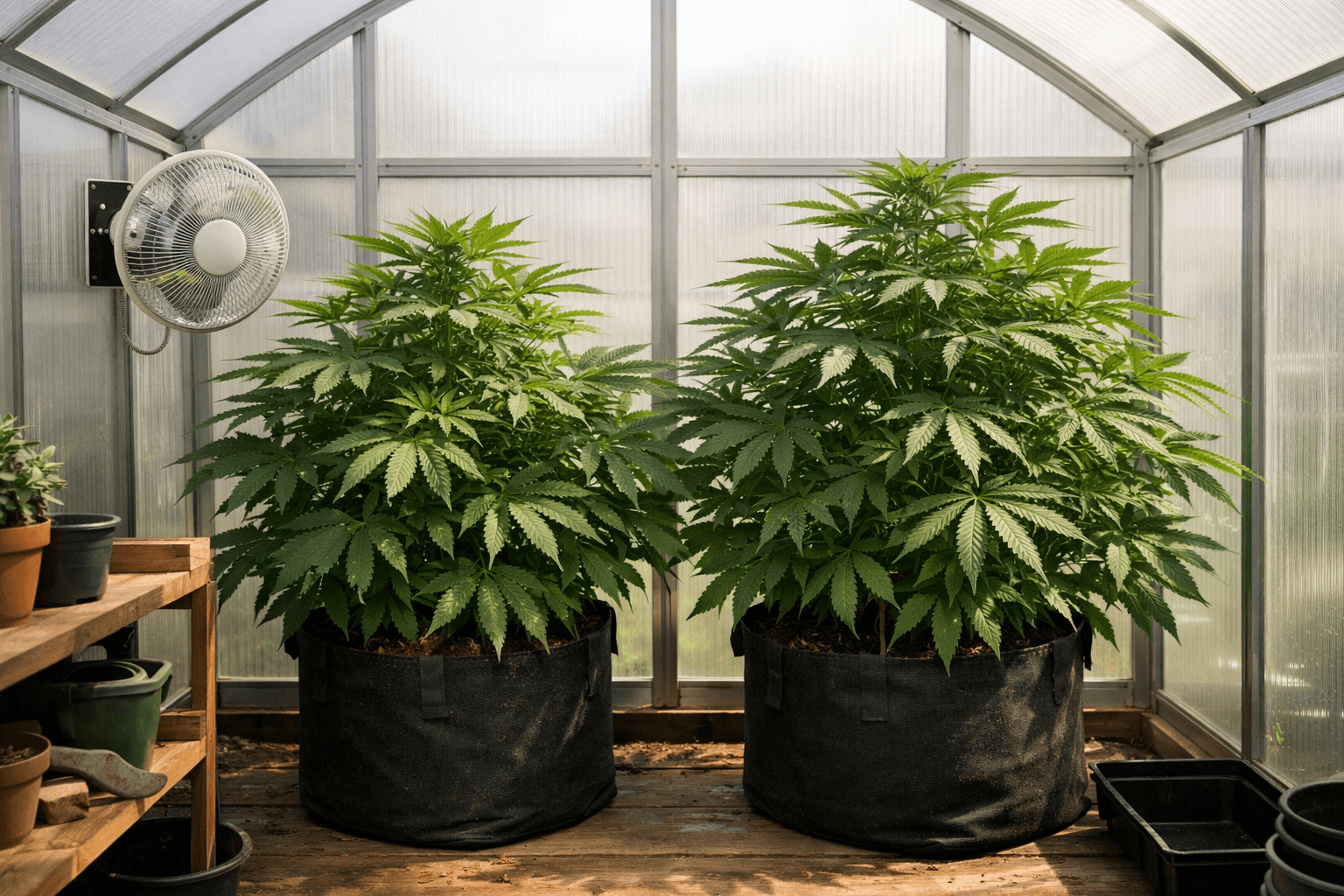
Polycarbonate twin-wall panels are the gold standard for Canadian cannabis greenhouses. They offer excellent light diffusion (eliminating hot spots on canopy), superior insulation compared to single-layer materials, and outstanding durability against snow loads and hail. The twin-wall construction traps a layer of air that acts as insulation, keeping heat in on cold nights and moderating temperature swings that stress plants. On overcast Canadian days, the diffused light transmission actually benefits large plants — scattered light penetrates deeper into the canopy than direct sunlight, meaning lower bud sites receive meaningful photon exposure rather than being shaded out entirely. A freestanding polycarbonate greenhouse sized for four plants typically runs $800–$2,000+ depending on brand and size.
Polyethylene film (poly tunnel / hoop house) is the budget-friendly workhorse. Modern 6-mil UV-stabilized greenhouse film lasts 3–5 seasons and transmits plenty of light for vigorous growth. A basic DIY hoop house built with EMT conduit or PVC can be constructed for $200–$500, making it the best entry point for home growers testing the greenhouse approach. The main trade-off is thermal performance: poly film loses heat faster overnight than twin-wall polycarbonate, so in shoulder-season cold snaps you may need a small propane or electric heater to protect against frost. Ventilation also requires more active management — unzipping doors and roll-up sides on warm days is non-negotiable to prevent heat stress and excess humidity.
Glass greenhouses are the premium option — beautiful, permanent, and excellent light transmission — but they're expensive ($2,000–$5,000+), heavy, and offer less insulation than polycarbonate unless double-paned. For most cannabis growers, glass makes more sense as a permanent garden structure that doubles for year-round use than as a dedicated cannabis grow space. If you're already building a glass greenhouse for vegetables or ornamentals, cannabis will absolutely thrive in it — but it's rarely the first choice when the goal is season extension on a cannabis-specific budget.
Structural Considerations for Canadian Climates
Regardless of which covering material you choose, the underlying structure must be built to handle Canadian conditions. This is where many first-time greenhouse growers make costly mistakes. A frame that's adequate in California or the UK can fail catastrophically under a Canadian snow load or spring ice storm.
Snow load capacity is the most critical structural consideration. Most off-the-shelf hobby greenhouses are rated for minimal snow accumulation — they're designed for mild climates. In Canada, you need a structure capable of handling the wet, heavy snow common from October through April. Polycarbonate panel greenhouses with aluminum extrusion frames generally handle snow loads better than lightweight poly tunnels, which can collapse under accumulation if not cleared promptly. If you're using a hoop house through late fall, plan to shake snow off the poly film after significant snowfall or install a secondary interior support line to prevent the roof from sagging under load.
Orientation matters more than most growers realize. A greenhouse oriented on an east-west axis maximizes sun exposure during the low-angle light of spring and fall — precisely the shoulder seasons where greenhouse growing provides its biggest advantage. The long south-facing wall catches morning and afternoon sun across the full growing season. Avoid placing your structure in the shadow of a fence, building, or tree line; even partial shading during the morning hours noticeably reduces accumulated daily light integral (DLI), which directly impacts plant development and yield.
Ventilation design is non-negotiable. On a clear July afternoon, the interior of an unventilated greenhouse can exceed 50°C — temperatures that stall growth, stress plants, and create conditions where spider mites thrive. At minimum, your structure needs roof vents or ridge venting that allow hot air to escape, plus low sidewall openings that draw in cooler ambient air. Automated vent openers that respond to temperature are a worthwhile investment for growers who can't monitor their greenhouse throughout the day. A small oscillating fan positioned to maintain gentle airflow across the canopy simultaneously keeps temperatures manageable and strengthens stems through mechanical stimulation — a double benefit that costs almost nothing to run.
Light deprivation is the technique that separates serious greenhouse growers from casual ones. By manually blocking all light from your plants for 12 hours per day using blackout tarps or integrated blackout panels, you trigger the flowering response in photoperiod strains regardless of the actual date on the calendar. This means you can flower plants in June — while days are still long — and have fully mature plants harvested by late July or August, then immediately start a second crop that finishes naturally in October. Double-cropping in a single Canadian season, something that's nearly impossible outdoors, becomes achievable in a properly equipped light-dep greenhouse. The commitment is real: blackout schedules must be followed with near-perfect consistency, as light leaks during the dark period can cause hermaphroditism or revert plants to vegetative growth. But for growers willing to put in the discipline, light deprivation is among the most powerful tools available. Shop outdoor cannabis seeds
FAQ
When can I start transplanting into my greenhouse compared to outdoor?
You can transplant hardened seedlings as early as late February in coastal BC or mid-April on the Prairies — weeks before your region's last frost date. Even an unheated greenhouse maintains soil and air temperatures 8–12°C warmer than outdoor conditions on sunny days, giving seedlings the thermal window to establish roots safely.
Can I grow longer-flowering strains (10+ weeks) in a Canadian greenhouse?
Yes — the 4–6 week head start from early spring growth makes strains with 10- to 11-week flower times viable in compressed growing zones. A plant that reaches July with six weeks of established vegetative mass will develop a dramatically larger canopy and significantly heavier yield than one started outdoors in May.
Do I need to heat my greenhouse or will a basic plastic structure work?
A basic unheated structure with plastic sheeting over a hoop frame is sufficient for most Canadian growers looking to extend their season. The passive solar heating alone — that 8–12°C temperature gain on sunny days — is enough to start your season several weeks early and protect crops from unexpected spring frosts.
How much earlier will my harvest be with a greenhouse?
Greenhouse-grown crops typically harvest 2–4 weeks earlier than pure outdoor grows, depending on your region and genetics. Beyond the harvest timing, the real advantage is the ability to run cultivars with much higher yield potential because the plants have adequate time to fully develop during their blooming phase.
19+ | Educational horticulture only.