Grow Under the Open Sky
Outdoor Growing Guides
Pots vs In-Ground for Outdoor Cannabis in Canada
Should you grow outdoor cannabis in pots or in-ground in Canada? Compare mobility, soil control, root space, and frost protection for the Canadian climate.
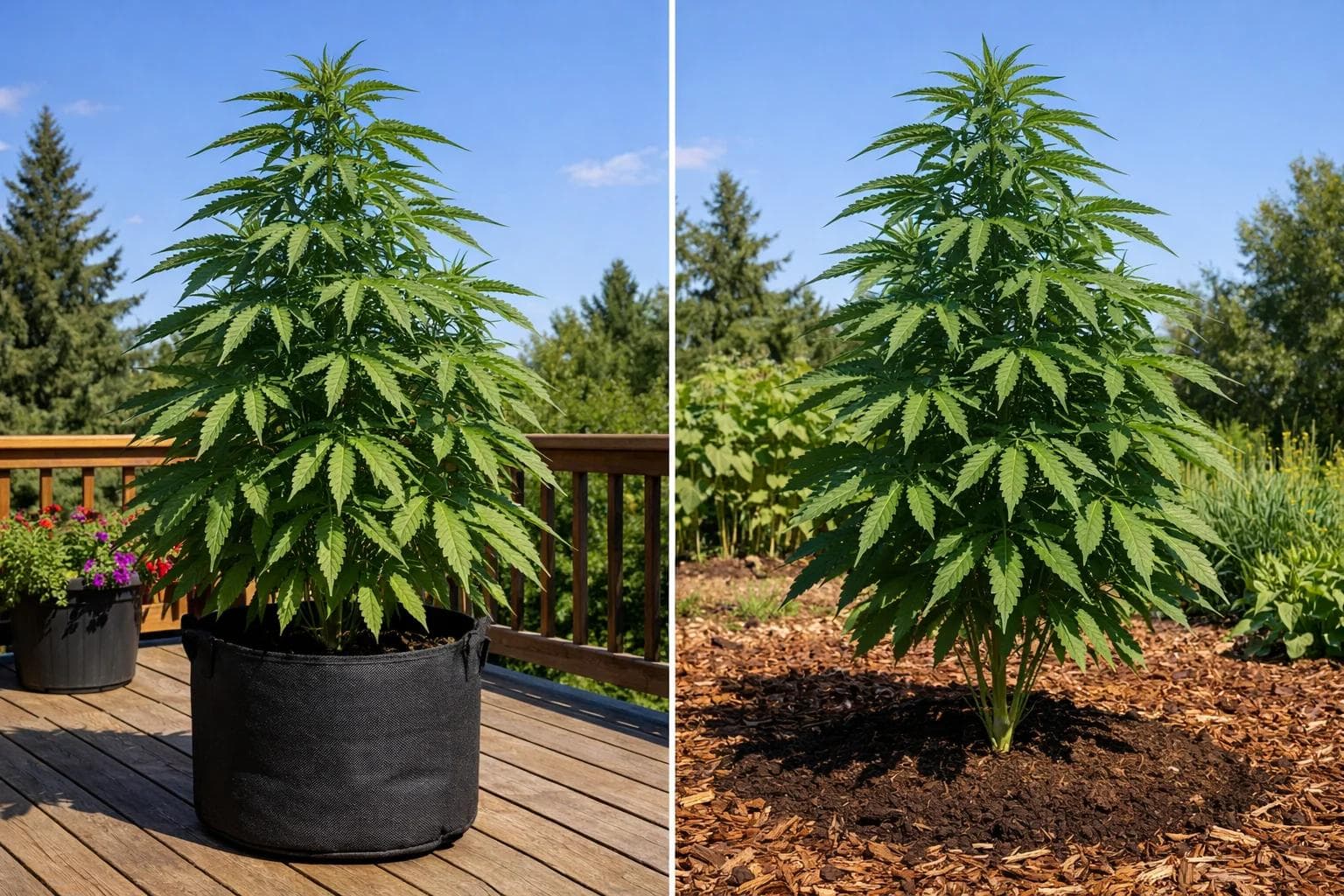
In-ground cultivation typically produces larger outdoor cannabis plants than containers due to unlimited root expansion and natural access to Canada's water table. These deeper moisture reserves reduce watering frequency and provide a buffer during dry spells, especially valuable for rural growers unable to water daily. BC growers report significantly larger harvests from single in-ground plants compared to containerized alternatives. Beyond yield advantages, in-ground cannabis cultivation eliminates container costs, premium potting mix expenses, and plastic waste over multiple growing seasons, making it the more economical choice for established locations where plant mobility isn't needed.
When conditions align, nothing beats planting directly in the earth. In-ground cannabis plants enjoy unlimited root expansion, and roots that spread freely produce significantly bigger plants. Experienced British Columbia growers in sheltered valleys have reported truly massive harvests from single in-ground plants — the kind of results that containers struggle to match. That root volume translates directly into canopy size: a plant with room to spread four feet underground will build a proportionally larger aerial structure, supporting more bud sites and heavier colas come harvest.
Canada's natural water table works in your favour underground. Roots tap into deeper moisture reserves, meaning less frequent watering and a natural buffer during the occasional summer dry spell. This is especially useful for rural growers who cannot water daily. In southern Ontario and interior British Columbia, summer temperatures can spike for weeks at a time — in-ground plants handle these stretches with far less intervention than container plants, which dry out quickly and require almost daily attention during heat waves.
The cost savings add up quickly: no pots, no premium potting mix for every container, and far less plastic waste. Over multiple seasons, the difference is substantial. A grower running six in-ground plants over three seasons avoids purchasing hundreds of litres of bagged soil and multiple large containers — expenses that compound fast when you factor in annual replacements of degraded fabric pots or cracked plastic.
Finally, in-ground planting creates a living ecosystem. Beneficial mycorrhizal fungi colonize roots, earthworms aerate the soil, and cover crops between plants suppress weeds naturally. Many growers believe this living soil network also enhances terpene expression — a concept sometimes called terroir — giving each garden a unique flavour profile rooted in its specific Canadian soil. To encourage this, many experienced growers inoculate transplant holes with commercial mycorrhizal inoculant and top-dress with compost throughout the season rather than feeding heavily with synthetic nutrients. The goal is to feed the soil, not just the plant. Over multiple seasons, a well-maintained in-ground bed becomes increasingly productive as the microbial population builds and the organic matter improves year over year.
Containers give Canadian growers something invaluable: control. When an early-September frost warning hits the Prairies or Quebec, you can wheel your plants into a garage overnight — and that mobility alone can save an entire crop. A single frost event in late August or early September, not uncommon in Alberta or elevated Quebec terrain, can wipe out weeks of late-season bud development. Growers in containers can respond within minutes; in-ground growers must rely on row covers, cold frames, or simply accept the loss.
Beyond frost protection, pots let you dictate your soil mix from day one. No guessing about heavy clay, contaminated lots, or unknown pH. You build your medium with quality compost, perlite, and coco, then dial in drainage exactly how your plants need it. This is a huge advantage across provinces where native soil ranges from thin and rocky to dense and waterlogged. Quebec clay, for instance, drains poorly and stays cold well into spring — a container grower can start with warm, airy medium weeks before in-ground soil has even thawed and drained. Similarly, growers in coastal British Columbia dealing with wet, acidic native soil can sidestep pH correction entirely by building a neutral, well-structured mix in their containers.
Container growing also simplifies amendments and feeding programs. When you control the medium, you can layer in slow-release organic amendments — bone meal, blood meal, kelp meal, rock phosphate — at precise ratios. You know exactly what your plant is sitting in, which makes diagnosing deficiencies far more straightforward than troubleshooting in unknown native soil.
Pests are also easier to manage in containers. Gophers, voles, and root-dwelling insects simply cannot access roots the way they can in open ground. If fungus gnats appear, you can isolate a single pot rather than treating an entire bed. Root aphids, one of the more destructive outdoor pests in certain regions, can devastate an in-ground bed before the problem is even detected — in containers, inspection is faster and treatment is targeted.
For renters, balcony growers, and anyone without permanent yard access, pots are the only practical option — and with the right container size they still deliver impressive yields. In provinces like Ontario and British Columbia where many growers live in apartments or townhomes, this portability turns limited space into a productive garden. A 30–45L fabric pot placed on a south-facing balcony or rooftop terrace, positioned to maximize daily sun exposure, can produce a very respectable harvest from a compact photoperiod or autoflowering variety. The key is selecting a strain whose finished size matches the container — a vigorous sativa-dominant plant in a 15L pot will be root-bound before midsummer, whereas a compact indica or a fast autoflower will thrive in the same container. Find strains suited to your growing method at Shop outdoor cannabis seeds.
Both pots and in-ground growing deliver rewarding outdoor harvests across Canada — the right choice simply depends on your climate zone, living situation, and goals. Browse Plantation Premium Seeds for short-season strains, fast autoflowers, and hardy genetics specifically selected to thrive in Canadian outdoor gardens.
Many experienced Canadian outdoor growers have settled on a hybrid method: sinking large containers — typically 45–100L fabric pots — partially into the ground. The buried portion insulates roots from temperature swings, mimics in-ground moisture buffering, and reduces how often you need to water, while the container itself preserves mobility and soil control. In practice, this means digging a hole roughly half the pot's depth, setting the fabric pot inside, and backfilling around the exterior with native soil or compost. Roots that escape through the fabric walls encounter real earth and can explore further, combining the best traits of both approaches. This method is particularly popular with growers in the Canadian shield region and interior Quebec, where the short season demands every advantage — the thermal stability of partial burial extends the effective growing window at both ends of the season without sacrificing the ability to move plants indoors when autumn arrives early.
FAQ
When is in-ground growing the right choice?
Choose in-ground if you have reliable rainfall and water access, and can commit to a fixed garden location. In-ground plants develop 3–4 feet of root depth compared to containers' 18–24 inches, which translates to significantly larger plants, better heat tolerance during summer spikes, and dramatically reduced watering needs.
What about drainage? Won't heavy rain waterlog the roots?
Proper drainage depends on your native soil—amend heavy clay with perlite, sand, or aged compost to improve water movement. If your region gets extreme rainfall, raised in-ground beds or mounds work well, allowing you to benefit from deeper moisture reserves while protecting roots from waterlogging.
How long before I plant should I prepare an in-ground bed?
Ideally, prepare the soil a season or two in advance. This timeline lets beneficial fungi and earthworms establish, organic matter fully integrate, and the living soil network mature. A well-seasoned bed produces larger plants and reportedly enhances terpene expression compared to freshly amended soil.
Will in-ground plants actually yield more than containers?
Yes—the larger root zone supports taller plants with more bud sites and heavier colas. Beyond size, the living soil ecosystem improves nutrient availability and terpene development. Most experienced growers see 30–50% heavier yields from established in-ground beds when water and temperature conditions are stable.
19+ | Educational horticulture only.