Grow Under the Open Sky
Outdoor Growing Guides
Starting Cannabis Indoors Before Moving Outside in Canada
Start cannabis seeds indoors in spring then move them outside successfully with expert timing guides for hardening off across Canada.
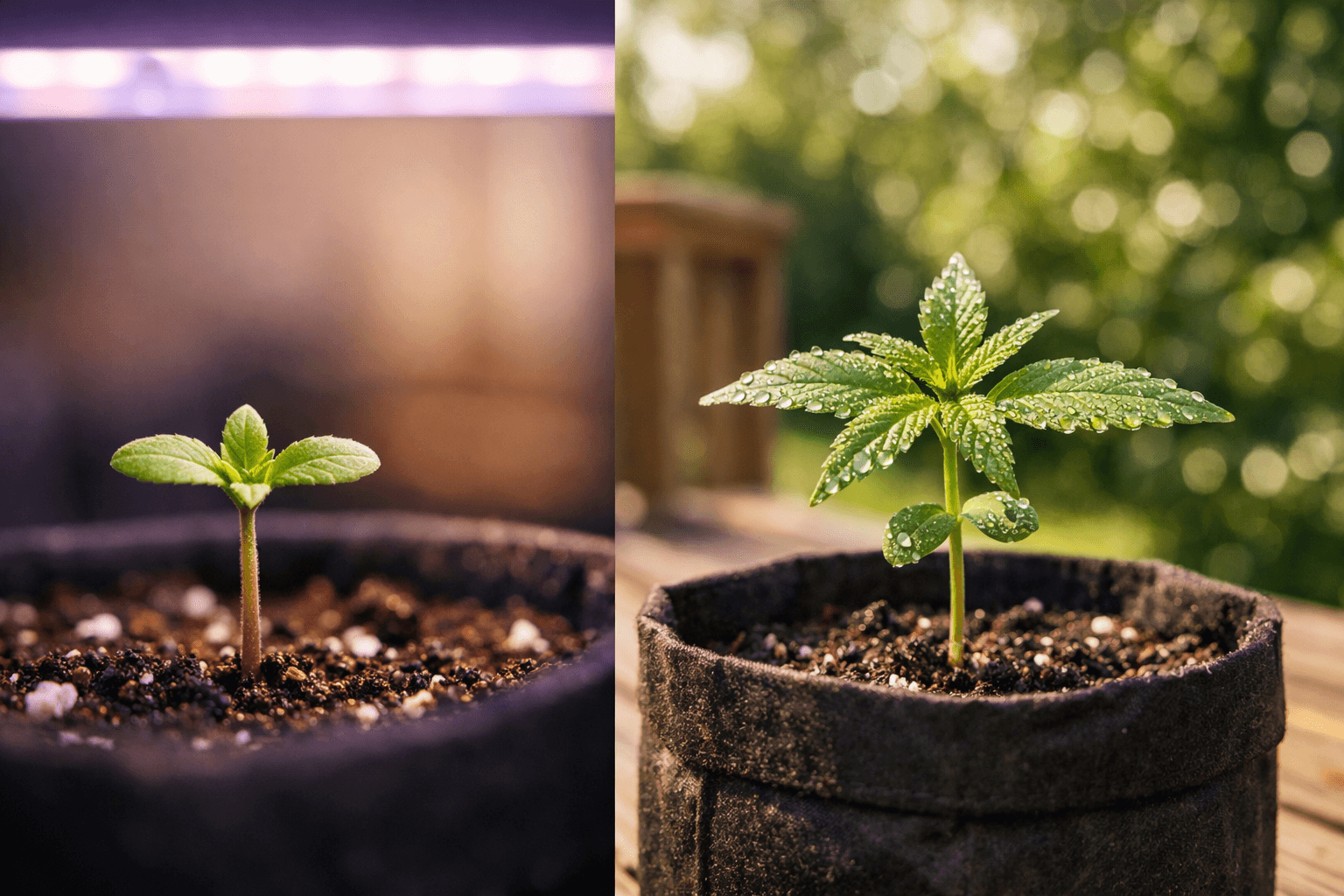
Starting cannabis indoors before moving outside requires careful transplant management to prevent shock. Provide shade cloth for 2–3 days after transplanting to ease the transition, and shield plants from strong wind with stakes or barriers. Expect mild wilting on days 1–2—this is normal as roots establish in new soil. Resume feeding with diluted vegetative nutrients after 3–4 days once you see new growth appearing at the top. Success indicators include firm stems, upward-reaching leaves, and visible new leaf development within one week. Timing varies by province; plan your indoor start in February–March and coordinate your outdoor transplant to match your region's growing season length. Proper hardening off and province-specific scheduling unlock prolific outdoor growth in Canada's short season.
Germination: Setting the Foundation for a Strong Outdoor Plant
Begin by germinating your seeds using the paper towel method. Place seeds between two damp paper towels on a plate, cover with a second plate or use a humidity dome, and keep them in a warm spot around 22–26°C. Most quality seeds crack open within 24–72 hours, revealing a white taproot.
Use pH-balanced water (around 6.0–6.5) to dampen the paper towels — tap water left to sit overnight works fine in most Canadian municipalities. Avoid soaking the towels; they should be moist, not dripping. If your home is cool, place the plate on top of a refrigerator or use a seedling heat mat set to 24°C to maintain consistent warmth. Check every 12 hours but resist the urge to over-handle the seeds. A taproot that has been touched or bent will still survive, but minimizing contact reduces stress on that delicate white root.
From Taproot to Seedling: The Solo Cup Stage
Once the taproot reaches 1–2 cm, plant it taproot-down into a pre-moistened solo cup filled with a light seedling mix or coco-peat blend. Place the cup under a CFL or LED grow light on an 18/6 light schedule (18 hours on, 6 hours off). Keep the light 5–10 cm above for CFLs or 30–45 cm for LEDs to prevent stretching.
Avoid using a heavily amended or "hot" soil at this stage — the seedling's tiny roots are sensitive, and excess nutrients cause tip burn or stunted growth before the plant even gets started. A seedling-specific mix, a plain peat-perlite blend, or straight coco-peat with no added nutrients is ideal for the first two weeks. You will introduce nutrients later, once the plant has developed a proper root network.
For the first 10–14 days, maintain humidity around 65–70% using a dome or plastic wrap and water sparingly — the solo cup should feel light before you add moisture. Misting the walls of the dome (not the seedling directly) is a good way to raise humidity without over-saturating the medium. Overwatering at the seedling stage is one of the most common causes of damping off — a fatal fungal condition that collapses the stem at soil level. Let the medium nearly dry between waterings, and always use room-temperature water.
Once the seedling has 2–3 sets of true leaves and roots are visible at the cup's drain holes (typically around 2 weeks), it is time for a first transplant into a 1-gallon pot. This intermediate container gives roots room to develop a strong network before the big move outdoors. Gently squeeze the sides of the solo cup, turn it upside down, and the root ball should slide out intact. Plant it slightly deeper than it sat before — burying the lower stem up to the first set of leaves encourages additional root development along the buried stem.
Hardening Off: The Step That Separates Good Harvests from Great Ones
Skipping hardening off is the single most common mistake Canadian growers make — and it can set your plants back weeks or kill them outright. Indoor seedlings have never experienced UV radiation, wind, or temperature swings. They need a gradual 7 to 10 day acclimation period before living outdoors full-time.
Think of it this way: a plant that has spent its entire life under a grow light is like a person who has spent winter indoors — you would not send them straight to a full day at the beach. The stomata, the waxy cuticle on the leaves, and the cell walls themselves all need time to adapt to harsher outdoor conditions. Rushing this step causes sunscald (bleached, papery patches on leaves), windburn (clawing, curled leaf edges), or outright transplant failure.
Days 1–2: Place plants outdoors in full shade for 1–2 hours, then bring them back inside. Choose a sheltered spot out of the wind — under a porch, against a fence, or beside a building works well. The goal is outdoor air exposure, not sunlight.
Days 3–4: Increase outdoor time to 3–4 hours, introducing dappled or morning sunlight only. Avoid exposure between 11 a.m. and 2 p.m. when UV intensity peaks. Eastern exposures — where the plant gets gentle morning light — are ideal at this stage.
Days 5–7: Extend to 5–6 hours with increasing direct sun. Leave plants out during mild evenings if overnight temperatures stay above 12°C. Begin introducing short periods of afternoon sun to prepare the plant for full-day exposure. If the forecast calls for wind above 30 km/h or temperatures below 10°C on any night during this window, bring plants inside without exception — cold stress at this stage can trigger early flowering in photoperiod varieties.
Days 8–10: Plants can now stay outside for full days, ideally 8 or more hours of direct sun. Continue bringing them in at night until your final outdoor transplant date. By the end of this window, leaves should be dark green, slightly waxy in appearance, and noticeably stockier than when you began — signs the plant has genuinely adapted to outdoor life.
The Final Transplant and Post-Move Care
The first week after transplant is critical. Provide shade cloth or a temporary screen for 2–3 days to ease the transition to full sun. Even a hardened-off plant benefits from slightly reduced light intensity immediately after its roots are disturbed by transplanting. Shield plants from strong wind with stakes or a simple barrier. Mild wilting on days 1–2 is completely normal — the roots are establishing in new soil and uptake is temporarily reduced. Do not overwater in response.
Water deeply at transplant time, then wait. Resist checking the soil every few hours. The roots need oxygen as much as moisture, and wet soil around freshly disturbed roots invites rot. The best signal to water again is a pot that feels noticeably lighter when lifted, combined with slight leaf droop in the heat of the day that recovers by evening.
Resume feeding with a diluted vegetative nutrient solution after 3–4 days, once you see the plant perking up and new growth appearing at the top. Start at approximately half the manufacturer's recommended dose — the plant's root system is still re-establishing and cannot process a full nutrient load immediately. Signs of a successful transplant include firm stems, upward-reaching leaves, and visible new leaf development within one week. New growth appearing at the top of the canopy is the clearest confirmation that root activity has resumed and the plant is back on track.
With the right indoor start, proper hardening off, and smart province-specific timing, Canadian growers can transform a short season into a spectacular outdoor harvest. The indoor-to-outdoor strategy is how experienced cultivators coax massive, fully mature plants out of our northern climate year after year. Browse Plantation Premium Seeds' collection of proven outdoor-ready and autoflowering genetics — carefully selected to thrive in Canadian conditions from coast to coast.
FAQ
How far in advance of my outdoor season should I start seeds indoors?
In Canada, start seeds indoors 6–8 weeks before your last frost date, typically late March to mid-April depending on your region. This gives seedlings time to develop a strong root system and several sets of leaves before outdoor transplanting.
What's the best way to transition seedlings from indoor lights to outdoor sunlight?
Harden off your seedlings by gradually exposing them to outdoor conditions over 7–10 days—start with 1–2 hours in shade, then increase sunlight and time outdoors each day. This process toughens plant tissue and prevents shock and leaf burn.
Why does seedling-specific soil matter, and what if I use regular potting soil?
Seedling-specific mixes are light and nutrient-free to prevent root burn on delicate new roots, while regular potting soil contains added nutrients that can cause tip burn and stunt growth. Stick with plain coco-peat, perlite blends, or seedling mix for the first two weeks.
Is CFL or LED better for starting seedlings indoors?
Both work well—CFLs are cheaper and simpler, requiring a 5–10 cm distance, while LEDs are more efficient and need 30–45 cm distance. Choose CFL for minimal investment or LED if you plan multiple batches and want lower electricity costs.
How do I know if my seedlings are getting enough moisture?
The solo cup should feel light (almost dry) before watering again—a light cup means roots are actively drinking. Overwatered seedlings develop damping off or root rot, while underwatered ones wilt noticeably by afternoon.
19+ | Educational horticulture only.