Grow Under the Open Sky
Outdoor Growing Guides
Growing Cannabis on a Balcony or Terrace in Canada
Everything you need to grow cannabis on a balcony or terrace in Canada. Legal tips, best strains for small spaces, container selection, and privacy solutions.
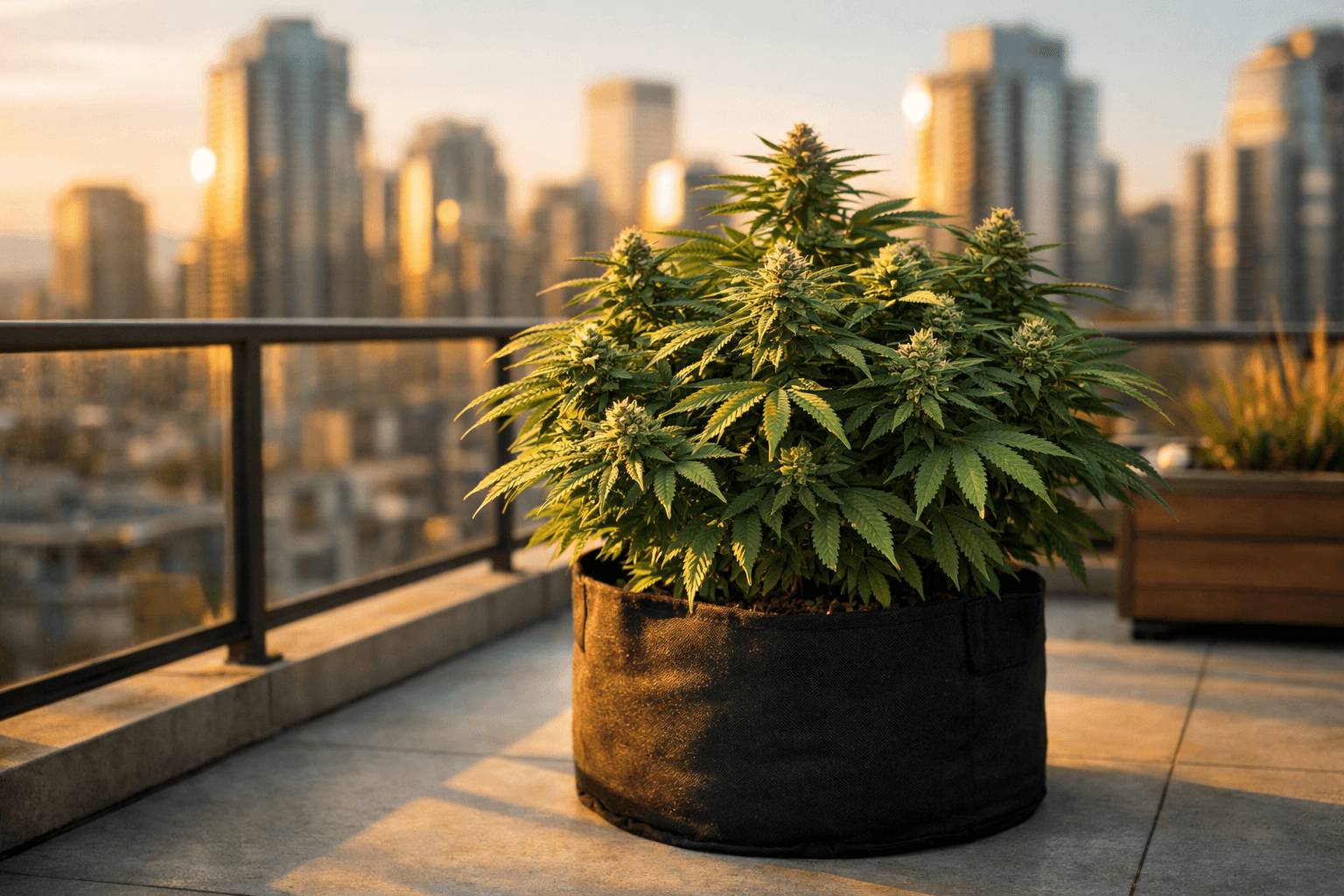
Growing cannabis on a balcony or terrace in Canada hinges on four critical factors. Your plants need a minimum of 4–6 hours of direct sunlight daily, with south-facing exposure ideal for Canada's growing season. Wind is a major challenge—install a windbreak using greenhouse plastic, bamboo screen, or tall companion plants to prevent stem damage and rapid soil drying. Verify structural capacity too: a 20-litre fabric pot with wet soil weighs over 20 kg. Smart container selection and windbreak installation unlock successful small-space cultivation.
Not every balcony is created equal. The single most important factor is sunlight: cannabis needs a minimum of 4–6 hours of direct sunlight daily, and more is always better. South-facing balconies are ideal in Canada, capturing the longest arc of sun throughout the growing season. East-facing spots work but may limit yields; north-facing balconies are generally a non-starter for photoperiod strains.
Before your first seed goes in the ground, spend a full day tracking where sunlight actually falls on your balcony. Use masking tape to mark where shade ends by noon, and check again at 3 PM. Tall neighbouring buildings, overhangs, and even your own building's façade can cut your usable window significantly. If you're getting a solid 6+ hours of unobstructed sun between 10 AM and 4 PM, you're in excellent shape. A solar path app can help you project this across the whole season — many growers are surprised to find that their mid-July sun exposure is very different from what they'll have in early September when plants are finishing.
Wind exposure is a major balcony challenge. High-rise gusts can snap stems, dry out soil rapidly, and stress plants. Install a simple windbreak — a sheet of greenhouse plastic, a bamboo screen, or even a row of tall companion plants — to buffer your grow without blocking light. Wind also accelerates transpiration: on a hot, windy afternoon, a 15-litre pot can go from saturated to bone-dry in under 24 hours. If you're growing above the 5th floor, plan to water daily during July and August heat waves, and consider a simple drip irrigation timer to keep moisture levels consistent when you're away.
Young plants are especially vulnerable to wind stress. In the first two to three weeks after transplanting outdoors, consider keeping seedlings behind a windbreak full-time and only gradually exposing them to open-air conditions. This hardening-off process builds stem thickness and prepares plants for the real conditions they'll face at peak season.
Don't overlook structural weight limits. A 20-litre fabric pot filled with wet soil can weigh 20+ kg, and four of them plus saucers and a watering can add up fast. Check your building's balcony load rating if you're on a higher floor. A good rule of thumb: distribute pots along the perimeter of the balcony near load-bearing walls rather than clustering them in the centre. Using lightweight perlite-heavy mixes or coco coir blends instead of dense potting soil can meaningfully reduce total weight without sacrificing drainage or root oxygenation.
Finally, be aware of heat reflection from concrete and glass — balcony surfaces can amplify afternoon temperatures dramatically, baking roots and drying containers faster than a ground-level garden ever would. Dark-coloured fabric pots absorb additional heat from below; if your balcony floor heats up significantly, elevate pots a few centimetres on wooden pallets or pot feet to allow airflow underneath. Root zone temperature matters — roots prefer 18–24°C. When the concrete under your pots is radiating 40°C of stored heat at 6 PM, your plants are fighting a battle you may not even see until it shows up as wilting or nutrient lockout.
Strain selection can make or break a balcony grow. In a compact urban space, you want plants that stay short, finish fast, and don't announce themselves to the entire building.
Autoflowering strains are the gold standard for balcony growers. They stay compact (typically 60–100 cm), flower automatically regardless of light schedule, and finish in as little as 8–10 weeks from seed. They're discrete, forgiving, and perfect for Canadian summers where you want to harvest before the fall frost hits.
The autoflower advantage goes beyond size. Because they don't depend on a light schedule to trigger flowering, autoflowering plants are also immune to the light pollution that plagues urban growers — streetlights, lit signage, and neighbouring windows that might confuse a photoperiod plant into thinking days are longer than they are. On a balcony in Montreal or Toronto, this alone can mean the difference between a clean harvest and a crop stuck in a perpetual vegetative loop.
Indica-dominant genetics also work well — they naturally grow shorter and bushier than sativas, making them easier to manage behind a railing. Look for strains marketed as "low odour" if neighbours are a concern. Indica plants also tend to have wider leaves and a denser canopy, which can provide some natural camouflage if privacy is a priority. Training techniques like low-stress training (LST) — gently bending and tying stems outward — can keep even indica plants flat and wide rather than tall and conspicuous, maximising light interception without adding height.
From the Plantation Premium Seeds catalogue, we recommend:
- Northern Lights Auto — A legendary low-odour indica that stays squat and finishes fast. Virtually bulletproof for beginners.
- Blueberry Auto — Compact, colourful, and resilient, with a sweet berry aroma that's less pungent than skunky alternatives.
- Critical Purple Auto — Heavy-yielding for its size, with a short flowering window ideal for Canada's limited outdoor season.
Avoid tall-stretching sativas like Haze varieties — they can easily exceed 2 metres and become impossible to manage (or hide) on a standard balcony.
On a balcony, your containers are your garden beds, so choose wisely. Fabric pots in the 10–20 litre range are the sweet spot for most balcony autoflowers and compact indicas. Fabric pots air-prune roots as they reach the container wall, preventing the root circling that occurs in plastic pots and encouraging a dense, fibrous root structure that feeds efficiently. They also drain much faster after heavy rain — a meaningful advantage on a balcony where drainage may be limited and overwatering is a common mistake.
For a typical autoflower, a 10–12 litre fabric pot is sufficient. If you're running a larger indica-dominant photoperiod plant with a longer veg period, step up to 15–20 litres. Avoid going much larger than 20 litres unless you have confirmed load capacity — the yield gain per extra litre diminishes quickly, and the weight adds up.
Fill pots with a well-aerated mix: a base of quality potting soil amended with 20–30% perlite for drainage, plus a slow-release organic fertiliser worked into the top layer. On a balcony, you won't have access to living soil and earthworm activity the way an in-ground garden does, so a good all-purpose organic dry amendment can compensate. Water when the top 2–3 cm of soil feels dry to the touch, and always water to runoff so salts don't build up in the medium over time.
A Canadian balcony is more than enough space to grow outstanding cannabis. With the right genetics, smart training, and a little urban ingenuity, four compact plants can reward you with a generous personal harvest. Browse Plantation Premium Seeds' autoflower and compact strain collections — specifically selected for small-space growers who want big results from their balcony, terrace, or rooftop garden.
FAQ
How do I know if my balcony gets enough sunlight?
Spend a full day tracking sunlight—use masking tape to mark where shade falls at noon and again at 3 PM. If you're getting 6+ hours of unobstructed direct sun between 10 AM and 4 PM, you're in excellent shape; south-facing balconies are ideal. A solar path app can help you project sunlight patterns across the entire season, since exposure shifts significantly between mid-July and early September.
What can I do about strong winds on a high-rise balcony?
Install a windbreak using greenhouse plastic, a bamboo screen, or tall companion plants to buffer your grow without blocking light. Wind can dry a 15-litre pot completely in under 24 hours by accelerating transpiration, so a windbreak also reduces water stress. This is especially critical during hot afternoons when wind stress is most intense.
How often should I water during heat waves?
Water daily during July and August when temperatures spike and wind is strong, since transpiration accelerates rapidly under these conditions. If you're away frequently, install a simple drip irrigation timer to maintain consistent moisture levels. Hand-checking soil moisture remains a good backup to stay responsive to your specific balcony conditions.
How do I harden off seedlings before moving them to a balcony?
Keep seedlings behind a windbreak for the first two to three weeks after transplanting, then gradually expose them to open-air conditions over time. This hardening-off process builds stem thickness and prepares plants to handle actual balcony wind and sun. Start with a few hours of daily exposure and extend it incrementally over two to three weeks.
19+ | Educational horticulture only.