From Decarb to Dosing
Cooking & Edibles
Cannabutter: A Science-First Guide for Canadian Home Cooks
Cannabutter recipe and dosing math for Canadian home cooks (19+). Decarb, infuse, strain, calculate potency. Science-first guide with storage tips.
Cannabutter is butter infused with activated cannabis fat. To make it properly, decarboxylate your flower first at 115°C (240°F) for 35–45 minutes, then simmer it below 93°C (200°F) for 2–4 hours. At roughly 70% extraction efficiency, 14 g of 20% THC flower yields approximately 120 mg THC per tablespoon — far more potent than a 10 mg legal edible.
Most cannabutter guides on the internet tell you to heat butter with weed for a few hours. That is roughly correct and completely insufficient.
They skip the chemistry that determines whether your batch works at all. They hand-wave the dosing math — the part that matters most for not having a terrible time. And for Canadian home cooks specifically, they ignore the legal context entirely: the Cannabis Act, Health Canada's 10 mg unit standard, provincial age limits, and the no-organic-solvent rule that defines what you are legally allowed to do in your kitchen.
This guide covers all of it. Not because the chemistry is complicated — it isn't — but because understanding what is actually happening in that saucepan is the only way to make consistent, safe, and predictable cannabutter every time.
Is it legal to make cannabutter at home in Canada?
Yes, making cannabutter at home is legal in Canada under the Cannabis Act for adults who have legally obtained or personally grown their cannabis. Adults 19 and older in most provinces may possess cannabis for personal use, and infusing it into food at home using heat and fat falls within that scope. Three rules govern what you can and cannot do.
1. Possession limits apply. Adults may possess up to 30 grams of dried cannabis (or its legal equivalent) in public. Home possession is not explicitly capped under federal law, but all cannabis must have been obtained legally — through a licensed provincial retailer or by growing up to four plants per household under personal cultivation rules.
2. No organic solvents. The Cannabis Act prohibits home extraction using organic solvents — butane, ethanol, naphtha, and similar substances. Infusing cannabis into butter or oil using heat alone is not solvent extraction and is therefore legally permitted. This is the foundation for all kitchen-based cannabutter and cannabis oil methods.
3. Home edibles are for personal use. Gifting or selling homemade cannabis edibles is a regulated grey area. Commercially selling edibles without a licensed processor designation is clearly prohibited. See the FAQ section on gifting for more nuance.
Age note: most provinces set the legal cannabis purchase and consumption age at 19. Alberta uses 18. Quebec's rules are more complex — Vancouver and Toronto home cooks have been making cannabutter legally since October 2018. If you are starting from legally obtained flower, your kitchen infusion is fully within the law.
Why is decarboxylation non-negotiable?
Raw cannabis flower contains virtually no active THC. It contains THCA — tetrahydrocannabinolic acid — a non-psychoactive precursor molecule with a carboxyl group (–COOH) attached. Applying heat drives off a molecule of carbon dioxide (CO₂), completing the decarboxylation reaction and converting THCA into psychoactive Δ9-THC.
Skipping this step means your cannabutter will contain mostly THCA. While THCA has documented properties of its own, it does not produce meaningful psychoactive effects when ingested as an edible. You would be making expensive flavoured butter.
Properly dried and cured flower decarbs most efficiently. Fresh cannabis contains 75–80% moisture, which absorbs heat, creates temperature gradients across the tray, and produces steam that interferes with uniform conversion. Always start with fully dried, room-temperature flower. If you grew your own, Curing and Storing Cannabis Buds before running a batch — the cure matters.
For a full treatment of the decarb chemistry — including time-temperature curves and CBDA→CBD conversion — see Decarboxylation: The Chemistry Behind Activating Cannabis.
What temperature and time should you use to decarb for butter?
Decarb your cannabis at 115°C (240°F) for 35–45 minutes. This combination sits in the optimal zone of the decarboxylation curve: hot enough to drive the THCA→THC conversion efficiently, cool enough to prevent THC from oxidising into CBN — the degradation byproduct that reduces potency and increases sedation.
Practical technique:
- Break up flower to roughly pencil-eraser size. Whole buds insulate their cores; overly fine grinds over-expose surface trichomes to heat.
- Single layer on parchment, inside a baking tray.
- Cover loosely with foil to reduce terpene vapour loss — aromatic compounds in trichomes evaporate at lower temperatures than decarb requires. Cannabis Terpenes Guide
- Calibrate your oven. Most residential ovens run 10–20°C off their dial setting. An oven thermometer costs under $15 and eliminates the single most common cause of weak cannabutter.
- Altitude note: Denver home cooks at ~1,600 m above sea level should add 5 minutes to their decarb window — oven air temperature behaves differently at elevation — and verify with a probe thermometer.
How does cannabis actually get into butter?
THC and other cannabinoids are hydrophobic — they dissolve readily in fats and oils but not in water. Butter is roughly 80% fat by weight. When decarbed cannabis is introduced to melted butter and held at temperature, cannabinoids migrate out of the plant material and bind to fat molecules through lipid-lipid affinity, a passive diffusion process driven by concentration gradient and temperature.
Water is added to most cannabutter recipes for three reasons: it keeps the infusion temperature below 100°C (water can't exceed its own boiling point — that's your thermal ceiling), it extracts water-soluble chlorophylls and impurities away from the butter, and it separates cleanly during refrigeration — leaving the green butter disc sitting on top of the darker water layer, which is then discarded.
Extraction efficiency in a standard stovetop batch runs 60–75%. This guide uses 70% as a conservative working estimate. The remaining ~30% is locked in plant cellulose, lost to evaporation, or left in the strained marc. This loss factor is why dose math must account for extraction efficiency — not just theoretical THC content stamped on your flower's label.
How much cannabis do you need per cup of butter?
A standard starting ratio is 7 g of decarbed flower per 225 g (1 cup) of unsalted butter plus 1 cup of water. For potent batches, use up to 14 g per cup. Beginners should start at 7 g to keep per-serving doses manageable and math-friendly.
Worked example: 14 g at 20% THC
Starting with quality, well-tested flower makes dose math reliable. For indica-dominant strains well-suited to calming edible applications, Northern Light Feminized Seeds offers consistent high-THC genetics. For dessert and baked-good recipes where flavour profile matters as much as potency, Wedding Cake Feminized brings sweet, vanilla-forward terpene complexity that survives infusion.
How do you actually make cannabutter step by step?
Equipment
- Baking sheet, parchment, and foil (decarb)
- Medium saucepan or double-boiler
- Kitchen thermometer (non-negotiable)
- Fine-mesh strainer + cheesecloth
- Mason jar or glass container
- Refrigerator space for at least 4 hours
Ingredients
- 7–14 g decarboxylated cannabis flower
- 225 g (1 cup) unsalted butter
- 240 ml (1 cup) cold water
Step 1 — Decarb (35–45 min at 115°C / 240°F) Preheat your oven. Break up flower, spread on parchment in a single layer, cover loosely with foil. Bake 35–45 minutes. Remove and allow to cool to room temperature before adding to butter — warm flower can spike your infusion temperature.
Step 2 — Melt butter with water Combine butter and water in a saucepan over low heat. Allow butter to melt fully before adding cannabis. The water buffer is not optional — it regulates temperature and prevents scorching on the pan bottom.
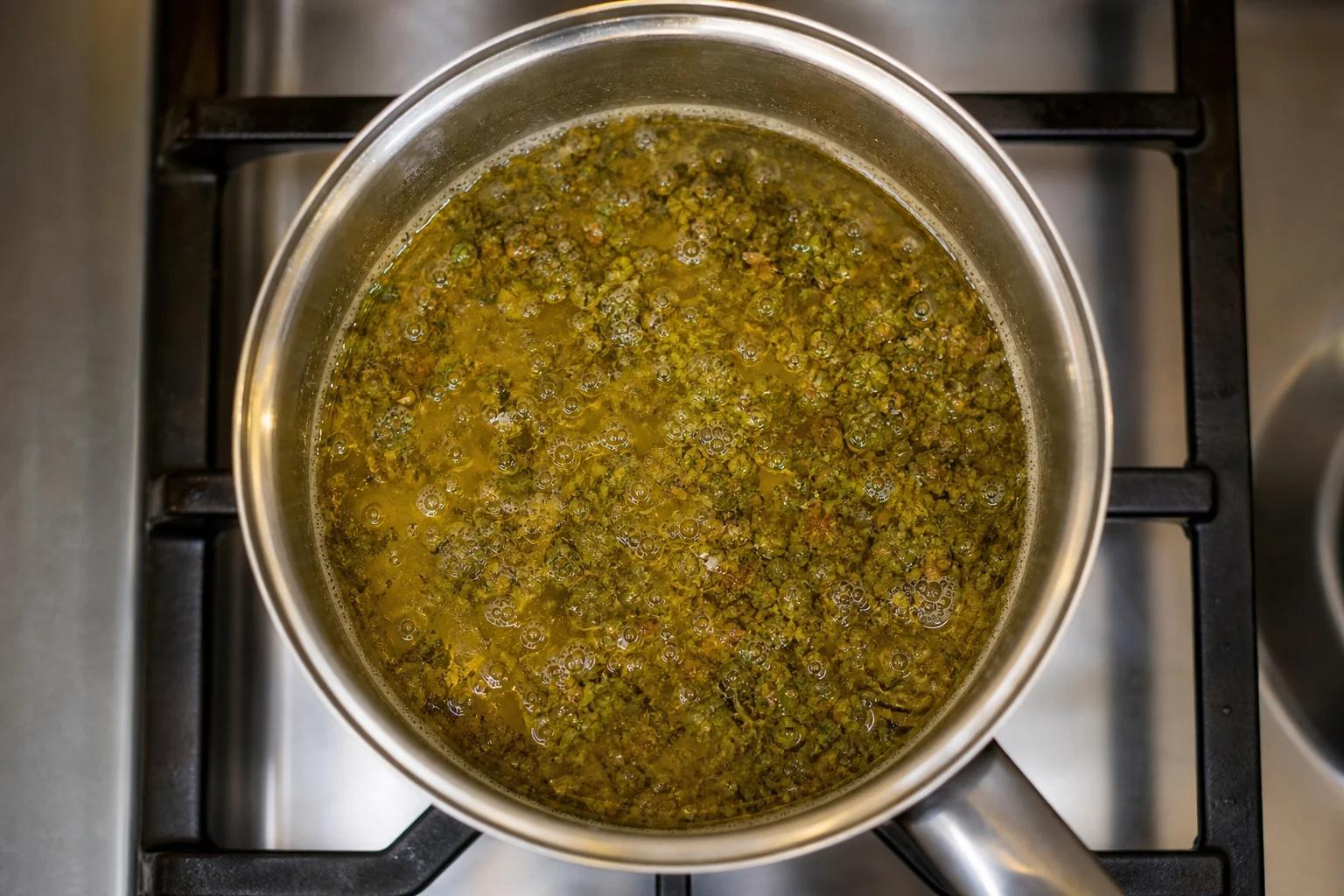
Step 3 — Add flower, simmer low and slow Add cooled decarbed flower to the butter-water mixture. Maintain 70–93°C (160–200°F). Never let the mixture boil. Simmer 2–4 hours, stirring every 30 minutes. Use your thermometer — a vigorous simmer and a gentle simmer look deceptively similar.
Portland home cooks working through a fall outdoor harvest know this well: ambient kitchen temperature matters less than saucepan temperature. Keep the thermometer in the pot, not on the counter.
Montreal kitchens in August often reach 28–30°C indoors — your butter will come to temperature faster. Use a lower burner setting and check every 20 minutes rather than 30.
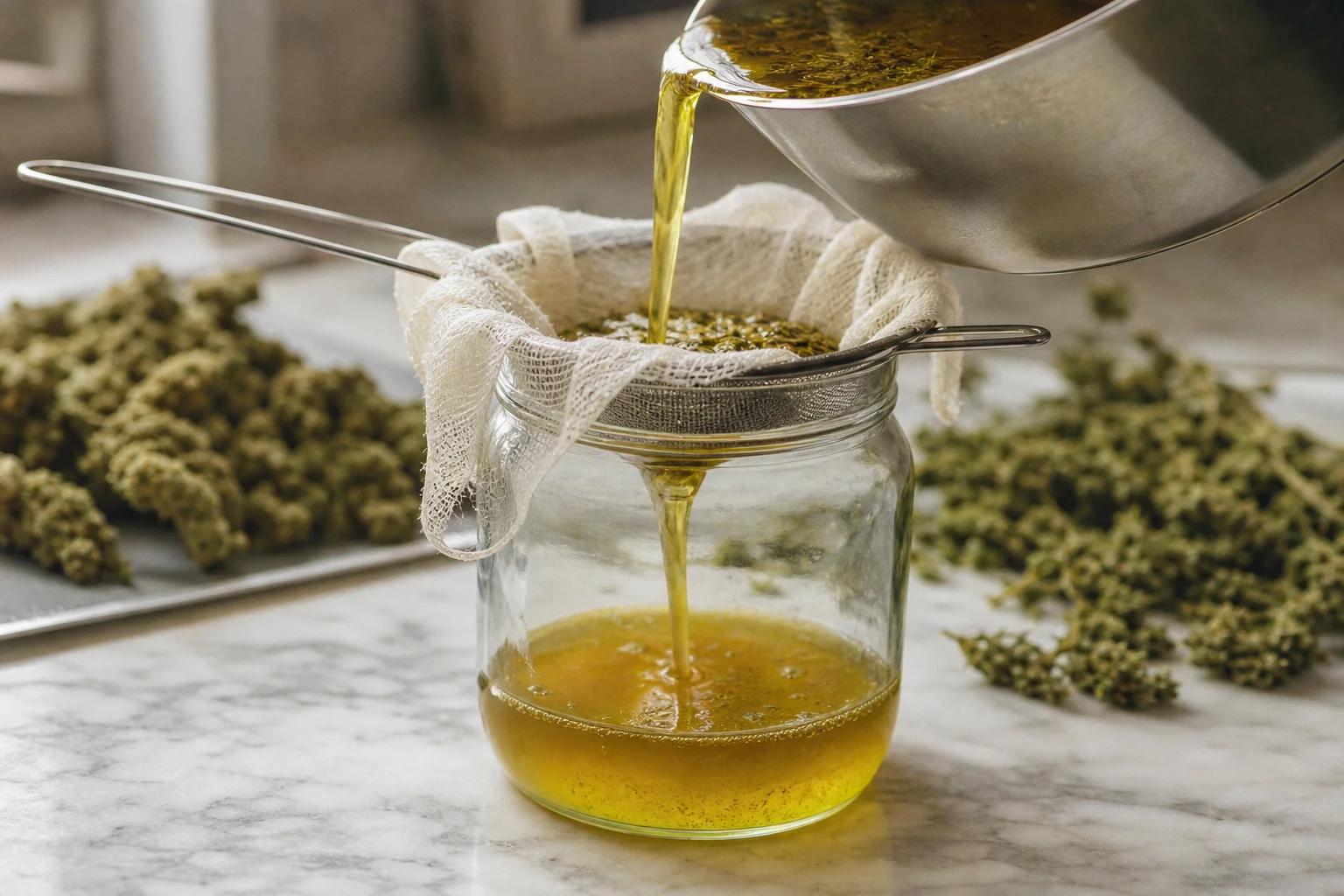
Step 4 — Strain Line a fine-mesh strainer with cheesecloth, set it over a mason jar or large measuring cup. Pour slowly. Once cooled enough to handle, press (do not wring) the plant matter in the cheesecloth. Wringing forces chlorophyll into the butter, adding bitterness.
Step 5 — Refrigerate and separate Refrigerate the strained liquid for at least 4 hours. The butter disc solidifies on top; discard the darker water below. Lift the butter disc, pat dry with a paper towel.
Step 6 — Label and store Seal the butter in a clean container. Label with: date, grams of flower used, estimated THC%, and calculated mg per tablespoon. This label is not bureaucracy — it is your safety reference every time you use the batch.
Can you use an air fryer, crockpot, or sous-vide instead?
Yes, all three work — each with real tradeoffs.
Edmonton home cooks who process large autumn batches often prefer the crockpot: it handles 2–3 cups of butter in a single run, requires minimal supervision, and keeps the kitchen from overheating during a winter infusion day.
How do you calculate the THC dose in your cannabutter?
The dose formula:
Dose (mg/tbsp) = (G × THC% × 1000 × 0.70) ÷ 16
Where:
- G = grams of flower
- THC% = percentage as decimal (20% = 0.20)
- 1,000 = converts grams to milligrams
- 0.70 = ~70% extraction efficiency (conservative estimate)
- 16 = tablespoons per cup of butter
Example: 7 g at 18% THC
(7 × 0.18 × 1,000 × 0.70) ÷ 16 = 882 ÷ 16 = ≈ 55 mg per tablespoon = ≈ 18 mg per teaspoon
A half-teaspoon of this batch is approximately 9 mg — just under a standard Health Canada 10 mg unit.
If you don't have a lab COA for your flower, use 15% THC as a conservative placeholder for home-grown strains with unknown potency, and 18–22% for well-bred feminized genetics with documented genetics. Overestimating potency is always the safer mistake.
How does homemade cannabutter compare to a 10 mg Canadian legal edible?
Health Canada limits commercially licensed cannabis edibles to 10 mg of THC per discrete unit . That standard is your most practical dosing reference when working with homemade cannabutter.
Conversion table: 14 g / 20% THC batch (≈ 122 mg per tablespoon)
Use a kitchen syringe or calibrated dropper for small measurements. A teaspoon by eye is not precise enough when doses start at 2.5 mg.
What is a safe starting dose for someone new to edibles?
Start with 2.5 mg of THC. Wait a full two hours before considering a second dose. Health Canada's lower-risk cannabis use guidelines recommend 2.5 mg as the entry-level reference for new edible users .
Using the 14 g / 20% THC batch above, 2.5 mg is approximately one-eighth of a teaspoon. This requires a 1 ml kitchen syringe to measure accurately — that level of precision is not excessive caution, it reflects the actual potency gap between homemade cannabutter and commercial edibles, which are professionally dosed to the milligram.
Key harm-reduction principles:
- Onset for edibles is 30 minutes to 2 hours, often closer to 90 minutes. Do not re-dose because you feel nothing.
- Effects peak 2–4 hours after ingestion and may persist 6–8 hours total.
- Eating with a fatty meal can delay onset and increase total absorption.
- CBD may modestly blunt THC effects if you over-consume. Rest, water, and time are the primary tools.
- If symptoms are severe — chest pain, difficulty breathing, loss of orientation — contact a medical professional or call 911.
Why do edibles hit harder and last longer than smoking?
When THC is ingested rather than inhaled, the liver converts Δ9-THC into 11-hydroxy-THC (11-OH-THC) — a metabolite that is more potent than the parent compound and crosses the blood-brain barrier more readily. This first-pass metabolism is the pharmacological reason edibles feel categorically stronger than smoking an equivalent THC quantity.
Inhaled THC hits peak plasma concentration fast — typically within 30 minutes — and clears substantially within 1–3 hours. Ingested THC follows a different circuit entirely: stomach → small intestine → portal vein → liver (where 11-OH-THC is produced) → systemic circulation → brain. This process takes 30 minutes to 2 full hours, creates a higher and longer-lasting peak, and produces effects lasting 4–8 hours depending on individual metabolism, body composition, and whether you ate beforehand.
The practical implication: you cannot calibrate an edible dose by how you respond to smoking the same flower. They are different pharmacological experiences driven by different metabolic pathways.
How long does cannabutter last and how should you store it?
Properly made cannabutter lasts 2–3 weeks in the refrigerator and up to 6 months in the freezer. The same bacterial growth and oxidation that limits plain butter's shelf life applies to cannabutter — the cannabis infusion does not act as a preservative.
Refrigerator storage: sealed glass jar with a dated, dosed label. Maximum 3 weeks.
Freezer storage: portion into tablespoon-sized ice cube moulds before freezing, then transfer the frozen cubes to a sealed, labelled freezer bag. Up to 6 months with minimal potency loss. How Long Do Edibles Last? Cannabis Edible Storage Guide
How should you store cannabutter safely in a household with minors?
The Cannabis Act requires that cannabis products not be accessible to minors . In practice:
- Store in a locked container, locked drawer, or a refrigerator compartment with a lock.
- Use opaque, unlabelled-from-the-outside containers — a label that says "cannabutter" is not sufficient if a child can read.
- Never store alongside regular butter, cooking fats, or food items that might be confused.
- Treat it with the same access controls you would apply to prescription medication.
Can you use oil, fresh cannabis, or other variants?
Can you make cannabutter with oil instead of butter?
Coconut oil, MCT oil, and olive oil all work as infusion bases. Coconut oil (~90% saturated fat) provides excellent cannabinoid binding and a stable shelf life. MCT oil (fractionated coconut oil) stays liquid at room temperature, making it useful for capsules, salad dressings, and precise sublingual dosing. Olive oil works but has a shorter infusion-friendly temperature window and more competing flavour compounds.
Butter remains the preferred base for baking: it provides flavour, solid-at-room-temperature portioning, and natural emulsification properties that oils cannot replicate in most baked-good recipes.
Can you use fresh or undried cannabis?
Technically yes, but expect significantly weaker and less predictable results. Fresh cannabis contains 75–80% moisture by weight, decarboxylates poorly, and creates steam that interferes with the lipid extraction chemistry. If you are starting from a recent harvest, cure your flower properly first — rushing from harvest to infusion is the most common reason beginner cannabutter batches fail entirely.
Seattle-area outdoor growers who harvest in early October sometimes try to fast-dry and immediately infuse. The result is reliably weak. A minimum 2-week cure — ideally 4 weeks — is worth the wait.
Troubleshooting: Why is my cannabutter weak, grainy, or too green?
Vancouver growers working with late-season outdoor flower should verify trichome maturity at harvest. Flower harvested with predominantly clear trichomes — under-ripe — will produce weak cannabutter regardless of how carefully the infusion is executed. Amber and cloudy trichomes signal peak THC accumulation.
What's next: using your cannabutter in baked goods and beyond?
Cannabutter is the fat-infused foundation. Everything downstream — brownies, cookies, shortbread, savoury sauces, capsules — depends on this batch being dosed correctly and stored properly.
Once you have a sealed, labelled jar with a known mg-per-tablespoon estimate, you are ready to incorporate it into recipes. The discipline that matters most is consistent measurement: the same amount of cannabutter in the same recipe, every time. Varying the dose by recipe is how unpredictable experiences happen.
For step-by-step guidance on incorporating cannabutter into specific baked-good formats — brownies, space cakes, shortbread — along with how to distribute THC evenly through a full batch of baked goods, see Cannabis Baked Goods: Weed Brownies, Space Cakes & Dosing Basics (19+).
FAQ
Is homemade cannabutter stronger than store-bought edibles in Canada?
Almost always, yes — significantly so. Licensed Canadian edibles are capped at 10 mg THC per unit by Health Canada regulation. A single tablespoon of well-made cannabutter from 14 g of 20% THC flower can contain 100–125 mg of THC. Treating homemade cannabutter like a commercial edible is how overconsumption happens.
Can I freeze cannabutter to make it last longer?
Yes. Portion into tablespoon-sized silicone ice cube moulds before freezing, then transfer frozen cubes to a sealed, labelled freezer bag. Properly sealed, cannabutter retains potency for up to 6 months in the freezer with minimal degradation.
Can I use cannabis trim or only buds?
Trim works but is substantially less potent. Sugar leaves and small trim typically test at 5–10% THC versus 15–25% for well-grown flower. You can use trim — adjust your dose math and plan to use 2–3× more plant material per cup of butter to achieve a comparable result.
What happens if I skip decarboxylation?
Your cannabutter will be non-psychoactive, or very nearly so. THCA does not meaningfully convert to active THC at standard simmering temperatures during the infusion step alone. You would need sustained high-temperature exposure that would also degrade your lipids and terpenes. A dedicated 40-minute oven decarb is not optional — it is the step that makes the recipe work.
Can I make CBD-only cannabutter?
Yes. The process is identical: CBDA→CBD requires the same decarboxylation chemistry (same temperature, same time). Use CBD-dominant strains or hemp flower. CBD cannabutter will not produce THC-like psychoactive effects but retains CBD's documented properties. Dose math applies identically — substitute CBD% for THC% in the formula.
How many mg of THC are typically in one tablespoon?
It depends entirely on the flower used. A 14 g batch of 20% THC flower at ~70% extraction efficiency yields approximately 120–125 mg per tablespoon. A 7 g batch of the same flower yields approximately 60–62 mg per tablespoon. Always calculate before you cook — never estimate by feel.
Is it legal to give a friend cannabutter cookies in Canada?
This is a genuine grey area. The Cannabis Act permits adults to share cannabis with other adults in non-commercial contexts, but homemade edibles occupy an ambiguous position between "cannabis" and "food." Commercially selling edibles without a processor licence is clearly prohibited. Gifting a homemade edible is technically a form of distribution under some interpretations of the Act. The cautious approach: share your cannabutter (the base infusion), not a finished baked good, and let the recipient make their own informed decision about how to use it. [CITATION: Cannabis distribution provisions for adult-to-adult sharing | Health Canada — Cannabis Act / Cannabis Regulations]
19+ | Educational horticulture only.