
Master Your Indoor Grow
Indoor Growing Guides
Curing and Storing Cannabis Buds: How to Preserve Potency & Flavour
Complete curing guide for cannabis — why curing matters, how to dry, step-by-step mason jar curing, humidity control, and long-term cannabis storage.
Humidity control is critical for preserving cannabis potency and flavour during curing. Aim for 62% RH during the active cure, paired with a digital hygrometer to monitor conditions. If humidity rises above 65% RH, extend burping time or leave the jar lid off for up to an hour before resealing. If it drops below 55% RH, the buds are drying too fast — seal tightly and, if needed, add a two-way humidity pack. Once curing is complete, aim for 58% RH for long-term storage. This careful humidity control prevents the guesswork that leads to failed cures and inconsistent results.
Humidity control during the cure isn't optional — it's the difference between a consistent, repeatable result and a guessing game. Two-way humidity packs are a practical option for short-term storage: they are bidirectional, adding moisture when the jar is too dry and absorbing it when it's too humid, unlike simple silica gel or orange peel hacks. Over a longer period, however, many growers find that they dull taste and aroma, and no independent study settles the question. A preferred approach is controlled drying (the 18/60/18 method), then a brown paper bag or glass jars in a humidity-controlled room, keeping the packs as a short-term backup. Aim for 62% RH during the active cure and 58% RH for long-term storage. Pair each jar with a small digital hygrometer so you can monitor conditions at a glance without relying on guesswork. Cheap analog dial hygrometers are notoriously inaccurate; spend a few dollars more on a digital unit and calibrate it with a known-humidity salt solution if you want readings you can actually trust. If your hygrometer reads above 65% RH, extend your burping time or leave the lid off for up to an hour before resealing. Readings below 55% RH indicate the buds are drying out — seal tightly and, if needed, add a fresh pack. When a pack becomes stiff and crystalline, replace it. At 58% RH, further moisture loss is slow and the cured flower stays in ideal condition without promoting additional microbial activity.
Properly cured and stored in a cool, dark, stable place, cannabis keeps its qualities for 12 to 24 months; beyond that, THCA converts to CBN faster, giving a more sedating effect.
Premium genetics deserve a premium cure. Everything PPS puts into its seeds — stability, potency, terpene expression — is only fully realized when you finish the job right. Start your grow with Shop premium cannabis seeds.
Once your buds pass the stem snap test, it's time to trim (if you haven't already) and begin the cure. Wide-mouth mason jars are the gold standard — they're airtight, non-reactive, and widely available across Canada. Fill each jar to approximately 75% capacity. Overpacking restricts airflow inside the jar and creates hot spots for moisture and mould; underpacking accelerates drying beyond your target range. If you're working with a large harvest, resist the temptation to cram everything into fewer jars — use as many as you need and label each one with the strain name and date of jar entry. A permanent marker on a piece of masking tape works fine; a simple spreadsheet works even better for tracking across multiple jars and harvests.
Seal the jars and store them in a cool, dark space — a drawer, cupboard, or dedicated cabinet all work well. Avoid storing jars near appliances that generate heat, like a refrigerator compressor or a dehumidifier exhaust port. Temperature fluctuations cause condensation on jar walls, which can introduce localized moisture spikes. Consistent cool temperatures — ideally between 15°C and 21°C — protect terpenes and slow the degradation of cannabinoids.
For the first 2 weeks, open the jars once or twice a day for 10 to 15 minutes; after that, once a week. This is called burping: it releases built-up humidity, allow fresh oxygen in, and check for any off-smells. Ammonia is a red flag indicating anaerobic bacterial activity — leave lids off for several hours if detected and consider whether the batch is salvageable. A light, pleasant cannabis scent with grassy or hay-like undertones early in the cure is completely normal; that chlorophyll smell fades as the material breaks down and terpenes become more prominent. By week two, most well-dried batches will start smelling noticeably more like the strain's actual terpene profile.
Cure for at least 4 weeks, ideally 6 to 8; most experienced growers — and your buds — will benefit from the longer end. Some varieties, notably the Kush family and original Afghan varieties, reach their full potential after three to six months. Complex terpene profiles continue developing well past the one-month mark, and the difference between a 4-week and 8-week cure is immediately noticeable in smoke quality, smoothness, and flavour complexity. Terpenoids like linalool and myrcene stabilize and express more fully as the cure progresses; rushing this process short-changes the entire genetic potential of the plant. Some growers do a dedicated tasting jar at week four and compare it to the main batch at week eight — the contrast is often enough to cure any impatience permanently.
Before you open a single jar, your buds need a proper dry. Skip this step or rush it, and no amount of curing will save the final product. Outdoors, many growers cut at night: branches cut cold do not heat up in the pile and reach the drying room intact (why harvest at night). After harvest, you can trim wet (removing fan leaves immediately) or dry (after drying). Both have pros and cons: wet trimming is easier on the hands and speeds up drying slightly, while dry trimming keeps the leaves closed around the buds, which protects the resin glands during the dry. Our recommendation: dry trimming. If the buds are frozen at harvest, let them thaw in the drying room before trimming, or the trichomes will snap off. Hang whole branches upside down in a dedicated, dark drying space (UV light degrades terpenes and cannabinoids even at this stage).
The 18/60/18 method is easy to remember: 18/60/18, meaning 18°C, 60% relative humidity, 18 days. Never go above 18°C: anywhere from 15 to 18°C is perfect, and turning up the heat to dry faster is a serious mistake that damages cannabinoids. The first 48 hours are critical: run a dehumidifier continuously to pull out as much water as possible, down to 30% humidity for the first 5 or 6 days if needed. Then bring it back up toward 50%, and finish at 60% for the trim, when the flower holds together and does not crumble. Airflow is essential for preventing mould, but never point a fan directly at your buds: circulate air gently around the room, for example with a small oscillating fan on low aimed at a wall or the ceiling.
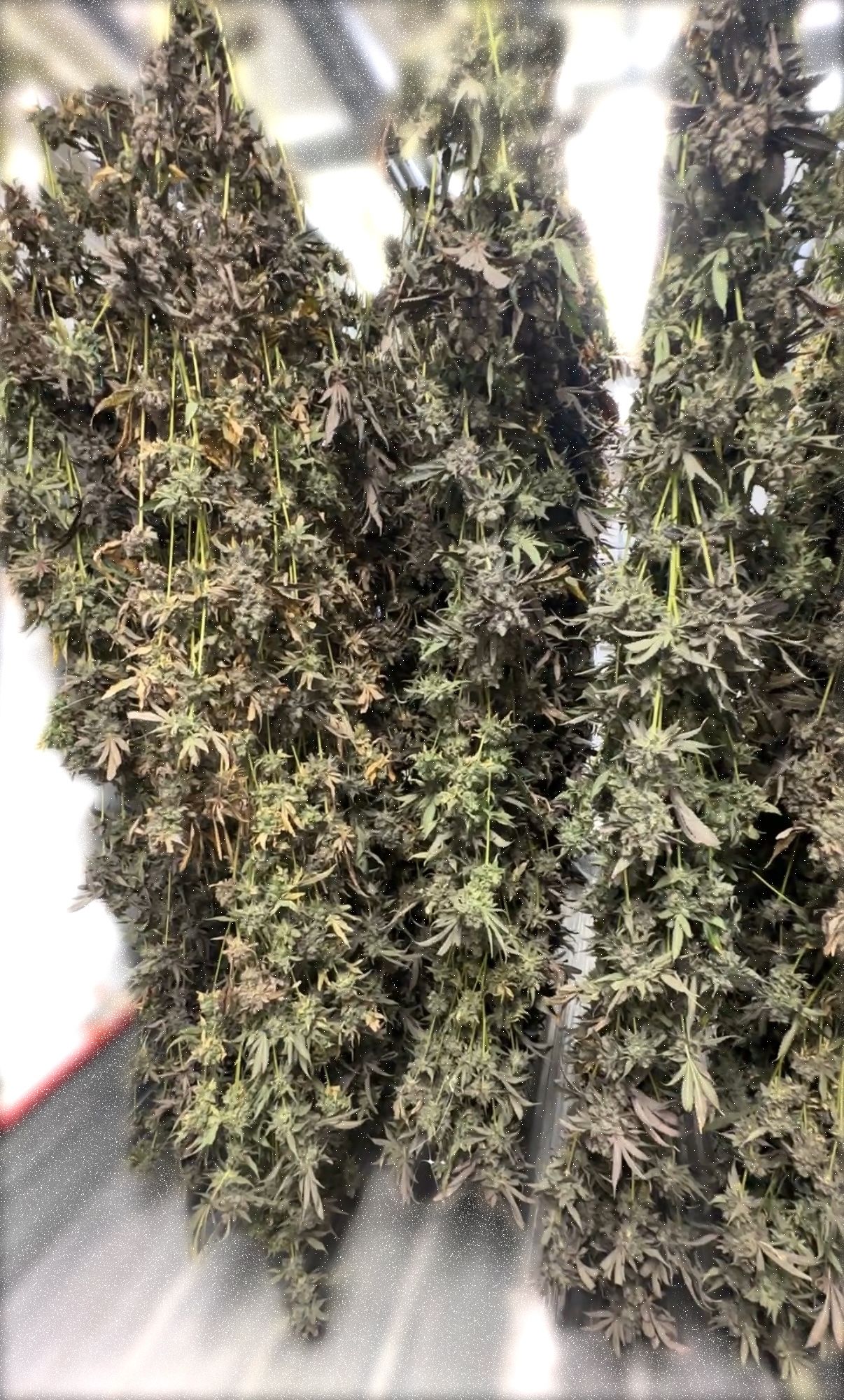
Drying takes 18 days in this method, whatever the bud density. Smaller, popcorn-style buds dry faster than large, dense colas, so check these separately so you're not jarring wet material alongside dry. The trap: dry leaves do not mean a dry branch. Depending on thickness, the inside of the stem often holds water, and bagged or jarred too early it turns mouldy or smells like wet hay. The stem snap test is your primary readiness indicator: when you bend a small branch and it snaps cleanly rather than folding, you're ready to jar. The outside of the buds should feel dry to the touch, but there should still be a slight give when gently squeezed. Better a little too dry than not dry enough, since a flower that is too dry can take moisture back in the jar, while a badly dried one cannot be saved. A controlled dry leads to a controlled cure, and a controlled cure is what separates mediocre results from truly exceptional flower.
The recommended method after the dry: dry trim, then a paper bag. Debud gently with scissors, without leaving too much stem under the flower. Once gathered, they take some moisture back, a handy trick is large brown paper bags for yard waste: the paper absorbs excess moisture, or gives some back to the buds if the room is too dry. Let the buds drop in as you cut them, without packing them down, and do not overfill. After a day or two, turn the bag over so the bottom ends up on top. Buds keep and keep refining in these bags for a very long time, even before the final trim. To store them longer, lower the humidity a little, always at a controlled temperature, and raise it again one or two days before working the flowers: too dry and they shatter, too wet is no better.
FAQ
What's the ideal humidity level for curing cannabis buds?
Maintain 62% RH during the active cure; this supports enzymatic activity and terpene development. Monitor with a digital hygrometer: above 65% RH, extend burping time or leave the jar open for up to an hour. Below 55% RH, the buds are drying too fast, so seal tightly and, if needed, add a two-way humidity pack.
How often should I burp my jars during curing?
For the first 2 weeks, open the jars once or twice a day for 10 to 15 minutes; after that, once a week. This releases excess moisture and refreshes oxygen. Once the buds settle at 58% RH for long-term storage, burping becomes much less frequent because conditions stay stable from one check to the next.
When should I switch from 62% to 58% humidity?
Move to 58% RH once you transition from active curing to long-term storage, typically after 1–2 weeks when enzymatic activity has slowed. The 62% level supports continued terpene development during the cure; 58% preserves the finished flower without promoting additional microbial activity during months of storage. Check the hygrometer each time you open a jar.
How do I know when a two-way humidity pack needs replacing?
Two-way humidity packs wear out at a pace that depends on how often you open your jars and how much moisture work they are doing. When a pack becomes stiff and crystalline, it is exhausted and should be replaced right away so the humidity in your stored buds stays where you want it.
19+ | Educational horticulture only.