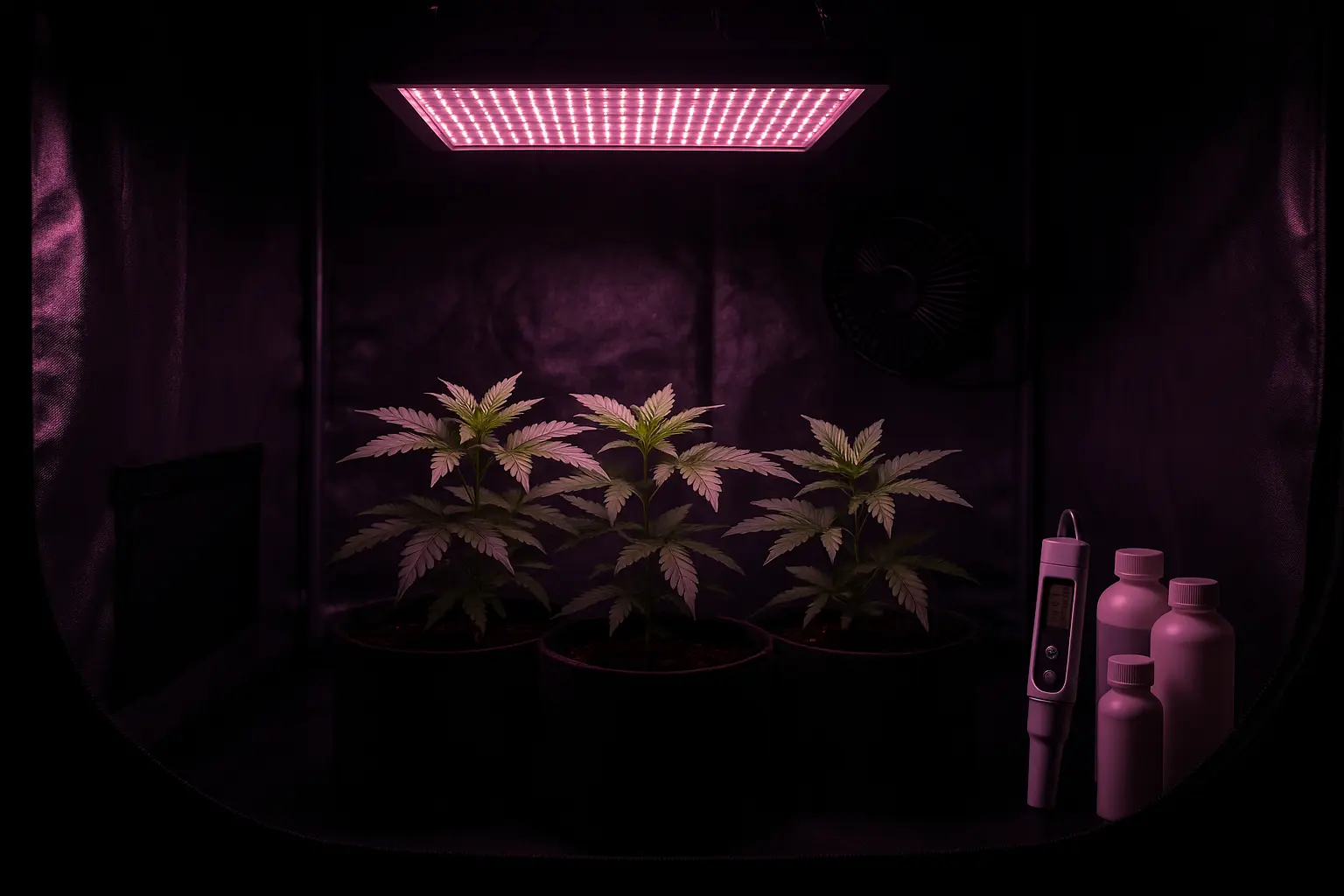
Master Your Indoor Grow
Indoor Growing Guides
Cannabis Grow Tent Setup: Complete Indoor Guide for Beginners
Step-by-step indoor cannabis grow tent setup — tent size, LED lights, ventilation, growing medium and beginner checklist for Canadian home growers.
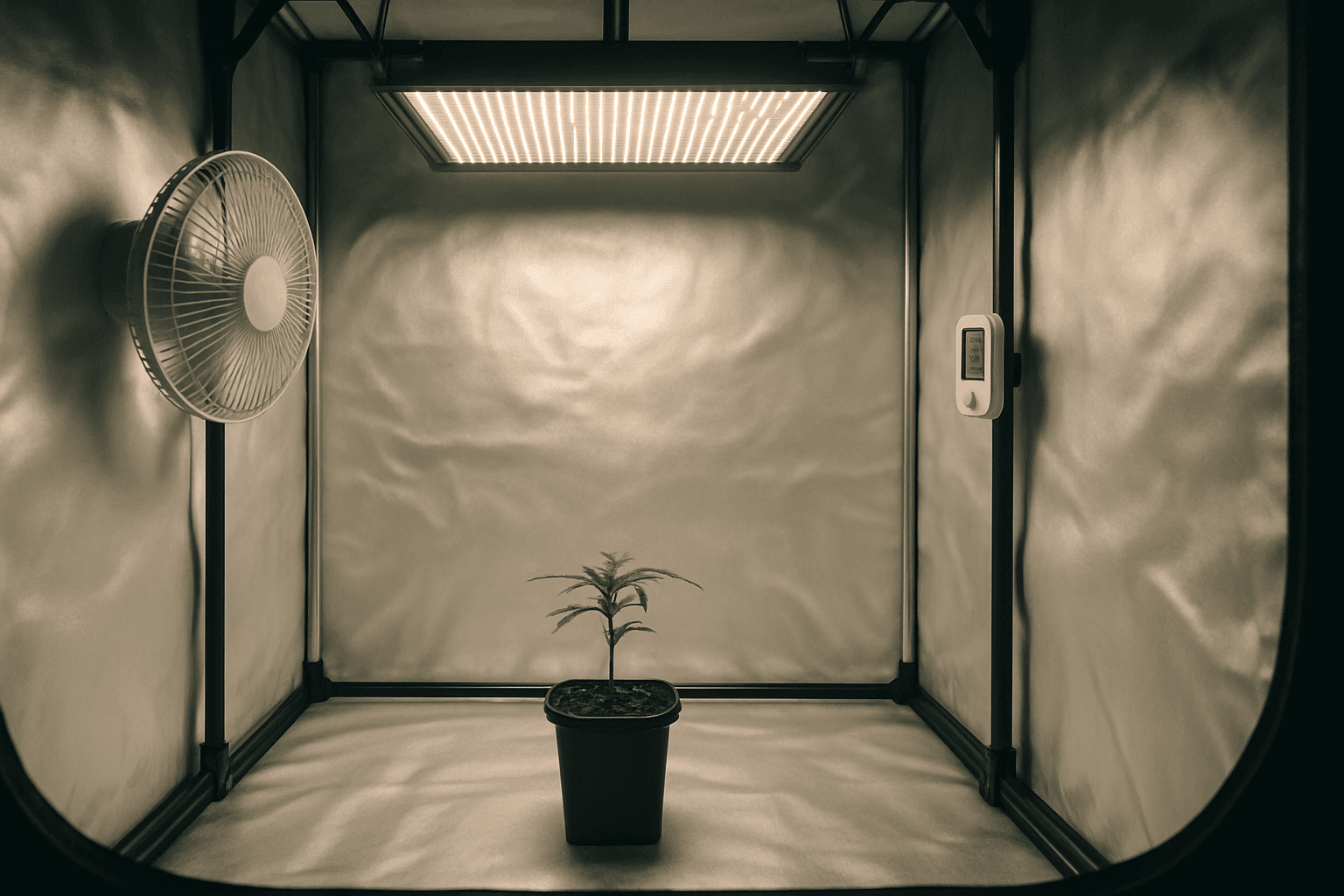
Selecting the right grow tent size is essential for indoor cannabis cultivation success. The 60×60cm tent accommodates 1–2 plants and yields 1–3 oz per harvest, making it ideal for beginners. The 80×80cm size supports 2–4 plants and offers enough space for training techniques like LST. For most Canadian growers, the 120×120cm tent is the sweet spot—it fits 4–6 plants, pairs with a 600–1000W LED system, and delivers the best balance of yield and manageability. Matching your cannabis grow tent setup to your space, ceiling height, and plant count prevents overcrowding and maximizes your harvest potential.
Matching your tent to your plant count and ceiling height is one of the most important decisions you'll make before your first seed goes in the ground. Get this right and everything downstream — lighting, ventilation, training, harvest logistics — becomes dramatically easier. Get it wrong and you'll be fighting your own environment for the entire grow.
60×60cm (2×2ft): The compact option, ideal for 1–2 plants. Perfect for beginners wanting to learn the fundamentals without a major investment. Expect 1–3 oz per harvest depending on strain and skill level. This size is also a popular choice for perpetual harvest setups where a second, larger tent handles flowering while the 60×60 runs a continuous clone or seedling cycle. The smaller footprint means your environmental controls — temperature, humidity, CO₂ — respond quickly to adjustments, which makes learning the feedback loops much faster.
80×80cm (2.5×2.5ft): A popular mid-range size supporting 2–4 plants comfortably. Gives you enough room to experiment with training techniques like LST or topping without feeling cramped. An 80×80 pairs well with a quality 200–400W LED panel and a 4-inch inline fan. Many growers find this to be the sweet spot for a first setup: large enough to see meaningful yields, small enough to stay manageable when something goes wrong. Running two plants in a manifold or mainline configuration inside an 80×80 is a proven strategy for maximizing canopy coverage without overcrowding.
120×120cm (4×4ft): The most popular tent size among serious home growers. Fits 4–6 plants and pairs perfectly with a 600–1000W LED system. This size offers the best balance of yield potential and manageability for most Canadians growing the legal limit. A properly dialled 4×4 with a high-performance LED and well-trained plants can produce 400–600g+ per cycle in experienced hands. It also gives you enough room to implement a ScrOG net effectively, spreading the canopy evenly across the entire footprint. For most growers who start on a 2×2 or 2.5×2.5, upgrading to a 4×4 is the natural next step.
Ceiling height is non-negotiable. A minimum of 2 metres clearance is recommended — ideally more. You need vertical space for the plant canopy, pot height, grow medium, plus hanging room for your light and carbon filter above. Measure your space carefully before purchasing. Running out of vertical room mid-flower is a problem with no easy fix. A common mistake is forgetting to account for the height of the pot itself — a 15L fabric pot sitting on a drip tray can easily eat 30–35cm before the plant even starts. Factor in at minimum: pot height (25–35cm), plant height at harvest (60–120cm depending on strain and training), and equipment clearance above (30–45cm for light and carbon filter). If you're working with a basement or low ceiling, autoflowering varieties tend to stay more compact and are a smart choice.
Tent quality matters more than most beginners expect. Look for tents with thick canvas (600D or higher), double-stitched corners, and metal pole connectors rather than plastic. Light leaks during the dark period can cause photoperiod plants to re-veg or hermaphrodite mid-flower. A quality tent pays for itself by protecting your genetics. Check all zippers, port flaps, and seams before your first light-on cycle.
A well-assembled grow tent isn't just equipment — it's a controlled environment where genetics can fully express themselves, harvest after harvest. Once your setup is dialled in, the biggest variable left is the quality of your seeds. Premium Prairie Seeds offers a carefully selected catalogue of indoor-optimized cultivars — from compact autoflowers suited to 60cm tents to high-yielding photoperiod strains bred to fill a 120×120cm canopy. Start with genetics you can trust, pair them with the setup outlined in this guide, and your first Canadian home harvest will be anything but average. Shop premium cannabis seeds
Your choice of growing medium shapes everything from watering frequency to nutrient uptake to how forgiving the system is when you make mistakes. There is no universally "best" medium — only the best medium for your experience level, available time, and goals.
Soil (Best for Beginners): A quality cannabis-specific or peat-based potting mix acts as a natural buffer for pH swings and nutrient imbalances. Organic amended soils like those from companies such as Fox Farm or BUILD-A-SOIL can be virtually water-only systems for much of the grow. Soil rewards patience and is the most forgiving medium available. When you overwater, soil recovers. When you overfeed slightly, the organic matter in the soil helps buffer the excess. A good rule of thumb: water only when the top 2–3cm of soil is dry and the pot feels noticeably lighter. Letting the roots chase moisture downward builds a stronger root system than keeping soil constantly saturated. For first-time growers, a quality amended soil paired with a simple pH meter is the most reliable path to a successful harvest.
Coco Coir (Intermediate): Coconut husk fibre behaves like a hydroponic medium in many ways — it's inert, drains fast, and allows roots to uptake nutrients rapidly. Coco growers typically see faster vegetative growth and heavier yields than soil growers, but you must pH your water to 5.8–6.0 and feed nutrients with every watering. Unlike soil, coco has no nutritional value on its own, so the plant is entirely dependent on what you feed it. This gives you precise control — a major advantage for experienced growers — but also means there is less margin for error. If you miss a watering or feed out of the correct pH range, the plant will show it within 24–48 hours. Coco also benefits enormously from high-frequency watering, ideally 2–4 times per day via a drip system, which keeps roots oxygenated and nutrient-available at all times. For a grower comfortable reading plant deficiencies and monitoring inputs, coco is one of the highest-performing mediums available indoors.
DWC Hydroponics (Advanced): Deep Water Culture suspends roots directly in oxygenated, nutrient-rich water. Growth rates are exceptional — plants in DWC can grow visibly faster than in any soil or coco system, particularly during vegetative stage. The mechanism is straightforward: roots have unlimited access to dissolved oxygen, water, and nutrients simultaneously, removing the rate-limiting steps present in other mediums. However, pH and nutrient concentration (measured as EC or PPM) must be monitored daily, and a pump failure or power outage can devastate a root zone within hours. Root rot is also a real threat in warm water, requiring reservoir temps to stay below 20°C and often requiring beneficial bacteria additives. Not recommended as a first-grow medium — learn to read your plant and manage pH in soil or coco first, then consider transitioning to DWC once you have a solid baseline of environmental awareness.
Pot Sizing: Use 11–15L (3–5 gallon) pots for photoperiod plants and 7–11L (2–3 gallon) for autoflowers. Undersized pots restrict root development and cause the plant to become root-bound before harvest — a condition that stunts growth and significantly reduces yields. Fabric pots are strongly recommended over plastic: they air-prune the roots naturally, preventing the circling root structure that develops in solid containers, and dramatically improve oxygenation throughout the root zone. The trade-off is that fabric pots dry out faster, which means more frequent watering — generally a positive for root health, though it requires closer attention to soil moisture during the first few weeks of growth.
FAQ
How do I choose the right grow tent size for a beginner?
Start with either a 60×60cm (2×2ft) for a single plant or an 80×80cm (2.5×2.5ft) for 2–4 plants. The 60×60 is ideal if you want to master the fundamentals with minimal investment, while the 80×80 gives you more room to experiment with training techniques like LST. Both sizes make environmental controls easier to manage as a beginner since temperature and humidity adjustments take effect quickly in a smaller space.
What lighting and ventilation do I need for a grow tent?
An 80×80 tent typically pairs well with a 200–400W LED panel and a 4-inch inline fan. For a larger 120×120cm setup, you'll want a 600–1000W LED system with more robust ventilation to manage heat and CO₂ exchange. The specific wattage depends on your plants and tent size, but investing in quality LED and a proper inline fan prevents most environmental problems beginners face.
Can I use my grow tent for both seedlings and flowering at the same time?
Yes, many growers use multiple tents in a perpetual harvest setup—a smaller tent can run a continuous seedling or clone cycle while a larger tent handles flowering plants. This approach maximizes your growing schedule, though it requires managing two separate environments with independent controls. Start with a single tent and grow cycle before attempting this strategy.
Why is matching tent size to my space so important?
Matching your tent to your plant count and ceiling height determines how well you can control lighting, ventilation, and environmental conditions downstream. A properly sized tent makes environmental feedback loops easier to understand and adjust, which is critical for beginners learning to dial in their setup. Getting this wrong means fighting your own environment for the entire grow instead of working with it.
What's a realistic yield expectation from a grow tent?
A 60×60 tent typically produces 1–3 oz per harvest, an 80×80 produces more with proper training, and a well-managed 120×120 can yield 400–600g+ per cycle in experienced hands. Your actual yield depends heavily on LED quality, environmental control, plant training, and your skill level. Starting with modest expectations for your first grow helps you focus on learning rather than chasing maximum production.
19+ | Educational horticulture only.