Master Your Indoor Grow
Indoor Growing Guides
Cannabis Training Techniques: LST, Topping, SCROG & More
Master cannabis training — low stress training (LST), topping, FIM, SCROG screen of green. Maximize yield and canopy with these proven techniques.
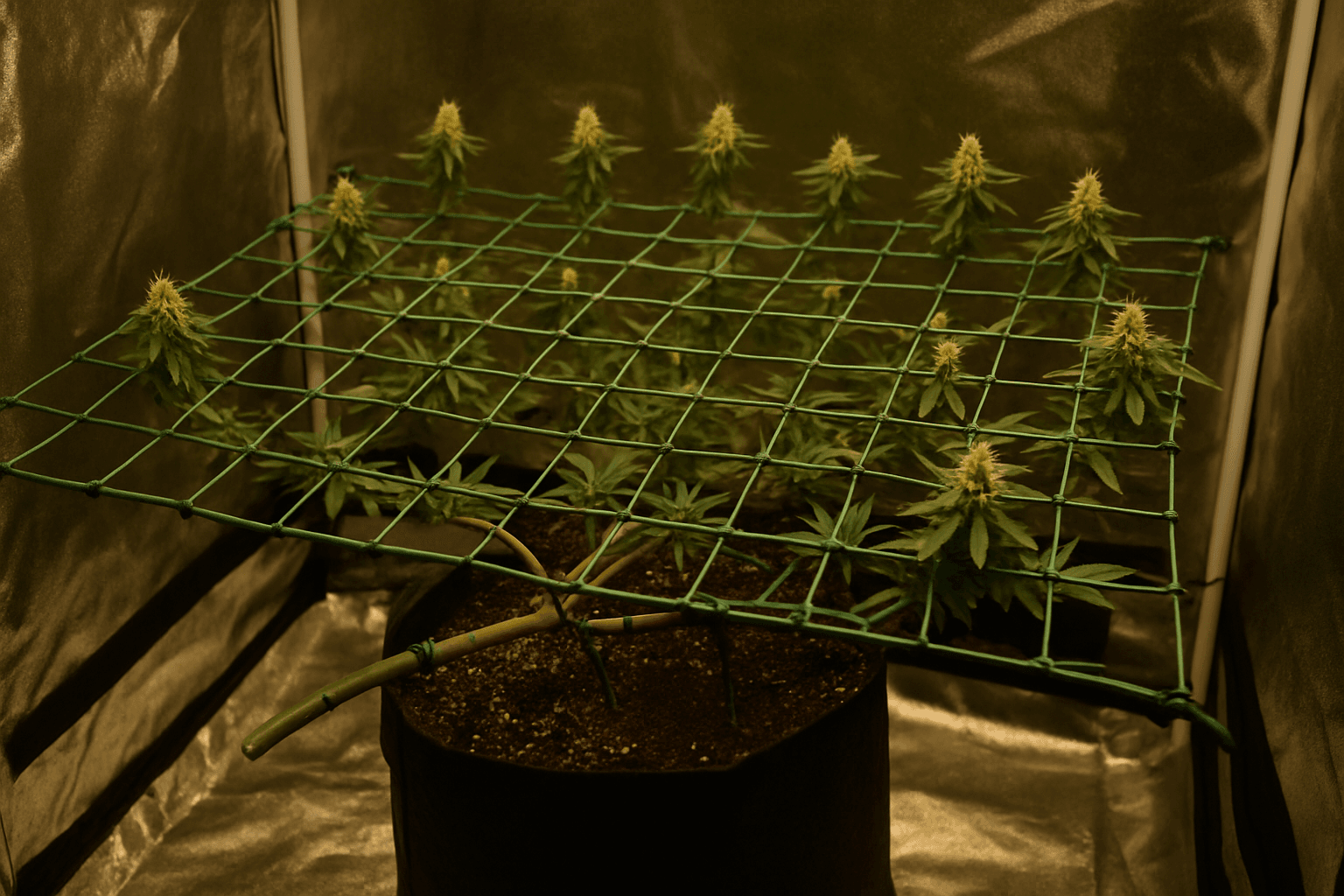
Master cannabis training techniques (LST, topping, FIM, SCROG) to maximize yield by directing more light to bud sites. LST is the ideal starting point for beginners: it's low risk, improves harvests immediately, and works by bending growth without cutting. High-stress techniques like topping remove tissue to trigger extra branching, while SCROG and lollipopping optimize canopy density. Layer these methods progressively as you develop skill: start with LST, add topping and SCROG to compound results, and build a complete high-yield training strategy.
If you're new to training, start with LST — it's low risk, highly effective, and will immediately improve your harvests. Once you're comfortable reading your plant's responses, layer in topping, ScrOG, and lollipopping to build a complete, high-yield training approach. Every technique here compounds on the last.
Plant training is one of the highest-impact skills a home grower can develop. By manipulating how your cannabis plant grows, you dramatically increase the amount of usable light each bud site receives — and more light means more yield. Training techniques fall into two broad categories: low-stress training (LST), which bends and repositions growth without cutting, and high-stress training (HST), which involves removing or damaging plant tissue to trigger a growth response. Both approaches work, and the best results often come from combining them strategically across your grow. Understanding how and when to apply each technique — and in what order — is what separates average yields from truly exceptional ones. A plant that has been trained well from early veg through mid-flower will develop a dense, even canopy where every cola receives comparable light intensity, rather than the typical Christmas-tree silhouette where a single dominant top shades everything beneath it.
The underlying biology is worth understanding. Cannabis exhibits a growth pattern called apical dominance: the plant naturally channels growth hormones, particularly auxins, toward the highest point — the main central cola. This causes that tip to grow faster and larger than everything else, while lower lateral branches remain short, weak, and light-starved. Every training technique described here works by disrupting or redirecting that hormonal dominance, forcing the plant to distribute energy more evenly across multiple bud sites. Done correctly, you transform a single-cola plant into a multi-site producer with a canopy that makes full use of your available light footprint.
Lollipopping is the practice of removing all growth from the lower one-third of the plant — small underdeveloped shoots, popcorn bud sites, and fan leaves that sit deep in the canopy where meaningful light never reaches. The logic is straightforward: these sites will never produce quality buds, but they still consume energy, water, and nutrients. By removing them, you redirect all of the plant's resources upward to the main canopy bud sites where they'll make a real difference.
Many growers underestimate how much the lower canopy costs the plant. A dozen small popcorn sites competing for photosynthates may collectively pull as much energy as two or three legitimate top-tier colas. Removing them isn't just about tidiness — it's a deliberate resource allocation decision. The bud sites that remain will swell noticeably in response, and you'll also improve airflow dramatically at the base of the plant, which is where humidity stagnates and issues like bud rot and powdery mildew most often get their foothold.
Perform a major lollipop at the transition to flowering — clean out everything below your screen or below the lowest main bud sites before the stretch begins. A lighter tidy-up at week three of flower removes any remaining stragglers that pushed through during the stretch. Use clean scissors, work efficiently, and avoid removing too much healthy growth at once. If the plant looks visibly stressed after a heavy defoliation session — drooping, slightly curled leaves — give it 24 to 48 hours to recover before any further manipulation. For a deeper look at selective leaf removal, see our cannabis defoliation guide for timing and technique. Ready to put these training methods into practice? Shop premium cannabis seeds
Low-stress training (LST) is the ideal starting point for beginner growers because it carries minimal risk — no cuts, no recovery time, and mistakes are easily corrected. The principle is simple: bend stems away from the centre of the plant and anchor them down so the plant grows outward rather than upward, exposing lower bud sites to direct light.
The genius of LST is that it works with the plant's own biology rather than against it. When you bend a stem horizontal, the tip — which the plant still recognizes as its highest point — curves back upward within 12 to 24 hours. Every node along that bent stem also begins reaching upward, and each of those becomes a potential new top. A plant that began veg with one dominant cola can finish with six, eight, or more similarly sized colas after consistent LST, all sitting at roughly the same height in the canopy and receiving equivalent light.
What you need: Soft garden wire, coated tie wire, or purpose-made LST clips that hook over the rim of your pot. Avoid anything that can cut into stems — no zip ties or rough wire. Fabric pots are particularly convenient for LST because you can thread wire through the sides at any point rather than being restricted to the pot rim. Some growers also use bamboo skewers pushed into the soil as anchor points, which gives more flexibility for training direction.
When to start: Begin LST early in vegetative growth, once the plant has developed four to six nodes and the stems are still flexible. Starting early means you're shaping the plant while tissue is pliable, and the plant has maximum time to respond before you flip to flower. Stems that have begun to lignify — that is, become woody and rigid — are much harder to bend without snapping. If you encounter a stem that resists, don't force it; instead, gradually introduce bend over two to three days, moving the anchor point a little further each time.
Step-by-step:
- Identify the main stem and the direction you want to train it — typically away from the pot's centre.
- Gently and slowly bend the main stem to a roughly 90-degree horizontal angle. Work gradually; if you feel significant resistance, stop and try again the next day.
- Secure the stem low to the soil using your wire or clip anchored to the pot rim.
- Over the following days, the plant will turn its new growth upward toward the light — reposition your anchor points regularly to maintain the horizontal spread as new growth extends. Plan to check and adjust every two to three days during active veg.
- As lateral branches reach upward, bend and anchor those as well, spreading them outward in all directions to fill your available canopy space evenly.
Topping is the most common high-stress training technique and one of the most effective tools for multiplying your main colas. It involves cutting off the main growing tip of the plant — the apical meristem — which removes the source of apical dominance and forces the two nodes directly below the cut to develop into new main colas. Top once, and you go from one top to two. Top each of those two new tops a few weeks later, and you have four. Some growers push to eight or even sixteen mains, though the law of diminishing returns kicks in past a certain point depending on your canopy size and strain.
Timing matters significantly for topping. Most growers top during mid-to-late veg, once the plant has developed at least five to six nodes. Topping too early — before the plant has sufficient leaf mass — can slow overall development considerably. Topping too late, especially after flipping to flower, stresses the plant during a critical hormonal transition and can delay bud development by one to two weeks. The sweet spot is a healthy, vigorous plant in active vegetative growth, ideally under 18/6 lighting.
Use a clean, sharp blade or scissors sterilized with isopropyl alcohol. Make a clean cut just above the node you want to become the new pair of tops. Expect some mild wilting or drooping for 24 to 48 hours after the cut — this is normal. The plant redirects its energy quickly, and within three to five days the two new tops will be visibly pushing upward. You can combine topping with LST by bending those two new tops outward as soon as they're long enough to anchor, which sets you up for an incredibly wide, productive canopy by flower time.
Screen of Green (ScrOG) takes the principles of LST and topping and formalizes them using a horizontal net or screen — typically installed 20 to 40 cm above the pot — that the plant grows into and through. Rather than anchoring growth to the pot rim, you weave branches through the screen openings, keeping all growth below the net during veg and directing new shoots to empty squares. By the time you flip to flower, the screen is filled with an even, dense canopy of similarly positioned bud sites.
ScrOG is particularly well-suited to growers working with limited vertical space, since you can keep the canopy flat and predictable. It's also excellent for maximizing the coverage area of a single plant, which is useful in jurisdictions — including Quebec — where plant counts may be regulated. A single well-trained ScrOG plant filling a 90×90 cm screen can rival the output of multiple untrained plants in the same footprint. The tradeoff is time: ScrOG requires a longer veg period to fully fill the screen, and the setup demands more hands-on attention during training than a simple LST approach. For most photoperiod strains, plan for six to eight weeks of vegetative growth minimum before flipping if you want a fully populated screen.
Combining techniques is where experienced growers unlock their highest yields. A common and proven sequence: top the plant once or twice in early veg to multiply main colas, apply LST to spread those colas outward, weave everything into a ScrOG screen through mid-to-late veg, then perform a full lollipop clean-out at the flip to flower. The result is a plant with maximum bud site count, optimal light penetration, and no wasted energy on unproductive lower growth. It requires planning and attention, but the discipline pays off in the dry weight at harvest.
FAQ
When should I start training my cannabis plant?
You can begin LST as early as the seedling stage, but most growers wait until the plant has 4-6 true leaves and is well-established in veg. The earlier you start, the more time you have to reshape growth and develop an even canopy before flowering begins.
What's the difference between LST and high-stress training like topping?
LST gently bends and ties down branches without cutting, keeping stress minimal and the plant intact. High-stress methods like topping remove tissue, triggering a recovery response that creates multiple main colas. LST is safer for beginners; HST requires more experience but can accelerate multi-cola development.
Can I combine LST, topping, and ScrOG in the same grow?
Absolutely—the best results come from layering techniques strategically across different growth stages. You might start with LST in early veg to build a wide base, then top the main stem, then apply ScrOG netting in late veg to even out your canopy. Each technique works on different growth patterns.
How much can good training actually increase my yield?
A well-trained plant can yield 20-50% more than an untrained one by maximizing light to every bud site instead of letting one dominant top shade the rest. The exact increase depends on your setup and skill level, but the difference is consistently dramatic.
Will training stress my plants and reduce potency?
LST causes minimal stress and actively benefits plant development. High-stress techniques like topping do trigger stress, but plants recover quickly during veg and the resulting multi-cola structure typically produces stronger overall yields and comparable potency to untrained plants.
19+ | Educational horticulture only.