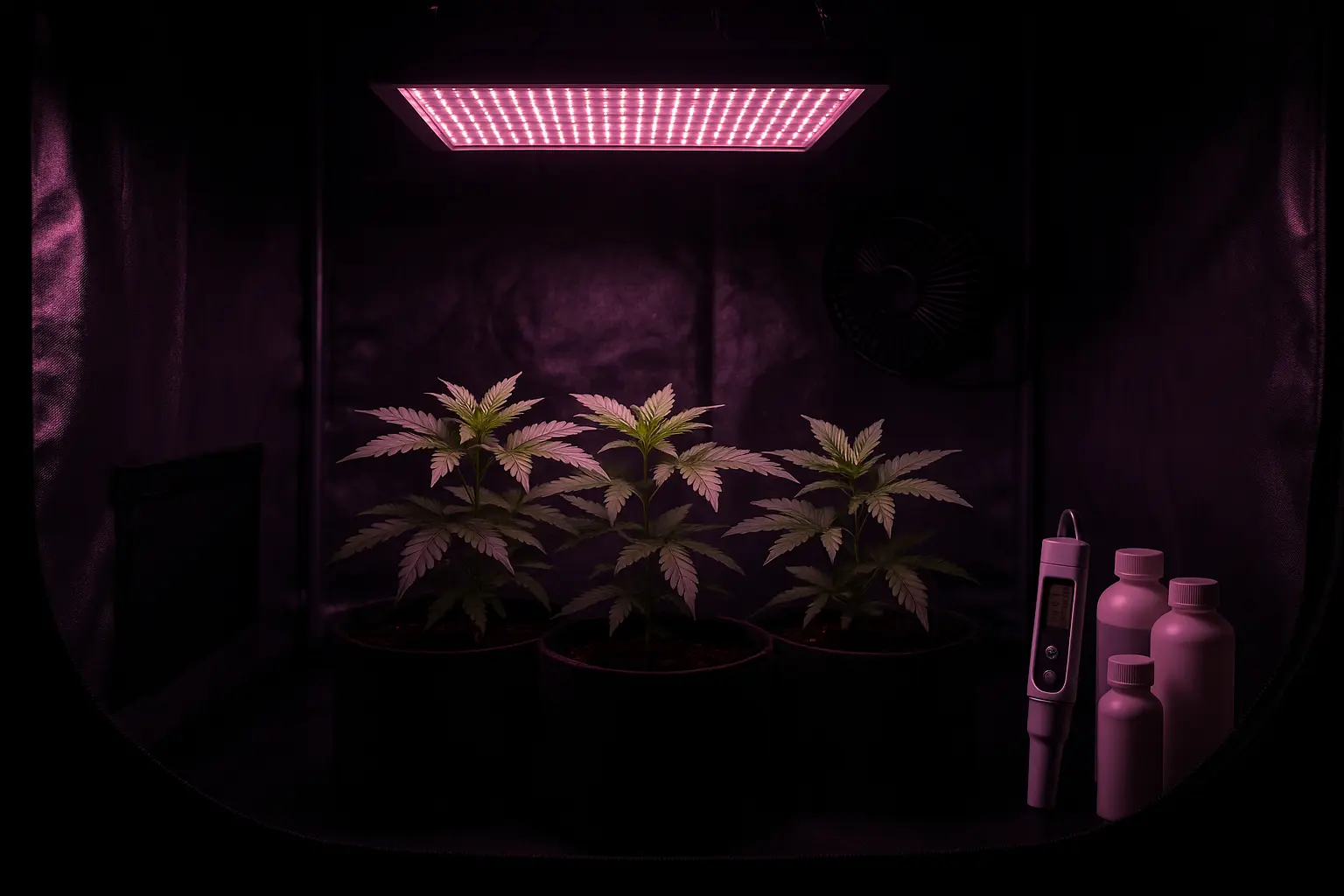
Master Your Indoor Grow
Indoor Growing Guides
Cannabis Temperature, Humidity & VPD: The Indoor Environment Guide
Optimize your cannabis grow environment — ideal temperatures, humidity levels for each stage, VPD explained, CO2 basics and environmental monitoring tools.
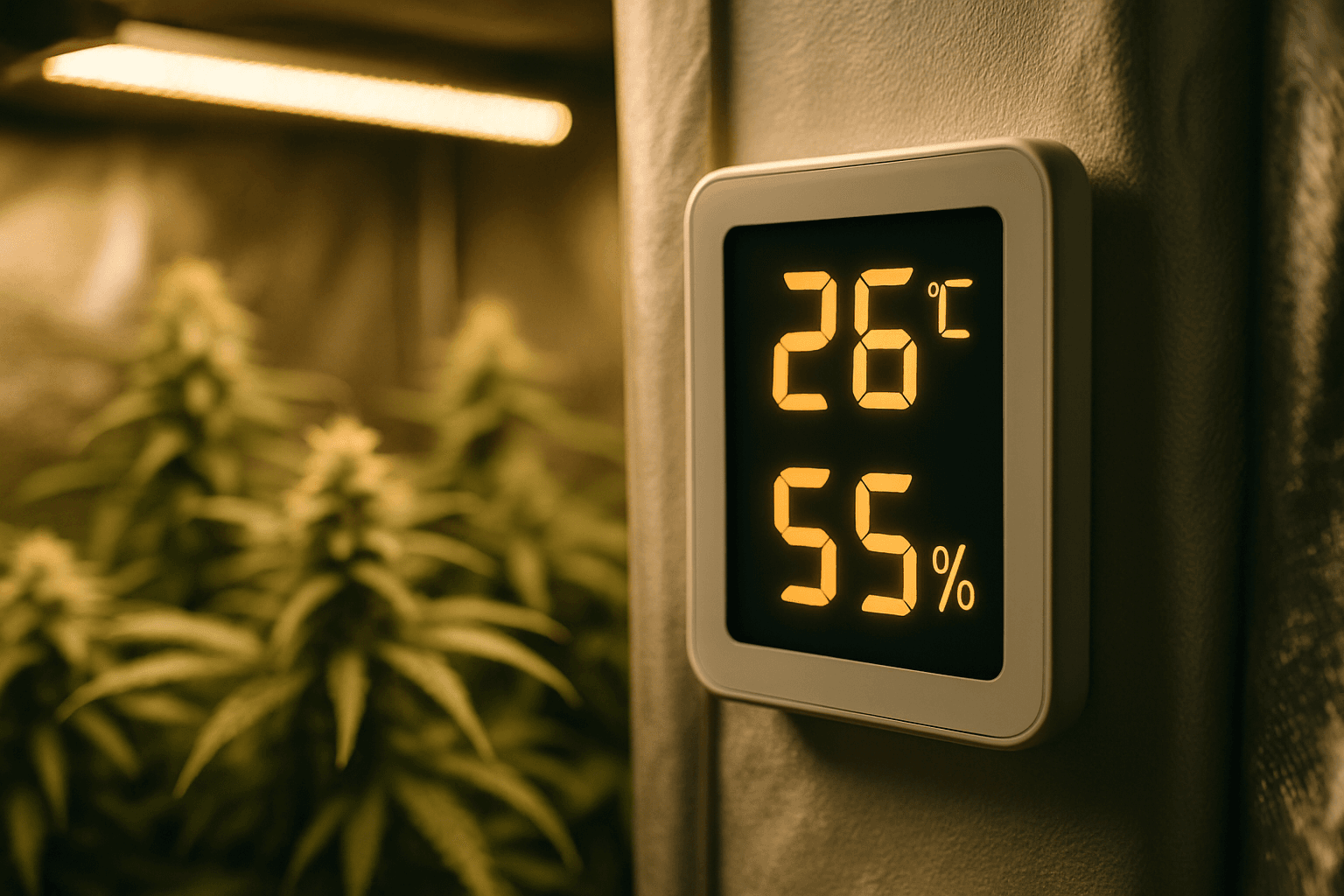
Optimizing temperature, humidity, and VPD (vapor pressure deficit) is essential for successful indoor cannabis cultivation. While ambient outdoor CO₂ at 400 ppm supports healthy plants, sealed grows can boost yields by supplementing to 1,200–1,500 ppm—but only when temperature, light intensity, and VPD are already optimized. CO₂ enrichment amplifies a good environment rather than rescuing poor conditions. For smaller setups, affordable CO₂ bags offer modest ppm increases without expensive tanks, making them practical for beginners seeking environmental control without major equipment investment.
Plants consume CO₂ as the raw carbon input for photosynthesis. Ambient outdoor air sits at approximately 400 ppm — enough to support healthy growth in a well-ventilated space. In a sealed, light-deprivation room where you have full control of air exchange, supplementing to 1,200–1,500 ppm can increase photosynthetic rate and yields noticeably, provided your temperature, VPD, and light intensity are already optimized. CO₂ enrichment only pays dividends when every other variable is dialled in — it amplifies a good environment, it doesn't rescue a poor one.
The relationship between CO₂ and temperature is worth understanding: as CO₂ ppm rises, the optimal temperature ceiling for photosynthesis also rises. At ambient 400 ppm, keeping your canopy around 24–26°C is ideal. At 1,200–1,500 ppm enrichment, plants can efficiently process light at 27–30°C without heat stress slowing them down — which is why CO₂ enrichment and higher-wattage lighting often go hand in hand in commercial cultivation. If you're running a 1,000W HPS or a high-powered LED at full throttle, CO₂ supplementation helps your canopy keep pace with available light energy rather than saturating and wasting it.
For smaller tents and beginner setups, CO₂ bags (such as ExHale bags) release CO₂ through mycelial metabolism and can bump ppm modestly without tanks or controllers. They won't hit 1,500 ppm, but they offer a low-cost, zero-maintenance nudge above ambient. Place bags above the canopy so CO₂ — heavier than air — drifts downward through the leaf zone. Bottled CO₂ with a regulator and timer is the step up for serious sealed rooms; pair it with a digital CO₂ controller that reads ppm in real time and opens the solenoid only when levels drop below your target. Running CO₂ on a timer tied to your lights-on period ensures you're not burning gas during dark hours when photosynthesis stops entirely. If your space uses active exhaust ventilation, enriched CO₂ will simply be exhausted before plants can use it — invest in sealing the room first.
Environment is the foundation everything else is built on. Before you spend money on premium genetics or advanced nutrients, dial in your temperature, humidity, and VPD across every stage. A genetically average seed in a perfect environment will outperform elite genetics in a neglected room every single time. Get the climate right first — then let great genetics do what they were bred to do. Once your environment is dialled in, Shop premium cannabis seeds to find genetics matched to your setup.
You don't need a commercial HVAC system to grow exceptional cannabis, but a few key tools make consistent environmental control achievable on any budget.
Inkbird IBS-TH2 or Govee Bluetooth sensors log temperature and humidity to your phone 24/7 — place one at canopy level, not on the wall. Wall-mounted sensors read the ambient air of the room, not the microclimate your plants actually live in. Canopy-level readings are what matter for dialling in VPD accurately. Inkbird IHC-200 or AC Infinity's UIS controllers automate exhaust fan speed based on temperature and humidity thresholds, removing the guesswork. Instead of manually adjusting fan speed when the room heats up on a summer afternoon, the controller ramps up airflow automatically and backs off at night when temps drop — your environment stays stable around the clock without babysitting.
Oscillating fans are essential: one at canopy level, one below, ensuring no dead air pockets where mould can establish. A gentle, constant breeze across leaves also strengthens stem tissue — the plant responds to mechanical stress by building thicker cell walls, which improves its structural ability to support heavy flower development later. For Quebec summers where ambient temperatures can drive tent temps past 30°C, a portable air conditioner (8,000–12,000 BTU for a 4×4 to 5×5 tent) becomes necessary rather than optional. Size it for your space: undersized units cycle on and off constantly without ever achieving the target temperature, driving up electricity costs and shortening the compressor's lifespan. A dehumidifier rated for the room volume closes the loop on humidity control, especially critical during late flower when dense buds create pockets of stagnant, humid air ripe for botrytis. Run the dehumidifier exhaust toward your intake so the warm, dry output air doesn't counteract your AC — small adjustments in airflow routing make a measurable difference in how hard your equipment has to work.
Relative humidity (RH) governs transpiration rate, disease pressure, and how hard your plants have to work to pull water through their root systems. Each growth stage has a distinct target range.
Seedlings (65–70% RH)
High humidity protects seedlings that have minimal root systems and rely partly on foliar moisture absorption. Without an established root network, a seedling's ability to stay hydrated depends significantly on the water available through its leaves and stem — dry air at this stage causes visible wilting and slows early development considerably. A propagation dome makes hitting this range effortless in dry Quebec winters when forced-air heating can drop indoor RH below 30%. Lift the dome briefly each day to allow fresh air exchange and prevent stagnant CO₂-depleted air from building up inside. Within 7–10 days of germination, as the first true leaves develop and tap roots begin reaching outward, you can start introducing lower humidity by cracking the dome open progressively over several days rather than removing it all at once.
Vegetative Stage (50–70% RH)
As roots establish, you can drop RH and let the plant work harder to pull moisture upward — this builds stronger vascular tissue and encourages roots to actively explore the medium in search of water rather than passively absorbing from foliar sources. Keep it above 50% to avoid excessive transpiration stress, but don't be afraid to push toward the lower end of this range as plants mature and canopy density increases. A denser canopy traps humidity between leaves, so what your sensor reads at canopy edge may differ meaningfully from conditions inside a thick interior. Defoliation during veg — selectively removing large fan leaves that block airflow — helps keep internal canopy humidity from creeping up. During the final week of vegetative growth before transitioning to 12/12, begin stepping RH down toward 50% so the shift into flower doesn't coincide with a sudden humidity drop that stresses the plant during an already-demanding hormonal transition.
Flowering Stage (40–50% RH)
As bud sites develop and flowers swell in weeks 4 through 7, dropping RH into the 40–50% range becomes a genuine disease-prevention measure, not just a preference. Botrytis (grey mould) and powdery mildew are both humidity-opportunistic pathogens — they establish most readily in stagnant, humid microclimates inside dense flower clusters. Running RH at 45% with strong oscillating fan coverage makes the environment structurally hostile to both. Check your dehumidifier's capacity against your tent volume: a 30-pint unit that handles a 4×4 in spring may struggle in mid-summer when ambient RH is already elevated. During peak Quebec summer humidity, many growers run both an AC and a dehumidifier simultaneously, accepting the redundancy in energy costs as cheap insurance against a late-flower mould event that can destroy weeks of work in 48 hours.
Late Flower / Final Two Weeks (35–45% RH)
The final push to harvest is when trichome density peaks and resin glands are at their most vulnerable to ambient moisture. Dropping RH to 35–45% in the final two weeks serves a dual purpose: it inhibits late-stage mould and it pushes the plant into a mild osmotic stress that some growers associate with increased terpene and resin expression. Keep temperatures in the 18–24°C range during lights-on and consider dropping to 17–20°C during the dark period — the temperature differential signals to the plant that autumn is approaching, which can amplify colour expression in anthocyanin-rich cultivars and nudge resin production upward as a natural stress response. Maintain airflow aggressively; this is not the stage to reduce fan speed in an attempt to reduce wind stress on heavy colas.
FAQ
What CO₂ level should I aim for in my grow room?
Ambient outdoor air contains about 400 ppm CO₂, which is sufficient for standard growth. In a sealed room with controlled air exchange, increasing to 1,200–1,500 ppm can noticeably boost photosynthetic rate and yields, but only if your temperature, VPD, and lighting are already optimized. CO₂ enrichment amplifies a good environment rather than fixing a poor one.
Is CO₂ supplementation worth it for a beginner with a small tent?
For beginner setups, CO₂ bags like ExHale bags are a low-cost, maintenance-free option that can modestly increase CO₂ levels without requiring tanks or controllers. They won't reach 1,500 ppm, but they provide a practical boost above ambient if you place them above your canopy so CO₂ drifts down through the leaf zone. Move to bottled CO₂ with a regulator if you're ready to scale your sealed room setup.
What temperature range is best when I'm running high CO₂ levels?
At ambient 400 ppm CO₂, keeping your canopy around 24–26°C is ideal. When you supplement to 1,200–1,500 ppm, plants can efficiently process more light and handle higher temperatures (27–30°C) without heat stress. This is why CO₂ enrichment pairs well with high-powered lighting—your plants can fully utilize the extra light energy.
Should I run CO₂ during the dark period?
No—CO₂ enrichment is only beneficial during lights-on hours when plants are actively photosynthesizing. Running CO₂ on a timer tied to your light schedule ensures you're not wasting gas during dark hours when photosynthesis stops entirely. This approach also reduces costs and improves efficiency in sealed-room setups.
19+ | Educational horticulture only.