Master Your Indoor Grow
Indoor Growing Guides
Grand Daddy Purple Cannabis: Complete Grow Guide for Canadian Cultivators
Complete Grand Daddy Purple cannabis grow guide for Canadian cultivators. Genetics, indoor/outdoor cycle, the purple-color trigger, nutrients, and pitfalls — Quebec, Ontario, BC and beyond.
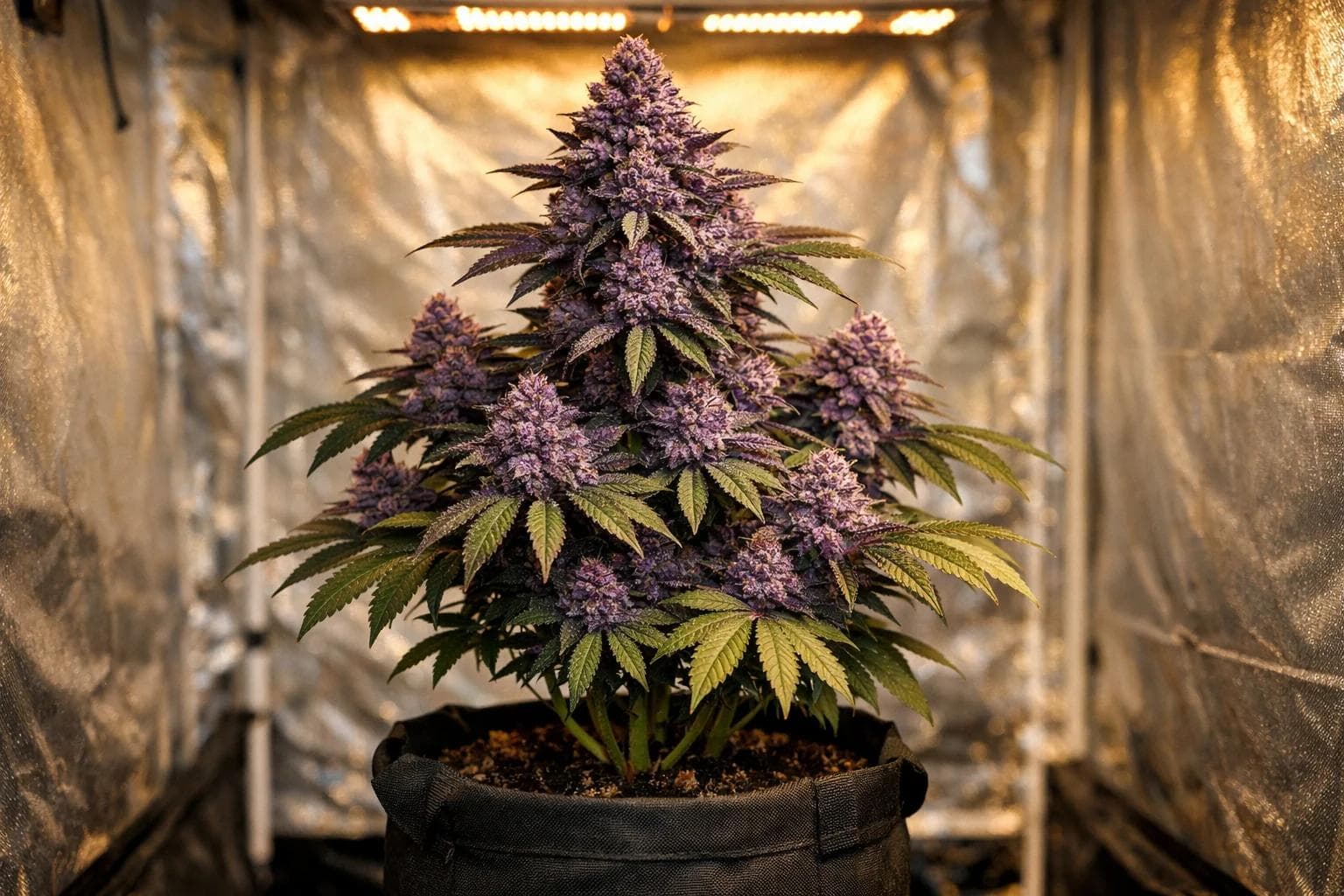
Grand Daddy Purple is a deep-sleep indica from Ken Estes, crossing Purple Urkle and Big Bud for grape-and-berry terps and dense purple flower. Indoors expect 8–9 weeks flowering, 400–500 g/m². Outdoors in Canada, harvest late September to mid-October. Cool finishing nights trigger the signature purple.
Grand Daddy Purple is a deep-sleep indica from Ken Estes, crossing Purple Urkle and Big Bud for grape-and-berry terps and dense purple flower. Indoors expect 8–9 weeks flowering, 400–500 g/m². Outdoors in Canada, harvest late September to mid-October. Cool finishing nights trigger the signature purple.
What makes Grand Daddy Purple a legendary indica?
Grand Daddy Purple earned its reputation through three things at once: a knockout violet color, grape-soda terpene profile, and a sedative high that broke through in California medical dispensaries in 2003. For Canadian growers chasing dense indica nugs with real bag appeal, GDP remains the benchmark.
Ken Estes stabilized GDP by crossing Purple Urkle, valued for its grape and berry profile, with Big Bud, valued for raw flower mass. The resulting hybrid is roughly 70% indica, 30% sativa, and the genetics carry one trait that few strains express as cleanly: high anthocyanin concentration in the flower bracts and sugar leaves . That pigment is what turns GDP from green to deep aubergine in the back half of flowering, and it's why growers obsess over finishing temperatures.
THC sits in the 17–23% range in most pheno expressions, with myrcene as the dominant terpene followed by caryophyllene and pinene. That myrcene-forward profile is what gives GDP its couch-lock — not pure THC percentage. New growers often chase the highest-test cultivars on the menu and miss that terpene structure does more to shape the experience than a single cannabinoid number.
Physically, GDP grows short and bushy. Internodes are tight, side branches stack close, and the main cola fattens into a club-shaped flower by week 6 of bloom. It's a strain that rewards growers who like a controlled canopy and punishes those who let it stretch unchecked. For a Canadian indoor tent in the 4x4 to 5x5 ft range, GDP fits four to six plants comfortably without crowding. Outdoors in Quebec, Ontario, or southern BC, expect a 1.2–1.6 m finished height with regular topping.
The strain also pairs well with low-stress training. Because the structure is naturally short, growers who plan to run a screen of green (ScrOG) get an even canopy faster than they would with a taller sativa-dominant hybrid. That structural cooperation is part of why GDP has stayed in rotation for over twenty years — it forgives a lot.
How do you choose between standard GDP and Fast Version for Canada?
Standard GDP runs 8–9 weeks of flower indoors and finishes outdoors around October 5–15 in most of southern Canada. Fast Version GDP, a recent breeder evolution, crosses GDP with an autoflower line to pull flowering down to 7 weeks and shaves about 10–14 days off outdoor harvest. The decision comes down to your climate window and patience.
If you're growing in Vancouver, Toronto, or Montreal with a clean greenhouse or indoor tent, standard GDP is the better choice. You get the full purple expression, the densest flowers, and the most complete terpene development. The extra two weeks of flower matter — anthocyanin pigments concentrate in the final stretch, and rushing that window costs you both color and aroma intensity.
Fast Version makes sense in two scenarios. First, if you're in a shorter-season region — northern Ontario, the Prairies, Atlantic Canada — where October frost arrives before standard GDP finishes outdoors. Second, if you want a faster indoor turnover and you're running back-to-back cycles in a small tent. The trade-off is a slightly less intense purple expression and roughly 10–15% less yield per plant. The high and terpene profile remain close to the parent.
Photoperiod versus autoflower also enters this decision. True GDP autoflowers exist on the market, but most lose noticeable flower density and purple saturation compared to photoperiod GDP. If autoflower is your only option due to space or light cycle constraints, look for crosses like Purple Kush Auto, which preserve the indica structure better than direct GDP auto conversions.
For a first-time GDP grower in Canada, the safest bet is feminized photoperiod seeds. You eliminate male plants and you keep the long flower window that GDP needs to express properly. Fast Version is the second-best choice for short-season outdoor.
Feminized Seeds
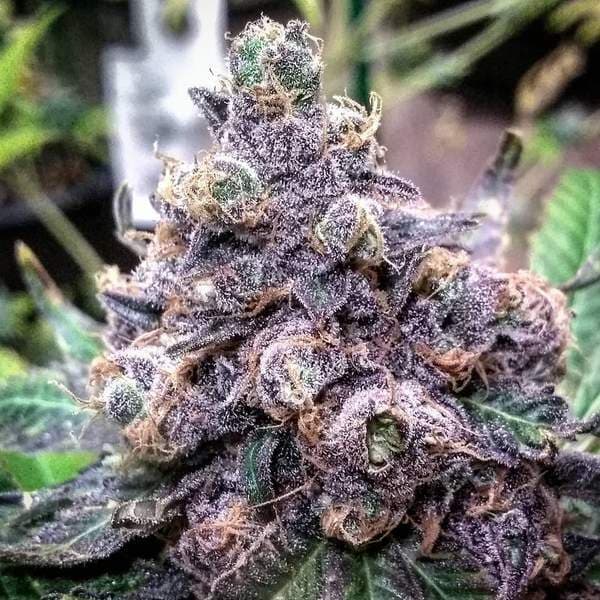
Grand Daddy Purple (Fast) Feminized
One more variable: pheno hunting. If you germinate a 5-pack of standard GDP feminized, expect three distinct pheno expressions. One will lean heavy Purple Urkle (smaller, more vivid purple, intense grape terps). One will lean Big Bud (taller, greener, larger flowers, milder terps). One will sit in the middle. Growers who want the iconic GDP look should pheno-hunt at least two cycles to identify and clone the keeper.
Germination and seedling stage — what GDP needs first
GDP germinates reliably with standard paper towel or direct-to-soil methods. Aim for 78–82°F (25–28°C) and 70–80% humidity for the first 72 hours. Healthy GDP seeds crack within 24–48 hours and show a 90%+ germination rate when fresh. Bury 1.5 cm deep, taproot down.
The seedling stage is where GDP shows its first real personality difference from sativa-leaning strains. Early growth is slow. The first true leaves appear 5–7 days after the cotyledons unfurl, and the third leaf set follows about a week later. New growers often panic at this pace and overcompensate with nutrients or heavy watering. Don't. GDP is building root mass before vertical structure, and that early root commitment pays off in week 5 of bloom when it has to support fat purple colas.
Light intensity in seedling stage should be moderate. A 200–300 µmol/m²/s PPFD reading at canopy level is plenty. Anything above 400 stresses the cotyledons and can stall growth for a week. T5 fluorescents or a dialed-back LED on 30–40% power works. Photoperiod settings during seedling stage are 18/6 (light/dark), which you'll maintain through the entire vegetative phase. For a full breakdown on light schedules across the grow cycle, see the PPS light schedule guide.
Humidity matters more than most growers think. GDP seedlings prefer 65–75% relative humidity, and dropping below 50% during this stage causes leaf curl and slow root development. A small humidifier or a clear dome over the seedlings holds the right RH without much effort. Once the second leaf set is fully open, you can start dropping humidity by 5% per week toward your veg target of 55–65%.
Soil pH for seedlings should sit at 6.2–6.5 in a peat-based medium. Coco coir runs lower, around 5.8–6.1. Tap water in most Canadian cities (Toronto, Vancouver, Calgary) arrives at 7.2–7.6 pH and needs adjustment before any nutrient feed. The PPS pH guide walks through the cheap meter-and-drop method that works for both soil and hydro.
Watering at this stage is a teaspoon at the base of the stem every 24–48 hours. The medium should stay damp, not wet. Overwatering kills more GDP seedlings than any pest or pathogen. If you can lift the pot and feel real weight, hold off another day. For a deeper germination walkthrough including direct-to-soil versus rockwool, see the germination guide.
Vegetative stage — building the right structure
GDP veg should run 4–6 weeks for most indoor setups. The plant builds a wide, bushy frame with tight internodes — exactly the structure you want for indica yields. The grower's job in veg is to shape that frame for maximum light penetration before the flower switch, because once flowering starts, GDP only stretches another 25–35%.
Topping is the single highest-impact technique for GDP. Topping at the fourth or fifth node, around day 18–25 of veg, converts the single main cola into two and resets apical dominance. A second topping a week or two later gives you four main colas, which is the sweet spot for a 4x4 ft tent. Beyond four colas you start losing density per cola — GDP wants to put serious mass into a small number of sites rather than spread it thin.
Low-stress training (LST) complements topping. Bend the main stems horizontally and tie them down with soft plant ties or coated wire. The lower branches will rise to meet the new canopy line, and within a week you'll have a flat, even surface. ScrOG is the next level up — a horizontal screen 20–30 cm above the medium, with branches tucked under the screen until the canopy fills the grid. GDP is one of the best ScrOG candidates because its short internodes give you 10–14 weaving points per plant. Full mechanics in the training techniques guide.
VPD targets in veg should be 0.8–1.1 kPa. At 75°F (24°C) that's around 65–70% RH. GDP is more tolerant of humidity swings than mold-prone strains, but you still want to stay in range to keep transpiration consistent. The VPD guide has the full chart with temperature crosswalks.
Pot size matters. A 3-gallon (11 L) fabric pot is the minimum for a full GDP cycle. 5-gallon (19 L) is better and supports the larger flower mass GDP can produce. Fabric pots beat plastic because the air-pruning effect prevents root circling and keeps the plant pulling nutrients efficiently through week 8 of flower.
By the end of veg, a well-trained GDP looks like a flat green disc, 50–70 cm wide, with 4–8 evenly spaced colas pointing straight up — the classic indica frisbee a Sherbrooke basement grower can flip into 12/12 knowing exactly where every cola will sit at week 8. If you see one cola dominating and others lagging by more than a few centimeters, super-crop the dominant one (gently crush the stem between thumb and forefinger to slow its vertical growth) and let the lagging colas catch up before flipping to 12/12.
The flowering stretch and how to manage it
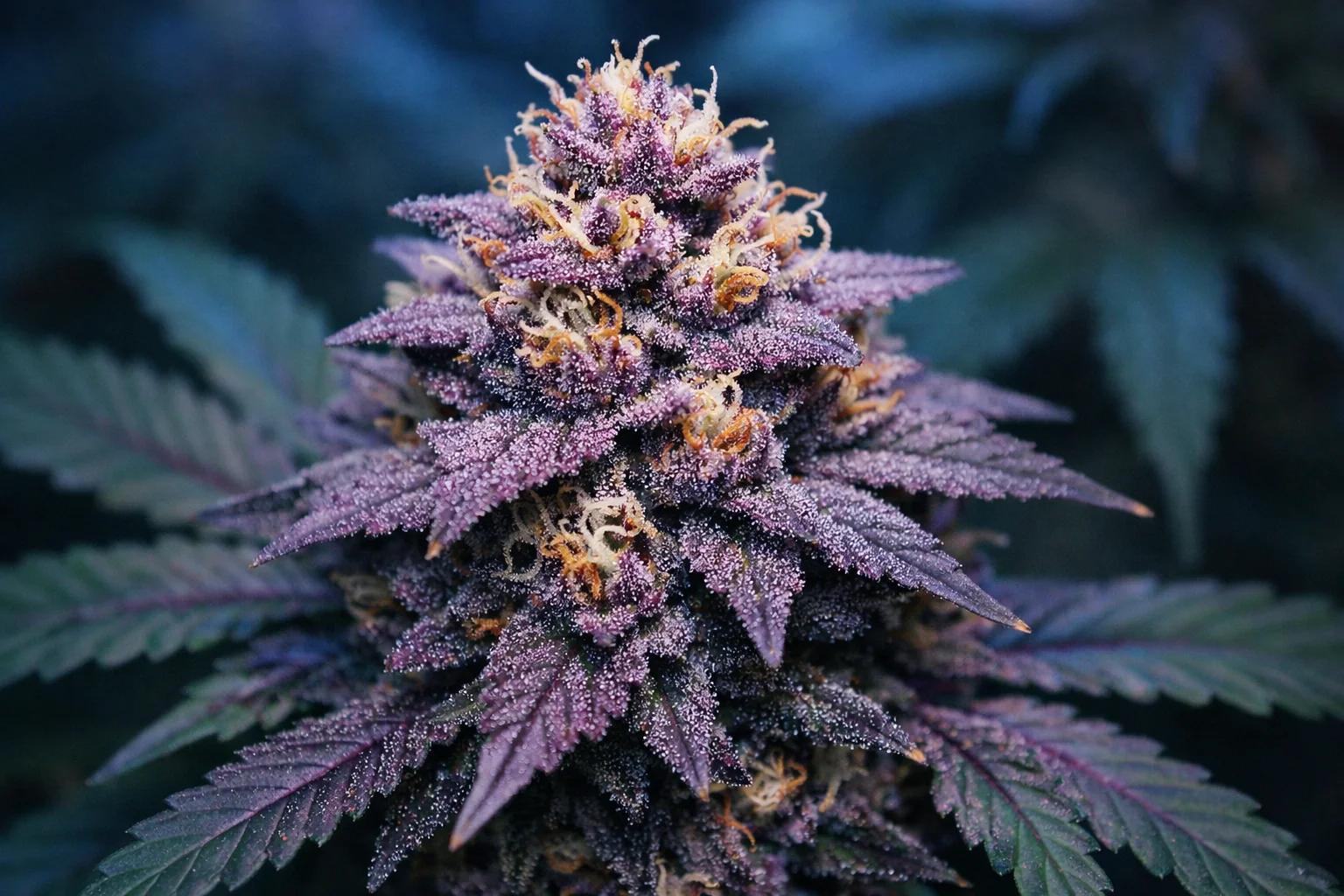
Flip GDP to 12/12 when the plant has filled 60–70% of its final intended canopy area. The flowering stretch — that explosive vertical growth in the first 14–21 days after the flip — adds 25–35% height. For a 60 cm veg plant, expect 75–80 cm finished. Plan vertical headroom accordingly: 60 cm of clearance above the canopy at flip time is the minimum.
The stretch is the most underestimated phase in a GDP grow. Many growers veg too long, flip into a small tent, and end up with colas pressed against the light by week 2 of bloom. If you're working with a 5-foot-tall tent (typical for a 4x4), cap your veg height at 35–40 cm. GDP's internodes tighten during the stretch, which means the new vertical growth is mostly bud sites — fast and stackable. By day 21 you should see preflowers transitioning into recognizable bud structures, and the stretch slows dramatically.
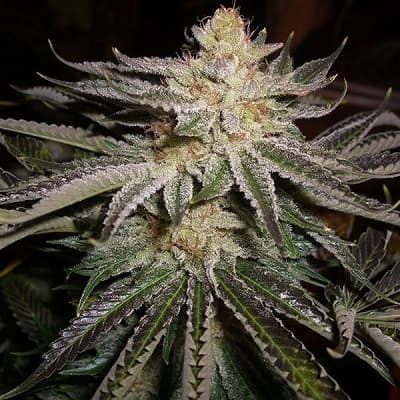
Feminized Seeds
Alien OG Kush Feminized
Defoliation during the stretch is where opinions split. Conservative growers remove only the largest fan leaves blocking lower bud sites. Aggressive growers schwazze — strip nearly all fan leaves at day 21 — to force light penetration. For GDP specifically, the moderate path works best. Remove 30–40% of the largest fan leaves at day 14 and again at day 28. Heavy defoliation stresses GDP enough to delay flowering by 4–7 days and you lose more in finish time than you gain in light penetration.
Light intensity should ramp up through the stretch. PPFD targets at canopy: 600–700 µmol/m²/s in week 1 of flower, climbing to 900–1000 µmol/m²/s by week 4. Higher than 1000 risks light burn on GDP, which has thinner leaves than some hybrids and shows bleaching faster. CO2 supplementation lets you push past 1000 safely, but for most home growers without sealed rooms, 900 is the practical ceiling.
Temperature during early flower should stay at 75–78°F (24–26°C) daytime and 68–72°F (20–22°C) nighttime. The day-night differential matters — a 6–8°F drop between lights-on and lights-off triggers the metabolic processes that drive bud density and resin production .
By week 4 of flower, the plant is committed. Flower sites are visible at every node, the colas are beginning to fill out, and the first hints of color change might appear in the lower leaves. This is where GDP starts to show why it's still on shelves twenty years after its release.
How do you trigger Grand Daddy Purple's signature purple color?
Drop nighttime temperatures to 60–65°F (15–18°C) starting in week 6 of flower. The day-night differential should be 15–20°F. This temperature stress signals the plant to produce anthocyanin pigments in the flower bracts and surrounding leaves, which is what creates the violet and deep purple coloration GDP is known for .
The purple color is not a nutrient deficiency, despite what some growers claim. GDP carries the genetic capacity to produce anthocyanins in high concentration — the trait is inherited from the Purple Urkle parent. Cold finishing temperatures activate the enzyme pathway that converts colorless precursors into the pigments you see. Without the cold trigger, the same plant stays mostly green even with identical genetics.
For indoor growers, this means running the lights-off period 10–15°F cooler than you normally would in late flower. If your tent runs at 75°F (24°C) during lights-on, target 60°F (15°C) during the dark cycle. In Canadian basements during October and November, this is often achievable by simply opening a vent to the cooler basement air. In summer or in warmer rooms, you'll need an AC or a portable cooler — not cheap, but the visual payoff is real.
Outdoor growers get this trigger for free in most of Canada. Late September and early October nights in southern Ontario, Quebec, and BC typically drop to 5–12°C, well below the threshold needed for anthocyanin expression. This is part of why outdoor GDP often shows more vivid purple than indoor GDP — the temperature differential is more extreme and more natural to the plant's evolved triggers.
A common mistake: triggering the cold too early. If you drop temperatures during week 3 or 4 of flower, you slow flower development and reduce yield. The window is week 5 onward, after the major flower structures are already built. The plant is no longer investing in mass at that point — it's finishing trichomes and pigments. Cold stress during the finish enhances both processes.
One more nuance: not every GDP plant will purple equally. Two seeds from the same pack can produce very different color expressions depending on which parent dominates the pheno. If purple color is your primary goal, pheno-hunt for the Purple Urkle-leaning expressions (smaller plant, more red-tinged stems early in veg, denser internodes) and clone that mother. Color saturation is largely genetic — the cold trigger just unlocks what's already there.
What nutrient profile does GDP respond to best?
GDP is a moderate-to-light feeder. Push too much nitrogen in veg and you get lush green leaves with weak flower production. Underfeed and you stall the metabolism that drives anthocyanin and terpene synthesis. The right curve runs medium-N in veg, transitions to low-N high-PK at flip, and tapers to flush-only by week 7 of flower.
In veg, target 150–180 ppm N (around EC 1.2–1.4 in coco, slightly lower in soil). Use a balanced 3-1-2 NPK ratio. GDP responds particularly well to calcium and magnesium supplementation in veg — 75–100 ppm Cal-Mag added to every feeding prevents the calcium deficiencies that show up as rust spots on mid-canopy leaves around week 3 of veg. The full nutrients and feeding guide covers the EC ramp across the cycle.
At the flip to flower, switch to a 1-3-2 NPK ratio and bump PPM up gradually. Week 1–2 of flower: 180–200 ppm. Week 3–5: 220–260 ppm. Week 6: 240–280 ppm but begin tapering nitrogen. Week 7: clean water or light flush. Week 8: flush only, no nutrients, lights on the same schedule.
Phosphorus and potassium drive bud density and resin production through the second half of flower. GDP rewards a heavier PK feeding in weeks 4–6 — many growers add a PK booster (something like a 0-9-18 supplement) at half strength during this window. Watch for tip burn on the upper leaves as your signal to back off. GDP shows nutrient excess clearly, with crisp brown leaf tips appearing within 48 hours of overfeeding.
Silica is worth adding throughout veg and early flower at 50 ppm. It thickens cell walls, which is what saves GDP branches from the snap-at-week-7 problem when the heavy colas swell beyond what an untrained main stem can carry. It also improves drought tolerance, useful for outdoor plants in dry Prairie summers.
pH should run 6.0–6.5 in soil and 5.8–6.1 in coco or hydro. GDP is sensitive to pH drift, particularly in the back half of flower when uptake is at peak. Check runoff pH weekly from week 4 onward — if you see drift above 6.8 or below 5.5, flush with pH'd water at 6.2.
Flushing the final 7–10 days is non-negotiable for taste. GDP carries strong terpenes that get muddied by residual nutrients in the flower at harvest. A clean flush — pH'd water only, no additives — lets the plant burn off stored nitrogen and produces a smoother smoke. You'll see yellowing of fan leaves in the final week, which is exactly what you want.
How does GDP perform outdoors in Canadian climates?
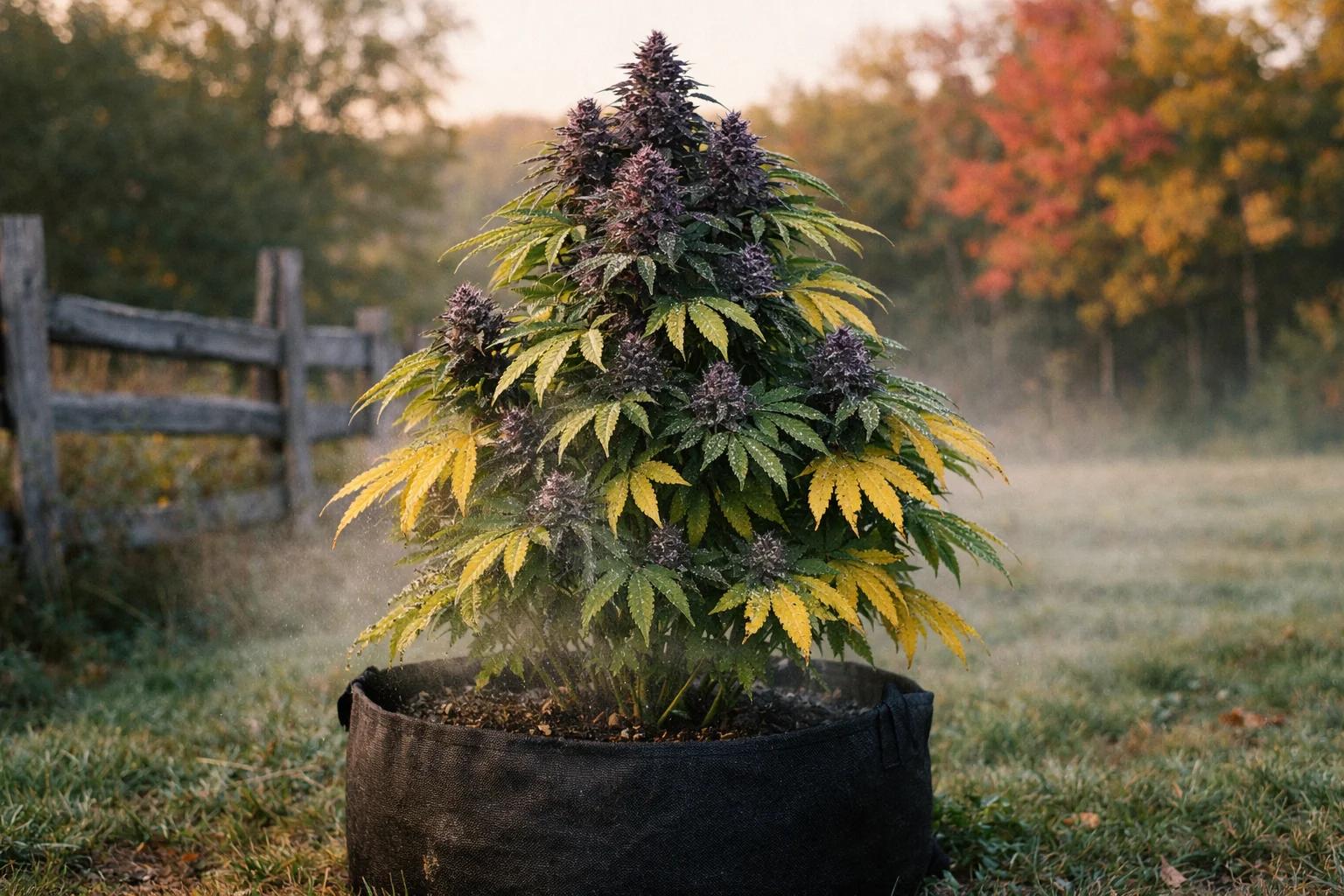
Outdoor GDP works in southern Ontario, Quebec, and BC reliably. Plant after the last frost (May 15–25 in most of southern Canada), and harvest October 5–15. The plant grows to 1.2–1.6 m with regular training and yields 300–600 g per plant in optimal conditions. The cool late-September nights give you the best purple expression of any indoor or outdoor setup.
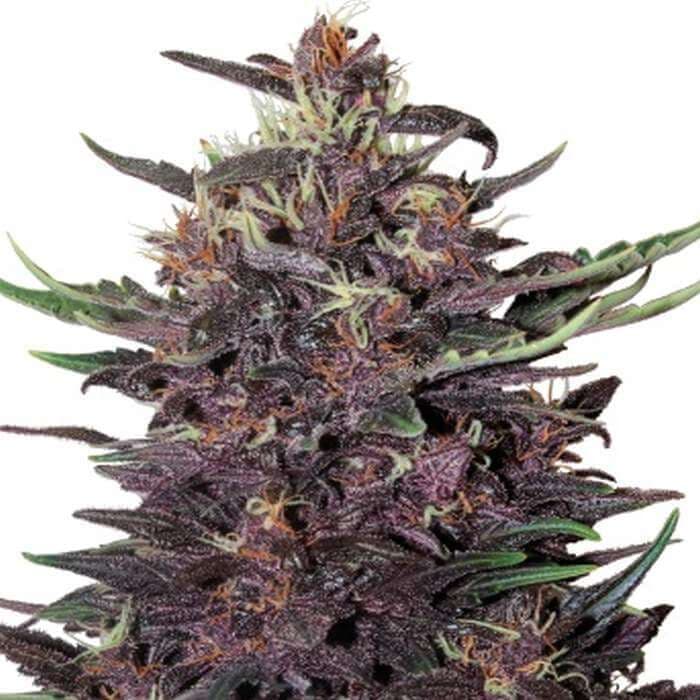
Feminized Seeds
Purple Kush Feminized
Site selection matters. GDP needs 7–8 hours of direct sun daily and protection from sustained winds. A south-facing wall, a sun-exposed corner of a yard, or a raised bed with windbreak hedges all work. Avoid low-lying spots that hold morning fog — GDP's dense flowers are mold-prone, and prolonged moisture on the colas in September is the single biggest outdoor failure mode in eastern Canada.
Soil prep starts in April for May planting. Amend native soil with compost, worm castings, and aged manure at a 30% mix. GDP wants drainage — heavy clay needs gypsum or perlite worked into the top 30 cm. Test soil pH before planting; outdoor soil in much of Canada runs slightly acidic (5.5–6.0), and lime amendment may be needed to hit the 6.2–6.5 target.
The Canadian outdoor cycle has a tight window. The outdoor cannabis calendar for Canada breaks down month-by-month tasks. For GDP specifically: top at the fifth node around late June, LST through July, transition to flower around August 5–15 (when natural daylight drops to 14 hours), and watch for flower mold from September 15 onward.
Powdery mildew and bud rot are the two outdoor pathogens that hit GDP hardest. Both thrive in 60–85% humidity with poor air movement. Defoliation in early September — removing 30% of inner fan leaves — improves airflow significantly and is the single highest-leverage anti-mold action you can take. A preventive spray with potassium bicarbonate or a beneficial bacteria foliar (Bacillus subtilis based) in early August reduces mildew incidence by 60–70% in most outdoor data.
Greenhouse growers get the best of both worlds: outdoor sun intensity, controlled humidity, and the cool nights needed for purple expression. A simple unheated greenhouse with vent fans extends GDP's reliable growing zone north into the southern Prairies and northern Ontario, where pure outdoor growing is marginal due to early frost risk.
Harvest timing outdoors follows trichome cloudiness. By October 5 in southern Canada, most GDP plants are at 20–40% amber trichomes — the indica sweet spot for sedative effect. Wait too long and you slip into over-ripening, which combined with autumn moisture risk is the wrong trade. The harvest guide covers trichome reading with cheap jeweler's loupes.
Common mistakes growers make with Grand Daddy Purple
Three failure modes show up over and over with GDP. The most common is overfeeding. GDP looks like a heavy feeder because it builds dense flowers, but it actually wants 70–80% of the nutrient strength you'd run on a Gorilla Glue or a Wedding Cake. Growers who push EC 2.0+ in late flower end up with locked-out plants, yellow leaves, and harsh smoke. Stay in the 1.4–1.8 EC range through peak bloom.
The second mistake is missing the cold trigger window. Growers see green flower at week 6 and assume their genetics are weak or their seeds were mislabeled. The real issue is room temperature — they're running 72°F (22°C) at night, well above the anthocyanin trigger. Without a 15°F day-night drop in weeks 5–7, the purple stays locked in the genetics and never expresses. Drop nighttime temps and the color appears within 5–7 days.
The third mistake is harvesting too early. GDP shows visual ripeness (fox-tailing colas, color shift, swollen calyxes) by week 7, and growers chop. The trichomes tell a different story — most plants need the full 8–9 weeks for trichomes to reach the cloudy-with-amber profile that delivers the sedative high GDP is known for. Cutting at week 7 produces a more head-forward, less couch-lock effect than the strain is supposed to deliver.
Other recurring issues:
Stem snap in late flower. GDP colas get heavy. The lower branches, which are weaker than the main stem, often snap under the weight of week 7 bloom. Bamboo stakes and soft plant ties every 20 cm along the branches prevent this. Bend before the plant breaks.
Powdery mildew at week 5 indoors. GDP's dense canopy holds humidity, and at 70%+ RH in late flower you'll see white powdery spots on fan leaves. Drop RH to 45–50% from week 5 onward and increase air circulation. Once mildew is established, the only options are aggressive removal and a beneficial-bacteria spray — and even then, infected flowers should not enter the final cure.
Botched curing. GDP terpenes are heat- and oxygen-sensitive. Dry too fast (under 7 days) and you lock chlorophyll into the flower, producing a hay-like taste. Cure in glass jars at 60–62% RH for 3–4 weeks minimum. The curing and storing guide covers Boveda packs, burping schedules, and long-term storage that preserves terpene profiles for 12+ months.
Pheno disappointment. A 3-pack of feminized GDP can produce one keeper, one mediocre plant, and one underperformer. This is normal for stabilized but not fully inbred genetics. Pheno-hunt across two cycles, identify the strongest expression, and clone forward from there.
The bottom line — is GDP the right strain for you?
Grand Daddy Purple is the right strain if you want a sedative indica with elite bag appeal, you have the temperature control to trigger purple, and you can run a 12–14 week indoor cycle or a full Canadian outdoor season. It's the wrong strain if you need a fast-finishing cultivar for a small tent with quick turnover, or if your grow room runs hot year-round without cooling.
For Canadian growers in particular, GDP rewards the patience that the climate already demands. Cool September nights, basement temperature differentials in October, and the natural rhythm of a temperate growing season all favor this strain. Pair GDP with another fast-finishing cultivar in the same tent and you can stagger harvests to keep the curing pipeline full year-round.
The strains worth running alongside GDP for a balanced indica rotation include Alien OG Kush (faster flower, similar couch-lock), Purple Kush Auto (quick outdoor backup), and any heavy-PK-responsive hybrid that lets you reuse the same nutrient line. The PPS indica strain catalog carries the full lineup with terpene and flowering-time data.
Looking ahead, the GDP lineage keeps shifting. Breeders in BC and Spain are stabilizing faster pheno expressions, crossing GDP with mold-resistant genetics aimed at humid Atlantic and Great Lakes summers, and pulling high-CBD purple variants for medical growers running ACMPR licenses. Twenty-plus years after Ken Estes locked the original line, the cultivar is still teaching new lessons — and the next wave of GDP crosses, especially the late-September-finish phenotypes coming out of Quebec and BC seed banks, is where the most interesting short-season Canadian outdoor genetics are likely to land in 2026 and beyond.
FAQ
How long does Grand Daddy Purple take from seed to harvest?
Indoors, expect 12–14 weeks total: 4–6 weeks veg plus 8–9 weeks flower. Outdoors in Canada, start indoors in late April, transplant outside late May, and harvest October 5–15. Fast Version GDP shaves about two weeks off the indoor timeline and 10–14 days off the outdoor harvest date.
Do I need cold temperatures for GDP to turn purple?
Yes. Anthocyanin pigments only express under cold-stress conditions, typically a 15–20°F day-night differential starting week 5 of flower. Without that trigger, GDP stays green even with the right genetics. Outdoor Canadian growers usually get this naturally in September; indoor growers need to manage room temperature deliberately.
What yield can I expect from GDP indoors?
A well-trained GDP under 600W of quality LED in a 4x4 ft tent yields 400–500 grams of dried flower across 4–6 plants. Top-end growers running ScrOG with CO2 supplementation hit 600+ grams. New growers should plan for 250–350 grams in a first cycle and improve from there with each grow.
Is Grand Daddy Purple beginner-friendly?
GDP is intermediate-friendly more than beginner-friendly. It tolerates feeding mistakes better than sativa-dominant strains, but it needs deliberate temperature management for color expression and trains best with structured techniques like topping and ScrOG. First-time growers can succeed with GDP if they accept the green-only outcome and skip the cold trigger their first cycle.
Can I grow GDP outdoors in northern Canada?
Reliably, no, in most of northern Ontario, the Prairies, and Atlantic Canada north of 49° latitude. The flower window closes too late for natural outdoor finish before frost. Greenhouses extend the workable zone significantly. Fast Version GDP and autoflower crosses like Purple Kush Auto are better choices for short-season regions.
What's the difference between GDP and Granddaddy Purps?
They're the same strain. Granddaddy Purps is the original spelling Ken Estes used; Grand Daddy Purple is the more common contemporary spelling. The genetics — Purple Urkle x Big Bud — are identical, though pheno expression varies by breeder source.
19+ | Educational horticulture only.