Master Your Indoor Grow
Indoor Growing Guides
Indica Cannabis Seeds: Genetics, Effects, and How to Grow Them Indoors
Complete guide to indica cannabis seeds: Hindu Kush genetics, real-world differences vs sativa, terpene-based effects, best indoor grow schedules, top Canadian picks.
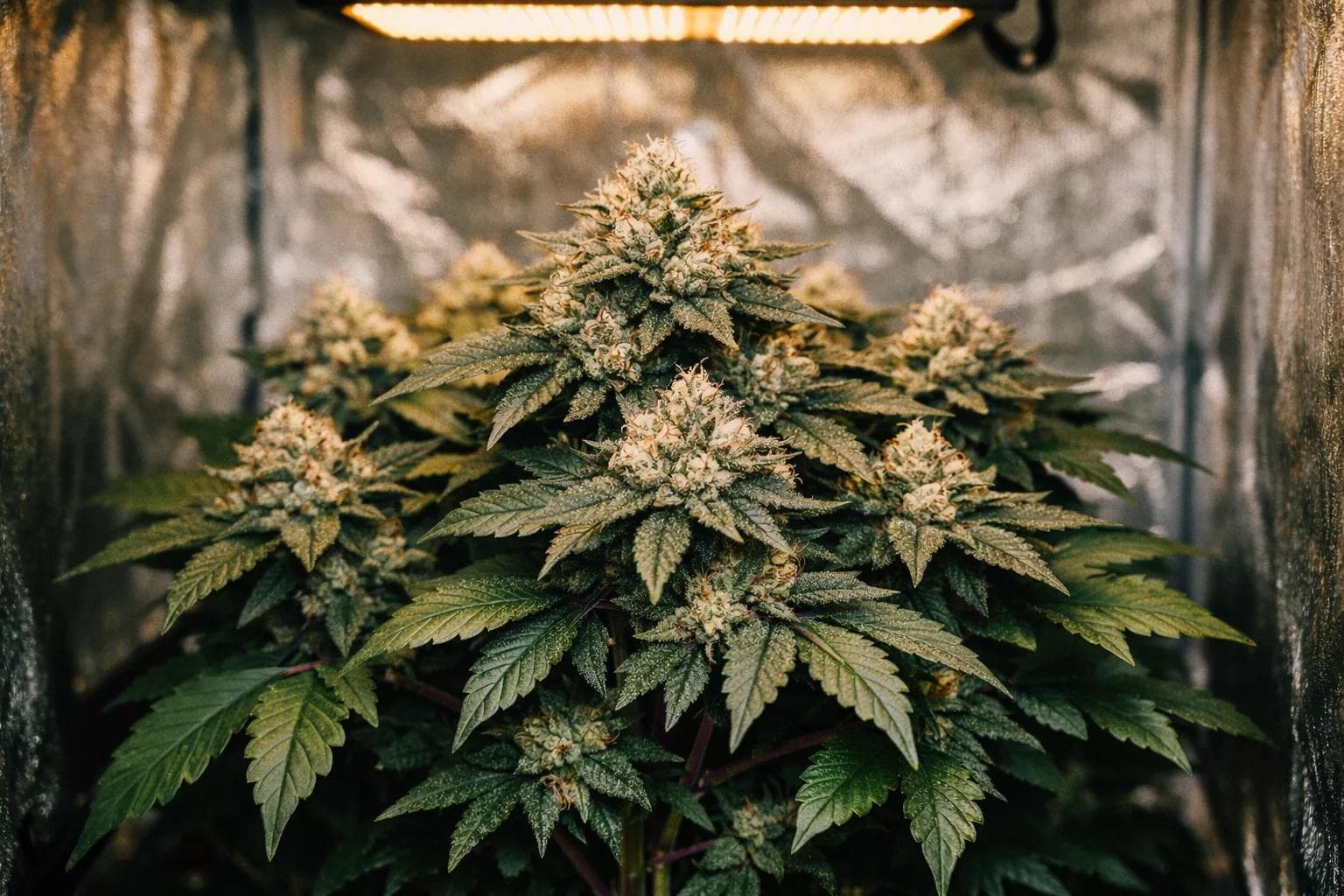
The biggest mistake new indica growers make is underestimating bud rot risk. Dense indica colas in a humid environment will mould from the inside out, ruining a harvest in days. Dial humidity down to 40% by mid-flower, run constant airflow, and defoliate inner leaves aggressively in week 5+. The yield protection is worth the labour.
Indica cannabis seeds produce short, bushy plants descended from the Hindu Kush mountains of Afghanistan and Pakistan. They flower in 7–9 weeks, top out at 90–150 cm indoors, and yield 400–550 g/m² with proper environmental control. The famous "in da couch" sedation isn't a function of being indica — it's a function of high myrcene and linalool terpene content combined with a heavy THC load. Choose indica seeds when you want compact structure, fast finishes, dense colas, and resin-heavy flower that suits indoor tents, small spaces, and Canadian growers who need predictable timelines.
What is an indica cannabis seed genetically?
An indica cannabis seed is the seed of a Cannabis indica plant — a subspecies of cannabis genetically distinct from Cannabis sativa and Cannabis ruderalis, characterized by short stature, broad palmate fan leaves with 7–9 wide fingers, dense bud structure, and a relatively fast flowering cycle of 7–9 weeks. Modern "indica" seeds sold in Canadian seed banks are almost always hybrid crosses with strong indica dominance rather than pure landrace genetics, but they retain the structural and chemical signatures that growers and consumers associate with the category.
The taxonomy gets contested in academic circles . For the purposes of buying seeds, growing plants, and predicting outcomes, the indica/sativa/hybrid framework still works because breeders selectively bred for the trait clusters that define each category — and those clusters are real and observable in your tent.
At the genetic level, indica plants express specific chemotypic markers: higher relative concentrations of myrcene (often above 0.5% of total terpene profile), elevated linalool and beta-caryophyllene, and cannabinoid ratios that tend to favour THC over CBD though both can be high in modern lines. The structural genes that produce broad leaves, internode compression, and dense calyx packing are also highly conserved across indica lines, which is why an OG Kush, a Northern Lights, and a Hindu Kush all look immediately recognizable as "indica" even to a novice grower.
Compare this with sativa seeds, which produce tall plants with narrow leaves, fluffy bud structure, longer flowering cycles (10–14 weeks), and dominant terpene profiles weighted toward limonene, pinene, and terpinolene. The two categories evolved in radically different environments and were selected by humans for radically different purposes for thousands of years before modern hybridization muddied the lines.
For Canadian growers buying seeds today, "indica-dominant" on a strain page means you're getting the short structure, the 7–9 week flower, the myrcene-heavy profile, and the deep-body effect — not necessarily a pure landrace genetic, but a reliable phenotype expression. If you're new to seed categories generally, our feminized vs autoflower vs Fast Version guide explains how seed-type categories layer on top of the indica/sativa axis.
Where does the indica plant come from?
Cannabis indica originated in the Hindu Kush mountain range spanning eastern Afghanistan, northern Pakistan, and parts of northwestern India, where it evolved over thousands of years at altitudes between 1,500 and 4,000 metres in a brutal climate of intense summer sun, cold mountain nights, low humidity, and short growing seasons. Every defining trait of the indica plant — compact size, dense bud structure, broad leaves, fast flowering, heavy resin production — is an adaptation to that specific environment.
The short, compact stature is a wind-resistance and frost-survival adaptation. At Hindu Kush altitudes, late spring and early autumn frosts kill anything that grows tall and exposed. Plants that stayed low, branched horizontally, and finished their reproductive cycle before September survived to pass on genes. Plants that grew like sativa — tall and lanky, flowering for 12+ weeks — died before completing seed production.
The dense bud structure with tight calyx packing is a UV-protection and pollination-efficiency adaptation. High-altitude UV radiation is intense, and dense colas protect inner flowers from radiation damage. Tight bud structure also concentrates pollen-receptive surfaces in a small area, making pollination more efficient in low-pollen-density environments where wind is unreliable.
The heavy trichome production — the resin that makes indica famous — is the most famous adaptation. Trichomes serve as a sunscreen, a humectant (trapping moisture in arid mountain air), an insect deterrent, and a UV shield all at once. Hindu Kush plants needed all four functions, so they produced trichomes in volumes that no other plant family on earth matches.
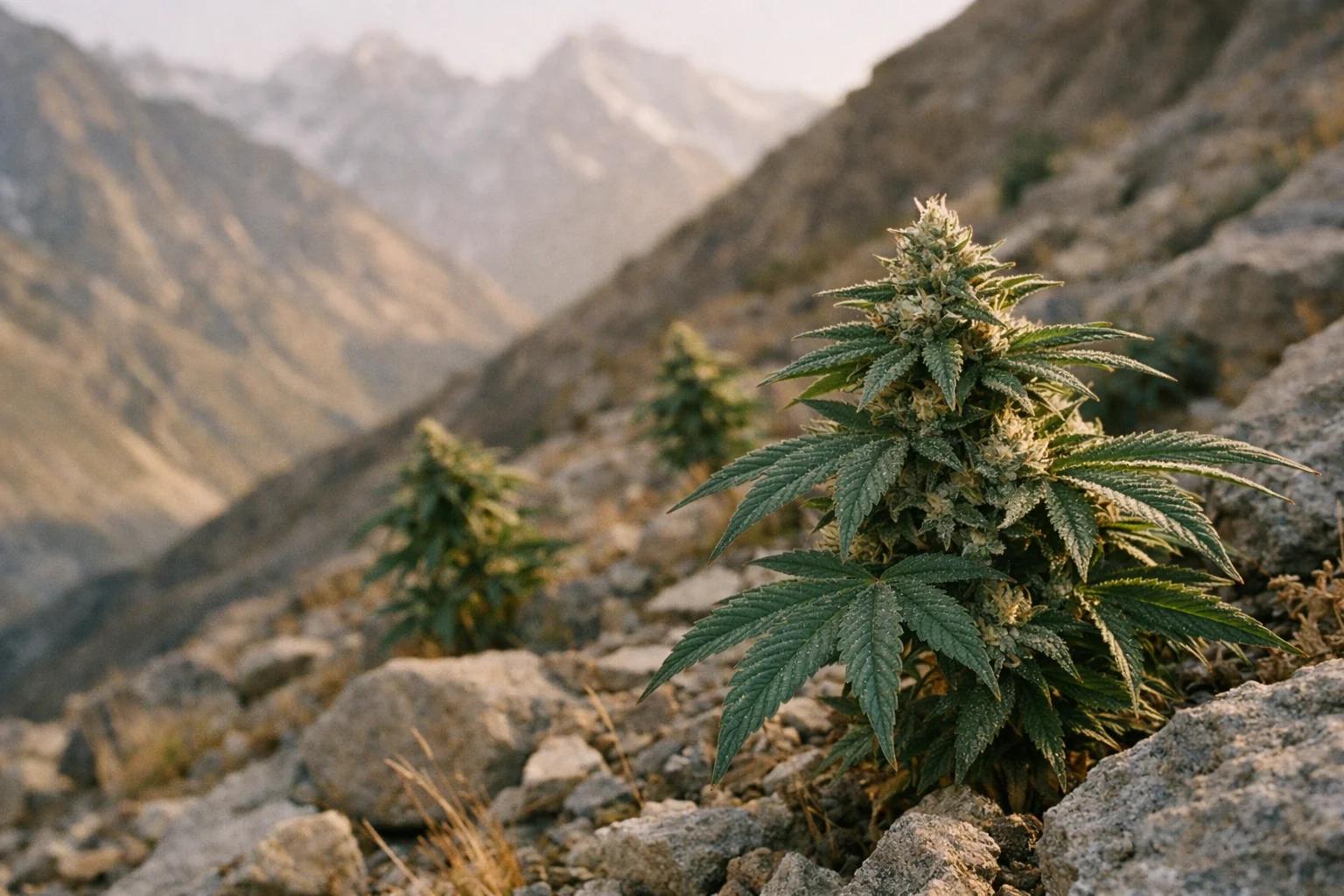
When 1960s and 1970s travellers on the "hippie trail" through Afghanistan and Pakistan brought Hindu Kush seeds back to North America and Europe, they handed Western breeders a genetic toolkit that revolutionized the cannabis industry. Every short, fast-flowering, resin-heavy strain on the market today — Northern Lights, OG Kush, Bubba Kush, Master Kush, Hindu Kush, Afghani, Master Bubba, Purple Kush — traces its core genetics back to those landrace plants. The hash-making traditions of Afghanistan and the cannabis tourism of Pakistan's tribal regions in the 1970s gave the seeds. Western breeders crossed them with sativa and ruderalis lines to create the hybrid library we work with today.
The deep historical context matters for growers because Hindu Kush ancestry explains the modern indica plant's preferences: it likes dry air (40–50% relative humidity in flower), it tolerates cold nights down to 10°C, it does not like high humidity (mould-susceptible due to dense bud structure), it appreciates intense direct light, and it finishes fast because it had to.
How does an indica plant differ from sativa in real terms?
Indicas differ from sativas in five measurable ways: structure (short and bushy vs tall and lanky), leaf morphology (broad 7–9 finger leaves vs narrow 5–7 finger leaves), flowering time (7–9 weeks vs 10–14 weeks), terpene profile (myrcene/linalool dominant vs limonene/pinene/terpinolene dominant), and effect chemistry (heavy sedating body load vs cerebral uplifting head effect). These differences are real and observable in any side-by-side grow.
The structural difference is the most immediate. A pure indica plant kept indoors will reach 80–130 cm in a 4×4 tent, with internode spacing of 3–5 cm between branches. A pure sativa in the same tent will hit 150–250 cm with internode spacing of 8–15 cm, often requiring topping or super-cropping just to fit under the light. This difference matters enormously when choosing seeds for a small space — and most Canadian home grows are small.
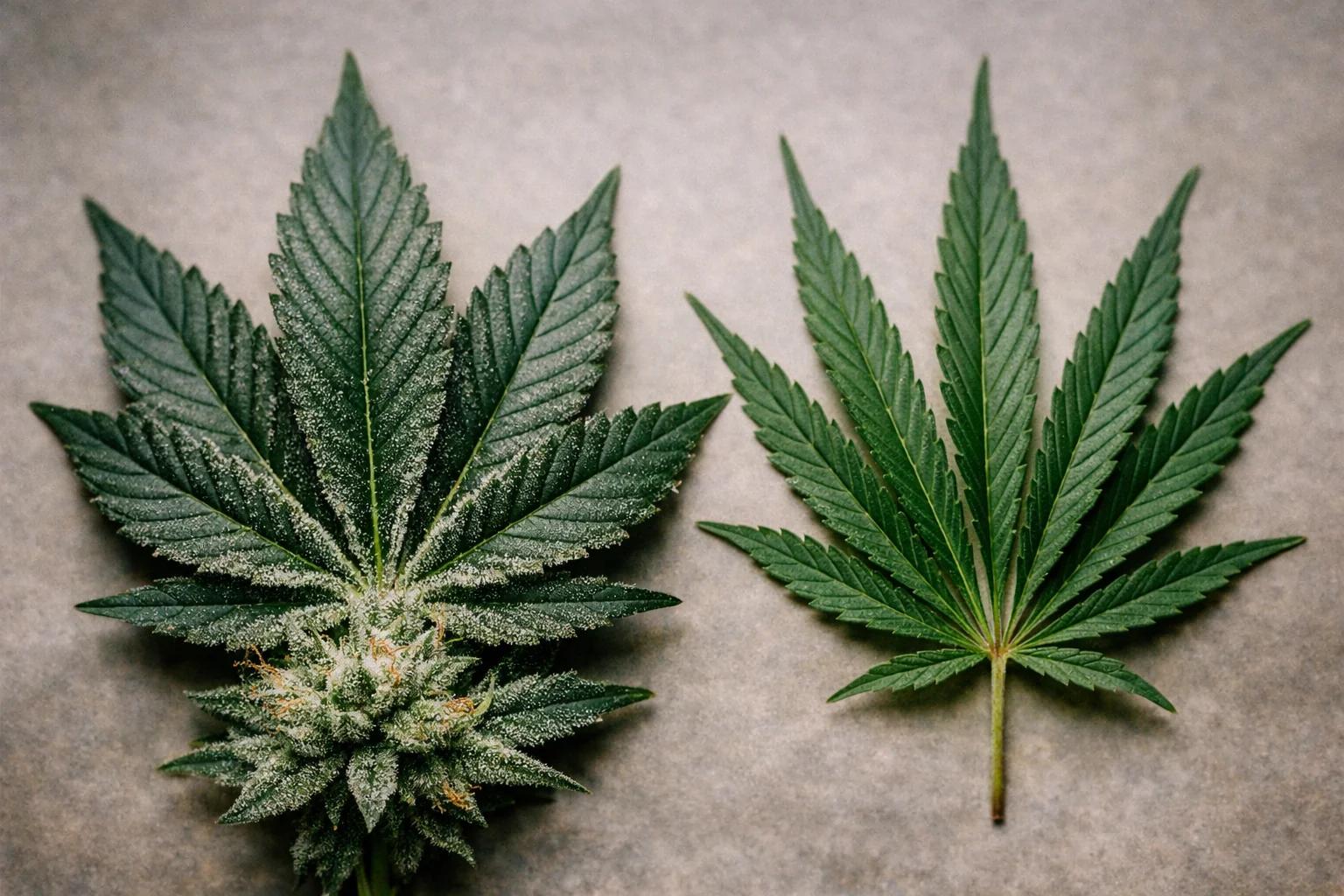
Leaf morphology is the textbook identifier. Indica fan leaves have 7–9 broad fingers, deep green color, sometimes turning purple in cooler temperatures due to anthocyanin expression. Sativa fan leaves have 5–7 narrow finger-blades, lighter green color, and a more delicate appearance. Within minutes of seedling growth, the leaf shape tells you which genetic family dominates.
Flowering time is the practical difference Canadian growers care about most. Indica strains finish in 49–63 days of 12/12 light. Sativa strains finish in 70–98 days. For an outdoor grower in Quebec or Manitoba where first frost arrives in early October, indica's 7-week finish is the difference between harvesting clean buds in mid-September and watching colas rot under October rain.
Bud structure differs visually and aromatically. Indica buds are dense, heavy, and rock-like — a single cola can weigh 30–80g dry. The high resin density makes them sticky to the touch. Sativa buds are fluffier, with looser calyx packing and more visible pistils, typically weighing 10–30g dry per cola. Density correlates with terpene retention — indica buds hold their aroma longer in storage.
Feminized Seeds
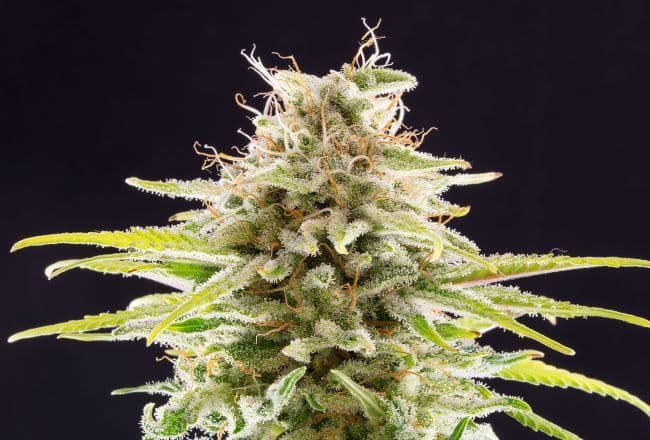
OG Kush Feminized
The terpene chemistry explains why effects feel different. Indica-dominant flower typically tests at 0.5–1.5% myrcene (the highest terpene concentration in the plant), 0.1–0.4% linalool, and 0.1–0.3% beta-caryophyllene. Sativa-dominant flower typically tests at 0.2–0.6% limonene, 0.3–0.7% pinene, and 0.2–0.6% terpinolene. These compounds aren't just smell — they bind to receptors and modulate the THC experience . For a deeper dive into how terpenes shape the high, see our cannabis terpenes guide.
Effect chemistry follows the terpene math. Indica flower produces what most users describe as "body high," "heavy limbs," "couch lock," and "deep relaxation." Sativa flower produces "head high," "cerebral energy," "creative buzz," and "social uplift." These descriptors are real and consistent across millions of consumer reports, but the cause isn't the indica/sativa label — it's the terpene chemistry expressed by indica-dominant plants. This distinction matters when shopping seeds: a "hybrid" labelled indica-dominant but tested low for myrcene won't feel particularly sedating regardless of its genetic ancestry.
What does indica actually feel like — and why?
The classic indica experience — heavy limbs, deep body relaxation, drowsiness, appetite stimulation, pain relief — is real and consistent for most users, but it's caused by terpene chemistry, not by an "indica gene" in the plant. High myrcene combined with linalool and high THC produces the sedating body load. Strip those terpenes out (by curing too long, storing improperly, or selecting a phenotype low in myrcene) and even a pure indica plant will produce a more neutral, less sedating high.
This matters because it overturns the popular shorthand that "indica = sleep, sativa = energy." That shorthand is wrong as a causal claim. The accurate claim is: indica plants tend to express terpene profiles that produce sedating effects, but the terpenes drive the effect, not the leaf shape. A sativa-dominant plant bred for high myrcene will feel sedating. An indica-dominant plant bred for high pinene will feel more alert. The seed industry markets on indica/sativa for simplicity; the science cares about terpene chemistry.
Myrcene is the dominant terpene in most indica strains and the single largest driver of the "in da couch" feeling. Found also in mangoes, hops, lemongrass, and thyme, myrcene at concentrations above 0.5% appears to enhance the sedating qualities of THC, increase peripheral muscle relaxation, and contribute to the heavy-body sensation. Strains testing above 1% myrcene — common in OG Kush variants, Bubba Kush, and Granddaddy Purple, the canonical myrcene-dominant cultivar — produce the most pronounced sedation.
Linalool is the second-most-impactful terpene in indica chemistry. Famous as the dominant compound in lavender, linalool at concentrations of 0.2%+ contributes to anxiety reduction, sedation, and the floral-spicy aroma characteristic of strains like Northern Lights (a linalool-leaning profile), Lavender Kush, and many Afghani crosses. Linalool's contribution to the "calm" of an indica high is well-documented in aromatherapy research and increasingly in cannabis-specific clinical work.
Beta-caryophyllene is unique because it binds directly to CB2 receptors — the immune-system cannabinoid receptors — which is why it has measurable anti-inflammatory effects independent of THC. Indica strains rich in beta-caryophyllene (over 0.3%) contribute to the pain-relief reputation. Found also in black pepper, cloves, and cinnamon, beta-caryophyllene is one reason indica strains are often the choice for chronic pain, arthritis, and inflammatory conditions in medical cannabis programs.
The effects most users associate with indica:
- Body sensation: heavy limbs, muscle relaxation, sometimes mild tingling. Onset within 5–15 minutes of inhalation, peak at 30–45 minutes.
- Mental state: reduced racing thoughts, calm focus, sometimes mild dissociation or floating sensation at higher doses.
- Sleep impact: pronounced drowsiness 1–2 hours after consumption, often deeper sleep with vivid dreams (or REM suppression at high doses).
- Appetite: classic "munchies" response, often more pronounced than with sativa varieties due to myrcene's interaction with appetite-regulation pathways.
- Pain relief: useful for muscular pain, joint inflammation, and nerve pain, particularly in strains high in beta-caryophyllene.
Why do indica plants suit indoor growers?
Indica plants are nearly purpose-built for indoor cultivation because their short stature, fast flowering, and dense bud structure match exactly what an indoor grow tent rewards: predictable height under the light, fast turnaround between harvests, and high yield per square foot. A 4×4 tent that struggles to host a single sativa plant can comfortably hold four well-trained indica plants producing 400–550 g/m² over a 7–9 week flower.
The height advantage is the single biggest indoor benefit. A standard grow tent is 200 cm tall. After accounting for the light fixture (20 cm), the pot height (40 cm for a 7-gallon pot), and the minimum distance between light and canopy (30 cm for an LED to avoid bleaching), the grower has roughly 110 cm of usable plant height. A sativa flipped at 12/12 will typically triple in height during stretch — meaning a 60 cm sativa pre-flip becomes a 180 cm plant by week 3 of flower and starts burning the canopy. An indica typically only doubles in height during stretch and stays within the safe zone.
For indoor light efficiency, indica's compact node spacing creates a denser canopy that uses light more efficiently. Light hitting an indica canopy travels shorter distances between budsites, meaning each watt of LED power converts to more dry flower. Trial data from indoor growers consistently shows higher grams-per-watt yields with indica-dominant strains compared to sativa-dominant strains in the same conditions — typically 1.0–1.5 g/W for indica vs 0.7–1.1 g/W for sativa under identical lighting.
The flowering timeline matters for the indoor grower's economics. An indica finishing in 7–8 weeks lets you complete 5–6 indoor harvests per year. A sativa finishing in 10–12 weeks limits you to 3–4 harvests. Over a calendar year, that translates to 60–80% more total flower production from the same tent. For personal supply or small-scale grows, the indica timeline is the right call.
Indica plants also handle indoor environmental imperfections better. They tolerate cooler indoor temperatures (down to 18°C night) better than sativa, which prefers warmer 22°C nights. They accept higher relative humidity during veg (up to 65%) and pull it down to 40–45% in flower without losing density. They handle close-quarters air circulation well because their structural sturdiness resists wind damage from oscillating fans.
The trade-off: indica plants are more susceptible to bud rot indoors because their dense colas trap moisture inside the bud where airflow can't penetrate. A Toronto basement grower in August — when outdoor dew points hit 20 °C and basement RH creeps to 70% — has to dial humidity down to 35–40% during late flower and run continuous airflow over the canopy. Defoliation in late flower — removing inner leaves to open up airflow inside the colas — becomes more important with indica than with sativa.
For training techniques that maximize indica's tendency to bush out, our LST and ScrOG training guide covers the specific techniques that fit indica's growth pattern. ScrOG in particular works exceptionally well with indica because the short stretch makes screen-filling predictable.
How tall and wide will an indica plant grow?
A typical indoor indica plant reaches 90–150 cm in height and 60–100 cm in width at maturity, varying based on pot size, veg time, lighting intensity, and training. Outdoors with unrestricted root space, the same genetics can hit 180–240 cm height and 120–180 cm width. Indica plants stretch roughly 2× their pre-flip height during the first three weeks of flower (compared to 3× for sativa), making them highly predictable for tent planning.
The math for indoor planning: if you flip your plant to 12/12 at 50 cm tall, expect it to reach 100–125 cm at harvest. If you want a final height of 90 cm to fit comfortably under your light, flip at 35–40 cm pre-flip height. This predictability is one of indica's biggest practical advantages over sativa for new growers.
Width predictions matter equally because most indoor tent failures aren't from plants growing too tall — they're from plants growing wider than the tent footprint. An indica plant in a 5-gallon pot vegged 4 weeks under a 240W LED will spread to roughly 70 cm wide in flower. In a 7-gallon pot vegged 6 weeks, expect 90–100 cm wide. Plan plant count accordingly: a 4×4 tent (120×120 cm) holds 4 medium indica plants or 1 large scrog. A 2×4 tent (60×120 cm) holds 2 indica plants comfortably.
Pot size is the single biggest variable in final plant size. A 3-gallon pot will produce a 60–80 cm indica plant. A 5-gallon produces 90–110 cm. A 7-gallon produces 110–130 cm. A 10-gallon produces 130–160 cm. Outdoors, 30-gallon to 100-gallon fabric pots can produce 200–280 cm bushes from the same genetics that would top out at 100 cm indoors. The plant grows to fill its root volume.
Veg time amplifies the pot-size effect. Two weeks of veg in a 5-gallon pot produces a different plant than six weeks of veg in the same pot. Most indoor indica growers veg for 3–5 weeks before flipping, which produces predictable medium-sized plants. Sea-of-green growers veg 1–2 weeks for small fast plants. Big-yield scrog growers veg 6–8 weeks then train horizontally to fill a screen.
Lighting intensity affects width more than height. Under low light (100W per square metre), indica plants stretch upward seeking more light, ending taller and narrower. Under high light (400W+ per square metre), plants stay shorter and bush out wider. This is why high-intensity LED setups produce the classic short bushy indica look, while older HPS setups at lower intensity often produced taller more open structure.
Feminized Seeds
Purple Kush Feminized
For outdoor Canadian growers, indica's size potential is liberating: a single plant in a 30-gallon fabric pot in southern Ontario with full sun can produce 400–800g of dry flower. The same genetics in a balcony pot in Montreal might produce 100–200g — the genetics aren't the limit, the root volume is. Match your pot size to your goals before you germinate.
What are the best feeding and light schedules for indicas?
Indica plants prefer a measured nutrient schedule that starts light, ramps up through veg, peaks in mid-flower, and tapers to nothing for the final 7–10 days of flush. Light schedules follow standard photoperiod protocol: 18/6 in veg, 12/12 in flower, with a 36-hour dark period before flipping to encourage faster transition. Total electrical conductivity (EC) tolerance peaks at 1.6–2.0 mS/cm in late flower — higher than sativa, which tends to burn at lower EC.
Veg-stage feeding for indica:
- Week 1–2 (seedling): water only or 0.4 EC feed at most. Roots are establishing; high nutrients cause leaf burn.
- Week 3–4 (early veg): 1.0–1.2 EC at pH 5.8–6.0 (hydro) or pH 6.2–6.5 (soil). Nitrogen-heavy ratio like 3-1-2 NPK.
- Week 5+ (late veg): 1.4–1.6 EC, same pH range, gradually shifting NPK toward 2-2-2 balance to prepare for the flowering transition.
Flower-stage feeding shifts dramatically:
- Week 1–2 (transition): 1.4 EC, NPK shifting to 1-2-2, calcium and magnesium supplementation important to prevent cal/mag deficiencies common in flower.
- Week 3–5 (peak flower): 1.8–2.0 EC, NPK 1-3-3 to support bud development, micronutrient-rich, watch for tip burn and adjust down 10% if leaves curl.
- Week 6 onward: ramp EC down by 0.2 per week toward the flush.
- Final 7–10 days (flush): water only at correct pH. This clears excess nutrients from the plant tissue and produces cleaner-tasting, smoother-smoking flower.
Light schedules for indica are straightforward but worth doing right:
Vegetative phase: 18 hours on, 6 hours off. Some growers run 24/0 to push faster growth, but indica plants respond better to a true dark period for cellular repair. The 6-hour dark window also drops the tent temperature by 4–6°C, which is healthy for plant cycle regulation.
Flowering trigger: switch to 12 hours on, 12 hours off. For maximum transition speed, run 36 hours of darkness before the first 12/12 day — this depletes the plant's stored hormones and forces a clean flowering signal. Many growers skip this step and the plant transitions fine, but the 36-hour dark hack shaves a few days off the total cycle.
Light intensity: indica plants tolerate higher PPFD than sativa during flower. Target 800–1,000 µmol/m²/s at canopy in flower for maximum bud development. Below 600 µmol/m²/s, you'll get airy buds. Above 1,200 µmol/m²/s, you risk bleaching and trichome degradation without CO2 supplementation.
Light spectrum: full-spectrum LED is standard. Some growers add UV-B supplementation in the final 2 weeks of flower to boost trichome production and THC. For an in-depth treatment of every variable from seedling stage to harvest light, see our cannabis light schedule guide.
Environmental targets for indica through the cycle:
- Temperature: 22–26°C day, 18–22°C night. Indicas tolerate a wider night drop than sativas.
- Humidity: 60–65% in veg, 50% in early flower, 40–45% in mid-flower, 35–40% in late flower to prevent bud rot.
- VPD (vapour pressure deficit): target 0.8–1.2 kPa in veg, 1.0–1.5 kPa in flower. Higher VPD pulls more transpiration and reduces bud rot risk.
- CO2: ambient (400 ppm) for most home grows; 800–1,200 ppm with supplementation can push yields 15–20% with adequate light.
Which indica strains rank as our top picks for Canadians?
Our top indica picks for Canadian growers prioritize flowering speed, mould resistance (Canadian humidity matters), yield, and classic indica terpene profiles. The shortlist below reflects strains we've grown out repeatedly in tester gardens across Canadian climates and that consistently deliver predictable results for both new and experienced growers. All are available as feminized or autoflower in our indica seed collection.
Northern Lights — the indoor benchmark. 80–110 cm at maturity, finishes in 49–56 days of flower, yields 450–550 g/m² indoors. Heavy myrcene and linalool terpene profile produces classic sedating body high. Mould-resistant due to slightly looser bud structure than pure Kush lines. Considered the easiest pure indica for first-time growers — virtually impossible to ruin.
OG Kush — the West Coast classic, indica-dominant despite some sativa heritage. 100–140 cm at maturity, 56–63 day flower, 400–500 g/m² yield. Dominant terpenes are myrcene, limonene (the classic "OG" lemon-pine smell), and beta-caryophyllene. Effects lean strongly indica despite the limonene presence due to high myrcene loadings of 0.8%+ in mature flower.
Hindu Kush — the landrace foundation that started everything. Pure indica, 80–120 cm at maturity, 49–56 day flower, 400–450 g/m². Lower THC than modern hybrids (typically 16–20%) but exceptionally high terpene density and a true Hindu Kush flavour profile of earthy hashish, sandalwood, and spice. Foundational strain for any grower who wants to understand where modern indicas came from.
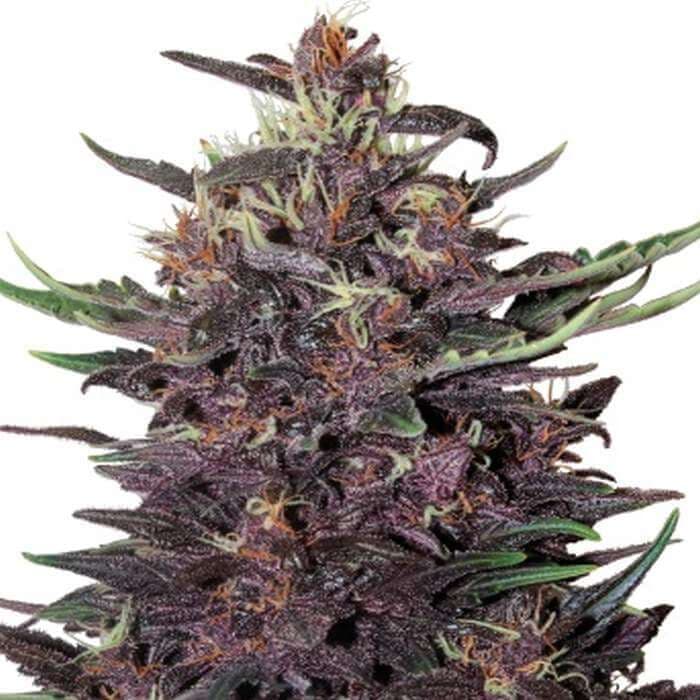
Purple Kush — the visual stunner. 90–120 cm at maturity, 56–63 day flower, 350–450 g/m² yield. Anthocyanin expression produces deep purple-to-black flower color, especially when night temperatures drop into the low teens during late flower. Heavy myrcene-linalool profile, very sedating, excellent for evening medical use. Slightly lower yield than Northern Lights but visually unmatched.
Bubba Kush — the cult favourite. 100–130 cm at maturity, 56–63 day flower, 400–500 g/m² yield. The densest buds of any commonly available indica — single colas frequently weigh 50–80g dry. Coffee, cocoa, and earthy notes dominate the terpene profile. Very high CB2-binding caryophyllene content makes this a favourite for pain relief programs.
Granddaddy Purple — the deep indica with grape-candy terpenes. 100–130 cm at maturity, 56–63 day flower, 400–500 g/m². Heavy myrcene combined with the rare grape-like terpenes makes this strain instantly identifiable. Very sedating, classic "couch lock" effect. Performs best in slightly cooler environments that bring out the purple coloration.
Feminized Seeds
Alien OG Kush Feminized
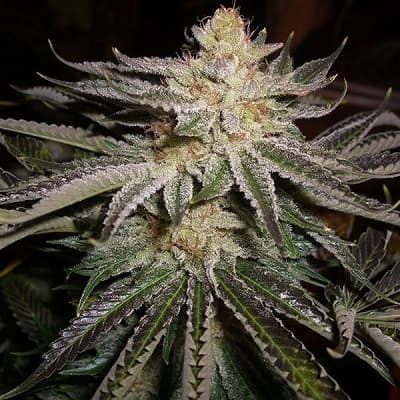
Alien OG — the West Coast power player. 110–140 cm at maturity, 56–63 day flower, 450–550 g/m² yield. Heavier than OG Kush in both yield and effect, with dominant myrcene plus alien-fuel terpene notes. Slightly more demanding to grow well — needs proper VPD management and clean nutes — but the reward is some of the densest, most resin-coated flower in the indica catalogue.
Master Kush — the resin king. 90–120 cm at maturity, 49–56 day flower, 400–500 g/m² yield. The trichome density on this strain is exceptional — even fan leaves frost up by late flower, making it a top pick for hash production. Effects are pure indica sedation. Lower THC than some modern hybrids but the terpene complexity makes up for it in subjective effect.
For Canadian outdoor growers in shorter seasons, autoflower versions of any of these strains will give you a 70-day total cycle and let you fit a clean harvest into a 100-day frost window. Browse the autoflower indica section for our current in-stock lines.
The selection logic: start with Northern Lights or Hindu Kush if you're new and want forgiveness. Move to OG Kush or Bubba Kush once you've completed a successful first grow. Try Purple Kush or Granddaddy Purple if you want the visual and aroma payoff of dark-flower phenotypes. Tackle Alien OG when you're ready to push yields hard. Master Kush is the right choice for anyone interested in making bubble hash or dry sift.
Common myths about indica strains
Several persistent myths about indica strains lead growers and consumers astray. Pulling them apart matters because seed-buying decisions and consumption decisions both benefit from clean understanding rather than recycled stoner-shop folklore.
Myth 1: "Indica = sleep, sativa = energy." Wrong as a causal claim. Effects are driven by terpene chemistry, not by the indica/sativa label. A sativa high in myrcene will feel sedating. An indica high in pinene and limonene will feel more alert. The general tendency holds — most indicas do produce sedating effects — but the cause is the terpene profile that indica plants happen to express, not the leaf morphology.
Myth 2: All indicas are short. Mostly true indoors, but outdoor indica plants in deep soil with full sun can hit 200–250 cm. The "short" trait is a function of root volume and environment as much as genetics. Don't assume an indica strain is balcony-safe based on indoor data.
Myth 3: Pure indica strains still exist on the seed market. Almost none do. Nearly every commercial "indica" today is an indica-dominant hybrid with some sativa or ruderalis genetics in the lineage, even when sold as a famous landrace name. True pure landraces are increasingly hard to source. The strains marketed as "100% indica" usually have 5–20% sativa heritage in their pedigree.
Myth 4: Indica plants are easier to grow. Mostly true, but they have specific failure modes. Indica plants are more susceptible to bud rot due to dense colas trapping moisture. They're more prone to mould in high-humidity environments. They show calcium deficiencies faster than sativas because they're absorbing nutrients into denser tissue. "Easier" is real but conditional — easy for indoor controlled environments, less so for outdoor wet climates.
Myth 5: Indica seeds finish faster outdoors. Partly true. Indicas do flower in fewer weeks under 12/12, but outdoor flowering trigger is timed to the autumn equinox regardless of indica or sativa genetics. The advantage of indica outdoors is the shorter flowering phase — 7 weeks of flower from late August trigger lands harvest in mid-October, compared to 11 weeks of flower for a sativa landing in late November (well past Canadian frost). The trigger date is similar, but the finish date differs significantly.
Myth 6: Indica strains are always more potent. No. Modern hybrid breeding has pushed THC content to similar levels across indica and sativa lines, with many sativa-dominant hybrids hitting 25%+ THC. The difference is in the felt experience, not the cannabinoid number. Indica's reputation for "stronger" highs comes from the body-loading terpene chemistry that creates a more dramatic subjective experience at lower THC numbers.
Myth 7: Indica is medical, sativa is recreational. This shorthand is mostly marketing. Both indica and sativa cultivars have medical applications — sativa for daytime pain management and depression, indica for sleep, chronic pain, and appetite. The medical/recreational divide is more about consumer pattern than plant chemistry.
Myth 8: You can identify an indica or sativa by smell alone. Sometimes true, often not. Many indica-dominant hybrids smell citrusy due to limonene content. Many sativa-dominant hybrids smell musky due to myrcene crossovers from indica parents. Smell tells you the dominant terpene, which correlates loosely with the indica/sativa axis but doesn't determine it.
The bottom line — when indica is the right pick
Choose indica seeds when your situation matches indica's strengths: short plants for indoor tents, fast flowering for limited seasons, dense yields per square foot, sedating evening-use effects, and predictable timelines from seed to harvest. Skip indica when you need daytime functionality, when you have tall vertical space to fill, or when you specifically want energetic cerebral effects for creative work.
For Canadian growers, indica's fit is exceptional. Most Canadian home grows happen in tents, basements, or modest indoor spaces where vertical height is the constraint. Most Canadian outdoor seasons are short enough that the 7-week indica flower is a season-saver compared to 12-week sativa flower. The dense Canadian humidity of September and October punishes sativa more than indica because indica finishes before the worst weather arrives. The combination makes indica the default starting point for new Canadian growers — and a reliable workhorse for experienced ones.
The strategic call by use case:
- First-time indoor grower with a 4×4 tent: Northern Lights or Hindu Kush. Forgiving, fast, predictable.
- Outdoor grower in Quebec or Ontario (a Niagara backyard, a Laurentides cabin): any feminized indica with 7–8 week flower (Northern Lights, OG Kush, Bubba Kush). Plant by May 24, harvest by mid-October.
- Outdoor grower in Manitoba, Saskatchewan, Alberta: autoflowering indica. Avoids the flowering-trigger timing problem entirely.
- Balcony grower with restricted space: Purple Kush autoflower or Northern Lights autoflower. Stays under 80 cm, finishes in 75 days, fits a 3-gallon pot.
- Medical user prioritizing pain or sleep: Bubba Kush, Master Kush, or Granddaddy Purple. High beta-caryophyllene and myrcene loadings deliver the strongest body effects.
- Hash and concentrate maker: Master Kush, Hindu Kush, Bubba Kush. Trichome density is the priority and these strains deliver.
- Experienced grower pushing for max yield: Alien OG or OG Kush with ScrOG training, dialled VPD, and 7-gallon pots. Achievable 600+ g/m².
One final thought: indica is the gateway category for almost every cannabis grower in Canada. The fast results, the forgiving genetics, the manageable size, the recognizable effects — all of these make indica the right place to start, and the right place to return to whenever you want a predictable, satisfying grow. The other categories have their place. But for a Canadian grower in a Canadian climate growing for a Canadian winter evening, indica is almost always the smart pick. Browse our full indica seed collection to find the strain that fits your space and goals.
FAQ
What's the average yield of an indica plant indoors?
Indica plants yield 400–550 g/m² indoors under proper conditions: a 4×4 tent (1.5 m²) with 480W of LED, 4 plants in 7-gallon pots, 4-week veg, 8-week flower. Per-plant yield typically ranges 100–150g dry. Highest-end yields (over 600 g/m²) require ScrOG training, ideal VPD management, and strong genetics — achievable but not guaranteed.
How long does an indica strain take from seed to harvest?
Total seed-to-harvest for a photoperiod indica is **12–14 weeks**: 1 week germination, 4–5 weeks veg, 7–9 weeks flower, plus 1–2 weeks dry and cure. Autoflowering indica strains run **10–11 weeks** total: 1 week germination, then continuous growth with automatic flowering at week 3–4 and harvest at week 10. Speed depends primarily on the specific genetics and grower experience.
Can indica seeds grow successfully outdoors in Canada?
Yes — indica's fast 7–9 week flowering window is ideal for short Canadian seasons. Outdoor indicas trigger flowering at the autumn equinox and finish by mid-October in most southern provinces, often before first frost. Northern provinces (zones 3–4) should use autoflowering indica varieties to avoid frost risk. Mould resistance varies by strain; Northern Lights and Hindu Kush handle Canadian autumn humidity better than denser-budded strains.
Is indica really better for pain and sleep than sativa?
For most users, yes — but the cause is terpene chemistry, not the indica label. Indica strains express high myrcene (sedation, muscle relaxation), linalool (anxiety reduction), and beta-caryophyllene (anti-inflammatory pain relief), which collectively produce sleep and pain benefits. Sativa strains expressing similar terpenes would produce similar effects. Check the terpene profile, not just the indica/sativa label.
Are indica seeds harder to germinate than sativa?
No — germination rates are essentially identical across indica and sativa varieties, typically 95%+ for fresh, properly stored feminized seeds from reputable banks. Standard germination protocols (24-hour soak, paper towel method, or direct planting in moist medium at 22–25°C) work equally well. Indica seeds tend to be slightly more uniform in size due to selective breeding for stability.
Why do indica plants sometimes turn purple?
Indica plants high in anthocyanin pigments turn purple when night temperatures drop below 15°C during late flower. The genetic predisposition is strain-specific — Purple Kush, Granddaddy Purple, and Purple Punch are bred for the trait. The color change doesn't affect potency directly but often correlates with terpene complexity and visual appeal. Forcing cooler night temperatures in the final 2 weeks of flower can enhance the color expression in genetically predisposed strains.
19+ | Educational horticulture only.