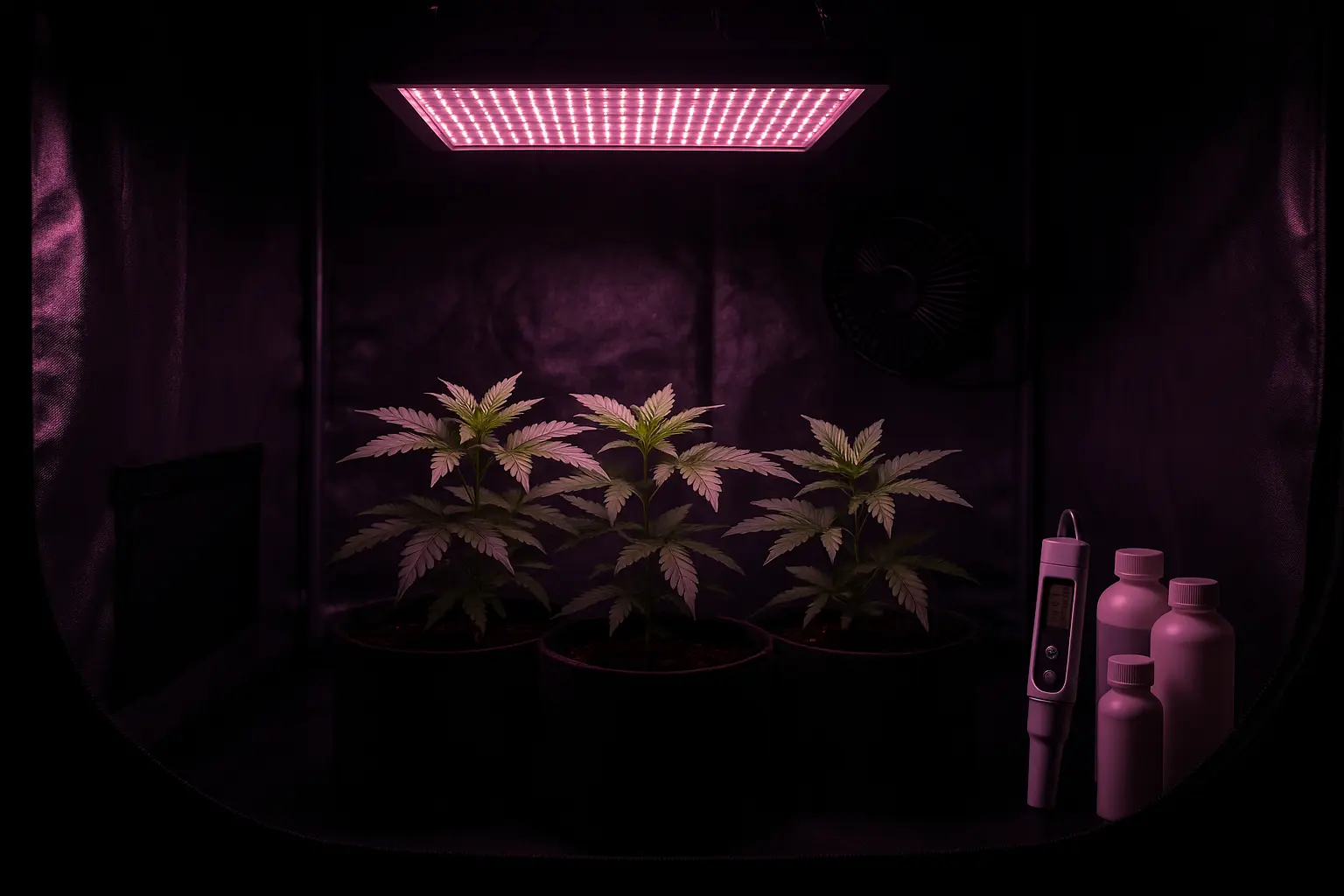
Master Your Indoor Grow
Indoor Growing Guides
Feminized vs Autoflowering Cannabis Seeds: Which Should You Choose?
Complete comparison of feminized vs autoflowering cannabis seeds — yield, grow time, difficulty, outdoor season. Which is right for Canadian conditions?
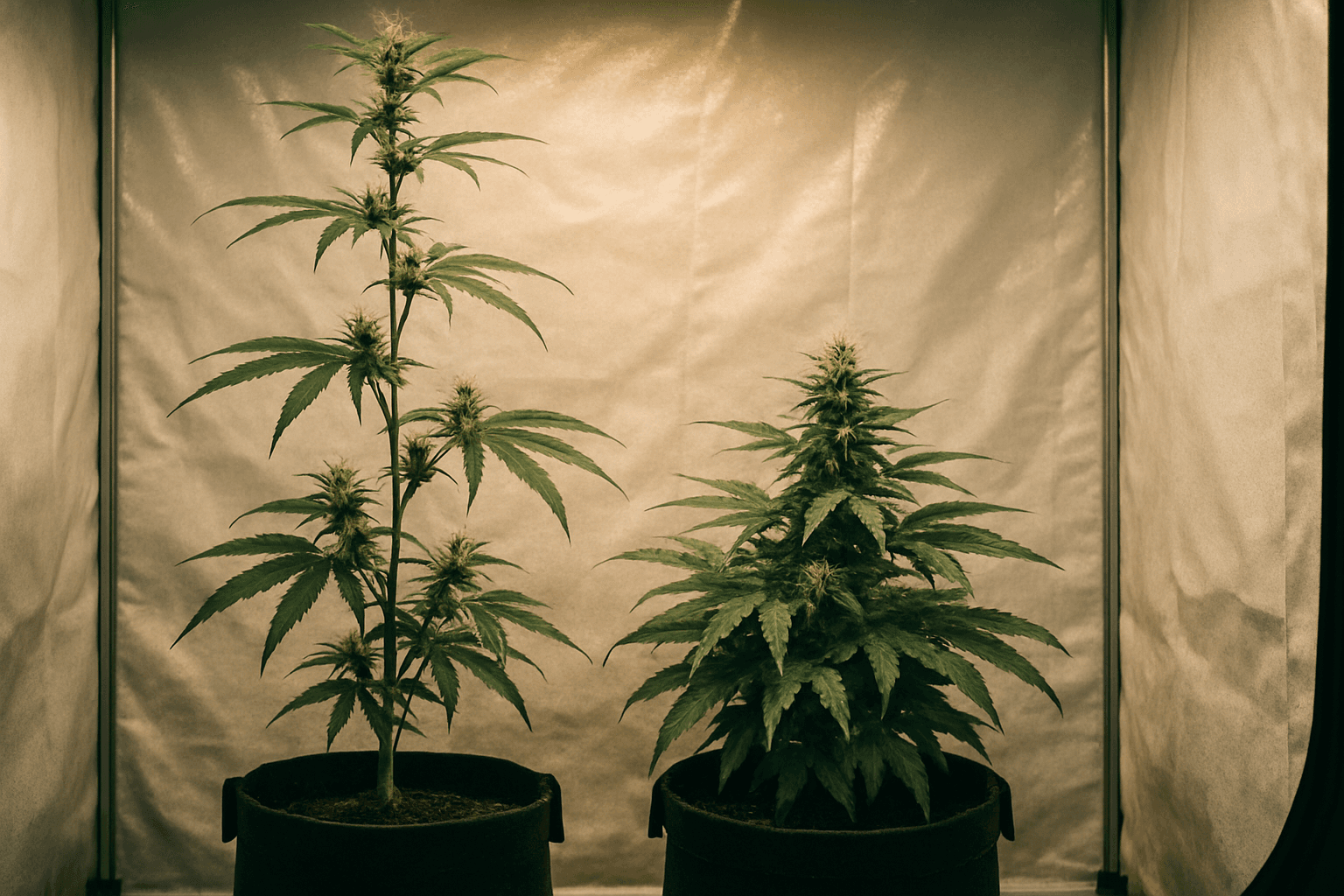
Autoflowering cannabis seeds complete full growth cycles in 60–75 days, flowering based on plant age rather than light hours thanks to Cannabis ruderalis genetics. This speed delivers practical advantages for Canadian growers: two or three outdoor harvests per summer, or rapid back-to-back indoor crops without resetting grow lights. Compared to feminized photoperiod seeds requiring extended light manipulation, autoflowering varieties sacrifice maximum yield for faster harvests, predictable timing, and climate resilience suited to Canada's variable conditions and short growing seasons—a strategic trade-off for cultivation efficiency.
Feminized seeds are bred to produce only female plants — the ones that develop the resinous, cannabinoid-rich buds you're after. By eliminating the roughly 50% chance of growing a male plant, feminized seeds let you dedicate every square centimetre of your grow space to productive plants. No culling half your crop at week four. No surprise pollination ruining a carefully tended harvest. Every seedling you germinate becomes a working plant.
The mechanics behind feminization typically involve stressing a female plant — through colloidal silver application or other methods — to produce pollen that carries only female (XX) chromosomes. The resulting seeds are genetically female. Reputable breeders test their feminization rates carefully; with quality genetics, near-100% female expression is standard.
Feminized photoperiod strains also give growers the most control over the entire growth cycle. Because flowering is triggered by a shift to 12 hours of darkness per day, you decide when your plants flip. That means you can veg for as long as your space allows — running plants under 18/6 for six, eight, even twelve weeks — to build large, bushy structures before switching to flower. Experienced growers use that window to apply training techniques like LST and ScrOG, bending and weaving canopy to maximize light penetration and dramatically increase yield per square metre. With enough veg time and proper training, a single feminized plant can fill an entire 1.2 × 1.2 m tent and return a harvest that would take several autoflower runs to match.
Autoflowering seeds carry genetics from Cannabis ruderalis, a subspecies native to the short-season, high-latitude regions of Central Asia and Eastern Europe. The critical trait ruderalis contributes is automatic flowering — these plants transition from vegetative growth to flowering based on age alone, typically around 3–4 weeks from germination, regardless of how many hours of light they receive each day.
The practical payoff is speed. Most quality autoflowering strains go from seed to harvest in 60–75 days, sometimes less. That compressed timeline opens up possibilities that simply don't exist with photoperiod plants: two or even three outdoor harvests in a single Canadian summer, or rapid back-to-back indoor cycles without ever adjusting your light timer.
That speed advantage is significant for indoor growers managing electricity costs as well. Shorter cycles mean lower cumulative power bills per gram produced, and the ability to run more cycles per year means your equipment earns its keep faster. For outdoor growers in Quebec and other northern provinces, timing the first autoflower seed around the long days of late May means a finished harvest by late July — well before any threat of early-autumn mould or frost.
Autoflowers also tend to stay compact — commonly reaching 60–100 cm in height — making them ideal for balcony grows, small tents, or any situation where stealth or space is a constraint. Their small footprint means you can run several plants under a single modest light without crowding, increasing variety without increasing your overall operation size. Growers who enjoy sampling multiple cultivars at once often prefer autoflowers for exactly this reason.
Modern autoflowering genetics have advanced dramatically over the past decade. Today's autos from reputable breeders deliver dense, high-potency buds that rival many photoperiod strains, while remaining far more forgiving of beginner mistakes like minor light leaks, inconsistent feeding schedules, and environmental fluctuations. Early-generation autos had a reputation for modest THC levels and airy buds — that reputation is now largely obsolete. Premium auto genetics can express complex terpene profiles, high resin production, and potency figures that would have been associated only with elite photoperiod cuts a few years ago. The trade-off is that autoflowers are less responsive to aggressive training; because their veg window is fixed, techniques like topping require precise timing and a light touch. Low-stress training (LST) — gently bending and tying branches outward — remains compatible and effective, but growers cannot rely on extended recovery periods the way they can with photoperiod plants.
Looking at both types side by side makes the trade-offs clear.
Yield: Feminized plants generally produce more per plant — often 400–600g+ indoors with proper training — while autoflowers typically yield 50–200g per plant, though multiple runs per year can close the annual gap. An indoor grower running four autoflower cycles annually in the same tent a single photoperiod grow would occupy can, with good genetics and dialled-in technique, match or exceed the annual gram output of the photoperiod route. The right comparison is annual yield per watt, not yield per plant.
Time to harvest: Autos win decisively at 60–75 days versus 90–120+ days for most feminized strains. Factor in veg time for photoperiod plants — typically four to eight weeks indoors — and the total cycle from seed to harvest can stretch to five or six months for a heavily trained feminized plant. That is a meaningful commitment in time, attention, and resources.
Light control: Feminized plants require strict light-schedule management indoors; even a small light leak during the dark period can interrupt flowering, cause stress, or in extreme cases trigger hermaphroditism. Autos perform well under any consistent light schedule (18/6 is popular) and forgive irregularities. This makes autoflowers particularly well-suited to shared spaces, mixed-use rooms, or any environment where maintaining a perfect 12-hour blackout is difficult.
Outdoor window in Canada: Autos are far better suited to Canada's shorter growing season, finishing before September frosts in most provinces; photoperiod plants need a full season from May to October and may struggle in northern regions. In Quebec specifically, the risk of early cold snaps in September can catch late-finishing photoperiod strains before they reach peak ripeness. Autoflowers planted in late May or early June finish comfortably in summer heat and can even allow a second outdoor run before the season closes.
Difficulty: Autos are more beginner-friendly overall. Their fixed timeline removes one layer of decision-making — there is no light flip to manage, no veg-length judgment call to make. That simplicity lets newer growers focus on nailing the fundamentals: clean water, proper pH, adequate but not excessive nutrients, and good airflow. Feminized photoperiod strains reward growers who are ready to invest in learning more advanced techniques and who want the flexibility to push plants to their structural limits.
Cost: Feminized seeds are widely available at accessible price points, while premium auto genetics can carry a slight price premium — so you can choose based on your growing goals and climate, not budget. Shop premium cannabis seeds both represent excellent value when yields are factored in.
Whether you're drawn to the speed and simplicity of autoflowering genetics or the yield potential and training flexibility of feminized photoperiod strains, Premium Parlour Seeds carries a curated selection of both — sourced from world-class breeders and selected for performance in Canadian conditions. If you are just starting out, a fast autoflowering strain lets you complete a full grow and learn from it before the season changes. If you have a few grows under your belt and want to push your setup further, a high-yielding feminized photoperiod strain will reward the extra attention you are ready to give it. Browse our full seed catalogue to find the perfect match for your grow space, your season, and your goals.
FAQ
What's the main difference in growing time between feminized and autoflowering plants?
Autoflowering plants complete their entire lifecycle in 8–12 weeks from germination, transitioning to flower automatically around week 3–4 based on age alone. Feminized photoperiod plants give you full control—you can veg them for as long as your space allows (weeks to months) before switching to a 12/12 light schedule to trigger flowering, making the total timeline much longer but far more flexible depending on your goals.
Can I use training techniques like LST and ScrOG on autoflowering plants?
Yes, but timing is critical—autoflowers have a narrow window before they automatically flip to flower. You can apply gentle training in the first 2–3 weeks of life, but aggressive techniques like heavy bending or extensive weaving work best on feminized plants, which give you 6–12 weeks of veg time to build structure and maximize your canopy before flowering.
Which is better for a beginner grower?
Autoflowers are often recommended for beginners because they're forgiving—there's no need to flip light cycles, and all plants are female so culling males isn't a concern. However, feminized plants offer more control and learning opportunities for advanced techniques, so the best choice depends on whether you value simplicity and speed or flexibility and higher yields.
Do feminized plants produce significantly higher yields than autoflowers?
Feminized photoperiod plants typically yield more per cycle when given adequate veg time and proper training, since they can grow much larger before flowering and allow you to maximize light penetration through the entire canopy. Autoflowers yield less per plant due to their smaller overall size, but you can run multiple cycles in the time it takes one long feminized grow, making annual harvests competitive if space is optimized.
Can I control when autoflowering plants start to flower?
No—autoflowers flower automatically based on age, typically around week 3–4, regardless of light schedule or environmental conditions. This removes the need to manage complex lighting but also means you can't extend the vegetative phase to build larger plants, unlike feminized photoperiod strains where you have complete control over the flowering trigger.
19+ | Educational horticulture only.