Master Your Indoor Grow
Indoor Growing Guides
When and How to Harvest Cannabis: Trichomes, Flushing & Curing
Know exactly when your cannabis is ready to harvest — trichome colour guide, pistil method, flushing, harvest day steps, drying and curing.
Harvest cannabis when trichomes shift from clear to milky-white, signalling peak THC. The pistil method offers a backup: harvest when 50-70% of pistils darken. After cutting, dry buds in darkness for 10–14 days. For curing, pack dried buds loosely into wide-mouth mason jars filled to 75% capacity and add a 62% Boveda humidity pack. In the first two weeks, open jars once or twice daily—called burping—to exchange air and develop terpene complexity. This final stage transforms good cannabis into premium quality with exceptional flavour.
From seed selection to the final cure, every decision you make shapes what ends up in the jar. The harvest and post-harvest process is the last opportunity to honour all the work that came before it — and when done right, the difference is unmistakable. Plantation Premium Seeds genetics are bred for exceptional trichome production and terpene complexity. Give them the finish they deserve. Shop premium cannabis seeds
Reading Trichomes: Knowing When to Cut
Harvesting at the right moment is the single most impactful decision you'll make during the entire grow cycle. Cut too early and you sacrifice potency, yield, and terpene development. Wait too long and THC degrades into CBN, shifting the effect toward sedation and reducing the crisp, complex high that premium genetics are capable of delivering.
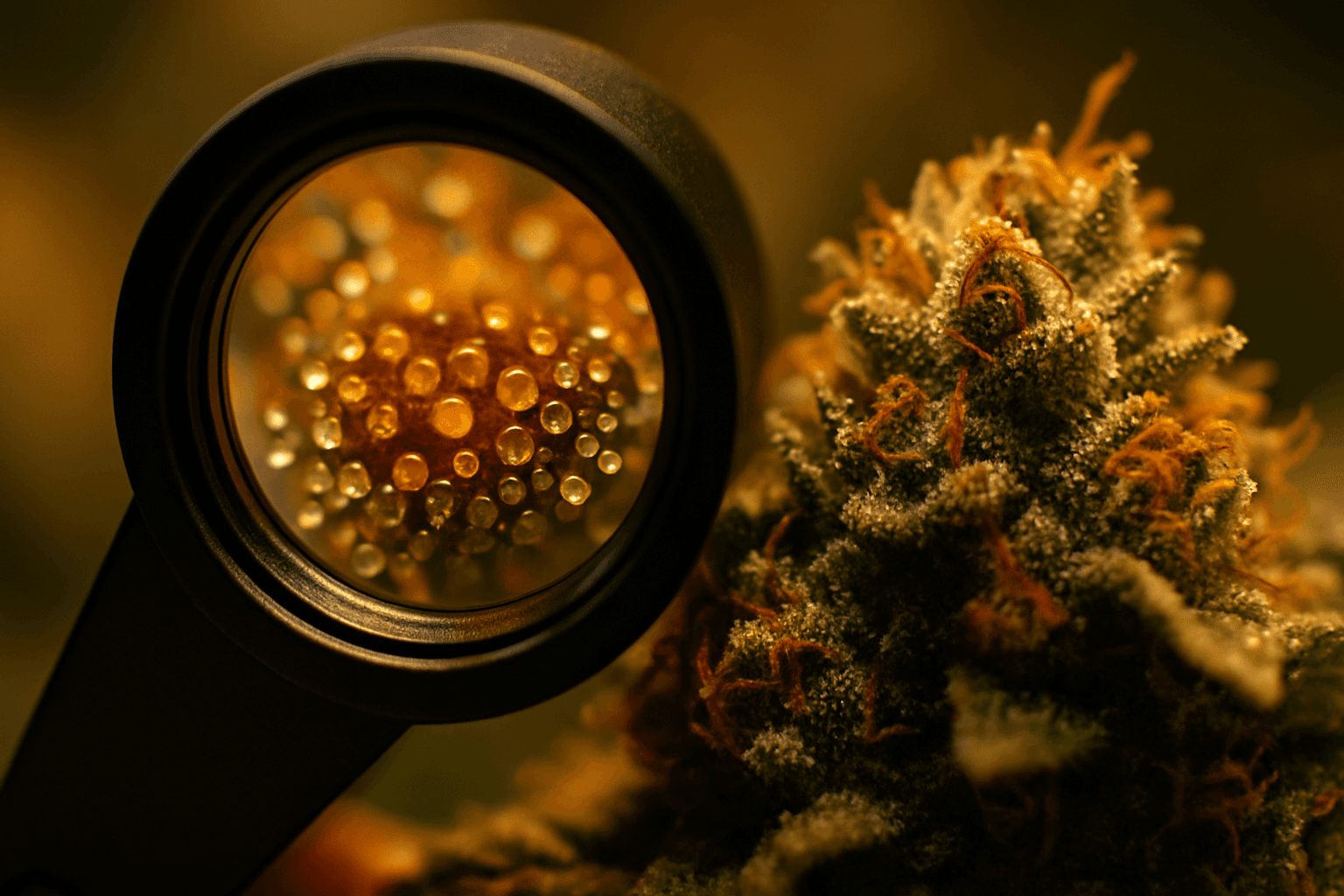
The most reliable method is a jeweller's loupe (30–60×) or a digital microscope. Both are inexpensive and allow you to examine individual trichomes on the calyxes of the buds directly. Skip the sugar leaves and fan leaves: their trichomes mature faster and make the plant look riper than it is (see our trichome guide). What you're looking for is the stage of development across the resin glands:
- Clear trichomes: the plant is still building resin. Do not harvest yet — cannabinoids are still accumulating.
- Cloudy/milky trichomes: THC is at or near peak. The effect will be more cerebral and energetic. Most sativa-dominant strains are best harvested here or just as amber begins to appear.
- Amber trichomes: THC is converting to CBN. Amber adds body weight and sedation to the effect. Most indica-dominant strains benefit from 10–20% amber mixed with predominantly cloudy trichomes for a balanced harvest.
Beyond trichomes, secondary indicators help confirm your read: pistil colour (50–70% orange or red suggests maturity), swollen calyxes, and a strong, pungent aroma that has fully developed. These cues together paint a complete picture.
Up north, frost and fall rain often decide before the plant does. Our guide to a late cannabis harvest in a northern climate covers how far into October you can push.
Flushing: Clean the Slate Before You Cut
If you've been growing in soil or coco with synthetic nutrients, flushing in the final 1–2 weeks before harvest is a widely practised step that many experienced growers swear by for smoother, cleaner-tasting smoke. The process is straightforward: switch to plain, pH-adjusted water (6.0–6.5 for soil, 5.8–6.0 for coco) and run it through your medium to dissolve and carry away accumulated nutrient salts. Some growers use a commercial flushing agent to speed this up, though plain water works well over the full flush window.
The volume of water matters. A thorough flush typically requires two to three times the container volume run through the medium in a single session. A 10-litre pot, for example, should receive 20–30 litres of water to effectively strip salt buildup from the substrate. Runoff EC (electrical conductivity) is the best objective indicator of how your flush is progressing — aim to bring your runoff EC down close to the EC of your input water before you consider the flush complete.
Signs your flush is working include yellowing fan leaves as the plant draws on its remaining stored nutrients — this is normal and expected. The plant is essentially consuming itself from the bottom up, prioritising energy toward finishing the buds. Do not panic or reach for nitrogen. This leaf yellowing is the outcome you want in the final week.
If you're growing organically, with living soil or compost teas, skip the flush entirely. Your microbial ecosystem is already buffering nutrient availability naturally, and flushing would disrupt that balance without any benefit. Organic grows often produce some of the cleanest-tasting results without any flushing at all, precisely because the soil food web regulates nutrient uptake throughout the cycle.
Harvest Day: Setup and Technique
Set your harvest up for success with a few key practices. Cut at the end of the dark period. Outdoors, we harvest at night, between midnight and first light, as late as possible before the sun reaches the buds; indoors, cut before the lights come on. A 2025 study measured a 31% drop in flower sesquiterpenes from the start to the end of the day, the start being lights-on in that indoor study (Dimopoulos et al., Journal of Experimental Botany). A long dark period before the chop (24 or 48 hours) is common indoors, but no published study has measured its effect yet; outdoors, from late September on, nights already run longer than 12 hours. The full reasoning is in our guide to the best time of day to harvest cannabis.
Work in a cool, clean environment. Trichomes are fragile and heat-sensitive; a warm room causes resin to become sticky and increases handling losses. Keep tools — scissors, pruning shears, trimming trays — clean and sharp. Residue builds up quickly; wipe blades with isopropyl alcohol between plants to prevent cross-contamination and maintain clean cuts.
Wet trimming (trimming while the plant is fresh) is faster and easier because the leaves are firm and distinct from the bud. It suits high-humidity climates where mould risk during drying is a concern. Dry trimming (leaving leaves on during the dry and trimming after) is slower but produces a gentler dry with more buffer against over-drying in low-humidity environments. Choose based on your conditions, not convention. If the buds are frozen at harvest, let them thaw in the drying room before trimming, or the trichomes will snap off.
Hang whole branches or cut individual bud-bearing branches and arrange them on drying racks depending on your space and airflow setup. Either method works — what matters most is consistent environment control in the days that follow.
Drying: Slow Is Better
The drying phase is where a significant portion of your final flavour profile is either preserved or lost. Rushing it with heat or aggressive airflow drives off terpenes before they have a chance to fully express in the cured product. Target a slow, controlled dry over 10–14 days in an environment maintained at 18–21°C with 50–60% relative humidity. Keep the space dark — UV light degrades cannabinoids — and use a small fan for gentle air circulation, never pointing directly at your buds.
Consistency matters more than hitting a perfect number. Wild swings in humidity or temperature — a door left open, a heater cycling on and off — stress the buds and can cause uneven drying where the outside crisps while the core remains wet. A basic hygrometer and thermometer placed near your drying space will tell you everything you need to know. If humidity climbs above 65%, run a small dehumidifier. If it drops below 45%, a passive humidifier or damp towel in the space can buy you time.
Your branches are ready to move to cure when the smaller stems snap cleanly rather than bending, and the outside of the buds feels dry to the touch while still retaining a slight give at the core. The interior of the bud should still carry some moisture — if it crumbles completely on the outside, your dry went too fast and the cure will suffer for it.
Resist the urge to rush. A nine-day dry at elevated temperature is not equivalent to a 12-day dry at 19°C. Every day you spend in the dry room at the right conditions is time that your terpene profile is being preserved rather than evaporated away.
Curing: Where Good Cannabis Becomes Great
Curing is where good cannabis becomes great cannabis. Pack your dried buds loosely into wide-mouth mason jars, filling them to about 75% capacity to leave room for air exchange. Avoid overpacking — compressed buds trap moisture and dramatically increase mould risk. If you're working with a large harvest, use multiple smaller jars rather than one large vessel. More surface area, more consistent results.
Drop a 62% Boveda humidity pack into each jar to maintain ideal moisture levels and protect against mould or over-drying. These packs are bidirectional — they add moisture when the environment is too dry and absorb it when humidity climbs — making them one of the most practical tools available to home growers. Replace them when they become rigid and dry.
For the first two weeks, open your jars once or twice daily — a process called burping — for 10–15 minutes to release built-up moisture and replenish oxygen. If you detect any ammonia smell or feel excess moisture, leave the lids off for longer. Ammonia odour is a warning sign of anaerobic bacterial activity; catch it early and you can recover the batch by extending the burp window. A faint, grassy or hay-like smell is common in the first few days and typically fades as the cure progresses. After two weeks, weekly burping is sufficient.
Aim for a minimum cure of four weeks; eight weeks or longer develops genuinely complex terpene profiles and noticeably smoother smoke. The enzymatic and chemical processes at work during curing — chlorophyll breakdown, moisture redistribution, further terpene development — cannot be shortcut with heat or machinery. Time is the active ingredient. Store jars in a cool, dark location throughout. A cupboard away from heat sources, or a dedicated curing box, works perfectly. Long-term storage beyond three months benefits from temperatures closer to 15°C and a vacuum-sealed jar to slow oxidation.
The patience you bring to the cure is the last variable between a good harvest and an exceptional one. Premium genetics deserve the full timeline — don't shortchange the finish.
FAQ
What percentage of amber trichomes should I aim for when harvesting?
Most indica-dominant strains benefit from 10–20% amber mixed with predominantly cloudy trichomes for a balanced harvest. Sativa-dominant strains are typically best harvested when trichomes are mostly cloudy with just the earliest amber beginning to appear, as this preserves the energetic, cerebral effect. The specific ratio depends on whether you prefer a more uplifting effect (less amber) or more body weight and relaxation (more amber).
Is a jeweler's loupe necessary, or can I tell trichome color without one?
A jeweler's loupe (30–60×) or digital microscope is essential for accurately reading trichome maturity—individual glands are too small to assess reliably with the naked eye. Without magnification, you risk harvesting too early (losing potency and complexity) or too late (allowing THC to degrade). These tools are inexpensive and the difference they make in harvest consistency and quality is unmistakable.
My plants aren't ripening evenly—can I stagger the harvest?
Yes, you can harvest plants or individual bud sites on different days as they reach your target trichome stage. Trichomes at the top of the canopy mature faster than lower buds, so staggering allows you to harvest each zone at its optimal moment rather than compromising on timing. This approach maximizes both potency and effect consistency across your entire crop.
How do pistil color and trichome color work together as harvest indicators?
Pistil color (aiming for 50–70% orange/brown) serves as a secondary confirmation of what you read in the trichomes under your loupe. Always use the trichome examination as your primary method—this is your most reliable signal. Let pistil color back up your decision and give you confidence that you're harvesting at the right moment.
What's the real difference between harvesting at cloudy versus amber trichomes?
Cloudy/milky trichomes indicate THC is at peak, delivering a more cerebral, energetic effect with crisp, complex flavours. Amber trichomes signal THC is converting to CBN, which adds body weight, sedation, and a heavier feel to the experience. Understanding what effect you want from your harvest should guide your trichome timing.
19+ | Educational horticulture only.