Master Your Indoor Grow
Indoor Growing Guides
Cannabis pH Guide: Why It Matters and How to Fix It
Complete cannabis pH guide — ideal ranges for soil and hydro, how to test pH, adjust with pH up/down, and recognize nutrient lockout symptoms.
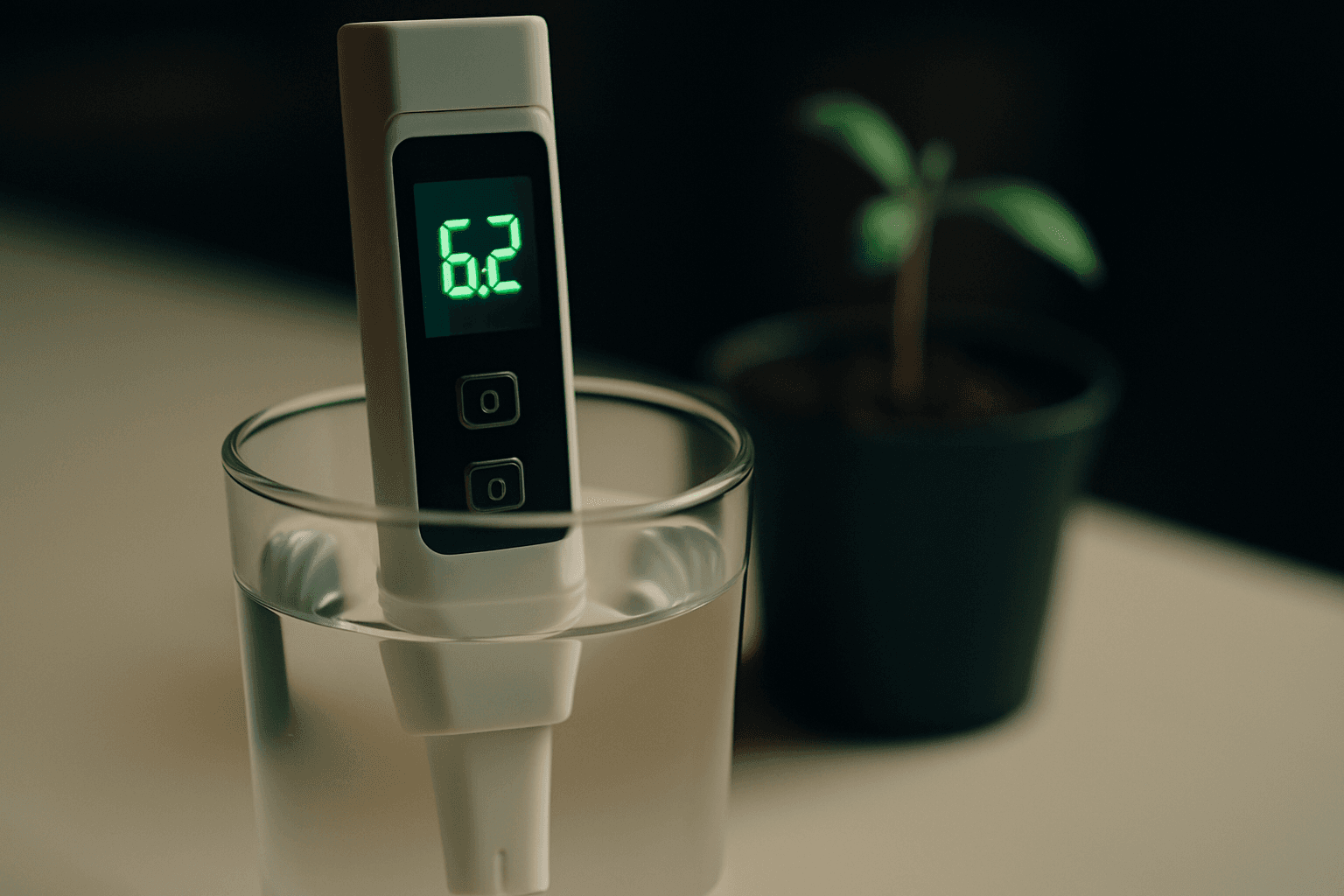
Cannabis pH directly impacts nutrient availability and plant health—getting it wrong causes nutrient lockout and mysterious growth problems. A $20 digital pH meter (typically $15–$30 CAD from brands like Bluelab or Apera) is the highest-return investment for any home grow. Test regularly and adjust carefully using a basic pH Up/Down kit. The critical habit: calibrate your meter using pH 4.0 and 7.0 solutions before testing. Precise readings to one decimal place prevent expensive nutrient problems before they start. Skip guesswork; invest in a quality meter and consistent measurement to unlock the full potential of your genetics and equipment.
Every dollar spent on premium genetics, quality lights, and specialty nutrients delivers less value if your pH is off. A $20 digital pH meter, a bottle of calibration solution, and a basic Up/Down kit are the highest-return investment in any home grow setup. Measure consistently, adjust carefully, and most 'mysterious' plant problems will stop being mysterious. Shop premium cannabis seeds
pH — potential of hydrogen — is a measure of how acidic or alkaline your water and root zone are, on a scale from 0 (battery acid) to 14 (drain cleaner), with 7 being neutral. Cannabis thrives in a slightly acidic environment, and that's not arbitrary. The chemistry of nutrient solubility is pH-dependent: each mineral element — nitrogen, phosphorus, potassium, calcium, iron, zinc, and a dozen others — has a specific pH window where it can dissolve into the water and be absorbed by roots. Step outside that window, even slightly, and your plants physically cannot take up what you're offering them, no matter how precisely you've mixed your feed.
The frustrating part is that pH lockout mimics deficiencies almost perfectly. A plant starved of iron because pH is too high looks nearly identical to a plant grown in soil with no iron at all. Without measuring pH, you're guessing — and growers who guess usually spend money chasing ghost deficiencies that were never there.
If your cannabis plants are yellowing, showing spots, or refusing to thrive despite a solid feeding schedule, pH is almost certainly the culprit. Studies and experienced growers consistently point to pH imbalance as the root cause of roughly 80% of apparent nutrient problems in home grows. You could be feeding your plants perfectly formulated nutrients and still watch them starve — because if your root zone pH is off, those nutrients simply won't absorb. Understanding and managing pH isn't advanced cultivation; it's the absolute baseline.
Some of the most common 'deficiency' symptoms growers troubleshoot are actually pH-driven lockout. Here's how they typically present:
- Iron deficiency (interveinal chlorosis): New growth turns yellow while leaf veins stay green. Almost always triggered by pH creeping above 7.0 in soil or above 6.5 in coco/hydro. Iron becomes nearly insoluble at higher pH values.
- Calcium and magnesium deficiency: Brown leaf edges, spots, and curling. Ca/Mg uptake is strongly inhibited when pH drops below 6.0 in soil or below 5.5 in hydro systems.
- Phosphorus deficiency: Dark green or purple-tinged leaves, slow growth, poor bud development. Phosphorus locks out both at very low pH (below 5.5) and at very high pH (above 7.0).
- Zinc and manganese issues: Mottled leaves, stunted internodes. These micronutrients have extremely narrow optimal pH windows and are the first to go when pH drifts.
Your testing method determines how accurately you can manage your grow. Here's what's available:
Digital pH meter (strongly recommended): A quality pen meter costs between $15–$30 CAD and gives you precise readings to one decimal place. Brands like Bluelab, Apera, and even budget options from Amazon perform reliably when maintained properly. The single most important habit: calibrate regularly using pH 4.0 and 7.0 buffer/reference solutions. These are inexpensive sachets or bottles that keep your readings accurate. An uncalibrated meter is worse than no meter — it gives you false confidence.
Calibration should happen at minimum once a week during an active grow, and always after the meter has been dropped, exposed to extreme temperatures, or stored dry for more than a few days. The process takes under two minutes: rinse the probe, dip it in your 7.0 buffer solution, adjust to match, then verify with the 4.0 solution. Most meters have a simple calibration button. If your meter reads 6.8 in a confirmed 7.0 solution, every measurement you've taken since the last calibration is suspect.
For the probe itself: never let it dry out completely. Store it immersed in proper electrode storage solution — a potassium chloride solution available from any hydro shop. Storing in plain tap water or distilled water will cause the glass membrane to degrade faster. A probe that's been stored dry for weeks will give sluggish, inaccurate readings until it's rehydrated, which can take hours.
pH drops (liquid reagent kits): Affordable and functional, but colour-matching introduces human error. Useful as a backup or for quick field checks, especially in outdoor setups where bringing a meter isn't practical. The resolution is limited — you can typically distinguish 6.0 from 7.0 but not 6.2 from 6.5.
Litmus paper: Least accurate option. Fine for a rough check, unreliable for dialling in a grow. Avoid relying on it as your primary tool. The colour gradients on litmus strips simply don't have the resolution needed to catch the 0.3–0.5 drifts that cause lockout.
Always test your water after adding nutrients and after pH adjustment — never before. Nutrients and additives change the pH of your solution, sometimes dramatically. Adding pH Up or Down to plain water and then mixing in nutrients will give you a final pH completely different from what you adjusted to. Build the habit: mix nutrients first, check pH second, adjust third, check again to confirm.
Different growing media have different chemistry, which is why pH targets vary by system:
- Soil: 6.0–7.0 (sweet spot around 6.3–6.8). Soil contains organic buffers and microbial life that tolerate and even benefit from slight fluctuation. The wider range also accounts for the natural breakdown of organic matter. In living soil and composted mixes, the biological activity itself helps buffer pH swings — one reason experienced organic growers often manage pH less aggressively than their hydro counterparts. That said, even organic soil grows can drift outside range, particularly when heavily fed with synthetic boosters or when the medium breaks down late in flower.
- Coco coir: 5.8–6.2. Coco is an inert medium that behaves like a hybrid between soil and hydro. It has a slight cation exchange capacity, so it needs a tighter, slightly lower range than soil. Coco also tends to hold calcium and magnesium on its surface through cation exchange, which is why Ca/Mg supplementation is standard in coco grows. Keep pH consistent here — coco has no organic buffer, so what you water at is what the roots experience.
- DWC/Hydro: 5.5–6.0. In fully hydroponic systems, roots are in direct contact with the nutrient solution at all times. Precision matters more here — even a 0.3 drift can noticeably affect micronutrient uptake. The reservoir itself will naturally drift upward as plants consume nutrients and water, so checking and adjusting daily is standard practice in DWC. A reliable auto-dosing system is a worthwhile investment at scale.
When adjusting pH, use dedicated pH Up (potassium hydroxide solution) and pH Down (phosphoric or citric acid solution) products. Add them in small increments — a few drops per litre — and re-test after each adjustment. pH solutions are highly concentrated and it's easy to overshoot, especially in small volumes. If you've swung too far in one direction, it takes more product to correct, and repeated large swings stress plants unnecessarily.
Establishing a consistent pH routine takes under five minutes per watering session once it becomes habit. Measure your source water, mix nutrients, check pH, adjust if needed, confirm, water. Log your readings in a notebook or phone note — even a simple table of date, pH in, pH runoff, and any adjustments. Over a few weeks, patterns emerge: you'll see if your tap water consistently comes in at 7.4, if your coco runoff drifts acidic in week five of flower, if certain nutrient combinations push pH in one direction. That data is what separates growers who chase problems from growers who prevent them.
The bottom line: pH management is not an advanced technique. It's the foundation everything else sits on. Premium genetics, dialled lighting, and quality nutrients are all multipliers — and pH is the number they all get multiplied against.
FAQ
What's the ideal pH range for cannabis, and does it differ by growing medium?
Cannabis thrives in 6.0–7.0 for soil and 5.5–6.5 for hydroponics or soilless media. Soil naturally buffers pH shifts, while hydroponic systems respond directly to adjustments, so hydro growers need more frequent monitoring. Staying within your medium's range ensures nutrients remain soluble and available to roots.
How do I know if pH lockout is causing my plant problems and not a real nutrient deficiency?
pH lockout typically triggers multiple deficiency symptoms at once—yellowing, spotting, and weak growth—despite using quality nutrients. If correcting your pH to the target range reverses symptoms within 3–5 days, it was lockout, not a missing nutrient. This is why measuring pH before buying more nutrients saves money and guesswork.
What's the fastest way to adjust pH if it's off?
Use a pH Up or Down product, following the bottle's dosing instructions—usually a few drops per gallon. Wait 15–30 minutes for the solution to stabilize, then re-measure with a calibrated meter. Small, frequent adjustments work better than large swings, which can stress your plants.
How often should I test my pH during a grow?
Check at least twice a week during active growth; daily is better if you're adjusting nutrients or feeding. Hydroponic growers should check daily because these systems drift faster than soil. A digital meter is a one-time investment that prevents lockout damage across multiple harvests.
19+ | Educational horticulture only.