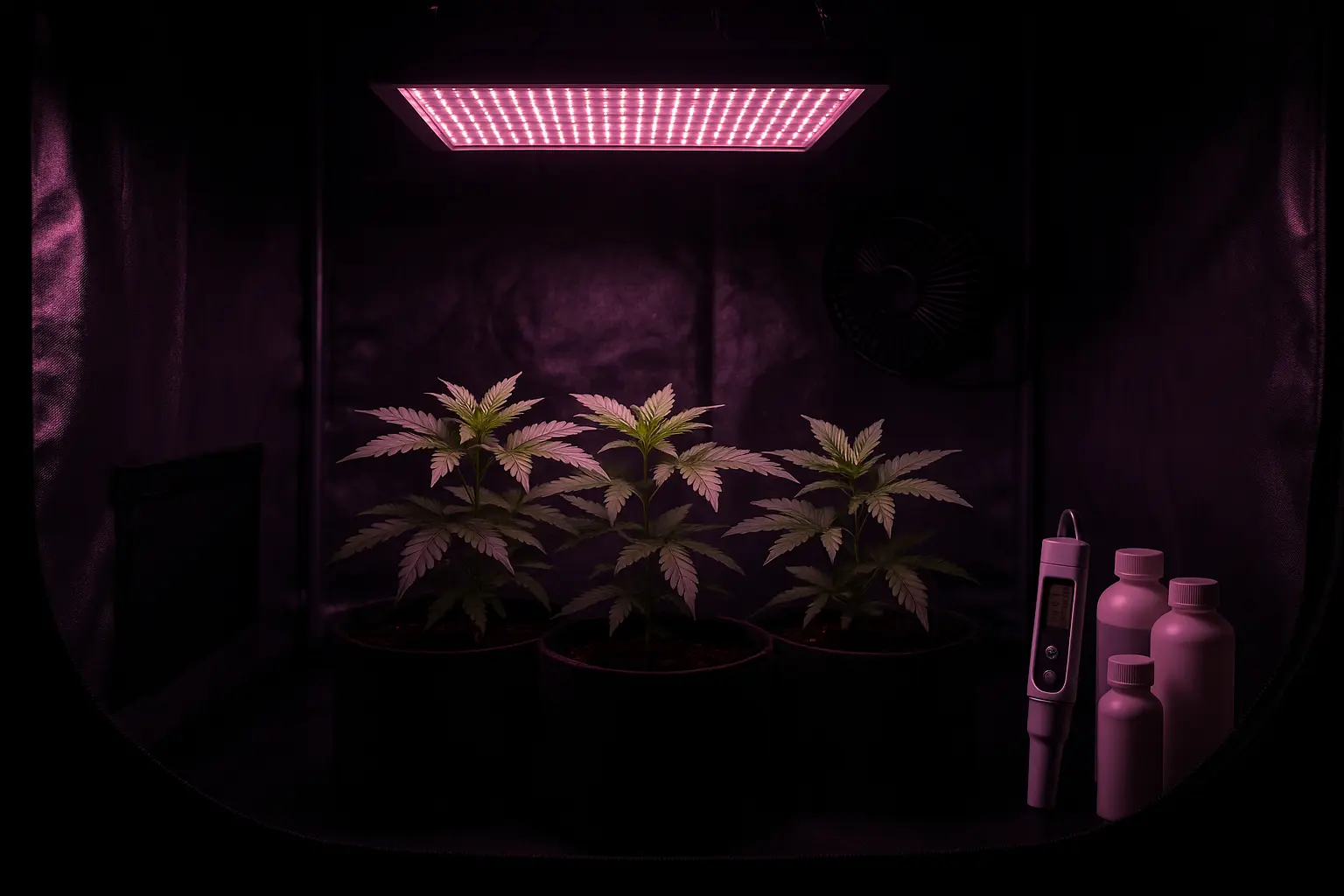
Master Your Indoor Grow
Indoor Growing Guides
Autoflowering Cannabis Growing Guide: Seed to Harvest in 70 Days
Complete autoflowering cannabis growing guide — timeline, key differences from photoperiod, training, feeding, and common beginner mistakes to avoid.
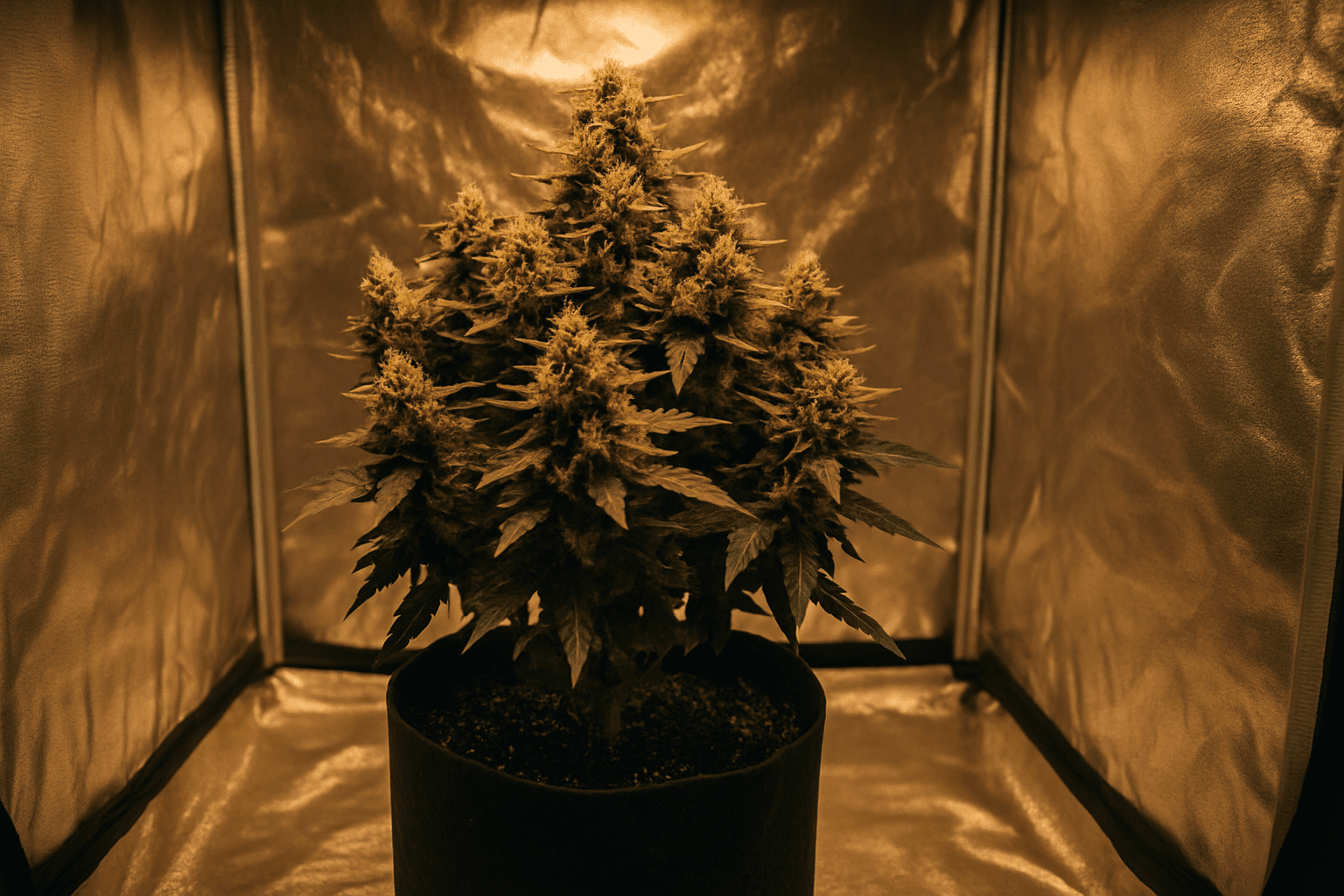
Autoflowering cannabis plants complete their entire lifecycle in approximately 70 days on their own internal schedule, requiring no photoperiod adjustments. During weeks 1–2 (seedling stage), maintain 65–70% humidity and 22–26°C temperatures with minimal watering and no feeding. Weeks 3–5 bring rapid vegetative growth—your window for training before buds form. Introduce light nutrients by week 3. Flowering begins around week 6, with preflowers and bud stacking continuing through week 10. This compressed timeline means autoflowering plants demand consistent conditions and faster nutrient response than photoperiod strains, but reward growers with a complete harvest in roughly 10 weeks from seed.
Quick answer: Autoflowering cannabis runs from seed to harvest in roughly 65-90 days on a fixed genetic schedule — no light-cycle change needed — making 3-4 harvests a year realistic for Canadian growers.
Key takeaways
- Full cycle in 65-90 days, no photoperiod switch required — genetics trigger flowering by age, not light hours.
- Never transplant an autoflower — germinate directly in the final container to avoid losing time you can't recover.
- LST is your main training tool; skip topping and FIM — the recovery time eats into a cycle with no slack.
- Start feeding at roughly 65-70% of photoperiod doses — autos are lighter feeders with a more sensitive root system.
- More forgiving of small mistakes than many growers assume, but a serious stress event costs time an auto simply doesn't have to recover.
What's the full autoflower timeline, week by week?
Knowing the calendar in advance is what lets you get ahead of each stage instead of reacting to it. Unlike photoperiod strains, you don't control when flowering starts — the genetics do that for you. That's both the main advantage and the main constraint of autos: every week counts, there's no extending veg to compensate, and mistakes get expensive fast.
Weeks 1-2 (Seedling stage): The seed germinates and the seedling pushes its first true leaves. Skip nutrients entirely, keep relative humidity around 65-70%, and use gentle, low-intensity light at 40-50cm distance. The root system is establishing itself — water in a ring around the seedling rather than right at the base to encourage outward root growth. Hold temperatures between 22-26°C and avoid any direct draft.
Weeks 3-5 (Vegetative stage): Growth accelerates hard. The plant develops nodes, branches, and its main structure — this is your window for any training (more on that below). Introduce nutrients at a light dose starting late week 3. A vigorous auto can easily clear 60cm by the end of its cycle, so plan your space accordingly now rather than later. Indoors, an 18/6 or 20/4 light schedule maximizes vegetative growth.
Weeks 6-10 (Flowering stage): The first pistils appear around week 6, and buds start stacking quickly. Shift your feeding toward a bloom formula — more phosphorus and potassium, less nitrogen. Start watching trichomes from week 9 onward. Humidity should drop progressively toward 45-50% to prevent bud rot, especially on denser phenotypes.
Week 11+ (Flush and harvest): Most autos are ready somewhere between 65 and 90 days from germination, though larger or higher-yielding phenotypes can push toward 100-105 days. Flush with plain, pH-adjusted water for 5-10 days, then harvest once 70-90% of trichomes have turned milky-to-amber depending on the effect you want — more milky for an energetic, cerebral effect, more amber for something heavier and more sedating. See our full harvest timing guide for the complete trichome colour breakdown and a step-by-step harvest day process.
How is growing an autoflower different from a photoperiod plant?
Growing an autoflower means adjusting a few habits if you're used to photoperiod strains.
No light-schedule change. You never need to flip from 18/6 to 12/12 to trigger flowering. Most growers run 18/6 the whole way through to maximize growth without burning extra electricity; some use 20/4, but the gains over 18/6 are marginal.
Smaller footprint, lower yield per plant. Most autos land between 50-100cm tall, which makes them ideal for closets, small tents, or balconies. The trade-off is a naturally lower yield per plant — autos generally cap out around 100-400 g/m² indoors, versus 500 g/m² or more for a well-trained photoperiod plant in the same space. Compensate by running several plants at once or stacking multiple cycles per year. For a fuller comparison of what each seed type actually offers, see our feminized vs autoflower vs Fast Version guide.
Faster, but with less room to recover than people often think. The same speed that makes autos appealing also limits how much you can intervene after a mistake. A photoperiod plant that hits a rough week in veg can simply extend its vegetative period to compensate — an auto can't. That said, autos are more tolerant of small, everyday slip-ups (a missed watering, a slightly off pH reading) than their reputation suggests; it's the two classic mistakes below — transplanting and overfeeding — that actually cause the damage growers blame on the strain itself.
No practical cloning. A clone taken from an auto inherits the mother plant's biological age and flowers on the same timeline, with almost no time left to develop real size or yield. Always start fresh from seed to get the genetics' full potential — which is also why picking stable, proven autoflowering genetics from a reputable seed bank matters more here than with photoperiods, where a weak seed can still be corrected with a longer veg.
Can you train an autoflower with LST or topping?
Training an autoflower correctly can meaningfully boost yield by improving light exposure across the canopy — but the rules differ from a photoperiod grow.
Low-Stress Training (LST) is your main tool. Gently bending and tying down branches to build a flat, even canopy lets more bud sites catch direct light without the kind of damage that takes weeks to bounce back from. Start LST between day 14 and day 21, once the plant has 4-5 nodes established — the right balance between having enough structure to work with and still leaving useful time before flowering locks in. See our training techniques guide for the full method.
Avoid topping and FIMing entirely. These high-stress techniques need a week or more of recovery time. On an auto, that recovery period eats directly into an already-short vegetative window and can meaningfully cut into your final yield. Stick to gentle methods: LST, a light Screen of Green, or simply redirecting branches that are growing inward.
What are the most expensive mistakes to avoid?
Even experienced growers slip up on autos. These are the ones that cost the most.
Transplanting mid-cycle is mistake number one. Every transplant causes stress and a recovery delay the plant doesn't have time to absorb. Plant directly into your final container — ideally 3-5 gallons (11-15 litres) for most varieties — from the start, or do a single very early transplant (before day 10) only if genuinely necessary.
Overfeeding early is counterproductive. Young roots burn, the plant gets stressed, and you lose more time fixing the problem than you'd have saved by feeding heavier. Classic symptoms — burnt leaf tips, yellowing edges, downward curling — can take 48-72 hours to become visible, by which point the damage is already done. Always start below the recommended dose and adjust up from there.
Ignoring water quality blocks nutrient uptake no matter how good your feeding schedule is. A poorly adjusted pH is one of the most common causes of deficiencies that aren't actually deficiencies. For soil grows, aim for pH 6.0-7.0, ideally around 6.3-6.5; in hydro or coco, tighten that to 5.8-6.2.
Interrupting the light cycle with darkness. Unlike photoperiods, autos don't need a dark period to trigger or maintain flowering. Unplanned dark periods from a power outage or a timer failure won't re-veg your auto, but they do cost growth hours you can't get back.
How do you feed an autoflower correctly?
Autoflowers have a more sensitive metabolism than photoperiod varieties. The simple rule: start at roughly 65-70% of the dose recommended on your nutrient bottle for a photoperiod plant at the same stage, then adjust based on how the plant responds. See our full nutrient guide for a stage-by-stage breakdown.
Weeks 1-2: No feeding at all. A quality potting mix already carries enough baseline nutrition for a seedling — adding fertilizer this early risks a root burn that slows growth for the rest of the cycle.
Weeks 3-5 (vegetative): Gradually introduce a nitrogen-forward grow formula, starting at 50% of the recommended dose in week 3 and moving up to 75% if the plant responds well (short internodes, broad dark-green leaves). Avoid exceeding 100% of the recommended dose for autos even in late veg.
Weeks 6-10 (flowering): Shift to a phosphorus- and potassium-heavy bloom formula while reducing nitrogen. Keep EC between 1.2-1.8 mS/cm for most varieties — beyond that range you risk salt buildup.
Weeks 10-11 (flush): Plain, pH-adjusted water only. Let the plant's internal reserves deplete naturally to maximize aroma and flavour at harvest.
Conclusion
Autoflowering cannabis remains one of the best entry points into home cultivation — fast turnaround, a manageable plant size, and the ability to run 3-4 full harvests a year in a standard Canadian setup. Get the fundamentals right (final pot from day one, gentle LST only, controlled feeding) and autos consistently reward growers who respect the timeline instead of fighting it. Outdoors, they fit Canada's short summers well: sown in May, harvested by August, comfortably ahead of the first September frost in most regions.
FAQ
How long does it really take to grow autoflowers?
Most autoflowers are ready from seed to harvest in 65–85 days, though faster varieties can finish in 60 days and heavier-yielding strains may take up to 90 days. The accelerated timeline means every week counts, so proper care during each stage is critical to hitting your target harvest date.
Can I transplant my autoflower to a bigger pot?
No — never transplant autoflowers. The root disturbance and recovery time eat directly into your limited grow window and can set your plant back by weeks. Germinate directly into your final container (a 3–5 gallon pot works well for most indoor autos) from the start.
When should I start feeding nutrients to my autoflower?
Avoid feeding during the seedling stage (weeks 1–2) and focus only on light watering. Start introducing light nutrients by week 3 when the plant enters the vegetative stage, then gradually increase feeding as it moves into flowering (weeks 6–10) when nutrient demands are highest.
What humidity and temperature do I need during flowering?
During the flowering stage, keep temperatures steady at 20–24°C and lower humidity to 45–55% RH to prevent mold and maximize resin production. Since autoflowers are on a fixed timeline and can't recover from stress like photoperiod plants, maintaining these stable conditions is essential.
19+ | Educational horticulture only.