From Seed to Seedling
Germination Guides
Complete Cannabis Seed Germination Guide
Germinate cannabis seeds successfully with proven techniques. Learn the paper towel method, optimal temperature, and timing for fast sprouting results.
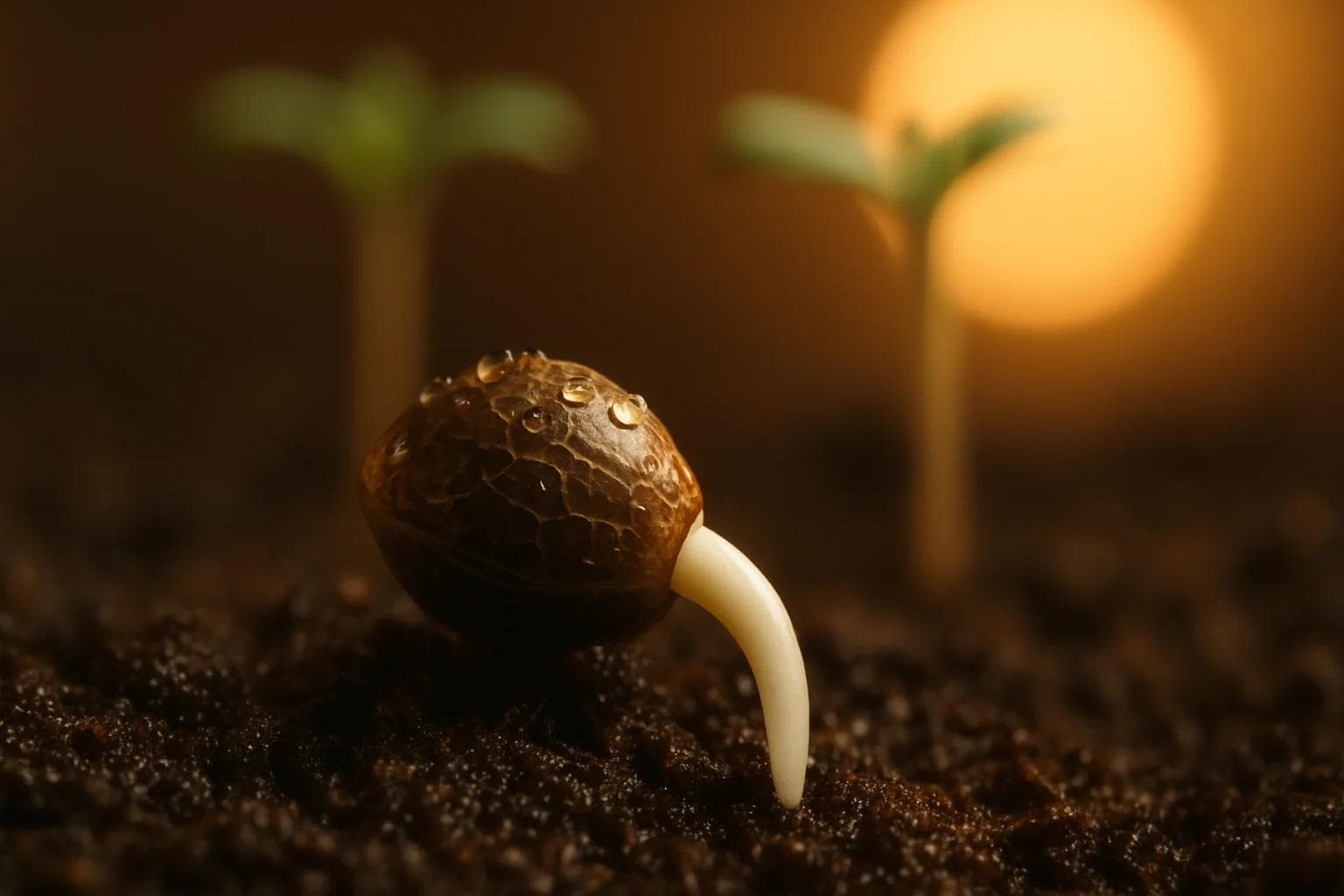
Cannabis seeds germinate when exposed to consistent warmth (22–25°C), stable moisture, darkness, and fresh air. Most seeds produce a taproot within 24–72 hours using the paper towel method. Once the taproot reaches 1–2 cm, plant it root-down, 0.5–1 cm deep in pre-moistened medium, and move to your growing setup.
You have seeds in hand. The hard part — choosing genetics — is done. What happens in the next 24 to 72 hours determines whether those seeds become vigorous seedlings or stay inert shells. Germination is the simplest stage of the cannabis grow cycle, but it's also the stage most often botched by beginners making entirely preventable mistakes.
This guide covers everything: the biology inside the seed, the four environmental conditions that control success, every major germination method with a clear comparison, the most common failure modes, and what to do the moment your taproot appears. Growing indoors in Toronto under Canada's 4-plant legal limit or running a small setup in Denver — the same principles apply either way.
No hype, no guesswork. By the end, you will know exactly what to do and exactly why.
What Is Cannabis Seed Germination and Why Does It Matter?
Cannabis seed germination is the biological process by which a dormant seed absorbs water, activates its embryo, and pushes out a radicle — the first root, called the taproot — that anchors the plant and begins drawing nutrients from the grow medium. It is the transition from inert seed to living plant.
It's also the only point in the cannabis lifecycle where you have zero margin for error. A plant that germinates poorly — cracked seed coat, stunted taproot, fungal contamination — carries that weakness through every subsequent stage. Starting clean, warm, and controlled gives your genetics the best possible expression from day one.
What's Inside a Cannabis Seed?
Understanding seed anatomy explains every germination rule you will follow. A cannabis seed (Cannabis sativa) contains three key components:
The embryo is the living plant in miniature — the future root system (radicle), shoot (plumule), and the first seed leaves (cotyledons) are all pre-formed inside. The embryo is metabolically dormant until water triggers enzymatic activation.
The endosperm is the energy reserve — a compact mass of starches and lipids that fuels the embryo's initial growth before it can photosynthesize. This is why seedlings do not need nutrients or light during germination itself.
The seed coat (testa) is the protective outer shell. A hard, dark, tiger-striped seed coat signals a mature, viable seed. Pale, soft, or cracked seed coats are red flags for viability problems. How to check if your seeds are viable before germinating
When water penetrates the seed coat — a process called imbibition — it rehydrates the endosperm and triggers enzyme cascades that begin breaking down stored energy. The embryo wakes up, the radicle elongates, and germination is underway. This is why moisture control is non-negotiable: too little and imbibition fails, too much and the seed drowns or rots.
What Are the Four Conditions Cannabis Seeds Need to Germinate?
Every successful germination method — paper towel, water soak, direct soil, starter plug — delivers the same four conditions: warmth, moisture, darkness, and air. These are not preferences. They are the biological triggers the embryo requires to activate.
What Temperature Do Cannabis Seeds Need to Germinate?
Cannabis seeds germinate most reliably between 22°C and 25°C (72–77°F). At 18°C or below, enzymatic activity slows sharply — germination stalls or fails entirely. At 28°C and above, the seed coat may dry out too quickly between moisture checks, and fungal contamination risk rises. The sweet spot is 22–25°C, consistent, not fluctuating.
In practice: Vancouver's mild winters still mean ambient indoor temperatures can drop to 18°C near windowsills. Ottawa and Calgary growers dealing with forced-air heating face a different problem — dry air that pulls moisture from paper towels faster than expected. In both cases, a seedling heat mat set to 22–24°C solves the problem reliably and costs under $30. It's one of the few pieces of gear that actually earns its place.
Do Cannabis Seeds Need Light or Darkness to Germinate?
Cannabis seeds require darkness during germination. Light exposure triggers photomorphogenic responses in the embryo that are counterproductive at this stage — it can inhibit radicle elongation and signal the plant to divert energy away from root development. Keep your germination setup in a dark drawer, cabinet, or covered container for the full duration.
This surprises some growers who assume light is always beneficial. Not during this phase. Light becomes critical only after the seedling breaks the soil surface and begins photosynthesis — that's when your grow lights turn on. Before emergence, darkness is the correct condition, full stop.
How Moist Should the Medium Be During Germination?
The medium — paper towel, soil, plug — must be evenly moist but never waterlogged. Squeeze a damp paper towel: it should not drip. Touch moist soil: it should hold shape without releasing water when pressed. The goal is consistent capillary moisture that allows imbibition without drowning the seed in oxygen-depleted water.
Overwatering is the single most common germination failure. Cannabis seeds need dissolved oxygen in the water around them. Standing water excludes oxygen and causes the embryo to suffocate — or the seed to develop damping off, a fungal rot that dissolves the seed coat from the inside. The paper towel should feel like a wrung-out sponge, not a wet cloth.
Does Airflow Matter During Germination?
Yes — passive fresh air circulation matters even here. Stagnant, high-humidity environments around the seed promote damping off and mold. If you use the two-plate or covered container method, crack the lid slightly every 12 hours to allow gas exchange. You are not trying to dry the medium — you are preventing fungal contamination from anaerobic pockets building up around the seed.
What Water Should You Use for Germinating Cannabis Seeds?
Use filtered, spring, or distilled water with a pH between 6.0 and 7.0. Tap water works in most Canadian cities — Toronto and Montreal municipal water is generally soft and well-treated — but let it sit uncovered for 30 minutes to off-gas chlorine before use. Hard tap water with high mineral content (common in Calgary and parts of Alberta) can leave residue that interferes with imbibition, so filtered is the safer default there.
Do not use sparkling water, mineral-heavy water, or water with added nutrients. The endosperm provides all the energy the embryo needs for those first hours. Adding nutrients at this stage can burn the developing radicle before it's even an inch long.
Some growers add a few drops of 3% hydrogen peroxide per litre of germination water. It slightly increases dissolved oxygen and has mild antimicrobial properties. Not essential with fresh seeds and good technique, but a legitimate tool for reviving older seeds or working in humid environments where damping off is a recurring problem.
How Do You Germinate Cannabis Seeds with the Paper Towel Method?
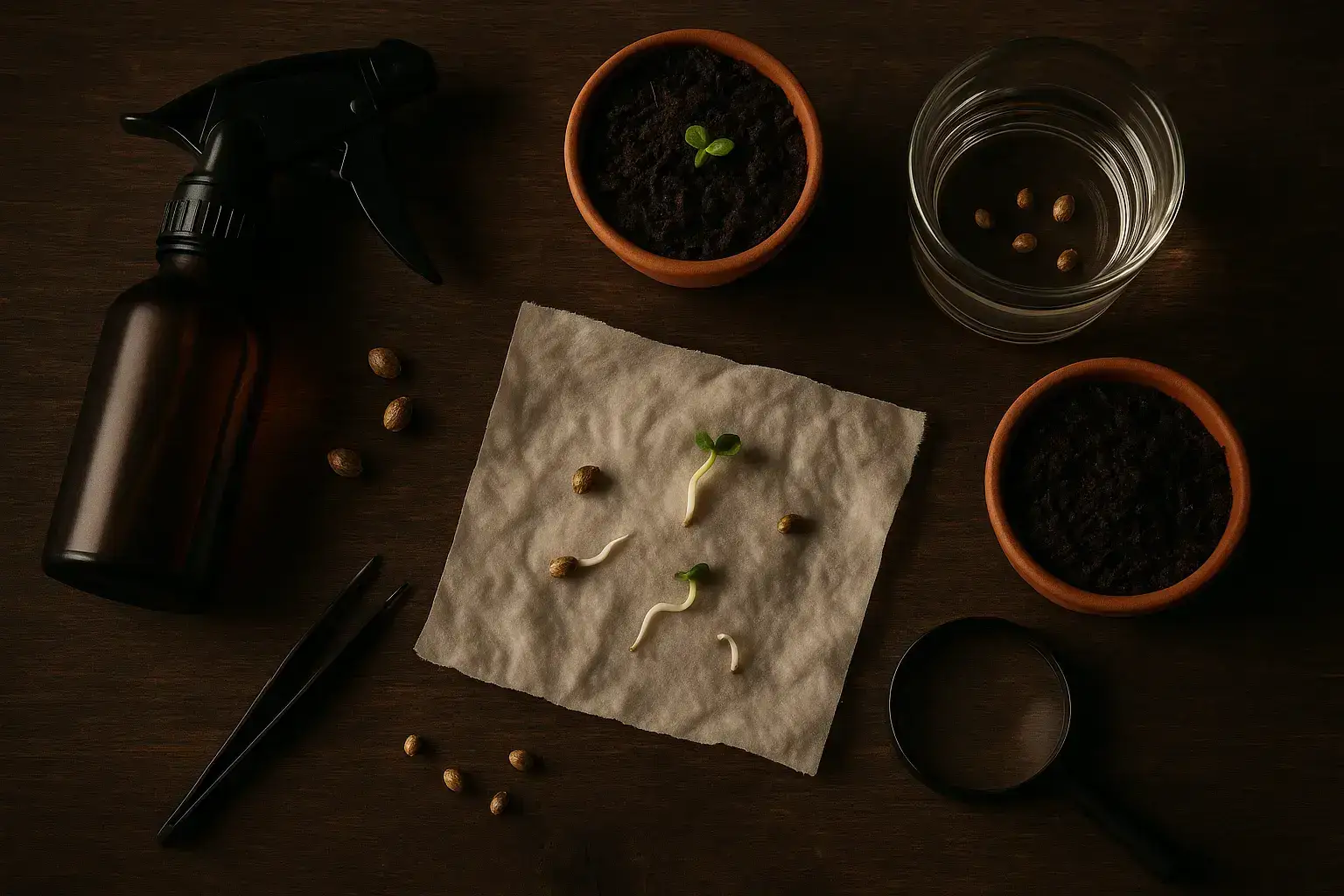
The paper towel method is the most widely used cannabis germination technique because it lets you monitor taproot development without disturbing the seed. It works reliably, costs nothing, and gives beginners visual confirmation before committing to a medium.
Step by step:
- Dampen two sheets of unbleached paper towel with pH-adjusted water. Squeeze out excess — the towel should be moist, not dripping.
- Place seeds 2–3 cm apart on one sheet. Fold or lay the second sheet on top.
- Place the setup on a plate or inside a zip-lock bag. Cover with a second plate or fold the bag shut, leaving a small gap for airflow.
- Store in a dark location at 22–25°C. A kitchen cabinet above the refrigerator or a seedling heat mat works well.
- Check every 12 hours. Re-moisten if the towel begins to dry. Do not move the seeds when checking.
- Once the taproot reaches 1–2 cm, transfer immediately to your growing medium.
Can You Germinate Cannabis Seeds in a Glass of Water?
Yes. The water soak method works by immersing seeds directly in a glass of pH-adjusted water at room temperature for 12–24 hours. Seeds that sink within a few hours are absorbing water actively — a good sign. Seeds that float after 24 hours may have low viability, though floating alone is not a definitive verdict.
After 12–24 hours in water, transfer seeds to a paper towel or directly to a pre-moistened medium. Do not soak longer than 24–32 hours — extended submersion depletes the oxygen around the seed and raises rot risk significantly.
The water soak works best as a pre-step before the paper towel or direct soil method, particularly for older seeds with hardened seed coats. It accelerates imbibition and can meaningfully improve germination rates for seeds stored more than a year.
How Do You Germinate Cannabis Seeds Directly in Soil?
Direct soil germination plants the seed straight into its first growing medium, skipping the paper towel or water stage entirely. It causes less handling stress and eliminates the transplant shock risk when moving a fragile taproot — which is exactly why some experienced growers prefer it over the paper towel approach.
Use a light, airy seedling mix — not dense compost or nutrient-rich soil, which is too hot for fragile seedlings. Pre-moisten the mix until uniformly damp. Create a 0.5–1 cm depth hole with a pencil or toothpick. Drop the seed in with the pointed end slightly down or horizontal — orientation is not critical at this stage. Cover lightly and maintain 22–25°C and steady moisture. Expect emergence in 2–7 days.
The real trade-off: you cannot visually confirm germination is progressing until the seedling breaks the surface. If something goes wrong — a temperature drop, overwatering — you won't know until the window has already closed.
What About Jiffy Pellets and Starter Plugs?
Jiffy pellets (compressed peat) and rockwool starter plugs are pre-formed germination media that offer the best of both worlds: controlled moisture retention, sterile environment, and direct transplantability into any medium or hydroponic system without disturbing roots.
Jiffy pellets: Soak in pH-adjusted water until expanded. Squeeze gently to remove excess water. Push the seed 0.5–1 cm deep into the pre-formed hole. Cover loosely. Maintain 22–25°C. The pellet goes directly into your soil or coco when the seedling is ready — no transplant shock, no fussing with taproots.
Rockwool cubes: Pre-soak in pH 5.5 water for 30–60 minutes before use — rockwool is alkaline by default and needs buffering. Insert the seed into the pre-drilled hole and pinch the top partially closed. Ideal for hydroponic and aeroponic setups. Keep cubes moist but not saturated.
Starter plugs are the preferred method for high-volume grows and for growers planning to move into DWC or NFT hydro systems, where root disruption during transplant can set the plant back significantly.
Which Germination Method Is Best for Beginners?
For first-time growers, the paper towel method combined with a 12–24 hour water soak pre-step is the most forgiving and informative approach. It gives you visual confirmation at every stage, costs nothing, and works equally well for feminized seeds, autoflowering seeds, and regular photoperiod seeds.
Method comparison at a glance:
Is Germinating Autoflower Seeds Any Different from Photoperiods?
The germination process itself is identical for autoflowering seeds, feminized photoperiod seeds, and regular seeds. Same four conditions: warmth, moisture, darkness, air. Autoflower seeds do not require any special treatment to get started.
What does differ is what comes immediately after germination:
- Autoflowers begin their internal clock the moment they sprout. Time is finite — most autoflowers complete their lifecycle in 70–90 days total. For this reason, most growers plant autoflower seeds directly into their final container (3–5 gallon pot), bypassing intermediate pots entirely. Transplanting an autoflower mid-lifecycle costs vegetative time you cannot recover.
- Photoperiods are more forgiving. You can germinate in a small starter pot, vegetate under 18/6, then transplant to a final container once established. The plant will not flower until you flip to 12/12.
How Long Does It Take Cannabis Seeds to Germinate?
Most healthy cannabis seeds produce a visible taproot within 24–72 hours under optimal conditions (22–25°C, consistent moisture, darkness). Older seeds, cold environments, or hard seed coats can push this timeline to 4–7 days. After 10 days with no taproot, the seed is almost certainly non-viable.
Germination timeline by condition:
- 24–48 hours: Typical for fresh, premium feminized or autoflowering seeds at 22–25°C
- 48–96 hours: Normal range for seeds stored 6–18 months, or at slightly lower temperatures
- 4–7 days: Possible with old seeds, cool conditions (18–20°C), or hard seed coats — not a failure yet
- 7–10 days: Concerning — check temperature, moisture, and seed quality; consider the water soak revival method
- 10+ days: Discard — the seed is almost certainly dead or severely compromised
What Are the Most Common Cannabis Seed Germination Mistakes?
Most germination failures trace back to one of five causes. Knowing the cause-symptom-fix chain prevents them entirely.
Mistake 1 — Temperature Too Low
Cause: Germinating on a cold windowsill, in an unheated basement, or in a room below 20°C — common in winter in Edmonton, Calgary, or any Canadian city with cold floors. Symptom: Seed sits inert for 4+ days with no taproot movement. No visible swelling. Fix: Move to a seedling heat mat. Target 22–24°C. Check temperature with a digital thermometer, not by feel.
Mistake 2 — Overwatering / Waterlogged Medium
Cause: Paper towel is soaking wet, or seeds are left submerged in water for 36+ hours. Symptom: Seed coat discolours, soft mushy texture, smell of rot. In soil: seedling never emerges, or emerges pale and collapses immediately (damping off). Fix: Squeeze paper towel until damp but non-dripping. Never leave seeds submerged beyond 24 hours. Use a sterile, light medium for soil germination.
Mistake 3 — Damping Off and Fungal Contamination
Cause: Non-sterile paper towel (printed, recycled, or coloured paper introduces contaminants), reused containers without sanitizing, high ambient humidity with no airflow. Symptom: White fuzzy mold on paper towel or medium surface. Seed coat is soft and discoloured. Root rots before elongating. Fix: Use plain, unbleached paper towel. Sanitize plates and containers with diluted hydrogen peroxide. Crack lids for passive airflow. How to prevent mold during germination
Mistake 4 — Damaging the Taproot During Transfer
Cause: Rushing the transfer, using fingers instead of tweezers, bending the taproot. Symptom: Taproot breaks, wilts, or darkens after planting. Seedling emerges bent or does not emerge at all. Fix: Wait until the taproot is 1–2 cm long — long enough to handle without panic. Use fine-tipped tweezers. Never grip the taproot directly — pinch the seed body. Plant root-down, 0.5–1 cm deep.
Mistake 5 — Letting the Paper Towel Dry Out
Cause: Checking too infrequently. In dry inland climates — Denver in winter, or indoor grows in Montreal with forced-air heating — paper towels can lose moisture in 8–10 hours. Symptom: Seed shows initial movement then halts. Taproot tip is brown and desiccated. Fix: Check every 12 hours. Re-moisten with a spray bottle. Never let the paper towel dry to the touch between checks.
How Do You Plant a Germinated Cannabis Seed in Soil?
Planting a germinated seed correctly is the final critical handling step before the plant takes over.
Planting protocol:
- Pre-moisten your seedling medium (light mix, coco, or Jiffy pellet). It should be damp throughout — not wet.
- Create a small hole 0.5–1 cm deep using a pencil, chopstick, or toothpick. No deeper — burying the taproot too deep deprives it of oxygen and delays emergence.
- Place the seed taproot pointing downward into the hole. If the taproot curls, curve it gently along the sides of the hole — do not force it straight.
- Cover loosely with medium. Do not pack or compress the surface — the seedling needs minimal resistance to push through.
- Mist the surface lightly. The medium is already pre-moistened; a heavy watering here will compact it.
- Maintain 22–25°C, darkness or low indirect light, and 60–70% relative humidity until cotyledons emerge.
What Should You Do After Your Cannabis Seeds Sprout?
Once the seedling pushes its cotyledons above the soil surface, the germination phase is complete. The plant is now a seedling and has different needs.
Immediate steps after emergence:
- Turn on your grow lights — seedlings need light from the moment they emerge. Start with 18 hours of light / 6 hours of dark for photoperiods and autoflowers alike.
- Lower light intensity — new seedlings are sensitive to intense light. Keep LED panels at 50–60% output or raise them 40–50 cm above the canopy for the first week.
- Do not fertilize yet — seedling mix or starter plugs contain enough nutrients for 10–14 days. Adding nutrients before the first true leaves appear causes nutrient burn on fragile cotyledons.
- Maintain 60–70% relative humidity — seedlings absorb moisture through their leaves before their root system is developed. A humidity dome over small seedlings for the first 5–7 days pays off, especially in dry indoor setups during Ottawa or Toronto winters.
- Water sparingly — small plants in large pots drown easily. Water around the seedling in a small ring, not directly at the stem. Let the medium dry slightly between waterings.
Conclusion
Germination is the shortest stage of the cannabis grow cycle — typically 24 to 72 hours from seed to taproot. It also sets the biological foundation for everything that follows. Get these first hours right and your genetics have every chance to express themselves fully. Get them wrong and you're fighting a deficit from day one.
The seed contains everything it needs for those first hours. Your job is to provide the right conditions and stay out of the way — warmth, moisture, darkness, and a little airflow. Nail the four pillars, avoid the five common mistakes above, and your seeds will do the rest.
FAQ
How warm should germination conditions be?
Cannabis seeds germinate best at a consistent temperature of 22–25°C (72–77°F). Temperatures below 18°C slow germination dramatically, while heat above 27°C can damage the seed coat. A heating mat or room thermometer helps maintain this ideal range throughout the 24–72 hour germination window.
What's the fastest way to germinate cannabis seeds?
The paper towel method is the fastest and most reliable, producing a visible taproot in 24–72 hours. Soak two paper towels, place seeds between them, fold, and keep them warm and dark in a sealed container. Once the taproot reaches 1–2 cm, transfer it immediately to your growing medium root-down.
Why did my seeds fail to germinate?
The most common causes are temperature fluctuations (below 18°C), seeds drying out, waterlogged conditions (oversoaking), or contamination from mold or bacteria. Always use filtered or distilled water for soaking, monitor temperature strictly, and ensure proper air circulation even in sealed containers.
How deep should I plant the taproot in soil?
Plant the taproot just 0.5–1 cm deep in pre-moistened (not wet) medium, with the tip pointing downward. Planting too deep wastes energy; too shallow risks the root drying out. Water lightly around the planting site and move seedlings to your full growing setup once the first true leaves emerge.
Do I need light during germination?
No—seeds germinate in complete darkness. Light is only needed once the cotyledons (first leaves) break the soil surface, typically 7–10 days after planting. Keep your germination container in a dark, warm spot and only expose seedlings to light once they've emerged.
19+ | Educational horticulture only.