From Seed to Seedling
Germination Guides
Transplanting Cannabis Seedlings — When & How to Do It Right
Transplant cannabis seedlings at the right time with expert guidance. Learn the signs, techniques, and timing to ensure healthy, thriving plants.
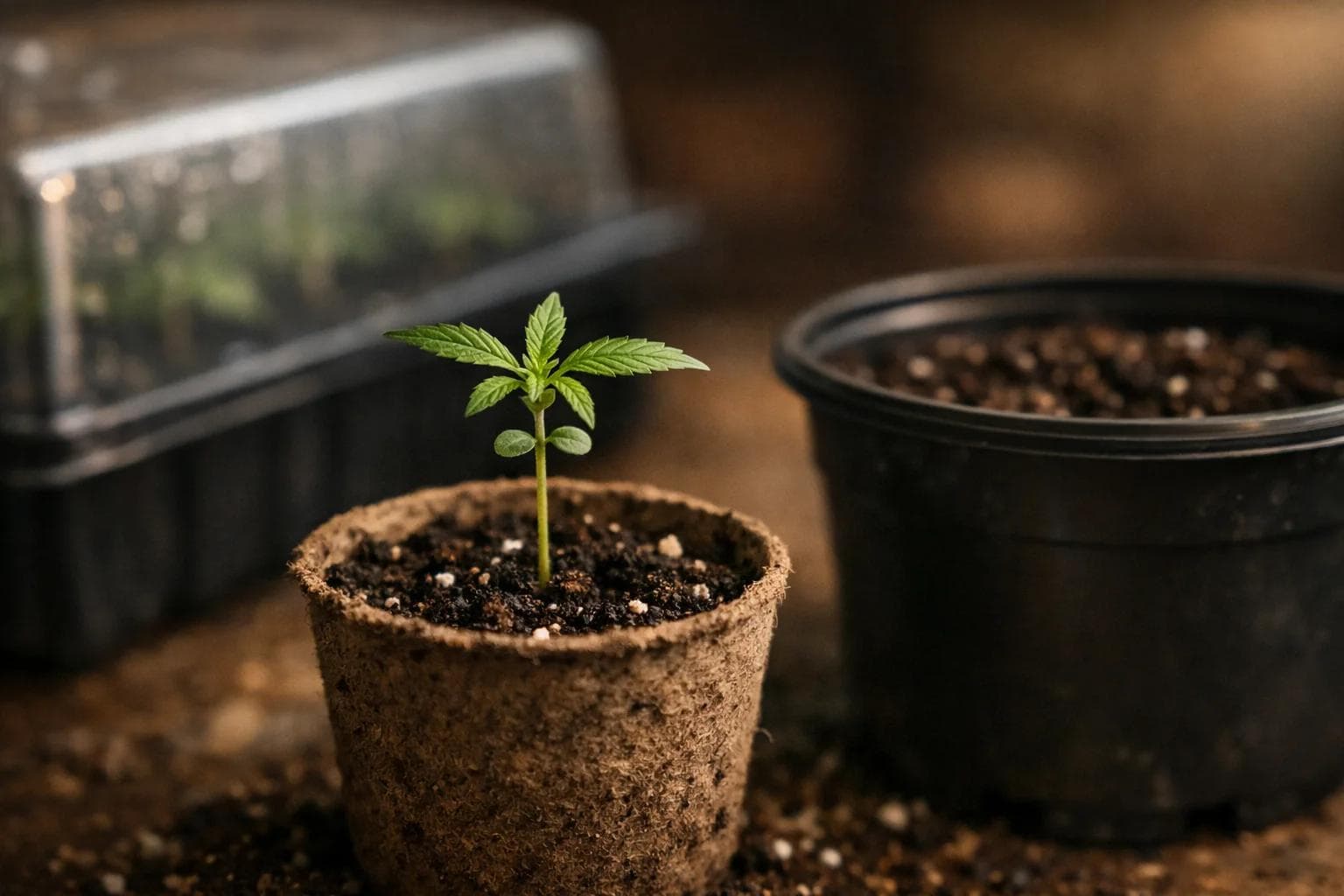
Transplant cannabis seedlings once they show 2–3 sets of true leaves and roots are visible at the drainage holes. Move to a container one size up, pre-moisten your medium, and skip nutrients for the first 48–72 hours. Autoflowers should always be seeded directly into their final pot to protect their fixed growth window.
When Should You Transplant Cannabis Seedlings?
Cannabis seedlings are ready to transplant when they have developed 2–3 sets of true leaves (nodes) and the root system has filled the current container. Node count is a more reliable indicator than a vague day estimate — a seedling in a starter cup showing three true node pairs, with roots visible at the drainage holes, is giving you a clear signal to move.
The common advice of "transplant after 2–3 weeks" is only useful as a rough backstop. Real readiness comes down to two diagnostic tests: the visual node check and the drainage hole inspection. If white roots are already pushing out the bottom, you're running late.
The container weight test: Lift the pot immediately after watering. If it feels surprisingly light within a day, the root mass is consuming moisture faster than the medium can retain it — a reliable early root-bound signal even before roots escape the container walls.
How fast you get there depends on your setup. A seedling under a well-dialled 600W LED at proper VPD can hit transplant-readiness in 10–12 days. Drop the light intensity, run cooler ambient temps, or use a heavier medium, and you're looking at 14–18 days. Light intensity, VPD management, and medium type all affect how quickly a seedling fills its container. Cannabis Seedling Stage — The Critical First 14 Days
What Are the Signs a Cannabis Seedling Is Root Bound?
Root binding occurs when the root system outgrows the available medium volume, forcing roots to circle container walls instead of expanding laterally. A root-bound seedling shows wilting despite well-moistened soil, yellowing despite adequate nutrition, and a visible growth stall on a plant that looked healthy just days before.
The lift test — the diagnostic step most articles skip: Gently squeeze the sides of a soft plastic starter cup and invert the seedling, supporting the base with your palm. If the root ball holds its shape and shows a dense white root network with minimal loose medium, the plant is ready — or already overdue.
Roots escaping the drainage holes are the most obvious confirmation. Check the underside of your container daily once seedlings approach the 10–14 day mark. Root development can run a few days slower in cool grow rooms — but the visual cues are identical regardless. When in doubt, do the lift test. Days are a rough guide; roots don't lie.
What Pot Size Should You Use at Each Stage?
Container sizing is where most beginner guides fail. Moving a seedling directly from a 100 mL starter cup into a 10-litre pot is a common and costly mistake. The oversized volume of wet, oxygen-poor medium around a small root system invites root rot and damping off before the roots can colonize the space. Damping Off in Cannabis Seedlings — Causes, Prevention & Treatment
A note on fabric pots: Fabric pots are worth serious consideration for any indoor run. When roots reach the breathable container wall, they air-prune naturally instead of circling — producing a denser, more efficient root structure than rigid plastic ever will. The trade-off is faster drying, so pay close attention to your watering cadence in the days right after transplant. For medium guidance, see Best Soil Mix for Cannabis Seed Germination and Germinating Cannabis Seeds in Coco Coir — Complete Guide.
How Do You Transplant Cannabis Seedlings Without Causing Shock?
Transplanting cannabis seedlings without shock comes down to three things: correct timing, medium preparation, and a gentle hands-on technique. The goal is to move the intact root ball into pre-moistened, room-temperature medium with as little disturbance as possible.
Step-by-step transplant technique:
- Prepare the new container first. Fill with your chosen medium and create a hole sized to the incoming root ball. Pre-moisten the medium — damp but not waterlogged. If your grow space runs cold (basement grows in winter are the usual culprit), bring your soil or coco to room temperature before use. Cold medium is a direct stress trigger for sensitive root tissue.
- Water the seedling lightly 2–4 hours before transplanting. Slightly moist medium holds together during inversion. Bone-dry medium falls apart and destroys the root ball structure.
- Gently invert the seedling. For soft starter cups, squeeze the sides to loosen the medium from the walls. For rigid containers, run a thin tool along the inside edge. Support the base of the plant between two fingers and invert. Never pull by the stem.
- Place the root ball into the prepared hole. The top of the root ball should sit at the same depth as in the original container. Do not bury the stem unless you are correcting a leggy seedling — see Leggy & Stretching Cannabis Seedlings — Causes & Fixes.
- Settle the medium. Gently firm the medium around the root ball — no aggressive packing. Leave the surface slightly lower than the container rim to hold water during the first post-transplant watering.
- Water in with plain, pH-adjusted water. No nutrients at this stage. Water from the base of the root ball outward to encourage lateral root expansion into the fresh medium.
How Do You Care for Cannabis After Transplanting?
Post-transplant care is the most overlooked part of the process. The 72 hours following a transplant are a recovery window, not a growth window — and how you manage this period largely determines whether your plant rebounds in two days or struggles for a week.
The 72-hour post-transplant protocol:
- No nutrients for 48–72 hours. Fresh medium contains enough available nutrition for immediate root establishment. Introducing nutrient salts too early irritates new root tips and delays the plant's ability to uptake water.
- Reduce light intensity slightly. Drop your grow light by 15–20% or raise it 10–15 cm for the first two days. High-intensity light drives transpiration demand on a root system that hasn't yet re-established contact with its new medium.
- Maintain relative humidity at 60–70%. Higher ambient humidity reduces transpiration stress during root establishment. A humidity dome placed over recently transplanted seedlings is useful for the first 24–48 hours. Using a Humidity Dome for Cannabis Seedlings — Setup & Tips
- Water lightly and locally. Irrigate only the area directly around the root ball. Flooding the entire container saturates uncolonized medium and creates anaerobic zones that invite pathogens.
Should You Transplant Autoflower Cannabis Plants?
The rule for autoflowers: Germinate directly into the final container whenever possible. A 6–10L pot from day one eliminates transplant risk entirely and lets the autoflower use every day of its fixed timeline for uninterrupted growth. Germinating Autoflower Seeds — Tips & Differences vs PhotoperiodIf you've already germinated in a small starter cup and must transplant, do it only once, and only during days 5–7 after the seedling has emerged — before the autoflower's internal clock has committed to its vegetative phase. After that narrow window, any transplant will cost you measurable yield.
Photoperiod strains tolerate multiple transplants because you control their vegetative clock with your light schedule. Autoflowers offer no such flexibility — plan your container strategy before germination, not after.
What Does Cannabis Transplant Shock Look Like, and How Long Does It Last?
Transplant shock is a temporary stress response caused by root disturbance. Affected cannabis seedlings show wilting or drooping leaves, slight yellowing of lower leaf tips, and a 1–3 day pause in visible growth. Some degree of this response is normal even after a technically well-executed transplant.
When to wait vs. when to worry:
- Wilting that resolves within 24–48 hours: normal post-transplant recovery — do nothing except maintain humidity
- Slow recovery extending to 72–96 hours: acceptable if the medium is not waterlogged; check drainage and hold off on additional watering
- Persistent wilting past 5 days, browning root tips, or a sour medium smell: investigate for root rot or damping off immediately — see Damping Off in Cannabis Seedlings — Causes, Prevention & Treatment
The first new leaf growth after transplant — typically within 3–5 days — is your confirmation that the root system has re-established and recovery is underway. Cannabis Seedling Care After Germination — Week-by-Week Guide
For full lifecycle context from germination through the seedling stage, see the Complete Cannabis Seed Germination Guide.
FAQ
Can you transplant cannabis during the flowering stage?
Transplanting during flowering is strongly discouraged. Root disturbance during flower can cause significant yield loss and may trigger hermaphroditism in stress-sensitive genetics. If root binding occurs during flower, the lowest-risk option is careful top-dressing of the existing container rather than a full transplant. Reserve transplanting for the vegetative stage only.
Should I water before or after transplanting?
Water the seedling lightly 2–4 hours before transplanting to help the root ball hold its shape during the move. After transplanting, water in with plain, pH-adjusted water — lightly, targeting the area directly around the root ball. Skip nutrients for the first 48–72 hours.
What is the best time of day to transplant cannabis?
For indoor grows, transplant at the very start of the light cycle so the plant has a full active period to begin recovery. For outdoor grows, transplant at dusk or on an overcast day to minimize transpiration stress during the critical first hours after the move.
How do I know if my plant is recovering from transplant shock?
The clearest sign of recovery is the resumption of new leaf growth, typically visible within 3–5 days of transplanting. Leaves will straighten, colour will stabilize, and the plant will visibly resume its upward growth pattern. New growth is confirmation that the root system has re-established contact with fresh medium. ---
19+ | Educational horticulture only.