From Seed to Seedling
Germination Guides
Germinating Autoflower Seeds — Tips & Differences vs Photoperiod
Germinate autoflower seeds successfully in 24-72 hours. Master the proven techniques and learn how they differ from photoperiod seeds for better results.
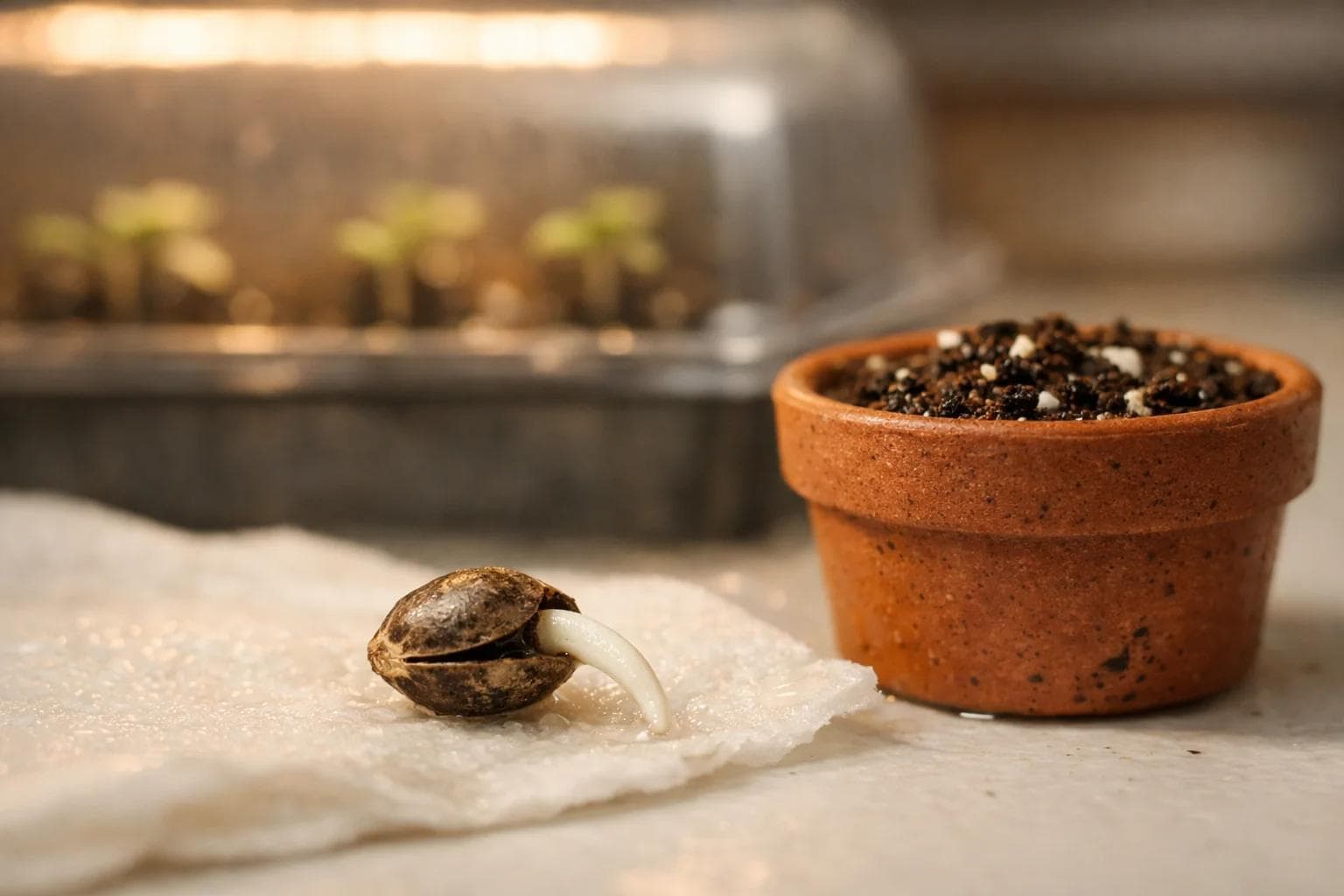
Autoflower seeds germinate in 24–72 hours using the same methods as photoperiod seeds — paper towel, direct sow, or a brief soak. The critical difference is that autoflowers run on a fixed 70–85 day lifecycle with no pause for recovery. Germinate directly into your final container whenever possible.
What Makes Autoflower Seeds Different From Photoperiod Seeds?
Autoflower cannabis plants carry Cannabis ruderalis genetics, which give them the ability to flower based on age rather than light cycle. Unlike photoperiod strains — which require a shift to a 12/12 light schedule to trigger bloom — autoflowers begin flowering automatically at around 3–4 weeks from germination, regardless of how many hours of daily light they receive. This biology makes them exceptionally convenient: no light schedule juggling, no separate flowering chamber, and a full seed-to-harvest cycle that typically runs 70–85 days.
That same biology comes with a catch most first-time autoflower growers don't fully appreciate until it costs them a harvest: autoflowers cannot pause. A photoperiod plant stressed during early growth can be held in the vegetative stage for weeks while it recovers — the grower controls the flowering trigger. An autoflower keeps moving through its internal timeline whether or not it's healthy. Root stress at Day 10 still costs the same number of recovery days, but those days come directly off the final yield window.
Every week of stunted early growth — whether from transplant shock, overwatering, or rough germination handling — is a week you don't get back. The ruderalis trait that makes autoflowers so convenient is the same one that makes them unforgiving of early-stage mistakes.
For growers in Quebec City or the Prairie provinces — where the frost-free outdoor window often runs only from early June to early September — this compressed lifecycle is a genuine advantage. A 75-day autoflower started outdoors in late May can finish before the first hard frosts, making it possible to complete a full cycle in regions where photoperiod strains would not reliably finish outdoors.
Can You Germinate Autoflower Seeds the Same Way as Regular Cannabis Seeds?
Yes — with one important distinction. The biological process of germination is identical: moisture, warmth (20–25°C), and darkness trigger the seed to crack and extend a taproot. Paper towel, direct sow, and seed soaking all work for autoflower seeds just as they do for photoperiod seeds. The difference is not in how you start germination, but in where the seed begins its life and what you do the moment the taproot appears.
How Do Autoflowers Compare to Photoperiod Seeds for Germination and Early Care?
What Is the Best Germination Method for Autoflower Seeds?
Direct sowing into the final container is the recommended germination method for autoflower seeds. It eliminates transplant stress entirely and gives the taproot a direct, unobstructed path through the full grow medium from day one. For most autoflower genetics, that means a 3-gallon (11L) or 5-gallon (19L) fabric pot filled with a light, well-aerated growing mix.
Method 1: Direct Sow Into Final Container (Recommended)
Moisten your grow medium until it holds moisture without dripping — a handful squeezed firmly should release a few drops, not a stream. Create a small planting hole approximately 1–1.5 cm deep. Place the seed with the pointed tip facing down, or in a neutral position if planting without pre-germination. Cover lightly and mist the surface. Place a humidity dome or loosely draped plastic wrap over the container to maintain moisture around the seed during the first 3–5 days. Using a Humidity Dome for Cannabis Seedlings — Setup & Tips
Growers in Vancouver running indoor setups during the dry heating season should watch ambient humidity closely — heated winter rooms can drop to 30–35% RH, which pulls moisture out of a fabric pot's surface faster than expected and can stall germination before the seedling breaks soil.
How Long Does It Take Autoflower Seeds to Germinate?
Autoflower seeds from quality genetics typically germinate in 24–72 hours under good conditions. Seeds with harder shells or older stock may take up to 5 days. If no taproot has appeared after 7 days, check medium moisture and temperature before writing the seed off. A 12–18 hour pre-soak in pH-adjusted water (6.0–6.5) can soften harder shells and improve germination speed on seeds you are uncertain about.
Method 2: Jiffy Pellet or Peat Pot (Acceptable)
Jiffy pellets and peat pots are acceptable for autoflowers because the entire root ball — growing medium included — transfers to the final container intact. Root fibres are not exposed or disturbed, making it more of a container swap than an actual root disturbance. This method is useful when germinating multiple seeds to select the strongest seedling before committing to a large final pot. Rockwool Cubes & Jiffy Pellets for Cannabis Seed Germination
Method 3: Paper Towel Pre-Germination (Use With Caution)
The paper towel method reliably triggers germination and confirms seed viability before planting — the risk is the transfer step. Once the taproot has emerged, the seedling must be moved to the growing medium without touching or bending the root tip. Transfer to the final container the moment the taproot reaches 0.5–1 cm. A longer taproot is a more fragile taproot: any contact with the root tip at this stage can introduce stress the auto may never fully recover from — remember, there's no pause button.
Should You Transplant Autoflower Seedlings?
Ideally, no. Autoflowers should be germinated directly into their final growing container to eliminate all transplant risk. If transplanting is unavoidable — because you started with a paper towel method or a jiffy pellet — transfer the seedling to its final container within the first 3–5 days after taproot emergence, before the root system has developed enough to be disrupted. After the seedling stage, transplanting autoflowers is not recommended under any circumstances.
The biology behind this rule traces directly to Cannabis ruderalis ancestry. Ruderalis evolved in short-season climates across Central Asia and Eastern Europe. It developed age-based flowering as an adaptation to environments where the outdoor window was simply too short to wait around for seasonal light cues. That same adaptation means the plant has no built-in mechanism for pausing development — a lever that photoperiod growers use routinely for plant recovery.Growers transitioning from photoperiod workflows — particularly those used to multi-stage indoor setups common in cities like Denver or Chicago — often find this the steepest learning curve when switching to autoflowers. With photoperiod genetics, transplanting through veg is standard practice and rarely causes lasting problems. With autoflowers, the final container is the first container.
What Light Schedule Should Autoflower Seedlings Be On?
18/6 (18 hours of light, 6 hours of darkness) is the most widely recommended light schedule for autoflower seedlings from germination through harvest. It provides strong, consistent growth while preserving the dark rest period that supports root development and overall plant physiology.
What Are the Biggest Mistakes When Germinating Autoflower Seeds?
The most common autoflower germination mistakes are transplanting too late, overwatering, and starting in the wrong container size. Each of these errors costs growing time that cannot be recovered on a fixed-lifecycle plant. Here is what is actually happening in each case — and why it hits harder with autoflowers than with photoperiod strains.
1. Transplanting After the Seedling Stage
This is the single most damaging and most common mistake when switching to autoflowers from photoperiod. Moving a seedling from a starter container to its final pot after Week 2 introduces root disturbance at exactly the wrong moment — when the plant is transitioning from seedling stage into pre-flowering development. The time cost is real and cannot be recovered. Transplanting Cannabis Seedlings — When & How to Do It Right
2. Overwatering During Germination and the Early Seedling Stage
The germination zone should be consistently moist — not wet. A waterlogged medium cuts off oxygen to the developing taproot and can stop germination cold. Water lightly around the perimeter of the container rather than flooding the surface, and allow the top centimetre of the medium to dry slightly between waterings.
Growers in Portland or Seattle managing indoor grows during Pacific Northwest winters often deal with naturally elevated ambient humidity, which compounds the overwatering risk and can create conditions for damping off if airflow is not adequate. Damping Off in Cannabis Seedlings — Causes, Prevention & Treatment
3. Starting in a Container That Is Too Small
Solo cups and small seedling pots are standard practice in photoperiod workflows. For autoflowers, they guarantee at least one transplant during the lifecycle. Start autoflowers directly in a 3- to 5-gallon fabric pot from germination through harvest. The apparent waste of space in the first two weeks costs nothing — the transplant would cost much more.
4. Incorrect Water pH During Germination
Target pH 6.0–7.0 for soil-based grows and 5.5–6.5 for coco coir or hydroponic setups. Off-pH water during the first few days of root development can create nutrient lockout conditions from the very start of the plant's life, before the first true leaves have even opened. Water pH & Quality for Cannabis Seed Germination
5. Adding Nutrients Too Early
Pre-amended cannabis soil provides all the nutrients a seedling needs for its first 10–14 days. Adding fertilizer — especially nitrogen-heavy formulas — during this window can burn the young root system before it has established any buffering capacity. Wait until the seedling has developed its second set of true leaves before introducing any supplemental feed.
Are Autoflowers a Good Choice for Canadian Outdoor Growing?
If you're growing outdoors in Canada, autoflowers aren't just convenient — in some regions, they're your only realistic option. In cities like Toronto, the reliable outdoor growing window runs from late May to mid-September. A 75-day autoflower started outdoors in early June can reach harvest in mid-August, giving growers the option of a second cycle before fall temperatures drop. For growers in Calgary or Edmonton, where the outdoor window is shorter and first frost typically arrives in late September, autoflowers are often the only viable path to completing a full outdoor cycle without supplemental lighting.
FAQ
Are autoflowers easier to grow than photoperiod strains?
Autoflowers are not inherently easier — they are more time-compressed. They eliminate light schedule management and deliver faster harvests, and that genuinely simplifies a lot of the daily grow management. The tradeoff is that their fixed lifecycle means mistakes during germination and the seedling stage hit harder than they would with a photoperiod plant — which can always be held in veg to recover. For most beginners, the simplified light management more than makes up for the tighter early-stage window.
Can I use the same soil for autoflowers as for photoperiod cannabis?
Yes, with one practical consideration: autoflower seedlings are sensitive to elevated nutrient levels in the early weeks. A light, well-aerated mix — or a standard potting soil cut with 20–30% perlite for drainage — works well from germination through harvest. Avoid heavily pre-amended or "hot" soils during the germination and seedling stage. [LINK: Best Soil Mix for Cannabis Seed Germination | /en/articles/best-soil-cannabis-seed-germination]
Do autoflower seeds need to be soaked before germinating?
Soaking is optional, not required. A 12–18 hour pre-soak in clean, pH-adjusted water (6.0–6.5) can soften the shell on harder or older seeds and accelerate germination. Fresh seeds from quality genetics do not require soaking and can be planted directly. A brief soak will not harm a healthy seed and can meaningfully improve germination rates on seeds you have questions about.
Can I grow autoflowers outdoors in Canada?
Yes — autoflowers are well-suited to Canadian outdoor growing because of their short, light-independent lifecycle. Most autoflower strains complete in 70–85 days, fitting comfortably within the outdoor growing window of most Canadian provinces. Growers in British Columbia, Ontario, and Quebec can typically complete at least one full outdoor cycle without difficulty. Those in more southern urban areas like Vancouver or Montreal can often plan for two outdoor cycles per season with early timing. ---
19+ | Educational horticulture only.