From Seed to Seedling
Germination Guides
Paper Towel Germination Method for Cannabis Seeds
Learn the paper towel germination method for cannabis seeds in 24–72 hours with proven step-by-step techniques and expert tips.
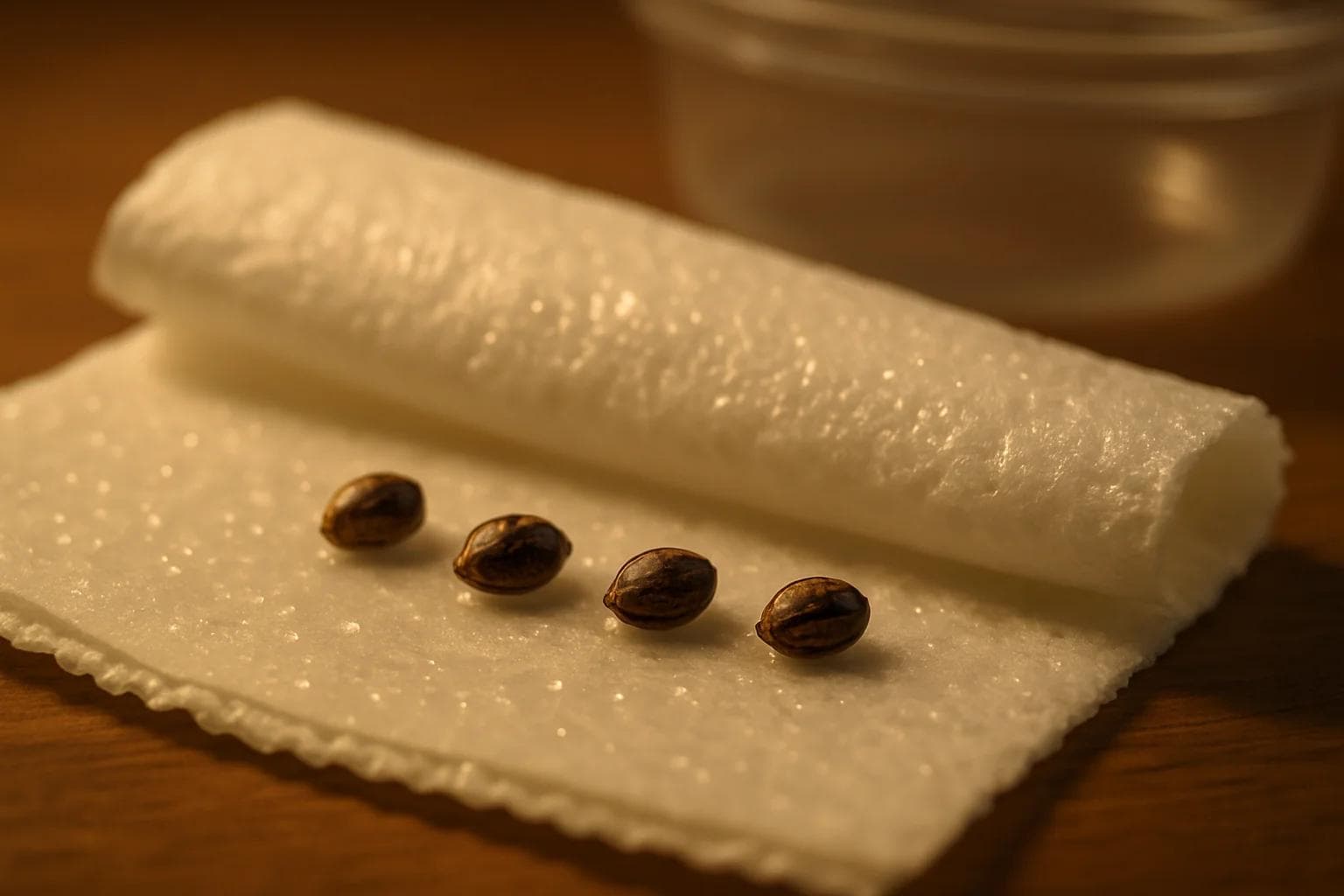
The paper towel germination method works by placing cannabis seeds between two damp paper towels inside a sealed container kept at 21–29°C (70–85°F) in darkness. Most viable seeds crack and show a taproot within 24–72 hours. When the radicle reaches 5–15mm, transplant it carefully into your growing medium, root-tip down.
The paper towel method is the most popular way to germinate cannabis seeds before planting — and for good reason. It lets you confirm viability before committing seeds to soil, monitor taproot development visually, and control moisture and temperature precisely. If you're germinating your first seeds under Canada's 4-plant home grow limit, or working through a careful second attempt after a failed round, this guide gives you exact parameters — not vague advice.
This is one method within a broader process. For a full overview of all germination approaches, see the Complete Cannabis Seed Germination Guide.
Before you start, check whether your seeds are actually worth germinating. Old, light-coloured, or cracked seeds have lower viability rates. How to Tell if Cannabis Seeds Are Viable to avoid a pointless week of waiting.
What Do You Need for Paper Towel Germination?
The paper towel method requires only a handful of common household items. The full setup costs almost nothing and takes under five minutes to assemble: two sheets of paper towel, a shallow plate or ziplock bag, filtered or spring water, your seeds, and optionally a heat mat. Good-quality seeds and clean water are the two variables that matter most.
Can You Use Any Paper Towel or Do You Need a Specific Type?
Use plain, unbleached or minimally processed paper towels — single-ply is fine. Avoid paper towels with lotion, fragrance, or heavy bleaching agents; these can introduce compounds that inhibit germination. Cheap, unscented kitchen roll works well. Skip cloth towels entirely — they retain too much moisture and create anaerobic conditions that suffocate the seed embryo before it ever gets started.
Do You Need a Heat Mat to Germinate Cannabis Seeds?
A heat mat is not mandatory, but it becomes important when ambient room temperature falls below 21°C (70°F). In Canada during winter months, basement grow rooms in Toronto, Ottawa, or Calgary can drop to 15–18°C overnight — well below the optimal range. A seedling heat mat set to 24–27°C (75–80°F) removes the temperature variable entirely and is a worthwhile investment for year-round reliability.
Materials checklist:
- 4 sheets plain paper towel (2 layers top, 2 layers bottom)
- 1 shallow dinner plate, or a clean ziplock bag
- 1 second plate to cover (if using plate method)
- Filtered, spring, or reverse-osmosis water (pH 6.0–7.0)
- Your cannabis seeds
- Tweezers (clean, for handling)
- Seedling heat mat (optional but recommended in cold climates)
- Thermometer / hygrometer (optional — for precision verification)
How Do You Germinate Cannabis Seeds in a Paper Towel Step by Step?
The full process runs from dry seed to transplant-ready taproot in 24–120 hours for most viable seeds. Each step has a specific parameter — not a vague guideline. Follow these six steps in order.
Step 1 — Prepare your water. Use filtered, spring, or reverse-osmosis water at pH 6.0–7.0. Tap water in most major Canadian cities is safe but can carry chlorine; let it sit uncovered for 30 minutes to off-gas, or run it through a carbon filter. Water temperature should be room temperature — 20–22°C (68–72°F).
Step 2 — Wet the paper towels. Lay two sheets of paper towel flat on a plate. Pour water over them until fully saturated, then hold them up and let excess water drain for 10–15 seconds. The towels should feel uniformly damp — never dripping. See the moisture section below for the exact squeeze test.
Step 3 — Place your seeds. Using clean tweezers or washed hands, place seeds on one half of the damp towel, spacing them at least 2–3 cm apart. Fold the other half over to cover them. If using a ziplock bag, place the towel inside and seal it loosely — leave a small gap for gas exchange. Seeds need oxygen as much as they need moisture.
Step 4 — Create a dark, warm environment. Cover the plate with a second inverted plate, or seal the bag and tuck it on a shelf away from light. Temperature is the most important variable at this stage. See the temperature section below.
Step 5 — Check every 12–24 hours. Open carefully. Do not disturb seeds unnecessarily. Re-moisten the towels with a few drops of water if they have dried at the edges. Never flood them. The goal is sustained, even dampness — not cycles of wet and dry.
Step 6 — Monitor for taproot emergence. The radicle (primary root) will emerge through the seed coat. Once it reaches 5–15mm in length, the seed is ready to transplant. This is the transplant window — do not let it grow beyond 20mm, where fragility and entanglement with paper fibres become a real problem.
How Wet Should the Paper Towels Be?
The towels must be damp — never soaked. Here's the practical test: squeeze a fully saturated sheet, then release. If water drips freely, it is too wet. After squeezing out excess, the towel should hold moisture internally without releasing any drops. This matters because cannabis seeds are living organisms that respire — they require both water to soften the seed coat and oxygen to fuel cell division. Waterlogged paper towels block oxygen exchange at the seed surface and can cause embryo suffocation or rot within 48 hours.
What Temperature Is Best for Paper Towel Germination?
The optimal range is 21–29°C (70–85°F), with 24–26°C (75–79°F) being the sweet spot for most cannabis genetics. Temperature activates the enzymes within the seed embryo that break down stored endosperm nutrients and initiate cell division. Below 18°C (65°F), enzymatic activity slows significantly and germination stalls or fails entirely. Above 30°C (86°F), moisture evaporates faster than seeds can absorb it, and heat stress can damage the embryo. In dry winter air — common in Vancouver apartments or Montreal basements running electric heat — check moisture levels every 12 hours rather than 24.
Does Pre-Soaking Help Before Paper Towel Germination?
Pre-soaking seeds in plain water or a diluted hydrogen peroxide solution (1–2%) for 12–24 hours before paper towel placement can soften stubborn seed coats and improve germination speed on older or harder-shelled seeds. Fresh seeds from a reputable source don't need it — but for anything stored more than 18 months, a pre-soak is worth the extra step. For the full protocol, see Soaking Cannabis Seeds Before Planting.
How Long Does Paper Towel Germination Take?
Most viable cannabis seeds crack and show a taproot within 24–72 hours under optimal conditions (24–26°C, sustained moisture, darkness). Older seeds, seeds with very thick coats, or seeds stored in suboptimal conditions may take up to 5–7 days. If a seed shows no movement by day 7, it is likely non-viable.
How Often Should You Check on Your Seeds?
Check every 12–24 hours — no more frequently. Excessive handling disrupts the micro-environment around the seed and introduces contaminants. Each check should accomplish two things: verify moisture level and scan for taproot emergence. If the towel edges feel dry, add 3–5 drops of water to those areas. If condensation is visible inside a sealed container or bag, open briefly to allow air exchange before resealing.
What Do You Do After Seeds Germinate in Paper Towels?
Once the taproot is visible, the seed is biologically committed to growing. The transplant window is narrow — act within a few hours of reaching the target radicle length. The longer you leave it, the greater the chance the root grows into the paper towel fibres, making extraction damaging.
How Long Should the Taproot Be Before Transplanting?
The ideal taproot length at transplant is 5–15mm (roughly 0.5–1.5cm). At this length, the root is strong enough to anchor into the growing medium but short enough to handle without breaking. A root under 5mm is fragile and may struggle to establish. A root over 20mm is more likely to kink during planting and has almost certainly started attaching to paper fibres.
How Deep Should You Plant a Germinated Seed?
Plant the germinated seed 1–1.5cm deep, with the taproot pointing downward. The seed should sit just below the surface — deep enough that the seed coat anchors itself as the cotyledons push up, but shallow enough that the seedling doesn't exhaust its stored energy trying to reach light. Planting too deep is one of the most common beginner mistakes, and it's entirely avoidable.
Transplant technique (step by step):
- Pre-moisten your growing medium (soil, coco coir, or Jiffy plug) to 50–60% moisture — it should hold its shape when squeezed but not release water.
- Create a small hole 1–1.5cm deep using a pencil or chopstick.
- Using clean tweezers, pick up the seed gently by the seed body — never pinch the taproot.
- Lower the seed into the hole, taproot pointing down.
- Lightly cover with growing medium. Do not compact it.
- Mist the surface lightly. Do not flood.
Why Didn't My Cannabis Seeds Germinate in Paper Towels?
Germination failure with the paper towel method almost always traces back to one of four causes: wrong temperature, wrong moisture level, non-viable seeds, or excessive handling. A systematic check will usually identify the problem.
Seeds didn't crack after 5+ days. First, rule out temperature. Seeds held below 20°C (68°F) can simply be dormant, not dead — move the setup somewhere warmer or add a heat mat and give it 48 more hours before writing them off. If temperature was correct, the seed may have a very thick coat. Try gentle scarification (lightly rubbing the seed coat on fine sandpaper) and re-attempt with a 24-hour pre-soak. Still nothing after 10 days total? Non-viable.
Mold or fuzzy white growth on seeds. White fuzzy growth is typically mold caused by standing water, poor airflow, or contaminated materials. Prevention is straightforward: use the squeeze-test moisture level, leave a small gap in any sealed container for gas exchange, and handle seeds with clean tools. If mold appears, gently rinse affected seeds under cool water, replace the paper towel, and back off the moisture slightly. Badly mold-affected seeds rarely recover.
Taproot broke during transplant. A broken taproot is not always fatal. If the root tip broke but more than 5mm of root remains, plant it anyway — cannabis seeds can sometimes generate secondary roots from the remaining radicle. Minimize handling, keep humidity high (80%+), and give the seedling 48–72 hours before assessing. No upward growth and the seed coat stays closed? Discard.
Seed coat stuck to cotyledons. This happens when the seed coat dries out during the papering or transplant phase, adhering to the emerging leaves. The fix: place a single drop of plain water on the stuck seed coat and wait 20–30 minutes for it to soften. Then gently work it free with a toothpick or tweezers. Do not pull or force — you will tear the cotyledons.
For a full diagnostic flowchart covering all germination failure scenarios across all methods, see Germination Troubleshooting Guide.
Is the Paper Towel Method Better Than Other Germination Methods?
The paper towel method is the most versatile and beginner-friendly option — but it is not the right choice for every situation. The main advantage is visibility: you can confirm taproot emergence before committing seeds to soil. The main disadvantage is handling: every transplant step is a moment where a delicate taproot can be damaged. Know what you're trading before you start.
- You want to confirm viability before planting (expensive or rare genetics)
- You are germinating photoperiod seeds where transplant timing is flexible
- You want to monitor the process closely (first-time grower)
- Autoflower seeds are better germinated directly in their final container — autoflowers have a fixed lifecycle and transplant shock can cost days of growth. See Direct Soil Germination for the no-transplant approach.
- Hydroponic systems: use Rockwool cubes or Jiffy plugs to eliminate transplant shock entirely.
FAQ
What's the success rate of the paper towel germination method?
Fresh, properly stored cannabis seeds germinated under optimal paper towel conditions (21–29°C, sustained damp-not-soaked moisture, darkness) achieve germination rates of 80–95%. The gap below 100% is accounted for by seeds with non-viable embryos or micro-damage not visible to the eye. Success rate drops significantly with seeds over two years old or those stored in warm, humid, or light-exposed conditions.
Can you germinate cannabis seeds in paper towels without a container?
Yes — an uncovered plate works fine in a warm, stable environment. The container or second plate primarily serves to retain humidity and block light. Without a cover, you will need to re-moisten the towels more frequently (every 8–12 hours rather than 12–24) and ensure the seeds are kept in a room with stable warmth. A ziplock bag or covered plate is more reliable and requires less babysitting.
Should you use filtered water or tap water for germination?
Filtered, spring, or reverse-osmosis water at pH 6.0–7.0 is ideal. Tap water in cities like Vancouver and Montreal is generally low in chlorine and safe to use after sitting for 30 minutes. Hard tap water (high mineral content) can alter the immediate pH environment at the seed surface. If your tap water is very hard or heavily chlorinated, filtered or bottled spring water is a low-cost upgrade that removes one variable from the equation.
Can you germinate autoflower seeds with the paper towel method?
You can, but it is not recommended. Autoflowering varieties begin their flowering clock from the moment of germination — every day lost to transplant handling is a day you don't get back. Direct soil germination, where the seed goes straight into its final container, eliminates transplant shock and keeps the autoflower's compressed lifecycle on track. Use paper towel for photoperiods; use direct soil for autoflowers. --- Quality genetics are the foundation of every successful grow. [LINK: Browse Premium Cannabis Seeds | /en/shop] ---
19+ | Educational horticulture only.