From Seed to Seedling
Germination Guides
Water pH & Quality for Cannabis Seed Germination
Learn how water pH and quality directly impact cannabis seed germination rates and success. Optimize your growing setup from day one.
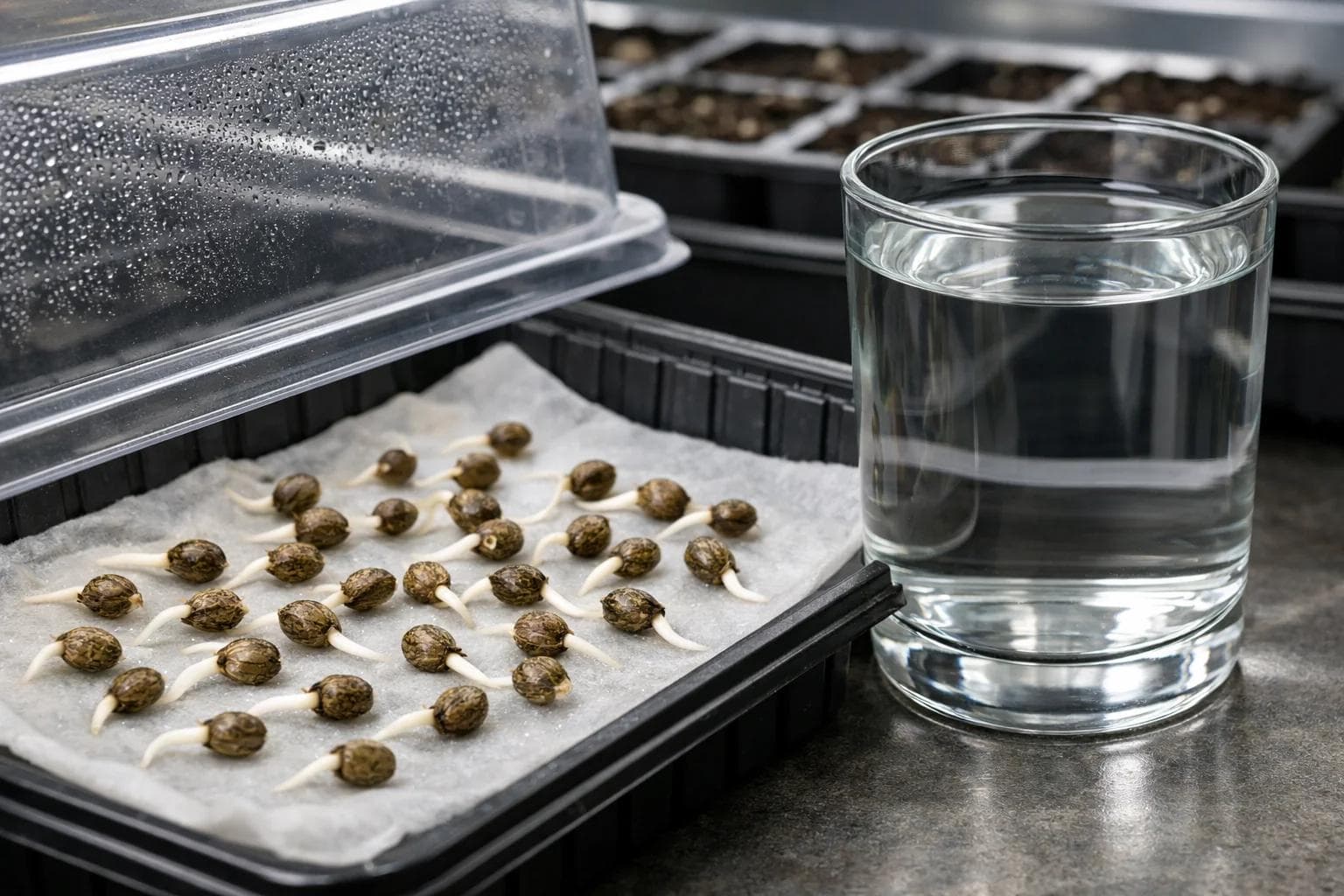
For cannabis germination, target pH 6.0–6.5 in soil, 5.8–6.2 in coco coir, and 5.5–6.0 in rockwool or hydro. Water outside this range disrupts enzyme activity and stalls germination. Tap water works, but chloramine — used in most Canadian cities — requires a Campden tablet to neutralize, not just sitting water overnight.
Pass 1 — Scan complete. Flagged: generic padding opener in water_types section, "That is above ideal" → keep (capsule), "Confusing the two is one of the most common hidden causes" (capsule — preserve), a few spots where 3 consecutive sentences follow identical Subject→Verb→Object rhythm, "The upside:" framing is weak, "an advantage over ultra-pure water" is vague. No hollow openers in headings, no "furthermore/moreover/it is worth noting." Grower voice is partially present but inconsistent — several paragraphs go clinical without a grounding detail.
Pass 2 — Section-by-section edits in progress.
Pass 3 — Final read complete. Humanization confirmed at 4.
Does pH Really Matter for Cannabis Seed Germination?
pH directly controls whether a cannabis seed can absorb the moisture needed to trigger germination. The enzymatic processes that soften the seed coat, initiate radicle emergence, and drive early cell division are highly pH-sensitive — they operate within a specific electrochemical range. Outside that range, germination slows, the taproot struggles to push through, or seeds stall entirely.
Put it this way: a seed dropped into pH 8.0 water is sitting in a mildly alkaline solution that limits hydration uptake and puts the brakes on the biological triggers that break dormancy. Drop below pH 5.5 and acidity starts stressing the seed's outer membrane. Neither extreme kills the seed on the spot — but both add strain at the stage where you want zero friction.
Adjusting water pH takes under five minutes and costs almost nothing. Lock this variable in before you place your first seed.
What Is the Ideal pH Range for Germinating Cannabis Seeds?
The ideal pH for cannabis germination is not a single universal number — it varies by growing medium. Soil buffers naturally and tolerates more variation; coco coir and rockwool have zero buffer capacity and require tighter precision. Use this table as your target before every germination session.
Does the Right pH Change Depending on Your Growing Medium?
Yes — and this is where most generic guides fail growers. The commonly cited "6.5 for cannabis" comes from soil-based vegetative stage advice. That number doesn't translate to germination, and it doesn't apply to inert media.
Soil contains organic matter, microbial life, and minerals that naturally buffer pH swings. A reading of 6.8 in a well-amended mix won't ruin your germination run. Coco coir is a different story — completely inert, nothing to absorb the swing. At pH 6.8, root emergence slows noticeably. At 7.0 or above, early nutrient lock sets in, and your seedling starts life already behind.
Rockwool cubes need to be pre-soaked at pH 5.5 before seeds go in, precisely because the material has nothing to catch pH drift after saturation. Rockwool Cubes & Jiffy Pellets for Cannabis Seed Germination
Always target the range for your specific medium — not a universal number.
Can You Use Tap Water to Germinate Cannabis Seeds?
Tap water is usable for cannabis germination — but it needs preparation before use. Most North American municipal water runs between pH 6.5–8.0; many Canadian water systems target pH 7.0–7.8 for distribution stability. That is above ideal for all germination media and needs to come down. The second issue is disinfectant chemistry — and this is the one most growers don't see coming.
Toronto, Vancouver, and Calgary have all switched from chlorine to chloramine as their primary disinfectant. Chloramine is more chemically stable than chlorine and survives the full run of distribution pipes — which is exactly why water authorities prefer it. For growers, the consequence is direct: the standard chlorine treatment (leaving water uncovered overnight) does absolutely nothing for chloramine.
How Do You Remove Chlorine or Chloramine from Tap Water?
Chlorine and chloramine require completely different treatment approaches. Confusing the two is one of the most common hidden causes of slow or compromised germination for growers on municipal water. It rarely gets flagged as the culprit — but check your city's water report and you may have your answer.
Chlorine:
- Leave water uncovered 24 hours at room temperature — chlorine offgasses naturally
- An airstone or bubbler cuts that to 1–4 hours
- Boiling eliminates chlorine in minutes; cool to room temperature before using
- Does NOT evaporate — sitting water overnight has zero effect on chloramine
- Campden tablet (sodium or potassium metabisulfite): crush ¼ tablet per 20L, stir for 5 minutes; inexpensive and highly effective
- Vitamin C (ascorbic acid): 1g per 100L neutralizes chloramine immediately; food-safe and available at any pharmacy
- Solid carbon block filter: removes chloramine on contact; standard pitcher filters are often insufficient for chloramine removal
Timing note: Treat for disinfectants first, then adjust pH. Campden tablets can slightly lower pH; factor this into your baseline reading before reaching for pH Down.
How Do You Test and Adjust Water pH for Cannabis?
Testing water pH is a two-minute process with the right tool. Three options are available to home growers, and they differ significantly in accuracy, cost, and reliability.
What Is the Best Tool for Testing Water pH at Home?
pH Meter (Digital) Most accurate and practical for regular use. Entry-level models cost $15–$40 CAD and measure to ±0.1 pH or better. Calibrate monthly using buffer solution (pH 4.0 and 7.0 calibration packets are inexpensive and widely available). If you're running more than one grow per year, this is your tool.
pH Drops (Liquid Reagent) Around $8–$15 CAD. Colour-match against a printed reference chart, accurate to ±0.2–0.5 pH. That's fine for soil grows, but less reliable for coco or rockwool where the margin tightens. No batteries, no calibration required — a solid backup option.
pH Strips Cheapest option, lowest accuracy. Reliable to ±0.5–1.0 pH at best. Acceptable for a rough sanity check — not recommended for coco coir or any inert media where precision is actually critical.
How Do You Adjust Water pH Step by Step?
- Fill your container to the required volume
- Treat for chlorine or chloramine if using tap water
- Add any dissolved minerals or cal-mag supplement, if applicable
- Test baseline pH
- Add pH Down (phosphoric acid) to lower pH, or pH Up (potassium hydroxide) to raise it
- Start conservative: 0.5–1ml per litre — stir thoroughly, retest
- Allow 5 minutes to stabilize; confirm final reading before using
Growers in Vancouver and coastal BC typically work with soft water that responds to small pH doses easily. In Calgary and southern Ontario, hard water with significant calcium content naturally buffers pH upward — you'll need more pH Down, and measuring your tap water TDS baseline before adding anything is worth the extra step. Cannabis Seedling Care After Germination — Week-by-Week Guide
What Type of Water Is Best for Germinating Cannabis Seeds?
Not all water sources behave the same way when preparing for germination. Each has real trade-offs to weigh against your setup.
Tap water (treated): The practical choice for most growers. Treat for disinfectants, dial in pH for your medium, and tap water performs as well as any other source. The trace minerals it contains also provide mild buffer capacity during germination — that's actually an edge over ultra-pure water, not a liability.
RO (reverse osmosis) water: Highly purified, very low TDS, near-neutral pH — but too clean for reliable germination on its own. RO water has almost no buffering capacity, making pH highly sensitive to small additions. A single small measure of pH Down can shift the reading by a full point. For germination, blend 10–20% tap water back in, or add a cal-mag dose to restore mineral content and pH stability.
Distilled water: Same limitation as RO — pure to a fault. Adequate for paper towel germination where no media buffering is involved, but pH is difficult to hold stable. The absence of trace calcium and magnesium can affect early cellular processes in the germinating seed.
Spring water (bottled): Quality is variable — always check the label for pH and TDS before using. A reading of pH 7.4 and TDS 350ppm still requires correction before germination use. Some spring waters sit naturally in the ideal range; others need as much adjustment as tap water. Bottled doesn't mean germination-ready.
Rainwater: Free and typically soft. In mild coastal climates like Portland and Los Angeles, rainwater is generally clean and easy to pH-adjust. In areas with significant industrial or urban air pollution, test carefully — acid rain can push pH below 5.5, well outside the germination range. Availability is also seasonal, which limits it as a primary source.
For most home growers, properly treated tap water at the correct pH is the practical, cost-effective standard. RO becomes more valuable at the seedling and vegetative stages when nutrient precision matters most. Paper Towel Germination Method for Cannabis Seeds
Ready to germinate? Buy seeds
FAQ
Does chlorine in tap water kill cannabis seeds?
Chlorine at normal municipal concentrations does not kill cannabis seeds outright, but it can slow germination by disrupting the microbial environment around the seed and introducing mild stress during water uptake. Chloramine is more chemically persistent and poses a greater risk in germination media. Treating tap water before use eliminates the variable entirely.
Can I use bottled water for cannabis germination?
Yes, with one condition: check the label first. Bottled spring water pH commonly ranges from 6.0 to 8.0 and may require adjustment. Some brands fall naturally within the ideal germination range; others need as much correction as tap water. Bottled water is not inherently superior to properly treated and pH-adjusted tap water — and it costs significantly more.
My tap water pH is 7.5 — is it too high to germinate?
Yes. A pH of 7.5 is above the ideal range for all germination media. In soil, germination will be noticeably slower; in coco or rockwool, root emergence will be significantly impaired. Use pH Down to bring it into the correct range for your medium before using. Always retest after adjusting.
Do I need to pH the water for paper towel germination?
Paper towel germination is the most forgiving method — the paper itself exerts minimal influence on water chemistry. However, pH still affects the water the seeds are soaking in during the germination window. Targeting 6.0–6.5 takes two minutes and removes one variable from an already simple process. Worth doing. [LINK: Paper Towel Germination Method for Cannabis Seeds | /en/articles/paper-towel-germination-cannabis] ---
19+ | Educational horticulture only.