From Seed to Seedling
Germination Guides
Using a Heat Mat for Cannabis Seed Germination — Setup & Tips
Get cannabis seeds to germinate consistently with a heat mat. Discover the optimal 78–82°F temperature, setup tips, and when to remove the mat.
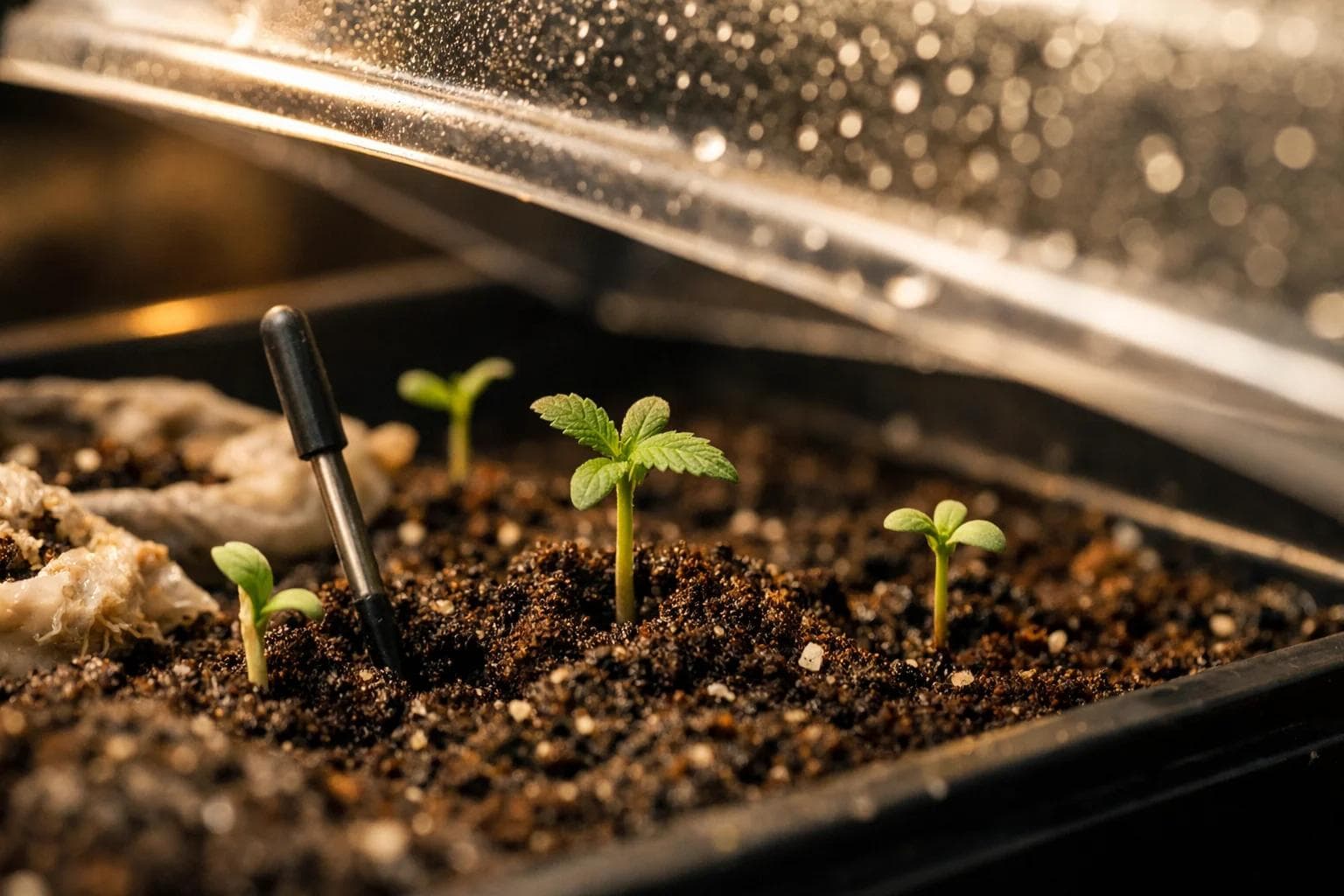
A seedling heat mat raises substrate temperature to the 78–82°F (25.5–27.5°C) sweet spot cannabis seeds need to germinate reliably. Set your thermostat controller to 82–84°F (28–29°C), place the probe inside the substrate at seed depth, and remove the mat when the first true leaves appear — typically 5–10 days after sprouting.
Getting cannabis seeds to germinate consistently comes down to three variables: moisture, darkness, and warmth. The first two are easy to control. The third — substrate temperature — is where most growers in cold rooms, unheated basements, and early-spring grow spaces fall short. A seedling heat mat solves that directly. This guide covers the right temperature, how to set up the mat for your specific germination method, how to use a thermostat correctly, when to remove the mat, and the eight mistakes that kill seeds before they ever sprout. Complete Cannabis Seed Germination Guide
Do Cannabis Seeds Need a Heat Mat to Germinate?
A heat mat is not biologically mandatory, but it becomes practically essential when ambient room temperature falls below 20°C. Cannabis seeds germinate most reliably when substrate temperature holds between 22–28°C — a range that cool basements, spare bedrooms, and unheated grow rooms rarely reach on their own during early spring.
For growers in Toronto starting seeds in March, basement ambient temperatures of 15–17°C are routine. In Calgary and Edmonton, even heated homes can have cold concrete floors that keep basement substrate temperatures hovering around 16°C well into May. Without supplemental heat, germination in these conditions stretches from the typical 2–4 days to 7–10 days or more — and failure rates climb significantly. A heat mat shifts the variable from whether seeds will germinate to simply when.
The mat is optional when:
- Your grow tent is already running lights and ambient temperature stays above 24°C
- It is summer and your indoor space naturally holds 22°C or warmer
- You are germinating in a heated propagation chamber with active temperature control
Can Cannabis Seeds Germinate Without a Heat Mat?
Yes — if ambient temperature is already 22–26°C, you may not need one. But in a cool room, seeds germinating without supplemental heat take longer, fail more often, and face a higher risk of damping off. Cold substrate slows enzyme activation, delays moisture uptake through the seed coat, and creates exactly the prolonged damp-but-not-germinating window that fungal pathogens need.
Will a Heat Mat Speed Up Cannabis Germination?
Yes — meaningfully. In a 15–17°C room, a heat mat running at the correct substrate temperature can reduce germination time from 7–10 days to 24–72 hours under ideal conditions. Warm substrate accelerates the enzymatic reactions that drive radicle emergence and moisture absorption through the seed coat — the mat simply removes temperature from the equation. Seed genetics, moisture level, and darkness handle the rest. Speed gains are most dramatic with fresh, high-viability seeds. Cannabis Seed Anatomy — How to Tell if Seeds Are Viable
What Temperature Should You Set a Heat Mat to for Cannabis Seeds?
Target a substrate temperature of 78–82°F (25.5–27.5°C). This is not your mat surface temperature — it is the temperature inside the growing medium at seed depth. Set your thermostat controller 2–4°F higher than your substrate target (82–84°F / 28–29°C) to compensate for heat loss through the tray, medium, and any airspace between mat and substrate.
What Temperature Is Too Hot for Cannabis Seed Germination?
Above 90°F (32°C) is where embryo damage begins. At this temperature, the radicle can emerge already browned and soft, or the seed coat cracks but the embryo stalls entirely — cooked before it can anchor. Signs of overheating include: paper towel drying out faster than expected, seeds that split without pushing a taproot, and mushy or discoloured radicles that disintegrate on contact. If you see any of these, check substrate temperature immediately before placing more seeds.
Do Autoflowers Need a Different Heat Mat Temperature?
No. The same 78–82°F (25.5–27.5°C) substrate range works equally well for autoflowering and photoperiod genetics. Autoflower strains carry ruderalis genetics evolved in cool northern latitudes, but germination biology is identical across cannabis subspecies — the embryo responds to warmth and moisture the same way regardless of flowering type. Don't let the cold-climate ruderalis origin talk you into running a cooler mat — the seed itself doesn't care about its ancestry at this stage. Germinating Autoflower Seeds — Tips & Differences vs Photoperiod Buy seeds
How Do You Set Up a Heat Mat for Cannabis Seed Germination?
Follow this sequence for a correct, repeatable setup:
- Place the mat on an insulated surface — not bare concrete. Cold floors in Montreal and Winnipeg basements will draw heat downward constantly, forcing the mat to work harder and creating uneven temperature distribution across the tray. A folded bath towel or thin foam pad under the mat solves this entirely.
- Connect the thermostat controller — plug the mat into the thermostat, plug the thermostat into the wall.
- Place your propagation tray or plate on the mat.
- Insert the thermostat probe into the substrate at seed depth — not on the mat surface, not under the mat. This step is covered in detail in the thermostat section below; getting it wrong is the most common setup error.
- Set controller to 82–84°F / 28–29°C.
- Add a humidity dome if using one — the dome and mat combination is the most effective germination environment available to home growers without climate-controlled equipment.
- Wait 30–60 minutes, then verify substrate temperature with a separate probe thermometer before adding seeds. rarely assume the mat has reached the right temperature without measuring.
How Does Heat Mat Setup Differ for Paper Towel vs Soil vs Plugs?
The core stack is always mat → medium → probe → seeds. What changes is where the probe sits and how moisture behaves:
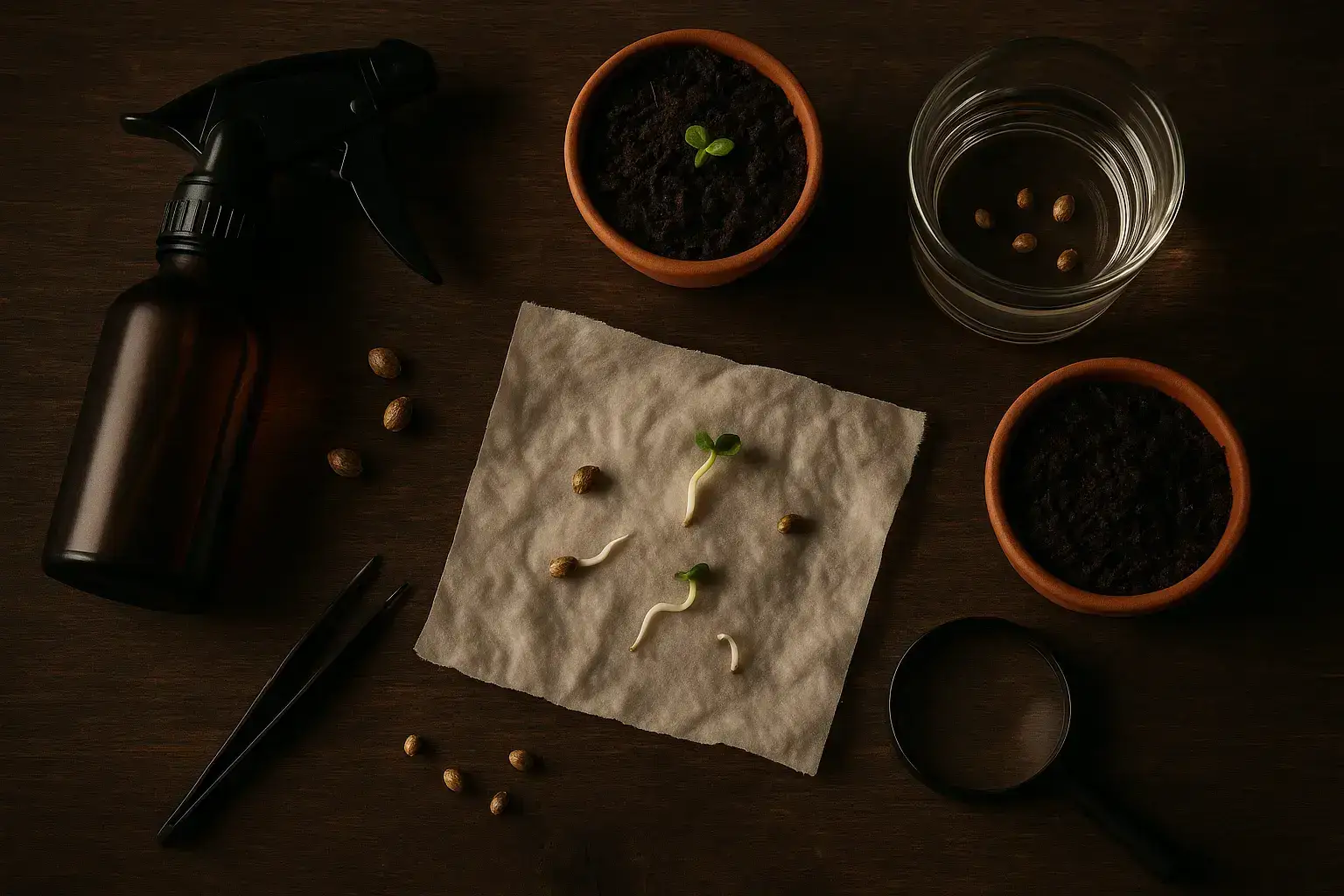
- Paper towel on plate: Mat → plate → damp paper towel with seeds → thermostat probe tucked between the folded towel layers, not below the plate. Paper Towel Germination Method for Cannabis Seeds
- Seeds in soil pots: Mat → tray → pots with pre-moistened soil → probe inserted into the soil at seed depth in the centre pot. Direct Soil Germination — Planting Cannabis Seeds Straight Into Soil Best Soil Mix for Cannabis Seed Germination
- Rockwool cubes or jiffy plugs in tray: Mat → propagation tray → plugs → probe inserted into the centre plug → dome on top. Rockwool Cubes & Jiffy Pellets for Cannabis Seed Germination
- Coco coir in pots: Same stack as soil, but coco retains more moisture than most soil mixes — check substrate moisture every 12 hours rather than 24, and reduce watering volume. Heat accelerates evaporation in coco faster than beginners expect. Germinating Cannabis Seeds in Coco Coir — Complete Guide
Do You Need a Thermostat with a Seedling Heat Mat?
Yes — without one, you are guessing, and the stakes are high. Without temperature regulation, most seedling mats overshoot their rated temperature by 5–15°F depending on ambient conditions, tray material, and dome presence. In an enclosed propagation tray with a dome fitted, substrate temperature can exceed 35°C within two to three hours of operation. A basic digital thermostat with a probe rated for a 5–42°C range covers everything you need — there is no reason to spend more for germination use.
Where Should the Thermostat Probe Go — On the Mat or in the Substrate?
Always in the substrate, at seed depth. Placing the probe on the mat surface is the single most common heat mat setup error: mat surface temperature runs 5–10°F hotter than actual substrate temperature. When the probe reads from the mat surface, the thermostat cuts power too early, and the substrate stays cold. Probe under the mat is worse — it never reads the growing medium at all, so the mat runs at full power until something goes wrong. The probe belongs where the seeds are: in the medium, at seed depth.
When Should You Remove the Heat Mat After Germination?
Remove the heat mat when the first true leaves appear — not at cotyledon emergence. True leaves are the serrated cannabis-shaped leaves that follow the rounded cotyledons; they typically emerge 5–10 days after the seedling breaks the soil surface. Stage by stage:
- Seed cracks, taproot emerges → keep mat on, maintain 78–82°F substrate
- Seed transferred into or already in substrate → keep mat on
- Cotyledons open above soil → mat still useful; begin checking ambient room temperature
- First true leaves appear → begin weaning or remove mat entirely
What Soil Temperature Do Cannabis Seedlings Need After Sprouting?
Seedlings thrive at 70–77°F (21–25°C) root zone temperature — slightly cooler than the germination window. This narrower, cooler range promotes lateral root development without driving excessive stem elongation. Root zone temperatures above 28°C after sprouting tend to produce stretchy, leggy seedlings rather than compact, stocky ones. Cannabis Seedling Care After Germination — Week-by-Week Guide
Should You Wean Seedlings Off the Heat Mat Gradually?
Yes, if room temperature is below 20°C. Reduce mat operation by 4–6 hours per day over 2–3 days before removing entirely. A sudden 10°C drop in root zone temperature shocks newly established seedlings — roots stall, growth slows, and you create unnecessary stress right when the plant should be directing energy into its first true leaves. If your room already holds 22°C or warmer, pulling the mat all at once is fine. Leggy & Stretching Cannabis Seedlings — Causes & Fixes
What Are the Most Common Heat Mat Mistakes During Cannabis Germination?
Most heat mat failures come from the same list:
- No thermostat — mat runs at full power, substrate overshoots, seeds are damaged or killed
- Probe on the mat surface — reads too hot, thermostat cuts power early, substrate stays cold
- Mat on bare concrete — cold floor pulls heat downward; common in Calgary and Chicago basements; fix with insulation under the mat
- Leaving the mat on too long — seedlings stretch toward heat from the root zone, damping off risk increases significantly after the true leaf stage
- Forgetting to re-moisten substrate — heat accelerates evaporation; in a warm setup, substrate can go from moist to bone dry within 24 hours
- Mat too large for the tray — exposed mat edges run hotter than the center; seeds near edges can overheat
- Heat mat + dome + zero airflow — warm, wet, stagnant air is the ideal environment for Pythium and Rhizoctonia; vent the dome at least twice daily
- Adding seeds before confirming temperature — typically measure substrate temperature after a 30–60 minute warm-up; rarely guess
How Do You Prevent Overheating and Damping Off with a Heat Mat?
Use a thermostat, ventilate the humidity dome at least twice daily for 5–10 minutes, check substrate moisture every 12–24 hours, and remove the mat at the true leaf stage without exception. Damping off — the fungal collapse that kills seedlings at the soil line — does not come from the mat itself. It comes from warm, wet, stagnant growing conditions that a mat can create if not managed correctly. The mat is a tool; airflow and moisture discipline are the safeguards. Damping Off in Cannabis Seedlings — Causes, Prevention & Treatment Preventing Mold & Rot During Cannabis Seed Germination
FAQ
Can I use a heat mat with a timer instead of a thermostat?
Not recommended. A timer cycles the mat on and off based on time, not actual substrate temperature — it has no way to respond to ambient temperature changes, tray insulation, or dome conditions. On a warm day, a timer-controlled mat can still overheat your substrate. A thermostat responds to real temperature readings. Use a thermostat.
Is it better to use a heat mat 24/7 or on a schedule?
Run it 24/7 with a thermostat from seed placement until you reach the removal stage. During germination, consistent substrate temperature matters more than any savings from cycling the mat off. Once you have a thermostat controlling output, the mat only runs when needed anyway.
Can I germinate old cannabis seeds with a heat mat?
Yes — heat mats are especially useful for older seeds with reduced germination vigour. Consistent warmth helps compensate for a weakened seed coat and slower enzyme activity in aged genetics. Combine the heat mat with a 12–24 hour pre-soak in plain water before placing seeds in your chosen method. [LINK: How to Germinate Old Cannabis Seeds — Revival Techniques | /en/articles/how-to-germinate-old-cannabis-seeds]
Do heat mats use a lot of electricity?
No. Most seedling heat mats draw 20–45 watts — comparable to a standard light bulb. Running one continuously for a full germination cycle adds a negligible amount to a Canadian hydro bill. Even in Ontario and BC where electricity rates are higher than the national average, a single mat running 10 days costs less than a dollar.
Can I stack multiple trays on one heat mat?
Not recommended. Heat dissipates unevenly through multiple layers of tray and medium, and your thermostat probe — positioned in the bottom tray — cannot accurately represent the temperature in the upper tray. Use one mat per tray layer, or use a single tray per mat.
19+ | Educational horticulture only.