From Seed to Seedling
Germination Guides
Cannabis Seed Anatomy — How to Tell if Seeds Are Viable
Discover cannabis seed viability signs: dark color, hard shell, tiger-stripe pattern. Master the float and squeeze tests.
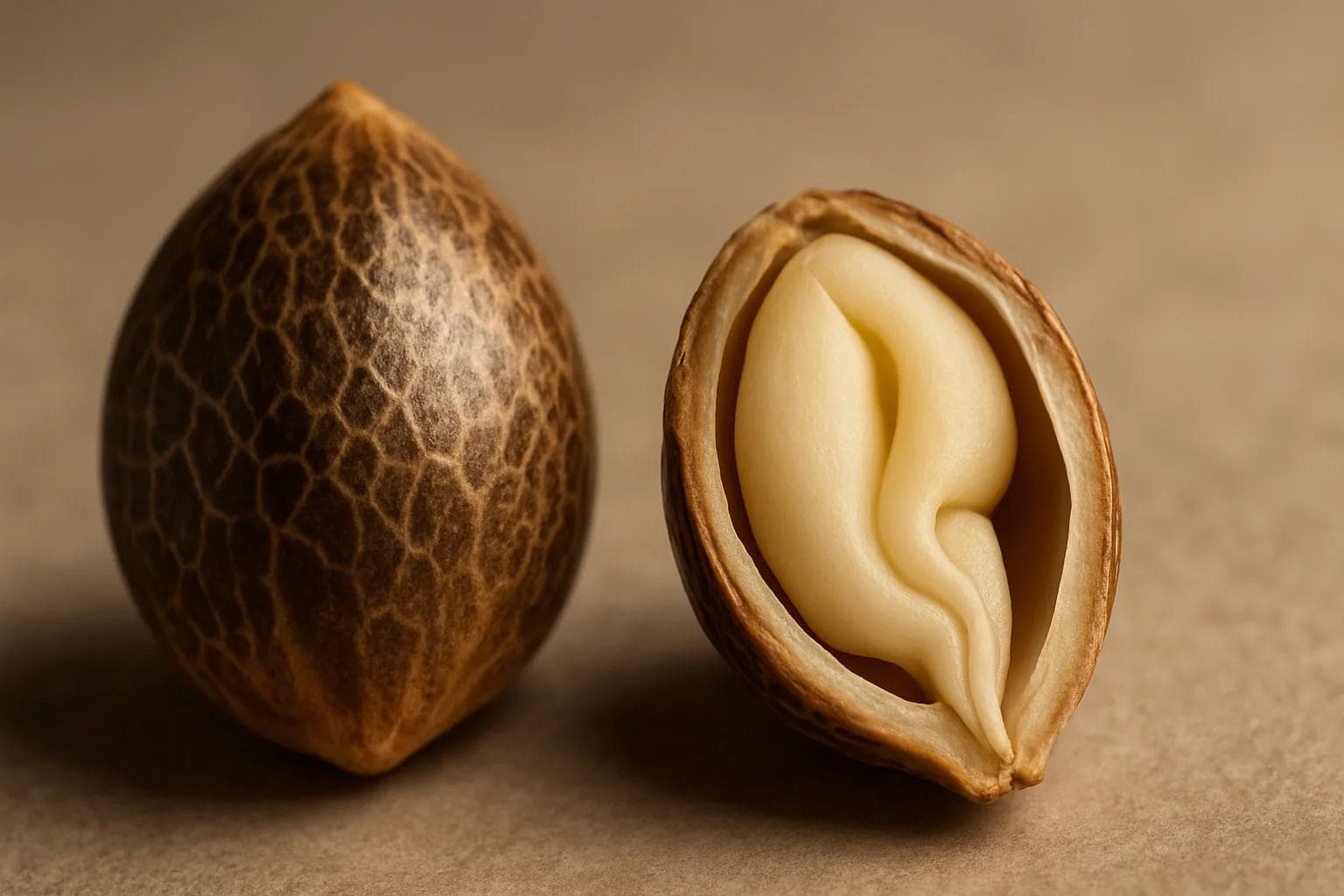
A viable cannabis seed is dark brown or grey with a hard shell, mottled tiger-stripe pattern, and waxy sheen. Before germinating, run a visual check, a gentle squeeze test, and a 1–2 hour float test. Seeds that are pale green or white, soft, or cracked are unlikely to sprout and should be discarded.
What Is Inside a Cannabis Seed?
A cannabis seed contains everything a new plant needs to emerge: a protective outer coat, a nutrient reserve, and a dormant embryo. Understanding these parts helps you recognize what a healthy seed should look and feel like — and what signs indicate the embryo inside has already failed.
What Are the Main Parts of a Cannabis Seed?
A cannabis seed has five key structures: the seed coat (outer hull), the endosperm (nutrient reserve), the embryo (the future plant), the cotyledons (embryonic leaves), and the radicle (embryonic root that becomes the taproot). All five must be intact and viable for germination to succeed.
The embryo is the core. If it has been damaged by heat, moisture, or age, the seed may look perfectly normal on the outside while being completely dead inside. That is exactly why external appearance alone — though useful — is not a sufficient viability check. You cannot crack a seed open to inspect the embryo, so you need to know what external signals are actually worth trusting.
What Role Does the Seed Coat Play in Germination?
The seed coat is the first line of defense and the primary signal of seed health. A well-developed seed coat is firm, smooth, waxy, and typically shows a mottled dark pattern — the tiger stripes that growers look for. It regulates moisture uptake during germination and protects the embryo from mechanical damage, pathogens, and temperature swings.
When the seed coat is pale, soft, or cracked, its protective function is already compromised. Moisture can enter unevenly, pathogens can breach the hull, and the embryo is unlikely to survive the germination process even if it is technically still alive. A damaged coat is not just cosmetic — it is the embryo's only shield from the moment water hits the substrate.
How Can You Tell if a Cannabis Seed Is Viable?
A viable cannabis seed is hard, dark, and patterned. Assess three things before germinating: colour, surface texture, and firmness. Seeds that score well on all three are worth planting. Seeds that fail even one indicator should be tested further before committing a grow slot to them.
What Does a Good Cannabis Seed Look Like?
A healthy, viable seed is dark brown or grey — sometimes nearly black — with a clearly visible mottled or striped pattern on the shell. The surface has a subtle waxy sheen. When you hold it between two fingers and apply firm pressure, it does not compress or crack. Size is less important than shell integrity and colour depth.
Visual checklist — viable seed:
- Colour: dark brown, grey, or near-black
- Pattern: tiger stripes, mottling, or spotted markings visible
- Surface: smooth and waxy, not rough or powdery
- Firmness: hard — resists finger pressure without flexing
- Shape: symmetrical teardrop, no visible cracks or splits
What Does a Dead Cannabis Seed Look Like?
A dead or immature cannabis seed is pale — often green, white, or light beige — with a soft, compressible shell. The tiger-stripe pattern is absent or faded. The surface tends to feel dry and papery rather than waxy. Some dead seeds show fine cracks running along the hull, a sign the seed coat dried out or was exposed to temperature fluctuation during storage.
Visual checklist — non-viable seed:
- Colour: pale green, white, cream, or light beige
- Pattern: absent, faded, or uniform with no mottling
- Surface: rough, dry, papery, or crumbling
- Firmness: soft — compresses or cracks under light pressure
- Shape: irregular, asymmetrical, or visibly cracked
How Do You Float Test Cannabis Seeds?
The float test is a quick screening tool that uses water density to separate likely-viable seeds from likely-dead ones. It takes two hours and requires nothing more than a glass of room-temperature water and a dark environment. It is not a guarantee — but it eliminates obvious failures before you waste a propagation slot.
Steps:
- Fill a glass with room-temperature water (not cold, not warm — cold water can shock seeds).
- Drop your seeds in gently.
- Cover the glass and leave it in a dark place for 1–2 hours.
- After the wait: seeds that have sunk to the bottom are likely viable. Seeds that are still floating are likely dead or immature.
- Germinate sinkers immediately — do not store seeds that have been soaked.
Is the Float Test Reliable?
The float test is a useful screening tool, not a pass/fail guarantee. Some viable seeds float because the seed coat traps a small air pocket — particularly seeds with a thick, waxy hull. Some non-viable seeds sink because the interior has collapsed and absorbed water. Both false positives and false negatives occur.
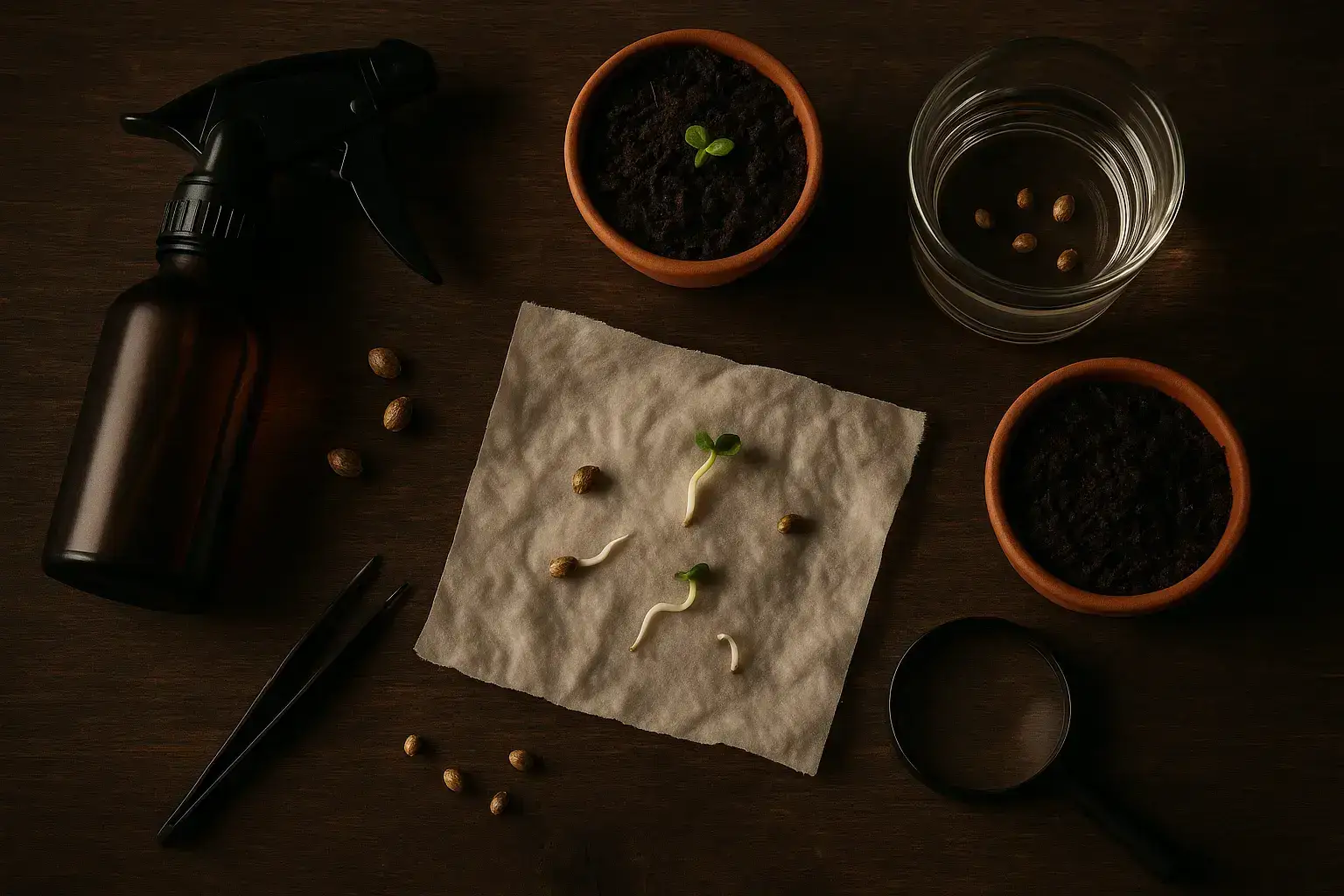
Use it as a first filter, not a final verdict. If a seed floats but passes the visual and squeeze checks, germinate it anyway — especially if it came from a reputable source with documented viability rates. The Paper Towel Germination Method lets you monitor the process closely so you can pull failed seeds quickly without wasting soil or a container.
Under Canada's Cannabis Act, home growers are legally permitted to grow up to four plants per household. With that limit in place, every seed matters. Running viability checks before committing a grow slot is not just good practice — it directly affects your harvest ceiling.
What Are Tiger Stripes on Cannabis Seeds?
Tiger stripes are the dark, irregular markings — bands, spots, or mottled patches — that appear on the surface of a mature cannabis seed coat. They are produced as the seed matures on the plant and indicate that the seed coat has fully developed. Well-defined tiger stripes are one of the strongest external indicators of seed maturity and viability.
Their presence means the seed coat completed its development cycle before the seed was harvested. Their absence is a warning sign — but not always a disqualifier.
Important nuance: Some strains naturally produce seeds with lighter colouring or less distinct patterning due to genetics, not poor quality. A pale seed from a reliable, well-stored batch should still be tested rather than discarded on appearance alone. Conversely, a darkly striped seed that is soft or cracked should not be trusted on surface markings alone.
Tiger stripes are a strong positive signal, not a standalone guarantee. Read them alongside firmness and colour.
How Long Do Cannabis Seeds Stay Viable?
Under ideal conditions, cannabis seeds can remain viable for 2–5 years. Under poor conditions — fluctuating temperatures, high humidity, light exposure — viability can drop sharply within a single season. Germination rates decline gradually with age: a fresh seed may germinate at 95%+, while a 3-year-old seed from the same batch under good storage may sit at 60–70%.
How Do You Store Cannabis Seeds to Keep Them Viable?
Store seeds cool, dark, dry, and airtight. The ideal storage conditions are: temperature between 6–8°C (a dedicated refrigerator drawer), relative humidity at 20–30%, zero light exposure, and an airtight container — ideally glass or vacuum-sealed — with a food-grade desiccant packet inside.
Avoid plastic zip bags. They allow micro-humidity exchange over time. Avoid freezing unless the seed is properly desiccated first — ice crystal formation inside the seed can destroy the embryo.
Home growers in cities like Calgary or Ottawa have a natural advantage here: cool basement environments can hold stable low temperatures through winter, provided humidity is actively managed. Growers in Denver benefit similarly — the mile-high altitude produces naturally low ambient humidity (often 20–30% RH indoors in winter), which is close to ideal seed storage conditions without active dehumidification. A basement corner that stays at 8–12°C year-round is a workable passive storage environment — but only if a desiccant packet is keeping relative humidity below 30%. Without humidity control, that cool basement becomes a slow germination chamber.
Can Old Cannabis Seeds Still Germinate?
Yes — but success rates drop with age, and revival requires patience. Seeds that are 3–5 years old can still sprout if they were stored well, but expect longer germination times and lower germination rates compared to fresh seeds.
Two techniques improve results with older seeds:
- Light scarification: Gently rub the seed between two sheets of fine sandpaper to thin the seed coat and improve water uptake. Do not break the coat — just scuff it lightly.
- Extended soak: Soak old seeds for up to 32 hours (vs. the standard 12–18 hours for fresh seeds). Use room-temperature water and change it after 24 hours if needed.
Do Feminized Seeds Look Different From Regular Seeds?
Visually, feminized seeds and regular seeds are largely indistinguishable. There is no reliable way to determine a seed's sex — or whether it is feminized — from external appearance alone. Colour, size, tiger stripe pattern, and hardness do not indicate whether a seed will produce a female, male, or hermaphroditic plant.
This is one of the most persistent myths in cannabis cultivation: the idea that seed shape or markings can predict sex. They cannot.
What you can observe:
- Feminized seeds from reputable genetics tend to be consistent in size and colouring within a batch — this reflects breeding quality and controlled production, not an inherent visual marker of feminization.
- Autoflower seeds are often slightly smaller and rounder than photoperiod seeds of comparable genetics, but this varies significantly by strain and breeder.
- Viability assessment (colour, hardness, float test) applies equally to feminized, regular, and autoflower seeds.
FAQ
Are hard or soft cannabis seeds better?
Hard seeds are significantly better. A firm shell indicates a fully developed seed coat that completed its maturation cycle. Soft seeds — those that compress or crack under light finger pressure — have either degraded from age or heat, or were harvested before fully maturing. A seed that cannot resist gentle pressure will rarely germinate successfully.
Can you germinate a white cannabis seed?
White or very pale seeds can occasionally germinate, but the odds are low. Pale colouring usually indicates an immature seed — harvested too early before the seed coat fully developed — or severe degradation from heat or light exposure. Run the float test first. If it sinks, attempt germination; if it floats, discard it. Do not dedicate a prime grow spot to a pale seed without testing it first.
What causes cannabis seed failure?
Cannabis seeds fail for five reasons: immaturity (harvested too early), heat damage during storage or shipping, excessive humidity triggering premature activation, age-related embryo decline without desiccant control, and physical damage from rough handling or improper freezing. Heat and humidity are the most common culprits. The most common causes of seed failure are: (1) immaturity — the seed was harvested before the embryo fully developed; (2) heat damage during storage or shipping; (3) excessive humidity causing the embryo to pre-activate and die before planting; (4) age-related decline when seeds are stored without desiccant or temperature control; and (5) physical damage from rough handling, compression, or freezing without proper desiccation. Growers in high-humidity climates like Portland, where indoor RH can easily climb above 50% in fall and winter, need to be especially vigilant about airtight storage — ambient humidity creeps into poorly sealed containers over weeks.
Should I squeeze test my cannabis seeds?
Yes — but only as a secondary check, and only with controlled pressure. Apply moderate force between two fingers: a viable seed will not flex or crack, while a non-viable seed collapses or crumbles. Too much pressure destroys good seeds. Use this test after visual inspection, never as your first or only filter. The squeeze test is useful for identifying obviously soft or already-cracked seeds, but apply it carefully. Use two fingers and apply moderate pressure — enough to test firmness, not enough to damage a viable seed. A good seed will not flex or crack. If a seed collapses under light pressure, it is not viable. Never perform the squeeze test aggressively — you can destroy a viable seed this way. Use it as a secondary check after the visual inspection, not a primary test.
Do bigger seeds produce bigger plants?
No — seed size does not reliably predict plant size, yield, or vigour. Seed size is primarily a function of strain genetics and growing conditions on the mother plant. A smaller seed from a proven genetic line will outperform a large seed from a degraded or unstable source. Focus on seed health indicators (colour, hardness, pattern, storage history) rather than physical dimensions. --- *Before you plant, make sure your seeds are ready. Once you have confirmed viability, follow our [LINK: Complete Cannabis Seed Germination Guide | /en/articles/cannabis-seed-germination-guide] for step-by-step germination methods matched to your setup.* ---
19+ | Educational horticulture only.