From Seed to Seedling
Germination Guides
Preventing Mold & Rot During Cannabis Seed Germination
Prevent mold and rot during cannabis seed germination by maintaining optimal humidity, temperature, and sterilizing your tools and substrate.
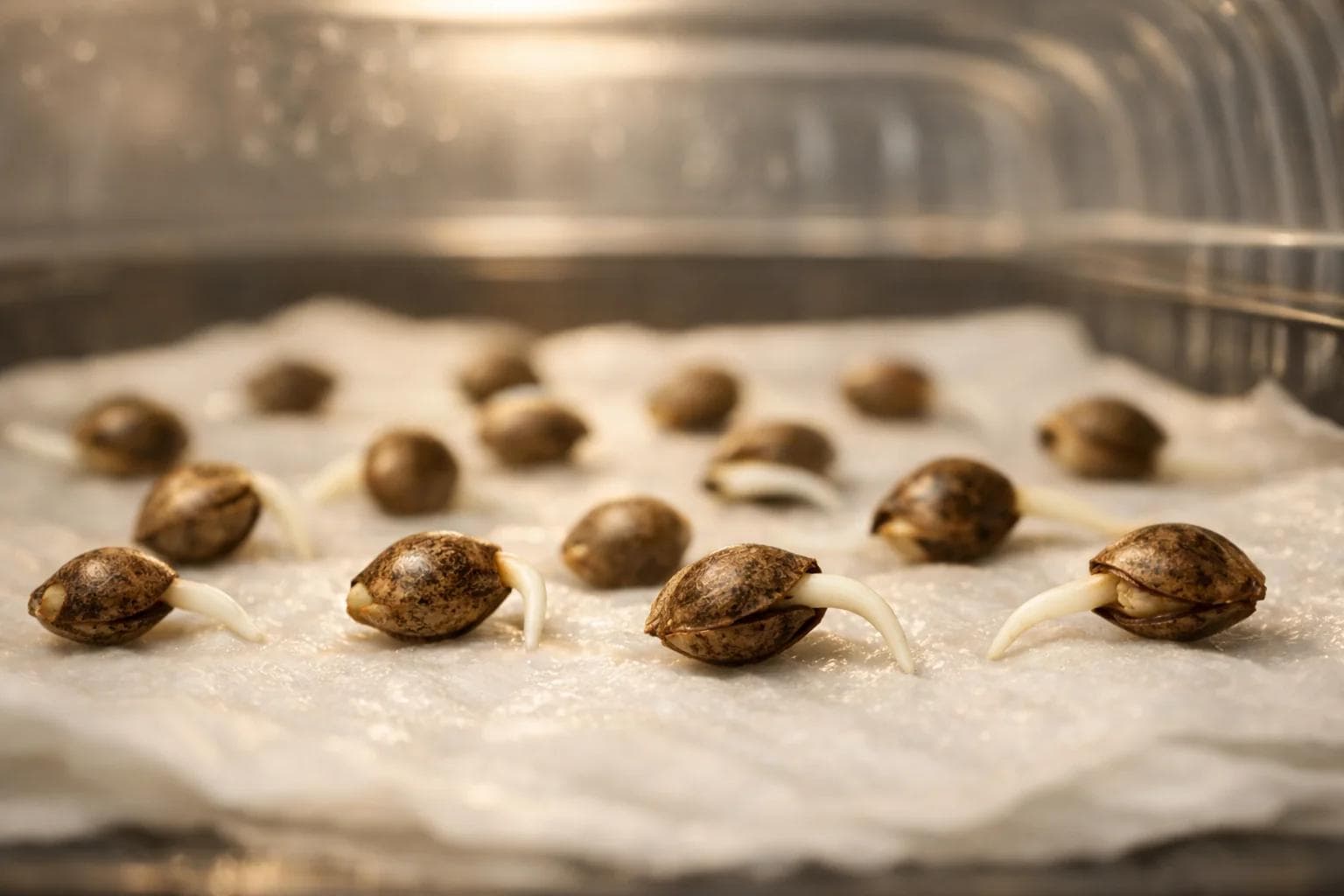
Mold during cannabis seed germination is caused by excess moisture, stagnant air, and contaminated tools or substrate. Keep temperature at 20–25°C and humidity at 65–70% RH, sterilize everything before you start, and open your germination container for 30–60 seconds every 12 hours. Most germination mold is completely preventable with the right setup.
What Causes Mold and Rot During Cannabis Seed Germination?
Mold during cannabis seed germination results from four converging conditions: excess moisture, poor airflow, contaminated substrate, and incorrect temperature. The primary fungal pathogens — Pythium, Fusarium, Botrytis, and Rhizoctonia — are opportunistic organisms that colonize softening seeds within the first 24–72 hours of hydration when those conditions align.
Seeds are most vulnerable during this window because the outer shell absorbs water, softens, and exposes the embryo to whatever's living in its environment. A lot can go wrong in 48 hours when the conditions are wrong.
These fungal spores don't arrive at germination time — they're already on your tools, your containers, your substrate, and often on the seed shell itself. Your job is not to eliminate spores (that's impossible) but to control conditions so they cannot establish and spread.
Why Does the Paper Towel Method Cause More Mold Than Other Methods?
The paper towel method places wet organic material in a warm, sealed, dark space — which is functionally a textbook mold incubator. Moisture has nowhere to drain, airflow is near zero, and cellulose gives fungal spores an ideal growth substrate. It is the most commonly used germination method and carries the highest mold risk of any approach.
That does not mean you should abandon it. But it means hygiene discipline is non-negotiable when you use it. Paper Towel Germination Method for Cannabis Seeds
Does Seed Age Affect Mold Risk During Germination?
Yes — significantly. Older seeds have thinner, more brittle shells and lower germination vigour, which means they spend more time hydrated before cracking open. The longer a seed sits wet without progressing, the longer mold has to colonize it. Seeds stored improperly in warm or humid conditions without desiccant degrade faster and are far more susceptible to rot during germination.
Cannabis Seed Anatomy — How to Tell if Seeds Are Viable | How to Germinate Old Cannabis Seeds — Revival Techniques
What Is the Ideal Temperature and Humidity for Mold-Free Germination?
The ideal germination environment is 20–25°C (68–77°F) at 65–70% relative humidity (RH). Below 18°C, germination slows dramatically and seeds sit wet for longer — increasing the window of mold exposure. Above 28°C, heat stress can damage the embryo while simultaneously accelerating fungal growth.
Both extremes create mold risk through different mechanisms, which is why chasing "warmer is better" and "cooler is safer" will both get you to the same place.
The 65–70% RH target is specific to germination — noticeably higher than the 40–60% RH you'd run during veg. This creates a real tension: seeds need moisture to germinate, but that same environment feeds the pathogens you're trying to suppress. The solution is precision and ventilation — not dryness.
Growers running basement setups in Toronto and Vancouver frequently see germination mold spike in late spring, when ambient humidity climbs before temperatures have stabilized. A digital hygrometer in your germination area costs next to nothing and gives you a real number — don't try to eyeball it. In drier indoor environments, heat mat use can create warm pockets that trap moisture if ventilation gets neglected.
How Does a Humidity Dome Affect Mold Risk?
A humidity dome helps maintain the 65–70% RH germination target, but a fully sealed dome over warm seeds can push RH to 90%+ within hours — creating ideal conditions for Botrytis and Pythium. The dome is a useful tool, not a passive solution.
Open dome vents once or twice daily and remove the dome entirely as soon as taproots emerge. In humid climates like Montreal or Portland, Oregon, you may need to ventilate more often. In drier environments like Calgary or Denver, passive dome humidity stays in range longer — but still check it; don't assume.
How Do You Sterilize Your Germination Setup to Prevent Mold?
Sterilization before germination is the single most impactful mold prevention step. Wipe all containers, tweezers, and scissors with 70% isopropyl alcohol before use. Bake soil substrate at 80°C (175°F) for 30 minutes to kill most fungal spores, or use pre-sterilized media — rockwool cubes or jiffy pellets eliminate the substrate contamination variable entirely. Always wash your hands thoroughly before handling seeds directly.
On water quality: tap water works fine in most cities but benefits from sitting uncovered for 24 hours to off-gas chlorine before use. That chlorine provides some passive surface mold suppression, but in sufficient concentration it can slow germination speed. Distilled or reverse osmosis water removes that variable entirely if you want the cleanest starting point possible.
Is Hydrogen Peroxide Safe for Pre-Soaking Cannabis Seeds?
Yes — 3% hydrogen peroxide (H₂O₂) is safe and actively beneficial for germination hygiene. Use 1–2 ml per 100 ml of water during the initial soak. H₂O₂ kills surface mold spores on the seed shell and simultaneously oxygenates the soak water, which can improve germination speed and reduce early fungal colonization risk.
Do not exceed this concentration. Pharmacy-grade 3% solution is exactly what you need. Higher-strength H₂O₂ damages seed coat tissue and the embryo — more is not better here, and it will cause the very harm you're trying to prevent.
How Much Airflow Do Germinating Cannabis Seeds Actually Need?
Germinating seeds need passive air exchange — not a fan blowing directly on them. Direct airflow will dry your setup out too quickly and stall germination. What prevents mold is the disruption of stagnant, spore-saturated air sitting undisturbed in a sealed container. Stagnant air is where Pythium and Fusarium establish their colonies.
The practical rule: open your germination container for 30–60 seconds at least once every 12 hours. Crack the lid, lift a dome vent, unseal the bag. This single habit disrupts the anaerobic microclimate that fungal pathogens depend on. No active fan circulation needed — air exchange alone does the job.
If you're running a basement setup in winter — Chicago, Seattle, anywhere with stagnant cold air — position a small fan pointing at a nearby wall rather than at the germination setup directly. Indirect air movement is enough to break up the dead-air pockets where spores settle.
What About Germinating in a Sealed Plastic Bag?
The ziplock bag method is popular because it is simple, but it carries the highest mold risk of any germination technique. A fully sealed bag rapidly reaches 95%+ RH and creates near-anaerobic conditions that Pythium thrives in — the opposite of what you want.
If you use this method: keep the bag at least 30% open at all times, check every 12 hours without exception, and transfer seeds to their growing medium the moment a taproot appears. Do not wait for maximum taproot length before moving them.
What Does Mold on a Germinating Cannabis Seed Look Like?
Mold at the germination stage presents in several distinct forms, and identifying it early determines whether rescue is possible or whether the seed needs to be discarded:
Surface mold (early stage): A white, grey, or green fuzzy coating on the seed shell or the substrate directly surrounding it. This is fungal mycelium — it spreads quickly and typically appears within 24–48 hours of contamination in warm, humid conditions. Act immediately if you see this.
Seed rot (advanced stage): The seed feels soft, mushy, or slimy when handled with clean tweezers. It may have turned brown or black. This is active decomposition of the embryo itself — not surface contamination. A mushy seed is not coming back.
Substrate spotting: Green, grey, or white circular patches appearing on paper towel, soil, or coco coir indicate mold colonies establishing in the growing medium. If you see this on the substrate but the seed still looks intact and firm, move fast — transfer to fresh sterilized media and get some air moving.
Smell: A sour, musty, or faintly ammonia-like odour when you open the container is an early warning signal that often precedes visible mold by hours. Trust the smell. It's one of the most reliable indicators you've got.
How Can You Tell the Difference Between Mold and Healthy Taproot Fuzz?
This is the most commonly misdiagnosed situation in beginner germination. Growers either panic at the sight of healthy root hairs, or — worse — mistake early mold for normal root development and do nothing until the seed is gone.
Healthy root hairs: Fine, very short white hairs radiating symmetrically outward from the taproot tip and along the radicle's length. They are uniform in length (roughly 1–2 mm), firmly attached to the root tissue, and grow in a consistent radial pattern. No odour.
Mold: Longer, wispy, irregular filaments — often described as cobweb-like. Mold typically appears on the seed shell rather than emerging from the root tip. It is frequently patchy, heavier in one area than another, and often carries a faint sour smell. In some cases there's a slight grey or greenish tinge rather than pure white.
The diagnostic rule: If the fuzz is growing outward from the root tip itself, and the root looks white and firm with no odour — those are root hairs. Your seed is healthy. If the fuzz is on the seed shell, the seed feels soft in any way, or you detect any odour when you open the container — treat it as mold and act immediately.
Can You Save a Cannabis Seed That Already Shows Mold?
Whether recovery is possible depends entirely on whether contamination is superficial or whether rot has reached the embryo itself. Do not wait — assess immediately and act.
Surface mold, seed still firm: Rescue is possible. Transfer the seed to a small glass containing 1–2 ml of 3% H₂O₂ per 100 ml of distilled water and soak for 20–30 minutes. Then move to a fresh, sterile substrate. Increase airflow, back off the moisture slightly, and check every 12 hours. Not guaranteed — but if the seed is firm, it's worth the attempt.
Mushy, brown, or slimy seed: Discard it. Once the embryo has degraded, no intervention restores viability. Continuing to incubate a dead seed only contaminates your setup and puts any remaining seeds at risk.
Slimy or brown taproot: If the taproot has emerged but shows brown discolouration or a slimy texture, suspect a Pythium infection. These seedlings rarely recover meaningfully. Discard, then fully sterilize your germination environment before starting again.
Starting with fresh genetics reduces mold risk from the beginning — Browse the PPS seed collection for seeds handled and stored for maximum viability.
What Is Damping Off and How Does It Connect to Germination Mold?
Damping off is a fungal disease caused by Pythium, Fusarium, and Rhizoctonia that kills seedlings in the first 7–14 days after emergence — typically presenting as a sudden stem collapse at the soil line, often overnight.
The connection most growers miss: the same pathogens that cause mold during germination are exactly the pathogens that cause damping off. A contaminated germination environment does not just kill seeds — it inoculates your substrate with the organisms that will attack your seedlings the moment they emerge. Preventing germination mold is, functionally, the first step of damping off prevention.
Germination Method Mold Risk Comparison
FAQ
Can moldy cannabis seeds still germinate?
A seed with surface mold and a still-firm shell has a reasonable chance of recovery after a 3% H₂O₂ rinse and transfer to sterile media. A seed that is mushy, brown, or slimy has no viable embryo remaining and should be discarded. Firmness is the key diagnostic — a hard seed under surface mold still has a chance; a soft seed does not.
What humidity level is safe for germinating cannabis seeds without mold?
65–70% relative humidity is the target range for germination. This is high enough to maintain seed hydration without reaching the 80–95% RH that *Pythium* and *Fusarium* prefer. Use a digital hygrometer to monitor — guessing humidity without a meter is one of the most common and avoidable mistakes in first-time germination setups.
Is tap water safe for germinating cannabis seeds?
Most municipal tap water is safe but should sit uncovered for 24 hours to off-gas chlorine before use. Chlorine suppresses some surface mold, but in sufficient concentration it can slow germination speed. Distilled or reverse osmosis water removes that variable entirely if you want a clean starting point.
How do I store cannabis seeds before germination to prevent rot?
Store seeds in an airtight container with a silica gel desiccant packet in a cool, dark environment — 6–8°C (a dedicated refrigerator shelf) is ideal. Keep internal container humidity below 30% RH. Avoid freezing unless preparing for long-term multi-year storage. Seeds stored correctly retain strong viability for 2–5 years.
Which germination method has the lowest mold risk?
Rockwool cubes and jiffy pellets carry the lowest mold risk because they are pre-sterilized, inert, and drain better than organic media. Direct soil germination is medium risk but benefits from natural microbial competition that can suppress pathogens. The paper towel in a sealed bag is the highest risk method and requires the most rigorous hygiene discipline to use safely. [LINK: Rockwool Cubes & Jiffy Pellets for Cannabis Seed Germination | /en/articles/rockwool-jiffy-pellet-cannabis-germination] ---
19+ | Educational horticulture only.