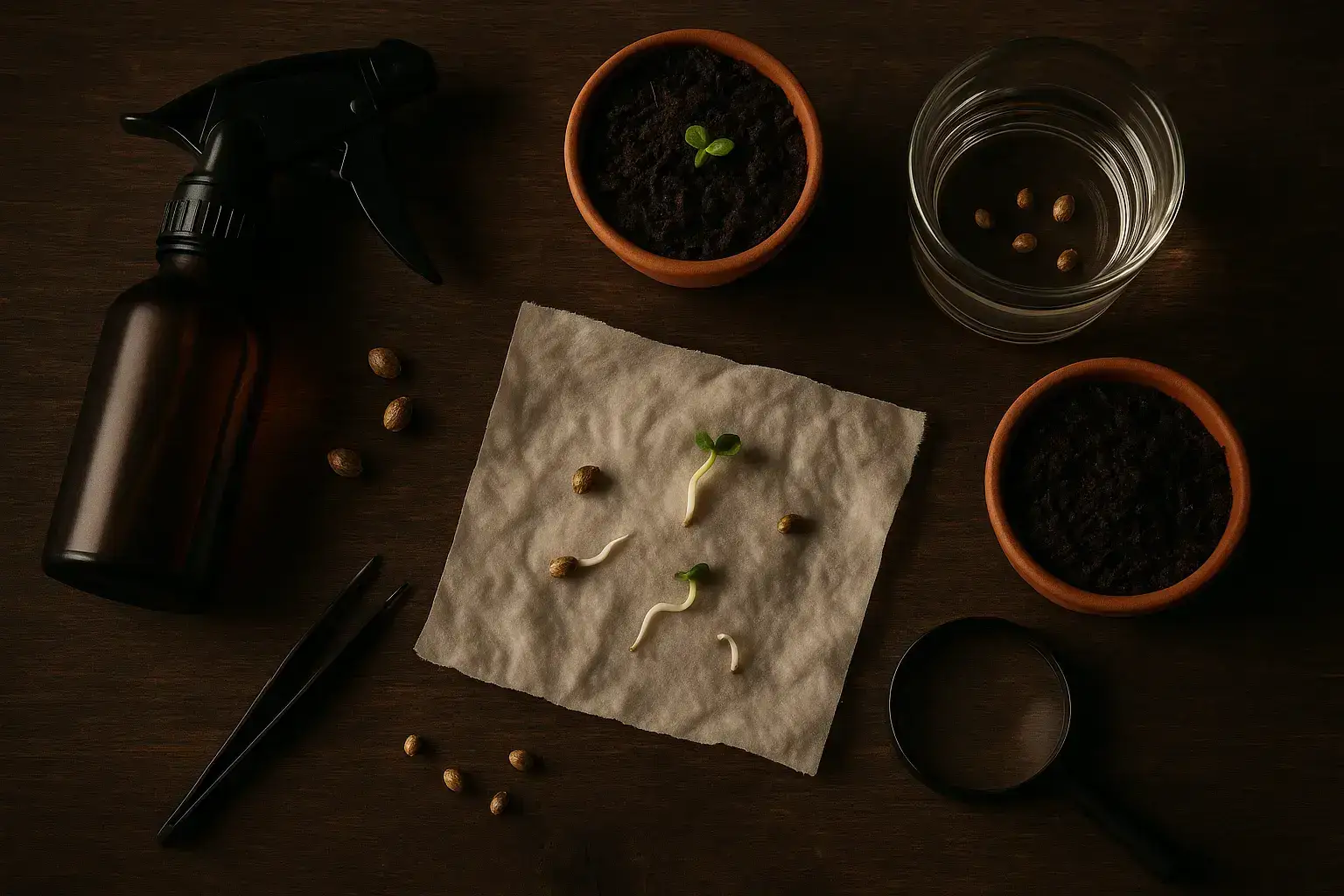
From Seed to Seedling
Germination Guides
Direct Soil Germination — Planting Cannabis Seeds Straight Into Soil
Master direct soil germination: plant cannabis seeds 1 cm deep for faster sprouting in 3-10 days. No paper towels or transplant shock.
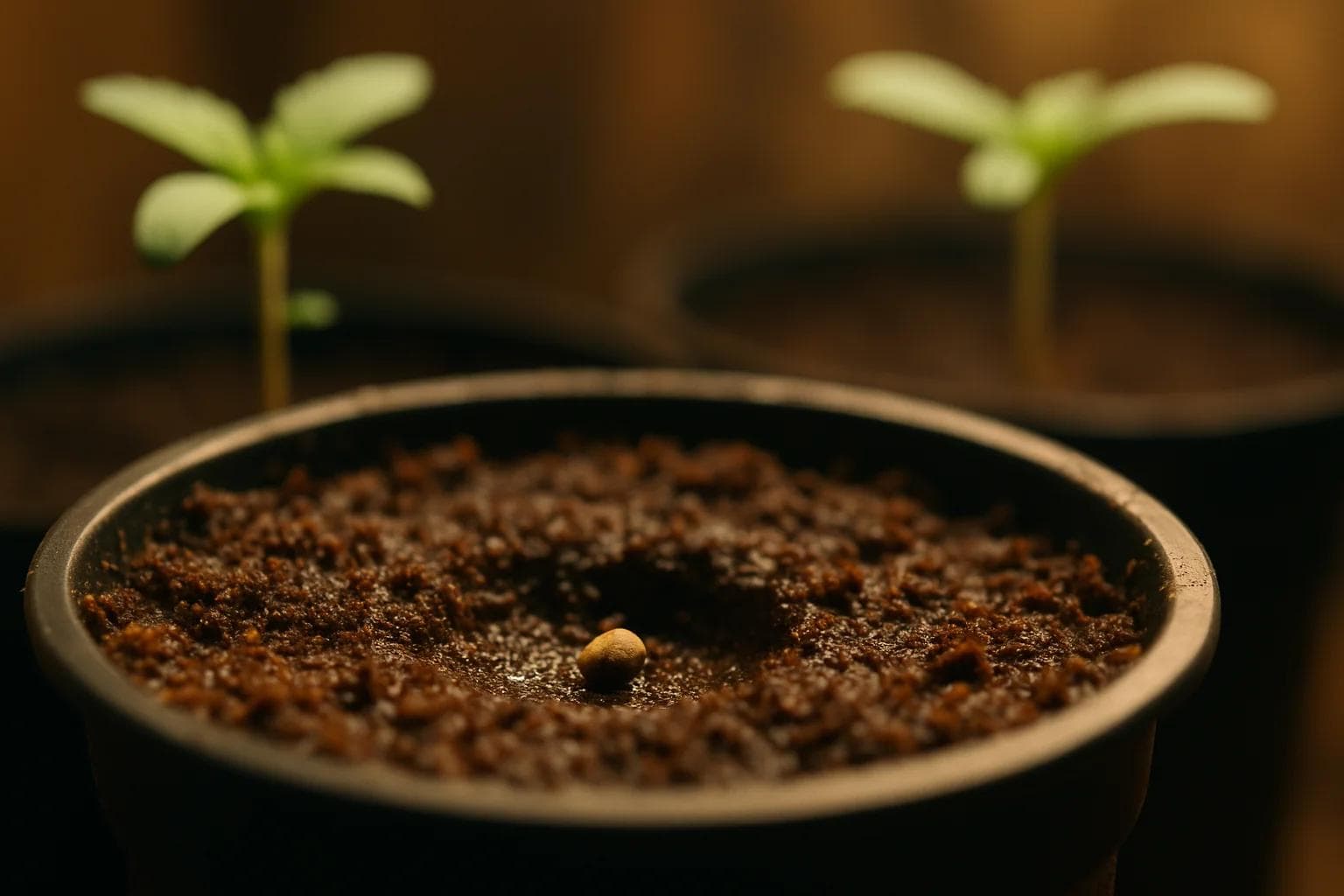
Yes, you can plant cannabis seeds directly in soil — no paper towel required. Place seeds 1 cm deep in pre-moistened seed starter mix, keep soil at 21–29°C (70–85°F), and expect sprouts in 3–10 days. This method eliminates transplant shock and is especially effective for autoflower seeds.
Direct soil germination is the simplest way to start cannabis seeds. No pre-soaking in shot glasses, no wet paper towel folded on a plate, no careful handling of fragile taproots. You prepare the soil, poke a hole, drop in the seed, and wait. For home growers working within Canada's 4-plant limit under the Cannabis Act, it's also the most forgiving approach — fewer steps means fewer opportunities for the seed to be damaged in transit.
That said, simplicity alone doesn't guarantee success. The difference between a seed that sprouts in four days and one that rots in a wet pot comes down to a handful of controllable variables: soil composition, moisture level, temperature, and planting depth. This guide covers all of them.
Can You Plant Cannabis Seeds Directly in Soil?
Yes, planting cannabis seeds directly in soil is a legitimate germination method used by home growers and commercial cultivators alike. The seed's radicle (primary root) emerges from the pointed tip of the seed coat, anchors downward into the soil, and pushes the cotyledon leaves up through the surface — all without any pre-germination step.
The trade-off compared to paper towel germination is visibility: you can't see the taproot developing. But the advantage is equally concrete — zero transplant shock, zero risk of damaging a fragile radicle during transfer, and a natural germination environment the seed has evolved to use.
Conflicting advice online usually comes from growers comparing results across different soil types, moisture conditions, or seed quality. When those variables are controlled, direct soil germination produces reliable results.
Who this method suits best:
- First-time growers who want the fewest steps
- Autoflower growers where transplant recovery time matters
- Growers starting their full 4-plant legal allotment at once
- Anyone who has had radicle damage from clumsy paper towel transfers
When Should You Use the Direct Soil Method?
The honest answer: direct soil germination is the right default for most home grows. The exceptions are narrow and specific.
Is Direct Soil Germination Better for Autoflowers?
For autoflowering genetics, direct soil germination isn't just convenient — it's the recommended approach. Autoflowers run on an internal clock that starts counting from germination, not from when you choose to transplant. Any recovery period after a transplant (typically 3–7 days of slower growth) cuts directly into your total vegetative window.
A grower in Vancouver starting an autoflower run in early March — before outdoor conditions are stable — benefits from planting directly into a final 3–5 gallon container indoors. The seedling never moves, never stalls, and hits its flowering trigger on schedule.
When Should You Choose a Different Method Instead?
Two situations call for a different approach:
Expensive or rare genetics: If you're working with limited stock of a hard-to-source strain, paper towel germination gives you visual confirmation that the taproot has emerged before you commit the seed to a pot. You see exactly what's happening. The handling risk is real, but so is the information advantage.
Coco coir medium: Direct soil principles don't transfer cleanly to coco. Coco has different moisture retention behaviour and a neutral pH that requires specific amendment. If your grow setup uses coco as its primary medium, different rules apply.
What Soil Should You Use to Germinate Cannabis Seeds?
The right germination medium is light, airy, low in nutrients, and holds moisture without becoming waterlogged. A dedicated seed starter mix — not standard potting soil — is the correct choice.
Standard potting soil is formulated for established plants with developed root systems. It often contains slow-release fertilizer at concentrations that burn or inhibit a seedling's first fragile roots. It also tends to compact around a small seedling, cutting off the oxygen exchange the developing radicle needs.
What to look for in a germination mix:
- Peat or coco-based with added perlite (20–30% perlite is ideal for drainage and aeration)
- Low or no added nutrients — seeds contain their own food supply for the first 1–2 weeks
- pH-buffered to 6.0–6.5 (test with a basic pH meter or pH strips)
- Vermiculite content is a bonus for moisture retention without compaction
- "Hot" soils with high nutrient loads (Ocean Forest, for example, is too rich for seeds)
- Garden soil or topsoil — clay content, outdoor pathogens, variable pH
- Perlite-only or bark-heavy mixes that dry out too fast
How Do You Prepare Soil Before Planting Seeds?
Soil preparation is where most germination failures start. The two most common mistakes — planting into dry soil, or planting into oversaturated soil — both happen at this stage.
How Wet Should the Soil Be Before You Plant?
Pre-moisten the soil before the seed goes in. Fill your container, water it thoroughly until runoff appears from the drainage holes, then let it drain and rest for 12–24 hours. By planting time, the soil should feel evenly moist throughout — not wet, not dry.
The squeeze test: grab a handful of soil and squeeze firmly. It should hold its shape when you open your hand, but no water should drip out. Dripping means it's too wet. Crumbles immediately — needs more water.
This pre-wetting step matters because it ensures the seed encounters uniform moisture as imbibition begins — the process by which the seed coat absorbs water to trigger germination enzymes. Dry pockets in the soil interrupt this process.
What Temperature Does the Soil Need to Be?
Target soil temperature: 21–29°C (70–85°F). At the lower end of this range, germination is slower but reliable. Below 18°C (65°F), germination stalls significantly and the seed becomes vulnerable to rot. Above 30°C (86°F), you risk damaging the emerging radicle.
In a Calgary or Edmonton home in late February, room temperatures often drop overnight. If your grow space isn't climate-controlled, a seedling heat mat placed under the pot will maintain consistent soil temperature. Alternatively, positioning a grow light 60–90 cm above the pot provides gentle ambient warmth.
If your room temperature stays comfortably warm — around 22–24°C — the soil will follow without any intervention.
What Size Container Should You Start In?
For autoflowers: Plant directly into the final container. A 3–5 gallon pot (11–19L) means the plant never gets transplanted. This is the strongest argument for direct soil germination in autoflower grows.
For photoperiod feminized seeds: A small starter container (0.5–1L, or a standard 16 oz. solo cup) is ideal. The small volume dries out at an appropriate rate, making overwatering harder to do. Transplant to a larger container after 2–3 weeks, once the plant has established a root system.
Drainage holes are non-negotiable regardless of container size. Stagnant water at the bottom of a sealed container will rot any seedling.
How Deep Should You Plant Cannabis Seeds in Soil?
Plant seeds 1 cm deep (roughly ½ inch). This is the most consistently cited depth across germination research and experienced grower practice — deep enough that the seed stays moist and has purchase for the emerging radicle to push against, shallow enough that the seedling can reach the surface without exhausting its energy reserves.
Orientation: Pointy end (crown) down. The taproot emerges from the pointed tip of the seed and drives downward by gravity. Planting it point-down means the radicle immediately heads in the right direction. If you plant it sideways or rounded-end down, the seedling can still self-correct — but it costs time and energy.
How to make the hole: Use a pencil tip, a chopstick, or your fingertip to make a small depression about 1 cm deep. Drop the seed in gently. Cover it by pushing the surrounding soil over the hole with your fingertip — do not compact or press down. The soil should settle loosely over the seed, not be packed around it.
**
Do You Need to Soak Cannabis Seeds Before Planting in Soil?
No, pre-soaking is not required for most fresh seeds. A healthy seed coat will begin absorbing moisture (imbibition) naturally once it's in pre-moistened soil. The germination process starts on contact with water in the medium.
However, a 12–18 hour soak in plain, room-temperature water can meaningfully help with:
- Seeds that are older and have developed a tougher, harder seed coat
- Seeds that have been stored in dry conditions for more than a year
- Seeds with visible texture that suggests a thickened outer layer
If you're working with seeds from an older batch, this step is worth adding before direct soil planting.
How Do You Water Seeds After Planting Without Overwatering?
Overwatering is the single most common way to kill a cannabis seed after it's been planted. The damage isn't dramatic — the seed simply sits in saturated, low-oxygen soil until it rots or develops damping off. It looks like patience failing, but it's almost always moisture management.
The first week after planting:
- Use a spray bottle, not a watering can
- Mist the soil surface when the top 0.5–1 cm looks dry — the deeper soil should still hold moisture from pre-wetting
- You are maintaining surface humidity, not re-watering the entire container
- In a Montreal apartment in February, indoor heating creates dry air — check the surface daily
Any clear cover works: a commercial propagation dome, a cut plastic bottle inverted over the pot, a clear plastic cup, or a small piece of cling wrap with a few air holes poked in it. Remove the dome as soon as the seedling breaks the surface — once the cotyledon leaves emerge, the seedling needs fresh air circulation.
Warning signs of overwatering:
- Soil surface stays visibly wet and shiny for 24+ hours after misting
- Green algae developing on the soil surface
- A sour or musty smell from the medium
How Long Does It Take for Cannabis Seeds to Sprout in Soil?
Under good conditions — pre-moistened starter mix, 21–29°C soil temperature, consistent humidity — most cannabis seeds sprout within 3–10 days.
What to expect by day:
- Day 1–3: Nothing visible. The radicle is emerging inside the seed coat and driving downward into the soil.
- Day 3–5: Most viable seeds from quality genetics will begin pushing the hypocotyl (the first stem loop) upward through the surface.
- Day 5–7: The cotyledon leaves (the small, paired rounded leaves) unfold and spread.
- Day 7–10: First true leaves begin to form. The seedling is officially established.
When to be concerned: No sign of emergence by day 10 means something likely went wrong — moisture failure, temperature drop, or seed viability. See the troubleshooting section below.
What Do You Do Once the Seedling Breaks the Surface?
The moment cotyledon leaves appear above the soil, your germination phase is complete and your seedling phase begins. Three immediate actions matter:
1. Remove the humidity dome. The seedling now needs fresh air and gas exchange. Keeping the dome on after emergence increases the risk of damping off by trapping excess humidity against the stem.
2. Adjust your light. The seedling needs light but not intensity. Start with:
- LED: 45–60 cm from the canopy (dimmed if your fixture allows)
- CFL: 15–20 cm (lower heat output, less burn risk for seedlings)
3. Light schedule:
- Photoperiod feminized seeds: 18 hours light / 6 hours dark (18/6)
- Autoflower seeds: 20/4 or 18/6 — both work, 20/4 maximizes vegetative time
What If Your Cannabis Seeds Don't Come Up?
How Do You Know If a Seed Has Failed?
Use this decision tree:
Day 3–5 and nothing visible: Normal. Be patient. Don't dig.
Day 7 and nothing visible: Check your conditions. Is soil temperature at 21°C or above? Is the surface moist? Has the humidity dome been in place? Correct any issues and wait.
Day 10 and nothing visible: Time for a careful investigation. Use a toothpick or chopstick to gently move a small amount of soil away from where you planted. Look for the seed.
What you find tells you what happened:
- Seed is intact, hard, and unchanged: Imbibition likely failed. The seed coat did not absorb enough water — either the soil was too dry, or the seed coat is too hard (older seeds). Try recovering it with the paper towel method.
- Seed is mushy, brown, or disintegrated: Overwatering or pathogen rot. The environment was too wet. Start fresh with a new seed and reduce moisture.
- Radicle visible but seedling didn't push up: Planted too deep, or soil was too compacted over the seed. The emerging stem ran out of energy before reaching the surface.
How Do You Prevent Damping Off in Soil Germination?
Damping off is a fungal condition — typically caused by Pythium or Fusarium species — that attacks the seedling stem at soil level, causing it to pinch, collapse, and die within hours of emergence. It looks like the seedling suddenly "fell over" at the base.
Prevention is straightforward:
- Use sterile seed starter mix, not garden soil or reused medium
- Never overwater — saturated soil is the primary condition damping off pathogens need
- Ensure air circulation around seedlings once the dome is removed
- Remove the humidity dome promptly after emergence
- Avoid spraying water directly onto the seedling stem
Can You Rescue a Seed That Hasn't Sprouted?
Seed intact and hard: Remove it from the soil carefully, switch to the paper towel method as a rescue, and give it another 48–72 hours. Many stalled seeds will activate with the closer moisture contact.
Radicle emerged but seedling didn't surface: Increase temperature to 25–27°C, ensure even moisture, and wait 48 more hours. The stem may still push through.
Seed soft, dark, or rotted: Discard and start fresh. There is no recovery for a rotted seed. Check your moisture and temperature conditions before planting the replacement.
Is Direct Soil Germination Better Than the Paper Towel Method?
Neither method is objectively superior — both work reliably when conditions are right. The honest comparison:
Recommendation: Default to direct soil for autoflowers and any situation where you want simplicity. Use paper towel if you're working with limited stock of a specific cultivar and want visual confirmation before committing to a container.
For first-time home growers in Toronto, Calgary, or Ottawa planting their legal 4 plants indoors under a CFL or LED setup, direct soil in small starter pots is the path of least resistance.
FAQ
What's the ideal soil temperature for direct germination?
Cannabis seeds germinate best between 21–29°C (70–85°F). Temperatures below 15°C significantly slow germination and increase rot risk, while sustained heat above 30°C can damage the seed's viability. A heating mat under your seed tray is a worthwhile investment if your growing space runs cool.
How deep should I plant the seed?
Plant seeds approximately 1 cm (about ½ inch) deep in the soil, with the pointed end facing downward. Too shallow and the seed may dry out during germination; too deep and the emerging cotyledons may exhaust their energy reserves before reaching the surface.
How moist should the soil be right after planting?
The soil should be pre-moistened to a damp state (like a wrung-out sponge) before you plant the seed. After planting, maintain light moisture using a humidity dome or periodic misting — avoid waterlogged soil, which causes rot.
How long until I see a sprout?
Most seeds sprout within 3–10 days under ideal conditions, with autoflower varieties typically emerging faster than photoperiod strains. If nothing appears after 14 days, the seed was likely not viable or conditions were too cold or too wet.
Is direct soil germination better than other methods like paper towel or water?
Direct soil germination eliminates transplant shock and the risk of damaging a fragile taproot during transfer, making it the most forgiving method for home growers. The trade-off is you can't visually confirm the taproot has emerged, but the simplicity and reliability make this the preferred approach for most cultivators.
19+ | Educational horticulture only.