From Seed to Seedling
Germination Guides
Best Soil Mix for Cannabis Seed Germination
Get the best soil mix for cannabis seed germination—2 parts peat moss to 1 part perlite—with perfect moisture and pH for healthy sprouts.
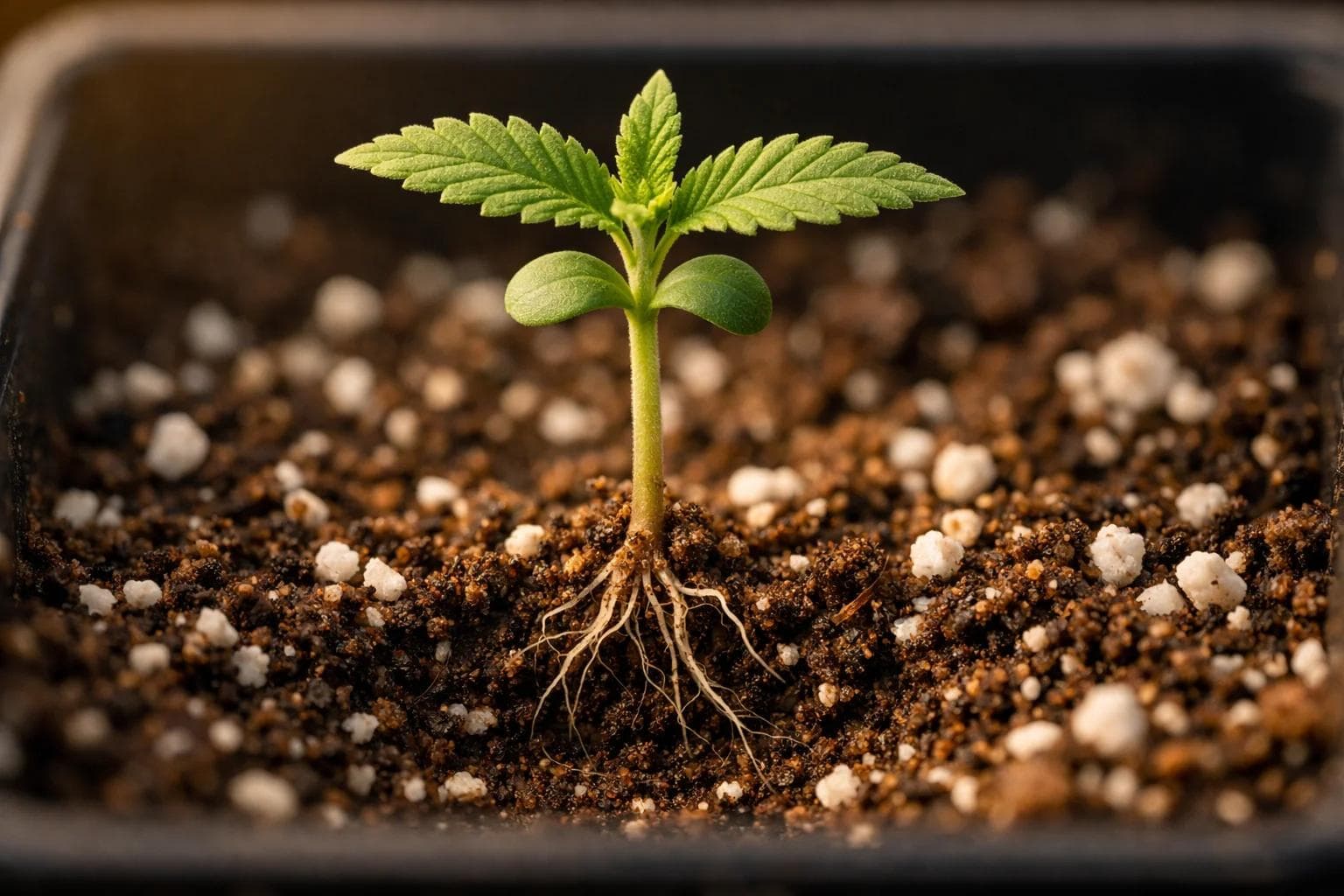
The best soil mix for cannabis seed germination is 2 parts peat moss (or coco coir) to 1 part perlite, pre-moistened to a wrung-out-sponge consistency, held at pH 5.8–6.5. Cannabis seeds carry their own nutrients for the first 7–14 days — what they need is aeration, consistent moisture, and a loose structure the taproot can penetrate without resistance.
What Makes a Good Soil Mix for Cannabis Seed Germination?
The ideal cannabis seed starting mix is light-textured, well-draining, moisture-retentive without waterlogging, near-zero in nutrients, and pH-stable between 5.8 and 6.5. A germinating seed draws entirely on its own stored endosperm energy for the first 7–14 days — it does not need fertilizer. What it needs is a loose structure the taproot can penetrate easily, consistent surface moisture, and enough root-zone oxygen to prevent fungal collapse.
The distinction between a seed starting mix and regular potting soil is more consequential than most beginners expect. Potting soil is formulated for established plants — denser structure, higher nutrient content, and greater moisture retention. Seed starting mix does the opposite: finer texture, lower fertility, better aeration. Using the wrong medium is one of the leading causes of early seedling failure in the first week. For a full overview of germination approaches, see the Complete Cannabis Seed Germination Guide.
The five properties that matter:
- Light texture: Loose enough that a 1–2 mm taproot pushes through without resistance
- Good drainage: Water passes through the medium in seconds — no standing water at the root zone
- Moisture retention: Holds enough water between mistings to keep the seed surface consistently damp
- Near-zero nutrients: No time-release fertilizer granules, no compost-heavy blends, no pre-added NPK
- pH 5.8–6.5: The optimal range for early cannabis root development and eventual nutrient uptake
What pH Should Cannabis Seed Starting Soil Be?
Cannabis seed starting soil should maintain a pH between 5.8 and 6.5 — slightly acidic, which is the optimal range for root development and mineral availability once the seedling begins to feed. Outside this window, deficiency symptoms appear on the first true leaves even when nutrients are theoretically present. Test using the slurry method: mix equal parts soil and distilled water, wait 15 minutes, measure with a calibrated pH pen. Water pH & Quality for Cannabis Seed Germination
A reading above 6.8 usually means the mix contains excess lime or garden soil. Below 5.5 and you risk magnesium lockout before the seedling reaches its second node. Most commercial seed starting mixes are buffered within the acceptable range — that's part of what you're paying for. DIY blends using peat moss typically land around 5.5–6.0, which is fine for germination.
What Are the Best Commercial Seed Starting Mixes for Cannabis in Canada?
The best commercial option for most Canadian growers is PRO-MIX Organic Seed Starter — available at Canadian Tire and Home Hardware locations nationwide, priced around $15–$20 for a large bag, and formulated with peat, perlite, mycorrhizae, and lime at a low nutrient level suited to germination. For growers who want a cannabis-specific OMRI-listed option, Purple Cow Organics Seed Starter is worth ordering online.
Note: This is not an affiliate comparison. PPS does not sell soil. All assessments are editorial.
How Do You Make Your Own Cannabis Seed Starting Mix?
A reliable cannabis germination soil recipe costs a fraction of commercial mixes and gives you full control over every ingredient. Two recipes cover most situations — a minimal two-ingredient budget blend and a premium five-ingredient version for growers who want the best possible start.
Budget Recipe — 2 Ingredients
Ratio: 2 parts peat moss : 1 part perlite
For a 3-litre batch (enough for 6–8 solo cups): 2L peat moss + 1L perlite. Peat moss delivers water retention and light structure; perlite adds drainage and root-zone aeration. The near-zero nutrient profile of both ingredients eliminates seedling burn risk entirely. It's the same two-ingredient baseline commercial propagators use — because it works.
Mix dry first, then add pH-adjusted water (6.0–6.5) gradually. Use the squeeze test: grab a firm handful, squeeze hard, release. You should see 1–2 drops fall — no more. If water streams out, it's too wet. If it crumbles apart without holding shape, add more water.
Coco coir as a peat substitute: Swap peat moss 1:1 for buffered coco coir. Coco has a near-neutral pH (~6.0), buffers more consistently than peat, and is a renewable resource — Sphagnum peat comes from slow-regenerating bogs, primarily sourced from Quebec and New Brunswick. Rinse and buffer coco coir before use to remove excess sodium.
Premium Recipe — 5 Ingredients
Ratio: 3 parts peat moss (or coco coir) : 2 parts perlite : 1 part vermiculite : ½ part worm castings : pinch of mycorrhizal inoculant
Each ingredient earns its place:
- Peat moss / coco coir: Moisture retention and structural foundation
- Perlite: Drainage and root-zone oxygen — the single highest-impact addition you can make to any starting mix
- Vermiculite: Slow-release moisture and thermal buffering — particularly useful in cold basements in Montreal or Winnipeg where ambient temperatures stay below 18°C through March and soil temperature drops are a real germination risk
- Worm castings: Trace minerals and beneficial microbial activity — keep to ½ part maximum; exceeding this tips the mix into hot-soil territory for seedlings
- Mycorrhizal inoculant: Colonizes young roots and extends effective root surface area for water and nutrient uptake
Should You Add Nutrients to a Cannabis Seed Starting Mix?
No. Cannabis seeds carry enough endosperm energy to sustain the seedling for the first 7–14 days without external fertilizer. Adding nutrients — even a mild balanced feed — risks cotyledon burn and twisted first leaves before the plant has developed enough root mass to process them. Hold off on feeding until 2–3 sets of true leaves are visible. Cannabis Seedling Care After Germination — Week-by-Week Guide
What Should You Avoid in Cannabis Seedling Soil?
The wrong starter medium is one of the most common and most preventable causes of seedling failure. The following ingredients and product types consistently cause problems — avoid them specifically, not just in principle.
Time-release fertilizer products (Miracle-Gro Moisture Control, Scott's Premium Potting Mix): These contain slow-release NPK granules designed to feed mature plants for three to six months. In a germination container, those nutrients dissolve immediately into the root zone at concentrations a seedling has no tolerance for — producing tip burn on cotyledons and stunted growth within the first week. Avoid any bag labelled with a multi-month feed claim or showing NPK values above 1-1-1.
Heavy clay or compacted outdoor garden soil: Clay retains excessive moisture, compacts around the root zone, and restricts oxygen. Unsterilized outdoor soil also carries fungal pathogens, pest eggs, and weed seeds. This is the primary vector for damping off — the Pythium and Fusarium-driven fungal collapse that kills seedlings at the base of the stem. Damping Off in Cannabis Seedlings — Causes, Prevention & Treatment
Water-absorbing polymer beads: Some consumer potting mixes contain synthetic polymer crystals intended to reduce watering frequency. In a germination container these create pockets of excess moisture that stay wet for days — ideal conditions for root rot. Always check ingredient labels before purchasing a bag that appears unusually heavy or gel-textured when wet.
Compost-heavy mixes: Mixes with more than 10–15% active organic matter are too nutritionally dense and microbiologically active for seedlings. They hold moisture unevenly and can raise root-zone temperature through decomposition activity.
Old, dry, or mouldy bagged soil: Bags stored open or in a damp shed carry mould spores, fungus gnat larvae, and pathogenic bacteria. Fresh seed starting mix should smell clean and earthy when opened. White mycelial threading or a musty, ammonia-like odour means discard it.
Can You Use Regular Potting Soil to Germinate Cannabis Seeds?
Regular potting soil is a calculated risk that rarely pays off. Most commercial potting soils are too nutrient-dense, too moisture-retentive, and frequently contain slow-release fertilizer granules. The result in cannabis seedlings is predictable: nutrient burn on cotyledons, compacted root development, and elevated damping-off risk. A purpose-made seed starting mix costs $15–$20 and covers dozens of starts. Each seed represents one of your four legal home-cultivation plants — the medium is not the place to save money. Cannabis Seed Germination Problems — Troubleshooting Guide
What Is the Best Container for Germinating Cannabis Seeds?
The best container for cannabis seed germination combines adequate volume (200–400 ml), effective drainage, and a size that signals transplant timing before roots become bound. Every other factor is secondary to drainage — a container without holes will drown your seedling regardless of how good the starter mix is.
Solo cups (200–250 ml): Drill 5–6 holes in the bottom using a hot nail or small drill bit. Translucent plastic lets you monitor root development without disturbing the plant — when white roots begin to circle the interior wall, transplant is due. Cheap, widely available, and used by growers at every skill level. Ideal for the first 10–14 days.
Cell trays / seedling flats: Perfect for germinating multiple seeds simultaneously. Standard trays fit under off-the-shelf humidity domes without modification, making post-planting moisture management far easier. Individual cells are typically 50–80 ml — small enough that roots reach the bottom in roughly 10 days, giving a reliable transplant signal. Using a Humidity Dome for Cannabis Seedlings — Setup & Tips
Peat pots / Jiffy pots: The entire container goes into the next pot at transplant, eliminating root disturbance entirely. The trade-off: peat wicks moisture away from the root zone faster than plastic — especially relevant in dry-climate grows. In Calgary or Denver, where indoor humidity can drop below 25% during winter heating season, peat pots require more attentive moisture checks than plastic equivalents.
Small fabric pots (1L): Air pruning occurs at the container wall, producing a branched, dense root system. Fabric dries faster than plastic — a natural advantage in humid environments like Vancouver or Boston where overwatering is the dominant beginner mistake, but a challenge for growers still calibrating their moisture management.
Size recommendation: 200–400 ml (7–10 cm diameter) is the sweet spot for the germination-to-early-seedling window. Too large and the soil stays wet too long between waterings; too small and roots hit the wall before the seedling is ready.
Should Autoflowers Start in Their Final Container?
Yes — most experienced autoflower growers start seeds directly in a 3–5 gallon final container to eliminate transplant shock and lost vegetative time. Autoflowers run on a fixed internal clock; stress in the first two weeks converts directly into reduced yield. If starting in a final container, fill the bottom two-thirds with richer vegetative soil and plant into a light starter mix in the top third of the container. Germinating Autoflower Seeds — Tips & Differences vs Photoperiod
How Wet Should the Soil Be When You Plant Cannabis Seeds?
Pre-moisten your entire batch before filling containers — not after planting. Add pH-adjusted water (6.0–6.5) to dry mix in a bucket or basin, mixing until the squeeze test yields 1–2 drops per firm handful. Fill containers with pre-moistened mix, plant seeds 0.5–1 cm deep with the pointed tip facing down or horizontal, and lightly mist the surface to settle soil around the seed. Cover with a humidity dome to maintain surface moisture without daily intervention. Using a Humidity Dome for Cannabis Seedlings — Setup & Tips
When Should You Transplant Cannabis Seedlings Out of Starter Mix?
Transplant when all three of these cues are present: roots visible at the bottom drainage holes, 2–3 sets of true leaves fully developed, and the seedling standing 3–5 cm tall. This typically occurs 10–14 days after sprouting. Waiting longer risks the seedling becoming root-bound and displaying deficiency symptoms as the near-zero nutrient profile of the starter mix is exhausted. Move into a richer vegetative soil in a larger container. Transplanting Cannabis Seedlings — When & How to Do It Right
Canadian Grower Timing Notes
Indoor germination timing for Canadian outdoor grows varies meaningfully by province. Vancouver and Victoria growers can start as early as February given the mild coastal season and 5–6 month outdoor window. Toronto and Ottawa growers should target March, with outdoor transplant after the Victoria Day weekend. Calgary and Edmonton growers typically wait until early April — late frost risk extends past mid-May in most years, and Prairie basement temperatures in February can drop below 15°C without a heat mat.
For cold-basement starts anywhere from Quebec City to Winnipeg, a heat mat under the seedling tray brings root-zone temperature to the optimal 21–27°C when ambient air is still 15–16°C. That single addition makes a meaningful difference in germination rates during early-season Canadian starts. Using a Heat Mat for Cannabis Seed Germination — Setup & Tips
Peat moss sold at Canadian Tire and Home Hardware is predominantly sourced from Sphagnum bogs in Quebec and New Brunswick — buying PRO-MIX or Berger brand peat means buying a domestic product. Home cultivation allows for four plants per household — each seed is a meaningful fraction of your legal grow. A $15–$20 bag of proper seed starting mix is the one investment you shouldn't try to skip.
FAQ
Can I use regular potting soil for germinating seeds?
No — regular potting soil is too dense and nutrient-rich for seed germination. It's formulated for established plants with thicker roots that handle compaction and higher fertility. For seeds, you need a light, low-nutrient seed starting mix that allows the tender taproot to penetrate easily and lets oxygen reach the root zone. Using regular potting soil is one of the leading causes of early seedling failure.
What's the ideal peat moss to perlite ratio?
The best ratio is 2 parts peat moss (or coco coir) to 1 part perlite. This ratio gives you the moisture retention of peat with the drainage and aeration of perlite — your seeds stay consistently moist without waterlogging. Pre-moisten the mix to a wrung-out-sponge consistency before planting so the seed surface stays damp throughout germination.
How wet should my germination mix be?
Your soil should feel like a wrung-out sponge — moist throughout but not soggy or dripping. Misting the surface once or twice daily keeps the seed moist without creating standing water that suffocates roots or invites fungal collapse. Consistency matters more than soaking; a seedling needs steady surface moisture and root-zone oxygen, not floods and dry cycles.
Do I need to add fertilizer to the germination mix?
No — cannabis seeds carry their own stored nutrients (endosperm energy) for the first 7–14 days and need zero added fertilizer at this stage. What they need instead is a loose, aerated structure with consistent moisture and pH between 5.8 and 6.5. Excess nutrients can actually damage tender seedlings, so save the feeding schedule for once the first true leaves emerge.
Can I use coco coir instead of peat moss?
Yes — coco coir works equally well as peat moss in a 2:1 ratio with perlite. Both give good moisture retention and create the light texture seeds need. The main difference is sustainability; coco coir is a coconut byproduct, while peat moss is harvested from bogs, so some growers prefer coco for environmental reasons.
19+ | Educational horticulture only.