From Seed to Seedling
Germination Guides
Leggy & Stretching Cannabis Seedlings — Causes & Fixes
Stop leggy cannabis seedlings with proven light, spectrum, and temperature fixes that produce compact, healthy growth in just 3-5 days.
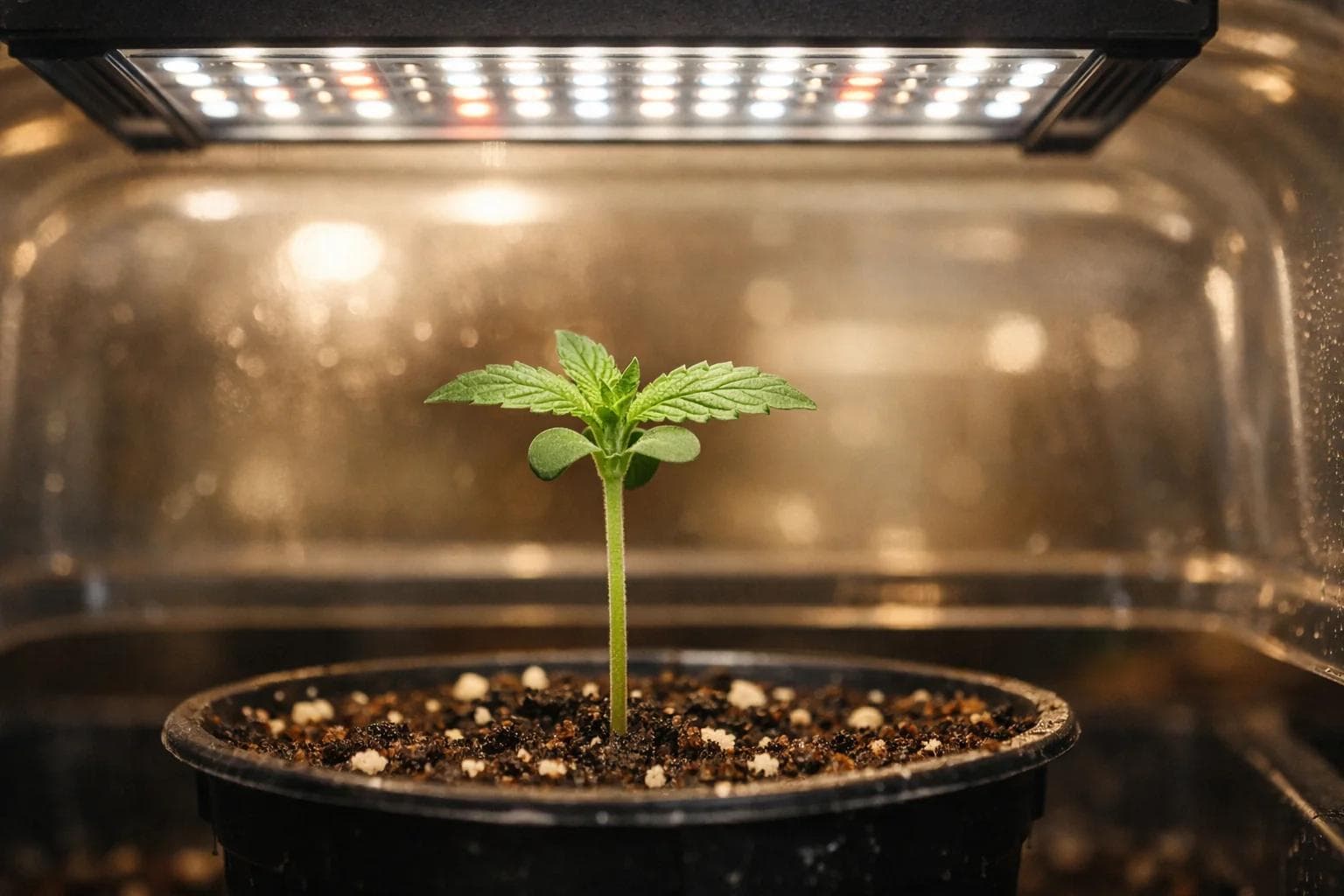
Stretching cannabis seedlings are caused by insufficient light intensity, incorrect light distance, a spectrum too heavy in red/far-red wavelengths, or canopy temperatures above 28°C (82°F). Move your light to the correct distance for its fixture type, target 200–400 μmol/m²/s PPFD, and expect compact new growth within 3–5 days of corrected conditions.
Why Is My Cannabis Seedling Stretching?
Cannabis seedlings stretch — producing tall, thin stems and wide node spacing — when they lack sufficient light intensity, receive the wrong light spectrum, experience excessive heat, or have no airflow to create mechanical stem stress. All four triggers activate the same survival response: the plant elongates toward perceived better conditions at the expense of structural strength.
A healthy seedling at 7–10 days old holds itself upright with internodes spaced no more than 1–1.5 cm apart and a stem thick enough to stand without support. If yours looks like a pale thread reaching for the ceiling, it is stretching.
What Is Etiolation and Why Does It Matter?
Etiolation is the biological term for light-deficiency-driven elongation. When light falls below the seedling's threshold, phytochrome receptors shift their Pr/Pfr balance, triggering auxin redistribution to the lower stem and rapid hypocotyl elongation. The plant is gambling that height will bring it closer to light. What it gains in reach, it loses entirely in structure — weak internodes, paper-thin walls, no lateral branching to speak of. Wrong start.
The practical point: stretch is an environmental problem, not a genetic one. Fix the conditions, and the plant responds. Begin with strong genetics: Shop cannabis seeds.
How Do You Know If Your Seedling Is Stretched vs. Just Growing Tall?
The key diagnostic metric is internode distance — the gap between consecutive node pairs measured with a ruler:
- Normal: 0.5–1.5 cm per internode at seedling stage
- Stretched: >2 cm per internode, especially with a stem narrower than a standard toothpick
Diagnostic decision tree — match your symptom combination:
How Far Should Grow Lights Be From Cannabis Seedlings?
Recommended light distance varies by fixture type: LED quantum boards at 20–30 cm (8–12") at 40–60% power, T5 fluorescent at 12–15 cm (5–6"), CFL at 10–15 cm (4–6"), and HID (MH/HPS) at 60–90 cm (24–36"). Getting this distance wrong is the single most common cause of leggy seedlings, and it is one of the simplest variables to measure and correct.
What PPFD and Light Intensity Do Seedlings Actually Need?
Cannabis seedlings need 200–400 μmol/m²/s PPFD at canopy level — equivalent to roughly 25,000–35,000 lux measured with a light meter. Phone lux meter apps can flag an obvious problem — if the reading is half what it should be, you know immediately. But they are not a substitute for a calibrated PAR meter when you are actually dialling in your setup.
A daily light integral (DLI) of 13–20 mol/m²/day at 18–20 hours of light delivers adequate energy for compact, vigorous early growth without pushing into heat stress territory. That is the window you are aiming for.
Does Light Spectrum Affect Seedling Stretching?
Yes — and this is the cause most beginners overlook. Blue wavelengths (400–500 nm) actively suppress stem elongation. Red wavelengths (620–700 nm) and especially far-red (700–750 nm) promote it. A light source heavy in red and far-red output will produce more stretch than one with a strong blue component, even if total intensity is identical.
Here is the mechanism: blue light activates cryptochrome photoreceptors, which signal the plant to stay compact and stocky. Red and far-red shift the phytochrome Pr/Pfr ratio toward shade-avoidance — the same drive that sends forest understory plants racing for the canopy. HPS fixtures are red-heavy by design. Plenty of growers have seen this firsthand: correct HPS distance, correct intensity, still stretching. Spectrum is why.
Spectrum choices that actually matter at the seedling stage:
- Best: Full-spectrum white LED with a 4000K–6500K colour temperature, or an LED with a dedicated blue channel you can prioritize
- Good: T5 cool-white (6500K) — strong blue output, low heat, easy to position
- Problematic at seedling stage: HPS, warm-white LEDs below 3000K, older blurple LEDs without blue-channel control
Can High Temperatures Cause Cannabis Seedlings to Stretch?
Yes. Canopy temperatures above 28°C (82°F) promote internode elongation even when light intensity and spectrum are correct. Temperature does not just add to stretch — it compounds it: high heat combined with borderline light intensity and high humidity produces the worst-case stretching scenario.
The mechanism is DIF — the day/night temperature differential. A large positive DIF (warm days, significantly cooler nights) drives more stem elongation than a small DIF where day and night temps stay close together. This catches a lot of growers off guard in early spring: a warm tent running in a cold Toronto basement in March, or a Calgary grower running a heat mat without checking canopy temperature, can easily push into 29–32°C at seedling level and see significant stretch even with the light properly positioned.
Target canopy temperature: 22–25°C (72–77°F). Tape your thermometer to a stake at seedling height — not hung at shoulder level in the tent. Ambient tent temperature runs consistently lower than canopy temperature and will give you a reading that feels fine when it is not.
How Do Humidity and Airflow Factor In?
High relative humidity above 75% reduces the plant's transpiration-driven stem-strengthening response, leaving cell walls less rigid. Layer in no airflow and it gets worse: stems that rarely experience mechanical movement have no signal telling them to thicken up.
A small oscillating fan at 30 cm on its lowest setting is all it takes to trigger thigmomorphogenesis — the cellular response to gentle movement — which produces thicker stems and tighter internode spacing over time. If you already have a fan in the tent, this costs nothing and takes thirty seconds to set up. It is also one of the most consistently skipped steps in beginner setups. Target 65–70% relative humidity during the seedling stage using a dome, not by cutting airflow. The dome manages moisture; the fan builds structure.
How Do You Fix a Stretched Cannabis Seedling?
Work through these steps in sequence. Do not make all adjustments at once — sudden combined changes create additional stress on an already-compromised seedling.
Step 1 — Correct light distance. Move your fixture to the recommended distance for its type (see table above). Measure with a tape measure, not by eye.
Step 2 — Increase intensity gradually. If using a dimmable LED, raise output by no more than 10% per day. Jumping from 30% to full intensity on a light-starved seedling can cause photooxidative damage.
Step 3 — Add gentle airflow. A small oscillating fan at 30 cm on the lowest setting. Even a USB desk fan is enough at this stage.
Step 4 — Correct canopy temperature. Fix a thermometer at seedling level. If you are above 25°C (77°F), increase tent ventilation, dial back heat mat intensity, or introduce a short cooling window at night to bring DIF down.
Step 5 — Support the stem if needed. If the seedling cannot hold itself upright, support it loosely with a toothpick and a small twist tie. Remove it once the stem stiffens — typically within 5–7 days of corrected conditions.
Can Stretched Seedlings Actually Recover?
Yes — if caught before three or more nodes are fully elongated. Once light and temperature are corrected, new internode growth becomes compact within 3–5 days. The already-stretched section of stem will not physically compress — that structure is set — but it stops getting worse, and the plant produces dense growth above it. If only the hypocotyl (the stem section below the cotyledons) is stretched, recovery is straightforward and the plant develops normally from there.
If three or more nodes are stretched with paper-thin stems, the plant is salvageable — but it will carry structural weakness into veg and will likely need training support throughout. Be realistic about that going in.
Autoflower growers are in a tighter spot. Auto veg time is genetically fixed at roughly 3–4 weeks — there is no extending it. One week of unrecovered stretch represents 25–33% of total veg time gone, with no way to get it back. Photoperiod growers can add extra veg weeks to compensate; autoflower growers cannot. Germinating Autoflower Seeds — Tips & Differences vs Photoperiod
Should You Bury a Stretched Seedling Deeper?
Yes, in most cases. Cannabis stems readily develop adventitious roots along buried sections, converting structural weakness into expanded root mass. Transplant into a taller container and bury the stem up to just below the cotyledons — do not cover the cotyledon leaves themselves. Transplanting Cannabis Seedlings — When & How to Do It Right
Use sterile, well-draining media for the buried section. Dense or waterlogged substrate around a buried stem significantly increases damping-off risk — keep moisture levels drier than you would for a surface-germinated seedling in the days following burial. Damping Off in Cannabis Seedlings — Causes, Prevention & Treatment
For media selection: Best Soil Mix for Cannabis Seed Germination
Can You Top or Train a Stretched Seedling?
Wait on topping. The seedling needs 4–5 true nodes with compact new internode growth before topping is safe — cutting into stretched, thin tissue at an early node creates a large wound relative to stem diameter and slows recovery.
Low-stress training (LST) is a different story. You can start earlier: bend the tall stem horizontal, secure it to the container rim, and let auxin redistribution do the work — reducing apical dominance and pulling lateral branches up from lower nodes. It is one of the better ways to partially compensate for early stretch and build a more even canopy without cutting. Cannabis Seedling Care After Germination — Week-by-Week Guide
How Do You Prevent Cannabis Seedling Stretching?
Prevention is faster and simpler than the fix. Apply this checklist from the moment the first seedling breaks the surface:
- Light from day one. Do not wait for true leaves to appear — provide correct-intensity light the moment the seedling emerges from the medium.
- Set distance by fixture type. Use the reference table in the light distance section; remeasure after any tent adjustment.
- Target 200–400 μmol/m²/s PPFD at canopy level. A phone lux meter app gives a rough directional check; a calibrated PAR meter gives accuracy.
- Use full-spectrum or blue-dominant light (4000K–6500K) during the seedling stage. Avoid red-heavy fixtures until vegetative transition.
- Measure canopy temperature at plant level — tape a thermometer to a stake at seedling height. Aim for 22–25°C (72–77°F).
- Add airflow from day one. A small fan on low is enough. This single habit prevents both stretching and damping off.
- Maintain 65–70% relative humidity with a dome — not by cutting airflow. Using a Humidity Dome for Cannabis Seedlings — Setup & Tips
- Check internode spacing daily. If gaps exceed 2 cm between any two nodes, intervene immediately — do not wait another day.
- Heat mat users: monitor substrate temperature and turn the mat off once ambient air stabilizes above 22°C. The mat's job ends when the tent warms up.
- Autoflower growers: apply this checklist more strictly than photoperiod growers — you have no veg extension available to recover lost time.
FAQ
Can you fix a cannabis seedling that's already stretched?
Partially. While the stretched lower stem won't thicken or shorten, providing correct light intensity and distance will produce compact, healthy new growth within 3–5 days. If the stem is too thin to support its weight, tie it loosely to a stake for support until the base hardens. Early correction prevents structural weakness as the plant enters vegetative growth.
How far should my grow light be from seedlings?
Distance depends on fixture type—HPS/MH typically 30–45 cm (12–18"), T5 fluorescents 15–25 cm (6–10"), and quality LED panels 25–50 cm (10–20") depending on wattage. Aim for 200–400 μmol/m²/s PPFD at canopy; check your fixture's distance chart for exact specs.
How quickly do seedlings recover after you fix the light?
You'll see a shift within 3–5 days—new nodes emerge closer together, the stem thickens noticeably, and leaves grow stockier and darker green. The stretched lower stem won't recover, but compact upper growth quickly dominates the plant's appearance, making the old stretch less visible as vegetative growth accelerates.
Is airflow necessary for seedlings, or is fixing the light enough?
Light is the primary lever, but gentle airflow (a small fan 60–90 cm away, 2–3 hours daily) accelerates stem thickening by creating mechanical stress that triggers natural strengthening. Without airflow, seedlings may look healthy under strong light but remain structurally weak. Combining both fixes gives the fastest, most robust results.
19+ | Educational horticulture only.