From Seed to Seedling
Germination Guides
Cannabis Seedling Stage — The Critical First 14 Days
Master the cannabis seedling stage. Learn exact day-by-day milestones and environmental targets that prevent beginner grow failures in the first 14 days.
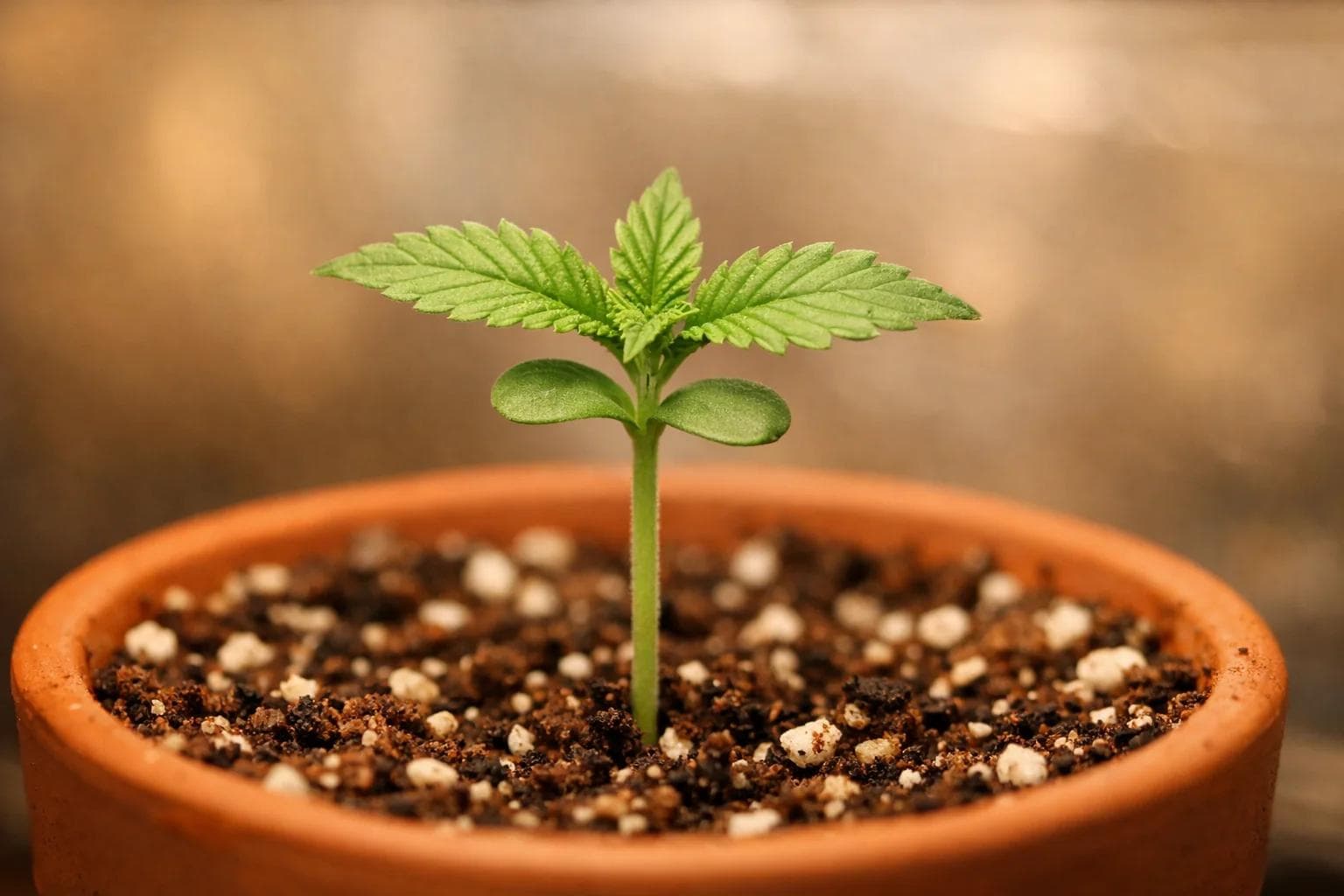
The cannabis seedling stage lasts 2–3 weeks from cotyledon emergence to veg transition. Maintain 22–26°C, 65–80% humidity, and 18/6 light at 100–300 PPFD. The single biggest risk is overwatering. A healthy seedling shows 3+ sets of serrated true leaves, a thickened stem, and visible root establishment by day 14.
Your seed has broken soil. Germination is behind you — but this is actually where most beginner grows fall apart. The cannabis seedling stage punishes doing too much far more than it punishes doing too little, and the mistakes that kill plants in week one rarely look like mistakes until it's too late. This guide covers exact day-by-day milestones, environmental targets you can actually hit, and a clear way to read your plants before small problems become dead plants. Complete Cannabis Seed Germination Guide
How Long Does the Cannabis Seedling Stage Last?
The cannabis seedling stage typically lasts 2–3 weeks from cotyledon emergence to vegetative transition. The transition point is defined by plant development — 4–5 sets of true leaves, a visibly thickened stem, and an established root system — not by a fixed number of days. Autoflowers may begin transitioning internally around days 10–14, so their seedling window is shorter and more critical. Germinating Autoflower Seeds — Tips & Differences vs Photoperiod
What Does a Healthy Cannabis Seedling Look Like Day by Day?
A healthy cannabis seedling progresses through five distinct visual stages between germination and veg: cotyledon emergence, first true leaf set, second node formation, visible growth acceleration, and pre-veg readiness. Each stage has specific markers — leaf shape, stem colour, internode spacing — that tell you whether development is on track or stalling.
Under the Cannabis Act, home growers are permitted up to 4 plants per household. That's not a lot of runway. Toronto growers starting seeds indoors in March, Edmonton growers working around a short outdoor window — every seedling counts, and the most avoidable losses happen right here, in the first two weeks. Quality genetics set the foundation for success: Shop cannabis seeds
When Do Cannabis Seedlings Grow Their First True Leaves?
True leaves typically emerge between days 3 and 5. They're immediately distinguishable from cotyledons — the round, smooth, pale-green seed leaves that captured the plant's first light. True leaves are serrated and genetically shaped, starting as a single blade before developing into 3-blade and then 5-blade sets at each successive node. Cotyledons will yellow and drop naturally around days 10–14. That's normal senescence — not a deficiency. Don't panic and start feeding.
Is It Normal for Cannabis Seedlings to Grow Slowly in the First Week?
Slow above-ground growth in days 1–7 is a sign of healthy priorities, not failure. Root development dominates the first week: the taproot is anchoring, branching laterals, and building the underground network that every future growth stage depends on. You won't see any of this. Nothing visible is happening above soil, and that's exactly how it should be. Visible above-ground acceleration typically begins days 7–10. The worst thing you can do during this quiet phase is intervene.
What Temperature and Humidity Do Cannabis Seedlings Need?
Cannabis seedlings need 22–26°C (71–78°F) and 65–80% relative humidity during the first two weeks. These ranges keep transpiration stress low while roots are establishing — before the plant has developed enough root mass to replace water it's losing through its leaves. rarely let temperatures drop below 18°C. Cold root zones dramatically slow development and open the door to damping off from Pythium and Fusarium.
Cool-basement grows in Montreal or Vancouver apartment setups in early spring regularly run 2–4°C below that floor. A heat mat under the tray fixes the root-zone problem without requiring you to heat the entire room. Using a Heat Mat for Cannabis Seed Germination — Setup & Tips
For growers tracking VPD: target 0.4–0.8 kPa during the seedling stage. That's lower than the 0.8–1.2 kPa range you'll run in veg and flower — which makes sense, since seedlings can't move water fast enough yet to handle higher vapour pressure demand. Cannabis VPD, Temperature & Humidity Guide
Seedling Environmental Quick-Reference Table
What Nutrients Do Cannabis Seedlings Need in the First 14 Days?
Most cannabis seedlings need zero added nutrients for the first 10–14 days when started in quality light-mix peat or perlite-amended soil. Cotyledons carry enough stored energy to fuel the first true leaf sets — they don't need your help yet. Feeding too early — especially nitrogen — burns delicate root tips and sets development back by days, not hours. If you're growing in coco coir or any other inert medium, introduce a dilute feed (EC 0.4–0.6, ¼ strength) no earlier than day 7–10. Best Soil Mix for Cannabis Seed Germination
What Light Schedule Is Best for Cannabis Seedlings — 18/6 or 24/0?
18/6 is the recommended default for the cannabis seedling stage. The 6-hour dark period gives the plant a biological rest window, supports natural starch reconversion, and locks in the circadian rhythm your plant will depend on through veg and flower. 24/0 won't kill seedlings, but there's no documented advantage over 18/6 for development rate or plant morphology — and it runs up your electricity bill for nothing.
Autoflowers are commonly run on 20/4 throughout their lifecycle. 18/6 is perfectly sufficient during the seedling stage, and if you're running both autos and photos in the same space, keeping everything at 18/6 removes one variable to track. Cannabis Seed Germination Problems — Troubleshooting Guide
How Far Should Lights Be from Cannabis Seedlings?
Light distance should target 100–200 PPFD in week one and 150–300 PPFD in week two — well below the 600–900 PPFD range used in late veg and flower. The exact distance depends on your light type:
- LED (quantum board / full-spectrum): Start at 60–75 cm (24–30"). Raise immediately if you see upward leaf curl, bleaching on new growth, or unusual internode tightening.
- T5 / CFL: 5–10 cm (2–4"). Low intensity and minimal heat make these the most forgiving seedling lights available.
- HID / MH: Keep at 90+ cm (36") minimum. Seedlings have no root mass buffer against heat-driven transpiration stress — at close range, HID heat causes rapid wilting that looks identical to overwatering.
When Should You Remove the Humidity Dome?
Humidity dome removal should be gradual. A seedling raised at 75–80% RH can wilt and stall if you pull the dome and expose it to ambient room air at 40–50% overnight. Use a 3–5 day weaning protocol beginning at day 6–8:
- Days 6–8: Crack the dome for 30–60 minutes twice daily.
- Days 9–10: Remove for 2–3 hour periods; replace for lights-off.
- Days 11–12: Dome off during all light hours; replace during dark period.
- Days 12–14: Remove dome fully once the seedling shows no wilting response to ambient air.
How Often Should You Water Cannabis Seedlings in the First Two Weeks?
Water cannabis seedlings only when the medium is nearly dry — rarely on a fixed schedule. In week one, a seedling in a 1-litre pot typically needs water every 2–3 days. Apply 10–30 mL in a small ring 2–3 cm from the stem to push roots outward as they chase moisture. rarely soak the full container volume; waterlogged medium suffocates roots before they've had a chance to establish.
Overwatering is the most common seedling killer — and it's easy to misread because the symptoms look a lot like underwatering:
- Overwatered: leaves droop downward at 45°, stem looks thick but feels soft, medium feels heavy
- Underwatered: leaves also droop, but curl inward and feel papery; medium pulls away from pot edges as it contracts
- Pot weight: Lift and compare to freshly watered weight. Noticeably lighter = ready to water.
- Surface check: Top 1–2 cm should be dry to the touch — not just surface-dusty.
- Coco colour: Coco lightens visibly when dry; dark coco = still saturated.
How Do You Identify Early Stress Signs in Cannabis Seedlings?
Cannabis seedling stress presents in five primary forms — stretching, overwatering, underwatering, light burn, and damping off — each with a distinct symptom profile. The most useful diagnostic tool is directional: where on the plant a symptom appears, and what the medium moisture looks like when you find it. Getting the diagnosis wrong and applying the wrong fix makes things worse, fast.
Diagnostic decision tree:
Leaves drooping? → Medium wet or heavy → Overwatering. Stop all watering; let medium dry completely. Increase airflow. → Medium dry and light → Underwatering. Apply a small ring watering now. Check moisture daily.
Leaves yellowing? → Yellowing from the bottom up → pH-driven nutrient lockout, underwatering, or normal cotyledon senescence (days 10–14). → Yellowing from the top down, new growth affected → Light stress or nutrient burn. Raise light distance; stop feeding if you've started any. → Pale, washed-out new growth without yellowing → Micronutrient lockout from incorrect pH. Check and correct water pH before the next watering.
Seedling tall, thin, leaning? → Stretching from insufficient light or light source too far away. Lower LED distance or bring in a CFL/T5 closer. Leggy & Stretching Cannabis Seedlings — Causes & Fixes
Stem collapsing or pinching at soil level? → Damping off — Pythium or Fusarium moving through the root zone under excess moisture, low temps, and poor airflow. Once you see stem collapse at soil level, the plant is gone. Prevention is the only option: don't overwater, keep temps above 20°C, and run gentle air circulation from day one. Damping Off in Cannabis Seedlings — Causes, Prevention & Treatment
Do Autoflower Seedlings Develop Differently from Photoperiod Seedlings?
Autoflower seedlings follow the same visual milestones as photoperiods in days 1–14 — same cotyledon emergence, same true leaf sequence, same environmental needs. The critical difference is timing compression and zero recovery margin. Because autoflowers begin pre-flowering transition based on internal clock rather than light schedule — typically around weeks 3–4 from germination — any stress during the seedling stage directly reduces final yield and potency. There is no extended veg period to compensate.
Practical notes for autoflower seedlings:
- Faster node development: expect nodes at days 5–7 versus days 7–10 for photoperiods
- Same environmental targets: temperature, humidity, PPFD, and pH are identical
- Coco feeding: introduce nutrients earlier — EC 0.4 by day 7 — since there's less time before pre-flower kicks in
- No LST yet: don't train anything until at least 4 sets of true leaves are present; autos don't have the recovery window
How Do You Know When the Seedling Stage Is Over?
The cannabis seedling stage is over when your plant shows 4–5 sets of true leaves, a stem diameter of 3–5 mm at the base, consistent internode spacing without stretching, and root tips beginning to reach drainage holes or container edges. At this point you can step up to full veg lighting intensity (400–600 PPFD), start a regular feeding schedule at ½ strength, and plan your Transplanting Cannabis Seedlings — When & How to Do It Right if you're still in a starter pot. Rushing this transition — pushing veg nutrients before the root system can actually absorb them — is the second most common beginner mistake after overwatering.
FAQ
How often should I water cannabis seedlings?
Water seedlings when the top inch of soil feels dry to the touch — typically every 2–4 days depending on humidity, temperature, and pot size. Overwatering is the single biggest killer at this stage; seedlings need moisture but not soggy soil, which causes damping-off and root rot. Use a spray bottle for the first 5–7 days if starting in soil directly, then switch to careful watering once roots are established.
What light schedule and intensity do seedlings need?
Cannabis seedlings need 18 hours of light and 6 hours of darkness (18/6 schedule), with light intensity between 100–300 PPFD (photosynthetic photon flux density). Start at the lower end (100 PPFD) and gradually increase intensity as the seedling develops true leaves; light that's too intense too soon causes stress and slows growth. LED grow lights positioned 24–36 inches above seedlings work well once cotyledons have emerged fully.
What temperature and humidity should I maintain for seedlings?
Keep seedlings between 22–26°C (72–79°F) with humidity at 65–80%; this range minimizes stress and reduces disease risk. Temperature below 20°C slows metabolism and increases damping-off risk, while above 28°C causes the seedling to stretch and weaken. Consistent conditions are more important than perfect conditions — sudden swings in temperature or humidity stress the plant more than a slightly suboptimal baseline.
How do I know when my seedling is ready to move to the vegetative stage?
A seedling is ready for vegetative transition when it has 4–5 sets of true (serrated) leaves, a visibly thickened stem, and established root development — typically by day 14 to day 21, though autoflowers may transition faster. You'll also notice a growth acceleration point where internode spacing widens and leaf size increases noticeably; this visual shift is the clearest sign development is on track.
19+ | Educational horticulture only.