From Seed to Seedling
Germination Guides
Damping Off in Cannabis Seedlings — Causes, Prevention & Treatment
Damping off destroys cannabis seedlings in 24-72 hours. Learn what causes this fungal disease and proven prevention and treatment methods.
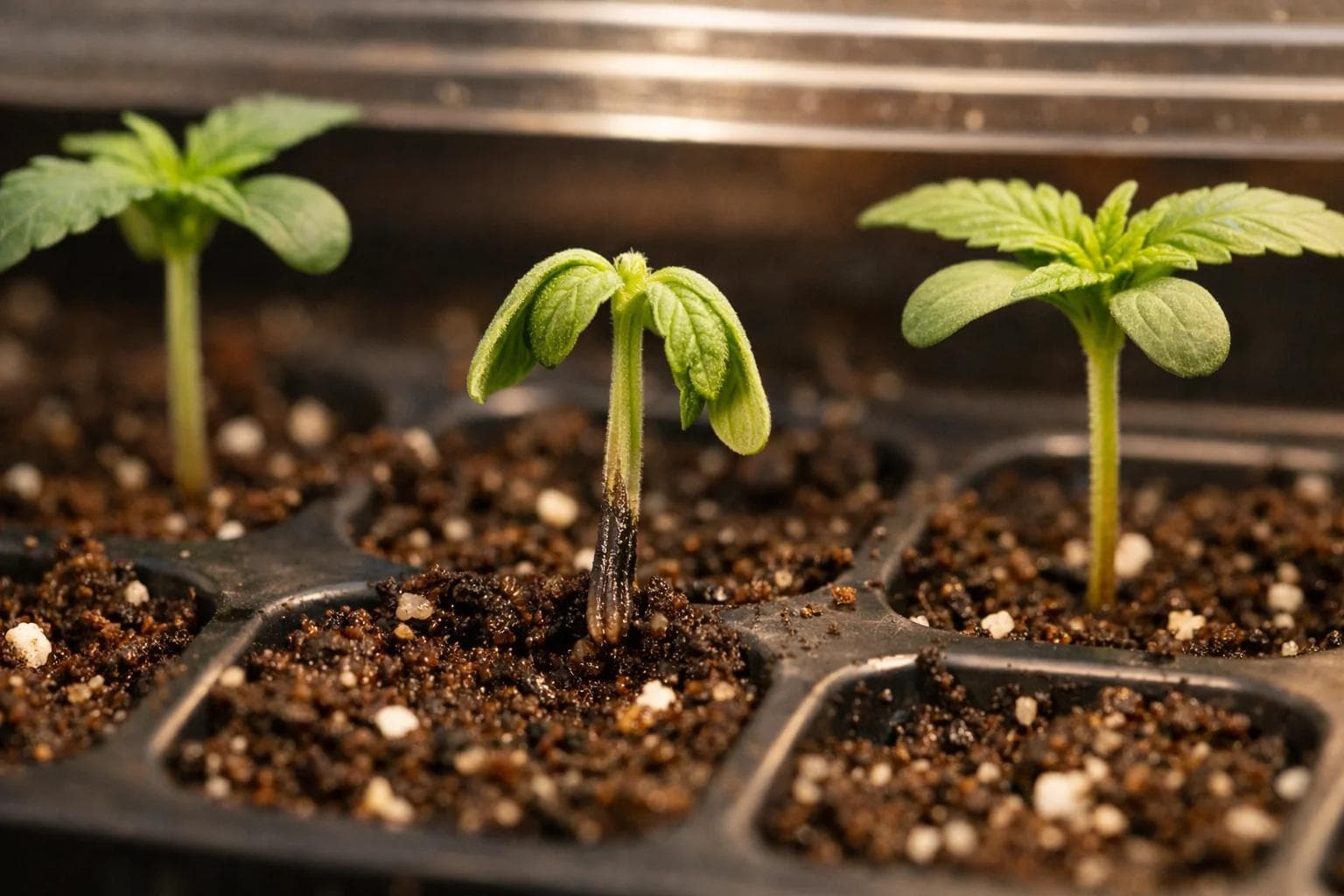
Damping off is a fungal and oomycete disease that kills cannabis seedlings by rotting the stem at the soil line — often within 24–72 hours of first symptoms. Caused primarily by Pythium, overwatering, and cool stagnant conditions, it is almost entirely preventable with sterile media, temperatures above 22°C, and careful watering. Once visible, isolate affected plants immediately.
What Is Damping Off in Cannabis Seedlings?
Damping off is a soil-borne seedling disease caused by water moulds (oomycetes) and true fungi that attack the stem at or below the soil line, causing rapid wilting and collapse. It strikes during the most vulnerable window of a cannabis plant's life — the first 7–14 days after germination — and can destroy an entire seedling tray within 48 hours.
The pathogens responsible — primarily Pythium, Fusarium, and Rhizoctonia solani — infect the hypocotyl, the stem segment between the root zone and the cotyledons. Once the hypocotyl is compromised, the seedling loses its ability to transport water and nutrients upward, and topples. That topple is typically a gut-punch moment, especially when the leaves above still look completely healthy and green.
What's the Difference Between Pre-Emergence and Post-Emergence Damping Off?
Pre-emergence damping off occurs when the seed rots in the medium before it ever sprouts — the grower sees no seedling emerge and often blames "bad seeds." Post-emergence damping off occurs after sprouting: the hypocotyl becomes thin, water-soaked, and brown at the soil line, and the seedling topples over despite still having green leaves above.
The distinction matters for diagnosis — and for your sanity. Pre-emergence is a silent failure frequently misattributed to seed viability, when the actual cause is a pathogen-saturated medium. If your germination conditions were wrong (too wet, too cold), the seeds were almost certainly fine. Post-emergence gives you a visible warning to act on. Both share the same prevention approach, but only post-emergence gives you a chance to triage remaining seedlings before losses compound. Start with quality genetics from Shop cannabis seeds.
How Long Does Damping Off Take to Kill a Cannabis Seedling?
Post-emergence damping off can kill a seedling within 24–72 hours of the first visible symptoms appearing at the soil line. Pre-emergence can prevent sprouting entirely within 3–5 days of sowing. Speed is governed by pathogen species, media moisture level, and temperature — cool, wet conditions accelerate Pythium dramatically, which is why cold-basement spring starts are especially vulnerable.
What Causes Damping Off in Cannabis Seedlings?
Damping off results from the intersection of pathogen presence and environmental conditions that favour rapid growth and spread. The four primary controllable causes are: contaminated or unsterilized growing media, overwatering, poor airflow, and media temperatures below 20°C. Remove any one of these and you reduce your risk substantially. Remove all four and damping off becomes rare.
What Is Pythium and How Does It Affect Cannabis?
Pythium is an oomycete — a water mould, not a true fungus — and the most frequently identified damping off pathogen in cannabis cultivation. Key species include Pythium ultimum, Pythium aphanidermatum, and Pythium debaryanum.
Unlike true fungi, Pythium produces motile zoospores that swim actively through saturated growing media, reaching and infecting the hypocotyl within hours. This is not a slow infection. Waterlog your media and Pythium doesn't wait around.
Pythium thrives in cool, oxygen-deprived, wet conditions — precisely the environment created by overwatered seedlings in dense growing media. It persists in unsterilized soil and on container walls for months. That reused seedling tray you didn't sterilize between grows? It remembers your last round.
What Other Pathogens Cause Damping Off?
Fusarium species are true fungi responsible for damping off at the seedling stage and vascular wilt in mature plants. Rhizoctonia solani is a true fungus that favours slightly warmer and drier conditions than Pythium, making it more prevalent when grow-room temperatures rise above 24°C.
Phytophthora species — oomycetes closely related to Pythium — thrive in waterlogged media and heavy soils. In practice, you often won't know which organism hit you. Multiple pathogens can coexist in the same media simultaneously, which is why broad-spectrum environmental prevention outperforms trying to target a single organism.
Does Overwatering Cause Damping Off?
Overwatering is the single most controllable damping off risk factor. Saturated media eliminates air pockets in the root zone, creates the anaerobic conditions Pythium requires, and triggers active zoospore production.
Growers who water on a fixed schedule — regardless of actual media moisture — report damping off far more consistently than those who water by feel and allow the top layer to dry between applications. The fix isn't complicated: lift the pot, check the weight, and put the watering can back down if it's still heavy.
Does Humidity Cause Damping Off in Cannabis?
High ambient humidity alone does not cause damping off, but high humidity combined with stagnant air creates surface moisture on stems and soil that strongly favours pathogen growth. The maximum-risk combination is sealed humidity dome + high RH + wet media + no ventilation — which describes most beginner seedling setups at least once.
In Vancouver and Portland, where ambient spring humidity stays elevated, indoor seedling environments accumulate surface moisture quickly without active airflow.
Can Contaminated Soil or Containers Cause Damping Off?
Yes. Pythium zoospores, Fusarium spores, and Rhizoctonia sclerotia all survive in unsterilized soil, on the walls of reused plastic containers, and in dried organic debris for months.
Garden soil is the single highest-risk medium for indoor cannabis seedlings — full stop. Reused plastic pots and seedling trays that weren't sterilized between grows are one of the most common contamination sources home growers face, and the most avoidable.
Is Damping Off Contagious Between Seedlings?
Pythium zoospores move actively through shared irrigation water and connected growing media. When you bottom-water a multi-cell seedling tray, contaminated water from one cell directly contacts adjacent cells and delivers zoospores to healthy seedlings. Physical contact between media in neighbouring cells is a transmission route too.
The moment you see damping off in a shared tray, stop bottom-watering immediately and isolate the affected seedling.
How Do You Identify Damping Off in Cannabis Seedlings?
What Does Pre-Emergence Damping Off Look Like?
Seeds fail to emerge within the expected 3–7 day window. If you carefully probe the medium, the seed is soft and discoloured — the shell may still be intact but the interior has rotted. White or grey fuzzy mycelium on the soil surface is a strong indicator that a pathogen is active.
This presentation is routinely misdiagnosed as seed failure. If your germination environment was off — too wet, too cold — blame the conditions before you blame the seed.
What Does Post-Emergence Damping Off Look Like?
The stem at the soil line becomes thin, translucent, water-soaked, and brown — often with a visibly pinched or constricted appearance. The seedling topples over while the leaves above may still look completely healthy and green. Cottony white or grey mycelium may be visible on the soil surface around the stem base.
Wilting does not recover with watering. That's the key distinction from simple underwatering or heat stress — more water will not fix this.
**
How Do You Tell Damping Off Apart from Overwatering or Nutrient Problems?
Use this diagnostic sequence:
- Stem constriction or mushiness at soil line → Damping off. Act immediately.
- Whole plant limp, stem intact, medium very wet → Overwatering or root oxygen deprivation.
- Yellow or brown leaf tips, stem intact → Nutrient deficiency or pH problem.
- Elongated pale stem, small leaves → Light deficiency (leggy seedlings).
How Do You Prevent Damping Off When Growing Cannabis?
Damping off prevention is a layered protocol, not a single tip. Apply all five layers and your risk drops to near zero — even in challenging environments like humid Montreal apartments or cold Calgary basement grow spaces in early spring.
Layer 1 — How Do You Choose the Right Growing Media to Prevent Damping Off?
Sterile, well-draining media is your first line of defence against damping off. Coco coir has natural antifungal properties — its lignin content suppresses Pythium colonisation — and its fast drainage leaves fewer anaerobic pockets.
Risk hierarchy from lowest to highest: coco coir → quality seed-starting mix → heavy potting soil → unsterilized garden soil. If you're working with a quality seed-starting mix rather than coco, adding 20–30% perlite improves drainage enough to meaningfully cut your risk. Never use outdoor garden soil for indoor cannabis seedlings.
Layer 2 — What Temperature Prevents Damping Off in Seedlings?
Maintain growing media between 22–26°C (72–79°F). Pythium is most aggressive below 20°C, which is a real risk for growers in Toronto and Calgary starting seeds in cold basements during March and April, when rooms may feel warm but concrete floors keep media cool.
A seedling heat mat brings media temperature into the safe range regardless of room conditions. If you're uncertain what your media is actually sitting at, a cheap infrared thermometer pointed at the soil surface is the most useful diagnostic tool you own during spring starts.
Layer 3 — How Often Should You Water Seedlings to Prevent Damping Off?
Water only when the top 1–2 cm of media begins to dry. For the first week, use a spray bottle to mist the surface rather than saturating from above. If bottom-watering, remove the tray from standing water after 2–3 minutes — never leave seedlings sitting in water. Every container must have drainage holes; no exceptions.
The trap most beginners fall into is watering on a schedule rather than by feel. Seedlings in a small pot under cool conditions may only need water every 2–3 days. In Detroit or Chicago where winter heating creates dry indoor air, you may need to water more frequently — but err toward underwatering either way.
Layer 4 — How Does Airflow Prevent Damping Off?
A small oscillating fan on its lowest setting, positioned to create gentle movement across (not directly at) seedlings, reduces surface moisture on stems and soil and disrupts the stagnant air layer that pathogens exploit. In Seattle and Vancouver, where spring indoor humidity is persistently high, active airflow is essential even in heated, seemingly dry grow spaces.
Humidity domes should have ventilation holes open at least partially after day three. The dome is a humidity buffer while roots establish — not a sealed terrarium.
Layer 5 — Can Biological Inoculants Prevent Damping Off?
Trichoderma harzianum and Bacillus subtilis are well-documented biological controls that colonise the root zone and outcompete Pythium and Fusarium for space and resources. Apply Trichoderma inoculant as a media drench at sowing time (typically 1–2g per litre of water — follow product label). Mycorrhizal inoculants support root health and immune response but are not direct antifungals; combine both for best results.
These are prevention tools, not cures.
Can You Save a Seedling with Damping Off?
Honestly: rarely. Once post-emergence damping off has visibly constricted the hypocotyl, the vascular tissue is compromised beyond recovery. The seedling cannot transport water or nutrients and will die regardless of intervention. The goal shifts from saving that individual seedling to preventing spread to healthy neighbours.
Remove the affected plant immediately, roots and all. Do not compost it.
What Treatment Options Actually Work for Damping Off?
Here is an honest efficacy breakdown:
- Hydrogen peroxide drench (3% H₂O₂, diluted 1:10 with water): Kills surface Pythium and briefly oxygenates the root zone. Apply once to the media surrounding the removed seedling — not as a repeated treatment, as it disrupts beneficial organisms.
- Chamomile tea: Mild antifungal surface properties. Useful as a preventive rinse on seedling trays; not a cure once disease is visible.
- Cinnamon powder: Dusting the soil surface lightly inhibits surface mycelium growth. Low-risk, no proven efficacy against Pythium specifically — treat as a supportive measure only.
- Biocontrol products (Actinovate, RootShield, Plant Doctor): Streptomyces lydicus- or Trichoderma-based products applied at first sign of disease can slow spread to neighbouring seedlings if applied immediately.
- Synthetic fungicides: Not recommended at the seedling stage. Root zone disruption and residue concerns outweigh the limited and unpredictable benefit against oomycetes.
What Should You Do the Moment You Find a Damped-Off Seedling?
- Remove the affected seedling and discard — do not compost
- Remove the top 2–3 cm of media immediately surrounding the removed plant
- Apply a 1:10 diluted 3% hydrogen peroxide drench to surrounding cells in the tray
- Stop bottom-watering — switch to surface misting only
- Increase airflow immediately
- Monitor remaining seedlings hourly for 24 hours
- If two or more additional seedlings show symptoms within 24 hours, restart in fully sterilized media
How Do You Sterilize Media and Containers to Prevent Damping Off?
Sterilization between grows is non-negotiable when reusing equipment. Pythium zoospores, Fusarium spores, and Rhizoctonia sclerotia survive for months in dried organic debris, unsterilized soil, and on plastic container walls. Skipping this step is the most common way experienced growers reintroduce pathogens to an otherwise clean setup.
How Do You Sterilize Plastic Pots, Trays, and Domes?
Bleach method (most reliable): Mix 1 part household bleach (5.25% sodium hypochlorite) to 9 parts water. Scrub all surfaces, then soak containers for 10 minutes. Rinse thoroughly with clean water. Allow to air dry completely before use. Kills Pythium, Fusarium, and Rhizoctonia at this concentration.
Hydrogen peroxide method (lower residue risk): Use 3% H₂O₂ undiluted as a spray or brief soak. Less corrosive than bleach, leaves no harmful residue, equally effective against oomycetes. Soak or spray, wait 5 minutes, rinse, dry.
How Do You Pasteurize Growing Media?
Reusing old soil for seedlings carries high damping off risk. If you must reuse:
- Oven method: Spread moist media 5 cm deep in a baking tray. Bake at 82°C (180°F) for 30 minutes. Do not exceed 93°C — higher temperatures destroy beneficial organisms and can release compounds toxic to seedlings from organic matter.
- Microwave method: Moisten media, place in a microwave-safe bag, microwave on high for 2–3 minutes per 500g. Allow to cool completely (at least 1 hour) before sowing.
- H₂O₂ drench for new media: Even fresh bags of potting mix can carry Pythium. A pre-sowing drench with 3% H₂O₂ diluted 1:10 is a fast, low-risk precaution — let the media fully drain and partially dry before adding seeds.
FAQ
How do I know if damping off is the problem versus just poor seed germination?
Damping off shows a distinctive pattern: the seedling sprouts normally with green leaves above, but the stem becomes thin, dark, and water-soaked right at the soil line, causing the plant to topple—often within 24–72 hours. Poor germination means no seedling emerges at all. If you see the collapse pattern with healthy-looking leaves attached to a blackened stem, that's damping off. If you see zero emergence with persistent moisture, you likely had a pathogen-infested medium or too-cold conditions.
What temperature should I maintain to prevent damping off?
Keep seedling temperatures above 22°C (72°F) at all times—ideally 23–26°C (73–79°F)—since pathogens like *Pythium* thrive in cooler, stagnant conditions. Even a simple seed heat mat can make the difference; cold soil combined with wet conditions is a perfect breeding ground for damping off. Most growers find that gentle bottom heat paired with low-humidity ventilation cuts risk dramatically.
How should I water seedlings to prevent damping off?
Water seedlings from below or use a fine mist, keeping the soil moist (not waterlogged) and never allowing standing water. Overwatering is the #1 cause of damping off—the fungi and oomycetes need moisture and poor drainage to spread. Ensure your seedling tray has drainage holes and let the top of the soil dry out slightly between watering; allow some air circulation with a small fan to keep humidity low and promote healthy root development.
If I notice damping off starting, can I save the seedling?
Once damping off becomes visible (darkening at the soil line), success rates are very low—the hypocotyl is already compromised and the seedling will likely collapse within hours. The best action is to immediately isolate the affected plant from the rest of the tray to prevent pathogen spread, then focus on protecting the healthy seedlings by improving ventilation, temperature, and watering practices. Prevention is far more effective than treatment at this stage.
19+ | Educational horticulture only.