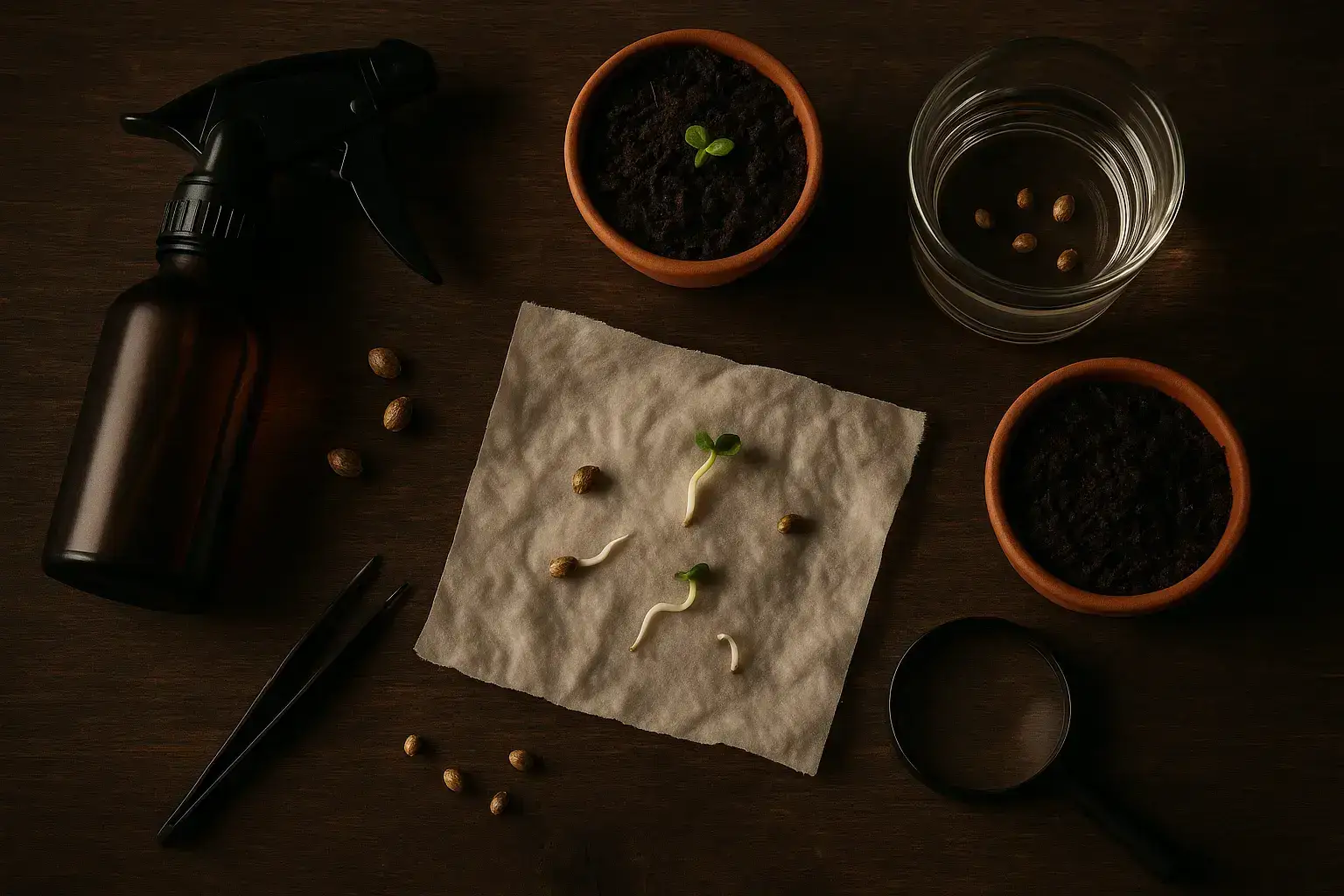
From Seed to Seedling
Germination Guides
Rockwool Cubes & Jiffy Pellets for Cannabis Seed Germination
Germinate cannabis seeds successfully with rockwool cubes or Jiffy pellets. Compare both methods and get results in just 3-7 days.
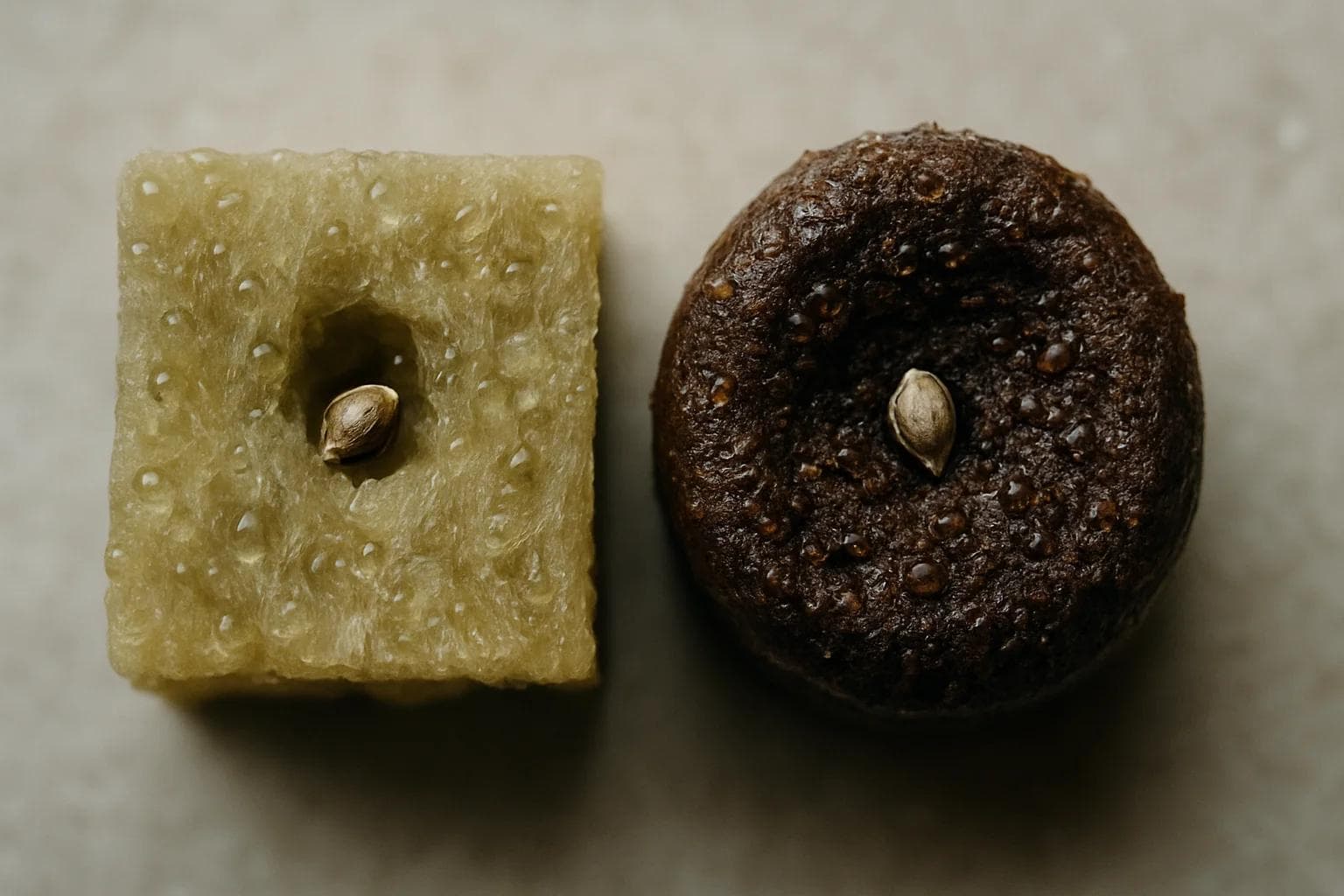
Rockwool cubes and Jiffy peat pellets are the two most reliable starter media for germinating cannabis seeds before transplanting. Rockwool requires a 4–5 hour soak at pH 5.5 before use; Jiffy pellets are pre-calibrated and ready after hydration. Both germinate seeds in 3–7 days at 25–28°C with 70–80% humidity under a dome.
What Is the Difference Between Rockwool and Jiffy Pellets for Cannabis Germination?
Rockwool (mineral wool) is a sterile, inert growing medium made from spun volcanic rock. Jiffy pellets are compressed discs of peat moss encased in biodegradable mesh that expand when hydrated. The key difference: rockwool is inert and pH-alkaline by default (requiring neutralization), while Jiffy pellets contain organic matter pre-buffered to approximately pH 5.5–6.0.
Your choice of medium should follow your destination system, not personal preference.
When to choose Jiffy pellets: You're going into soil or coco coir, or this is your first germination attempt. The pellet biodegrades directly into the grow medium with zero root disturbance. Hard to beat for simplicity.
Autoflower note: Autoflowering seeds have a genetically fixed vegetative window — transplant stress costs you days of growth you cannot get back. With autos, the ideal approach is to start in the final medium from day one. If you need a starter plug, rockwool direct-to-hydro or Jiffy direct-to-coco minimizes handling. Photoperiod strains are more forgiving on transplant.
How Do You Prepare Rockwool Cubes for Cannabis Seed Germination?
What pH Should You Soak Rockwool in Before Use?
Rockwool cubes leave the factory at pH 7.0–8.0 due to residual alkalinity from the manufacturing process. Soaking them in pH-adjusted water at 5.5 for 4–5 hours neutralizes this alkalinity and brings the root zone into the optimal range for cannabis seedling uptake (pH 5.5–6.2). Skipping this step is the single most common cause of slow or failed germination in rockwool.
Materials needed:
- Rockwool cubes (standard 1" or 1.5" starter size)
- pH meter or reliable test drops
- pH-down solution (phosphoric acid)
- Clean water (room temperature, ~20°C)
- Propagation tray with humidity dome
- Heat mat (20–30W for a standard 10×20 tray)
- Tweezers
- Mix your soak solution. Fill a container with clean water and adjust to pH 5.5 using pH-down. Confirm with a calibrated pH meter — eyeballing is not sufficient. The number matters here.
- Submerge the cubes. Place rockwool cubes fully submerged for 4–5 hours. Do not rush this — the buffering takes time to penetrate the fibre matrix.
- Remove and drain — do not squeeze. Lift the cubes out and allow excess water to drain by gravity. Squeezing collapses the air pockets that roots need. The cube should feel moist but not waterlogged — like a wrung-out sponge.
- Place in tray. Arrange drained cubes in your propagation tray with the pre-made seed hole facing up. If your cubes don't have a pre-drilled hole, make one approximately 1 cm deep with a toothpick or pen cap.
- Label if germinating multiple strains. Once seedlings emerge, visual identification becomes surprisingly difficult. Label cube positions before anything goes in the ground.
How Do You Prepare Jiffy Pellets for Cannabis Seed Germination?
How Do You Prevent Overwatering in Jiffy Pellets?
Overwatering in Jiffy pellets happens when the compressed peat is fully saturated and has no air space left. The fix is deliberate: hydrate with warm water (not boiling, not cold), allow the pellet to expand fully to its natural height (~4 cm), then tip it gently and let excess water drain before placing it in the tray. The pellet should feel moist and hold its shape — not drip when held. A shallow propagation tray (not a deep container) helps ensure pooled water cannot wick back up into the pellet base.
Materials needed:
- Jiffy pellets (36mm or 41mm diameter)
- Warm water (~30–35°C)
- Shallow propagation tray
- Humidity dome
- Heat mat (same specs as rockwool setup)
- Tweezers
- Place pellets in tray. Arrange compressed pellets flat-side down in the propagation tray.
- Add warm water. Pour warm water over and around the pellets — approximately 30–40 mL per pellet. Warm water hydrates the peat more evenly than cold and speeds expansion.
- Allow full expansion. Wait 5–10 minutes until each pellet has expanded to its full height. If any remain partially compressed, add a small additional amount of water directly to the top.
- Drain excess water from tray. Tilt the tray and pour off any water pooling at the base. Jiffy pellets should not sit in standing water.
- Check moisture. Squeeze a pellet gently between two fingers — it should feel like a moderately damp sponge, not dripping. If it drips, give it more drainage time.
- Locate the pre-made hole. Most Jiffy pellets have a shallow indentation at the top. If it's too shallow, create a 1 cm hole with a toothpick.
No pH adjustment is required for Jiffy pellets — the peat is pre-calibrated to approximately pH 5.5–6.0 by the manufacturer.
How Do You Plant Cannabis Seeds in Rockwool and Jiffy Pellets?
Planting depth is 1 cm — no deeper. Place the seed with the taproot end pointing down if the seed has already cracked (from a pre-soak). If planting a dry seed directly, orientation matters less — the taproot will find its way down. Cover lightly with a small pinch of medium or a loose fragment of rockwool fibre. Do not press down or pack the hole closed.
Planting protocol (same for both media):
- Use tweezers or a moistened toothpick to handle seeds — skin oils and mechanical pressure can damage the seed coat
- One seed per cube or pellet — never double-plant
- Depth: 1 cm below the surface (roughly the depth of your thumbnail to the first joint)
- If pre-soaking seeds first, place them in the medium after the taproot shows 2–5 mm of growth — this shortens above-ground emergence time significantly. See Soaking cannabis seeds for pre-soak protocol
- After planting, cover the tray with a humidity dome immediately
- Target: 25–28°C medium temperature, 70–80% relative humidity
How Long Do Cannabis Seeds Take to Germinate in Rockwool and Jiffy?
Most cannabis seeds germinate within 3–7 days in both rockwool and Jiffy pellets under ideal conditions (25–28°C, 70–80% RH, darkness). The seed coat softens, the taproot splits the shell and pushes down into the medium, and the cotyledons (seed leaves) emerge upward within 24–48 hours of taproot emergence.
Factors affecting germination speed:
- Temperature: The single biggest variable. Every degree below 22°C extends germination time. At 18°C, seeds that would sprout in 3 days may take 10. Heat mat consistency matters more than the dome.
- Seed age and storage: Fresh seeds from well-stored stock germinate faster and more reliably. Seeds stored in warm or humid conditions — unsealed bag, direct light — show slower and less consistent germination. This is worth checking before blaming the medium.
- Genetics: Some strains are simply faster germinators than others. It's partially genetic and not a reflection of seed quality.
- Moisture balance: Over-wet media increases damping off risk (pythium). Under-wet media causes the seed coat to dry out before the taproot can establish.
Online growing communities have reported germination success rates ranging from 50% to 90% in rockwool and Jiffy pellets — but these figures are anecdotal, sourced from forum threads without documented methodology, and results vary heavily based on seed quality, prep technique, and environmental consistency. Medium type is rarely the differentiating factor. Start with high-viability genetics and correct prep protocol before attributing failure to what you're germinating in.
How Do You Transplant Seedlings from Starter Plugs Into Your Grow System?
Signs the seedling is ready to transplant:
- Roots are visible through the bottom or sides of the cube/pellet (white root tips, not brown)
- First true leaves (serrated cannabis leaves) are showing beyond the cotyledons
- Seedling stands upright and has a visible stem structure
- Typically 5–10 days after germination
Can You Use Jiffy Pellets in a Hydroponic System?
Jiffy pellets can be used in hydroponic systems with modifications, but rockwool is significantly better suited. The issue: peat moss is an organic material that degrades over time in recirculating water, releasing particles that clog pumps, drippers, and net pot screens. If you're transplanting a Jiffy seedling into a DWC or NFT system, remove the biodegradable mesh and rinse the root zone gently before placing it in the net pot. For ebb-and-flow or drip systems, monitor water filters closely. The simpler fix: if you know you're going hydro, start in rockwool from day one and eliminate the problem entirely. Jiffy pellets integrate cleanly into soil and coco coir with no modification needed.
Transplanting to hydroponic systems (rockwool cube):
- Select net pot size: 2-inch net pots work for small cubes (1" rockwool); 3-inch pots are better for 1.5" cubes and give the roots more room. Standard for DWC and NFT.
- Add a base layer of hydroton (clay pebbles): Rinse hydroton thoroughly before use to remove dust. Add enough to the bottom of the net pot so the cube sits at the right height — the top of the cube should sit just below the rim of the net pot.
- Place the rockwool cube: Set the cube in the net pot. It should sit snugly without forcing it.
- Pack hydroton around the cube: Fill the gaps on all sides with rinsed hydroton, pressing gently to stabilize. Do not bury the cotyledons.
- Introduce to reservoir: For DWC, the water level should initially touch the bottom of the net pot to allow capillary uptake. Drop the level to the standard reservoir gap (2–4 cm below net pot) once roots reach the water. For NFT, ensure the film flow rate doesn't directly spray the rockwool surface — wicking from below is the target.
Make a hole in the soil or coco the same size as your cube or pellet. Place the plug directly in the hole and firm the medium gently around it — no need to remove the mesh on Jiffy pellets for soil transplants; the mesh biodegrades. The pellet should be fully buried with the seedling stem at the same height as in the plug. Water lightly with pH-adjusted solution (6.0–6.5 for soil, 5.8–6.0 for coco) to settle the medium around the root zone.
Match pH and temperature between the propagation medium and the destination system to reduce transplant shock. A seedling moved from a 26°C dome into a 20°C reservoir will stall — allow reservoir water to come up to room temperature before introduction.
What Are the Most Common Mistakes When Germinating in Rockwool and Jiffy Pellets?
Even with the right media, avoidable errors account for most germination failures. These are the patterns that surface repeatedly in troubleshooting threads — catalogued here by medium because the failure modes are not the same:
Rockwool-specific mistakes:
- Skipping the pH soak entirely. Planting directly into an unsoaked cube means the root zone sits at pH 7.5+, locking out nutrient uptake and stunting early root development. There are no shortcuts here.
- Squeezing the cube after soaking. This collapses the air pockets roots need to breathe. Drain by gravity only — every time.
- Leaving rockwool exposed to light. Algae will colonize the surface quickly under grow lights, competing with the seedling and adding pathogen pressure. Keep cubes covered or shaded. This catches a lot of growers running open-top trays.
- Using cold tap water to hydrate. Cold water expands the peat unevenly and can leave compressed zones the taproot struggles to penetrate. Use warm water (~30°C).
- Leaving pellets sitting in water in the tray. Peat that's continuously saturated drives out all oxygen from the root zone. Pour off pooled water immediately after expansion.
- Overwatering after planting. Once the seed is placed, add no water unless the surface is visibly dry. Mist — do not pour.
- Planting too deep. Anything below 1.5 cm significantly increases emergence time — the seedling has to push through more medium to reach light.
- Removing the humidity dome too early. Cotyledons are fragile and need 70–80% RH for the first 5–7 days. A room at 45% RH will desiccate seedlings within hours of dome removal.
- No heat mat in a cool room. In Calgary and Montreal home grows through cooler seasons, room temperatures of 17–19°C are normal — well below the 25°C floor for reliable germination. Bottom heat from a mat is the single most cost-effective intervention you can make for a propagation setup.
FAQ
Can you reuse rockwool cubes for multiple grows?
Technically yes — rockwool can be sterilized and reused. In practice, the effort and contamination risk outweigh the cost savings. Spent cubes harbour residual root matter, salt deposits from nutrient solutions, and potentially pythium or other pathogens. Sterilization requires a diluted hydrogen peroxide soak and thorough rinse, followed by a fresh pH 5.5 conditioning soak. New cubes cost less than $0.30 each for a home grow. Not worth carrying contamination forward into a new crop.
Are Jiffy pellets biodegradable and safe for cannabis?
Yes. Jiffy pellets are composed of compressed peat moss in a biodegradable cellulose mesh. The mesh and peat break down naturally in soil over several weeks. The peat itself is pH-adjusted to approximately 5.5–6.0, which is suitable for cannabis. The trace organic matter in the peat is not a nutrient source in any meaningful quantity — treat the pellet as a germination medium only, not a fertilizer.
Is rockwool bad for the environment?
Rockwool is a non-biodegradable material that cannot be composted or recycled through standard streams. Spent cubes go to landfill. Manufacturing also involves high-temperature, energy-intensive processes. This is a legitimate consideration for growers who prioritize sustainability. Alternatives with lower environmental impact include compressed coco coir starter plugs and rapid rooters (composted bark). For growers where hydroponic compatibility is the priority, rockwool's environmental cost is generally accepted as the trade-off for superior system integration.
Do you need a heat mat for rockwool germination?
In any environment below 22°C ambient, yes. Rockwool conducts temperature changes quickly: a cold propagation tray in a cool room will pull the root zone temperature down to ambient within hours. At 18–20°C — common in basement grow rooms in spring and fall — germination rates and speed drop significantly. A 20–30W seedling heat mat set to 26–28°C surface temperature is the most reliable way to hold the target range without over-engineering the setup.
Can you germinate autoflower seeds in Jiffy pellets?
Yes — Jiffy pellets work for autoflowering seeds. The caution is transplant sensitivity: autoflowers don't have a long vegetative window to absorb root disturbance and keep growing. If using Jiffy pellets for autos, transplant as soon as roots are visible through the mesh — don't wait for the pellet to become root-bound. Bury the entire pellet in soil or coco with minimal handling. If your destination is a hydroponic system, consider starting directly in a small rockwool cube in the net pot to eliminate the transplant entirely. See [LINK: Paper towel germination | /en/articles/paper-towel-germination-cannabis] for comparison if you're avoiding starter plugs altogether.
What is the germination success rate for rockwool vs. Jiffy pellets?
Community data suggests rates between 70–90% for both media under controlled conditions, but this data is anecdotal — sourced from online growing communities without documented methodology. Medium type is not the primary variable. Seed genetics, pH accuracy, temperature consistency, and moisture control account for most of the variance. High-viability seeds with correct prep will outperform mediocre seeds in perfect conditions every time. If you're seeing repeated failures with either medium, the [LINK: Germination problems | /en/articles/cannabis-seed-germination-problems] article covers diagnostic steps by failure mode. --- *For the full overview of germination methods including paper towel, direct soil, and water soaking, see [LINK: Complete germination guide | /en/articles/cannabis-seed-germination-guide].* *Start with genetics that are worth the effort — [LINK: Browse our seed collection | /en/shop].* ---
19+ | Educational horticulture only.