From Decarb to Dosing
Cooking & Edibles
Decarboxylation: The Chemistry Behind Activating Cannabis
Decarboxylation explained: how heat converts THCA to THC, the ideal temperature and time, and why every cannabis edible needs decarbed flower.
Decarboxylation is the heat-driven process that converts inactive THCA into psychoactive THC — and CBDA into CBD — by releasing a CO₂ molecule from the cannabinoid's structure. For most home-grown flower, 110 °C (230 °F) for 30–45 minutes in a preheated oven delivers maximum THC activation without significant cannabinoid degradation.
Raw cannabis does not get you high. Not because the plant lacks potency — it's because the dominant cannabinoid in fresh and properly cured flower is THCA, the acidic precursor to THC. THCA is non-intoxicating until heat converts it. That conversion is decarboxylation, and whether your edibles work or do nothing comes down to whether you get this step right.
If you have just brought your harvest through a careful cure and storage process, your flower is biochemically intact — trichomes preserved, cannabinoid acids stable, waiting to be activated. This guide covers what decarboxylation actually does to the molecule, the home protocol to execute it correctly, and the sensory checks to confirm the reaction is complete.
This is the foundational step before any infusion — cannabutter, oil, tincture, or capsule. The chemistry in this 30–45 minute window determines every milligram of potency in everything you make afterward.
What Is Decarboxylation in Cannabis?
Decarboxylation is the chemical reaction that converts acidic cannabinoids — primarily THCA and CBDA — into their neutral, biologically active forms (THC and CBD) by removing a carboxyl group (–COOH) from the molecule and releasing it as carbon dioxide (CO₂). In practical terms: controlled heat turns cured flower into infusion-ready material by completing the chemical transformation the plant started but never finished.
The reaction occurs slowly at room temperature over months — which is why aged or improperly stored flower gradually loses potency without any intentional heat applied. A deliberate decarb drives that same reaction to near-completion in 30–45 minutes by maintaining a precise, sustained temperature. The process is irreversible — once THCA becomes THC, the cannabinoid cannot revert to its acidic precursor.
The timing of your harvest matters here because trichome ripeness at the moment of harvest determines the THCA-to-CBDA ratio in your starting material — and that ratio shapes your decarb planning, especially if you're working with a multi-cannabinoid strain.
Why Does Cannabis Need to Be Decarbed?
THCA does not bind efficiently at the CB1 receptor — the primary cannabinoid receptor responsible for psychoactive effects. Eat raw cannabis without decarbing first and you are delivering THCA into your body, not THC. The physiological result is negligible intoxication, no matter how much flower you consume. Smoking or vaping sidesteps this entirely because combustion and vapour temperatures (300–700 °C) instantly decarboxylate cannabinoids at the moment of inhalation.
Edibles are different. A cookie baked at 175 °C sounds like more than enough heat, but the flower is suspended inside fat-based batter that insulates the material — the internal temperature of the infused fat stays well below 100 °C through the entire bake. The cannabinoids never reach their activation threshold inside the recipe. Pre-decarbing ensures conversion is fully complete before the infusion process begins, so potency is locked in before your butter or oil ever touches the stove.
CBDA, the acidic precursor to CBD, follows the same logic. Growers running high-CBD genetics for oils or tinctures cannot skip decarboxylation — they simply need a different protocol, which is addressed further below.
The Chemistry — What's Actually Happening to the Molecule?
THCA has the molecular formula C₂₂H₃₀O₄. Its distinguishing structural feature is a carboxyl group (–COOH) attached at position C-2 of the resorcinyl ring. When heat is applied, that carboxyl group becomes thermally unstable and cleaves from the molecule — departing as CO₂ — leaving behind THC (C₂₁H₃₀O₂). The balanced reaction is:
THCA → THC + CO₂
The 0.877 mass-loss factor — explained
Because CO₂ physically leaves the molecule, decarbed cannabis weighs measurably less than raw cannabis — and this mass loss is predictable. The molecular weight of THCA is 358.5 g/mol; the molecular weight of THC is 314.5 g/mol. The ratio is 314.5 ÷ 358.5 = 0.877. For every gram of THCA in your starting material, decarboxylation can yield at most 0.877 grams of THC — assuming 100 % conversion efficiency.
In a home oven, you won't reach 100 % conversion. A realistic range for controlled home decarb is 85–95 % of the theoretical maximum, depending on temperature calibration, material moisture content, and grind consistency. The 0.877 figure is a conversion constant used in potency estimation formulas — it represents the ceiling, not the expected real-world yield.
THCA → THC is not the same reaction as THC → CBN
THC degrades into CBN (cannabinol) through a separate oxidative process — not a continuation of decarboxylation. CBN formation is driven by extended heat above the decarb sweet spot, prolonged UV exposure, and time. CBN is a recognised cannabinoid with its own profile, but it is a degradation endpoint, not a goal.
The chemistry is sequential: THCA → THC (decarboxylation, desired) → THC → CBN (oxidative degradation, undesired). Managing oven temperature and time keeps you working within the first reaction and out of the second. CBGA — the acidic precursor to CBG — also decarboxylates under heat, with an optimum closer to the CBDA range than to THCA, making multi-cannabinoid decarb a genuine balancing act for strains with significant CBGA content.
What Temperature Do You Decarb Cannabis At?
The optimal decarb temperature for THC-dominant flower is 110 °C (230 °F) — low enough to limit terpene volatilization and CBN formation, high enough to drive THCA → THC conversion efficiently within 30–45 minutes. CBD-dominant flower requires a higher thermal input; mixed-ratio flower sits between the two protocols.
At roughly 1,000 m elevation, Calgary-area growers may notice slightly faster surface moisture evaporation from flower during the first 10 minutes in the oven — but the underlying cannabinoid conversion chemistry is unchanged. The reaction kinetics are temperature-dependent, not altitude-dependent.
How Long Does It Take to Decarb Cannabis?
For THC-dominant flower at 110 °C (230 °F), decarboxylation is effectively complete in 30–45 minutes. Well-dried and coarsely ground material hits the conversion endpoint closer to 30 minutes; denser material or loosely broken buds need the full 45. Compensating for uncertain oven temperature by running longer is the wrong move — if the oven is too cool, the chemistry doesn't complete; if it's too hot, you're accelerating CBN formation at the expense of THC.
A lower-temperature approach — 105 °C (220 °F) for 50–60 minutes — is viable when terpene preservation is the priority. The reaction rate slows, but given sufficient time, conversion stays complete. For most home growers, the 110 °C / 30–45 minute protocol offers the best balance of full conversion and terpene retention.
How Do You Decarb Cannabis in the Oven?
The standard home oven method is reliable and repeatable when you give proper attention to temperature accuracy. Here's what you need and how to run it.
Equipment you need:
- Rimmed baking sheet or oven-safe glass dish
- Parchment paper (two sheets)
- An oven thermometer
- An airtight glass jar for cooling
- Coarsely broken or grinder-processed flower
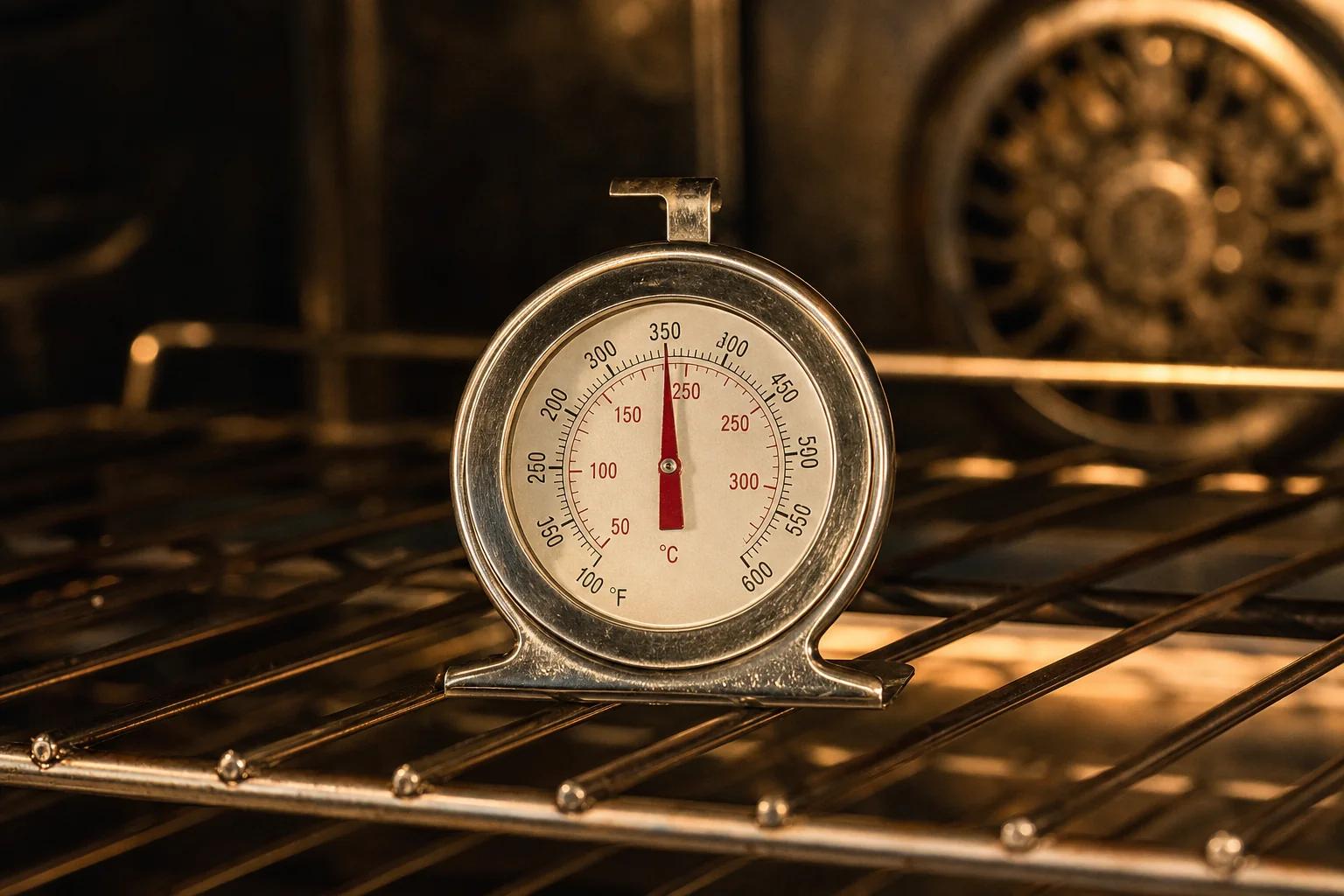
- Preheat fully — using the thermometer, not the dial. Set your oven to 110 °C (230 °F) and place an oven thermometer on the centre rack. Wait until the thermometer reads the actual target temperature — typically 15–20 minutes after the oven signals it is ready.
- Grind coarsely. Break the flower to a rough, tea-leaf consistency. You want even heat penetration across the batch, not a fine powder that loses surface volatiles immediately and clumps during infusion.
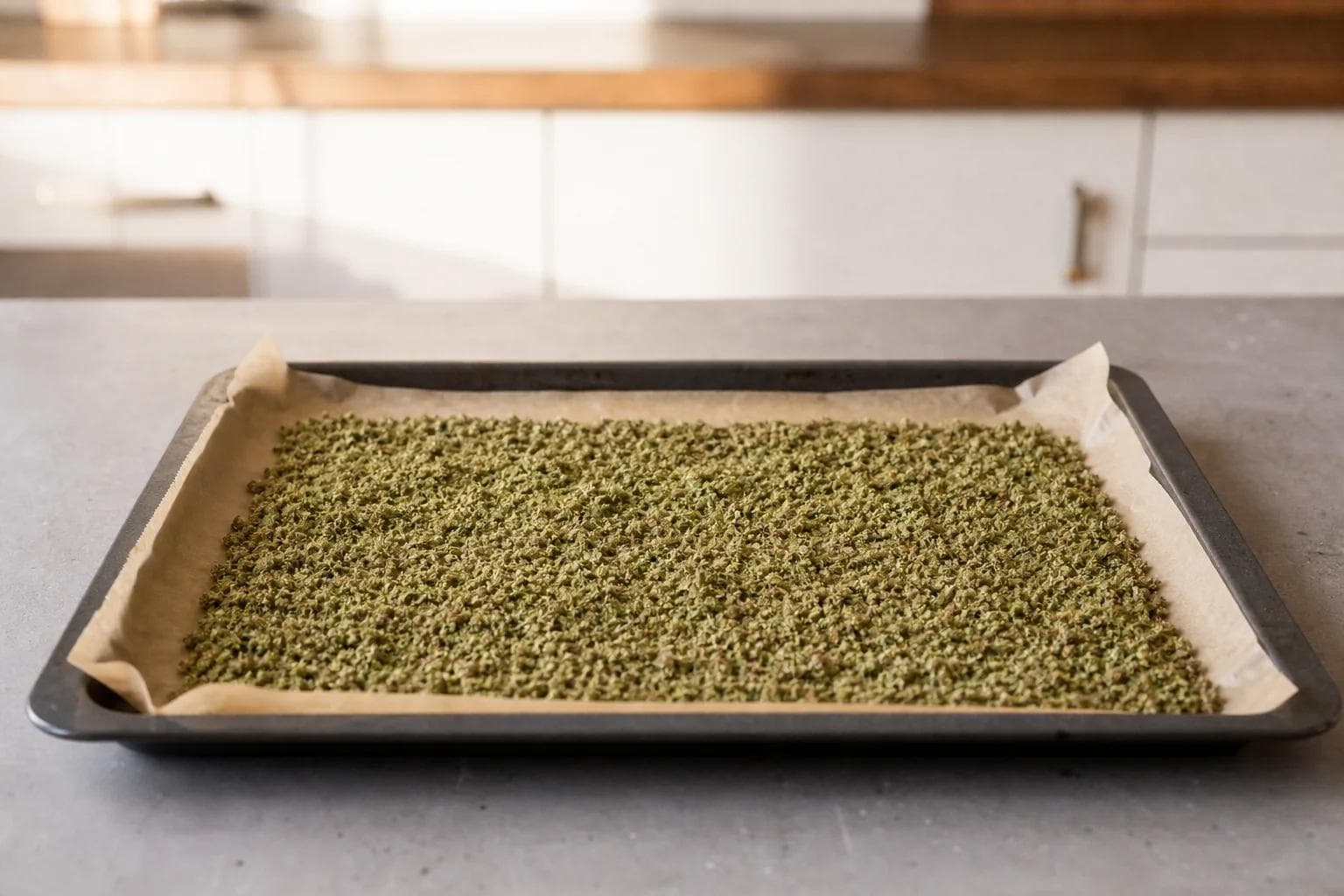
- Spread in a single, non-overlapping layer on parchment. Uneven piles mean uneven decarb — the material at the edges converts while the dense centre lags. One even layer ensures every gram sees the same thermal environment.
- Cover loosely with a second sheet of parchment. This slows surface moisture loss in the first half of the session and keeps the most volatile terpene aromatics in the pan rather than escaping into the oven.
- Place on the centre rack. Hot spots cluster near the top, bottom, and back of most ovens. Centre rack, centre of the shelf — the most thermally stable position in most domestic ovens.
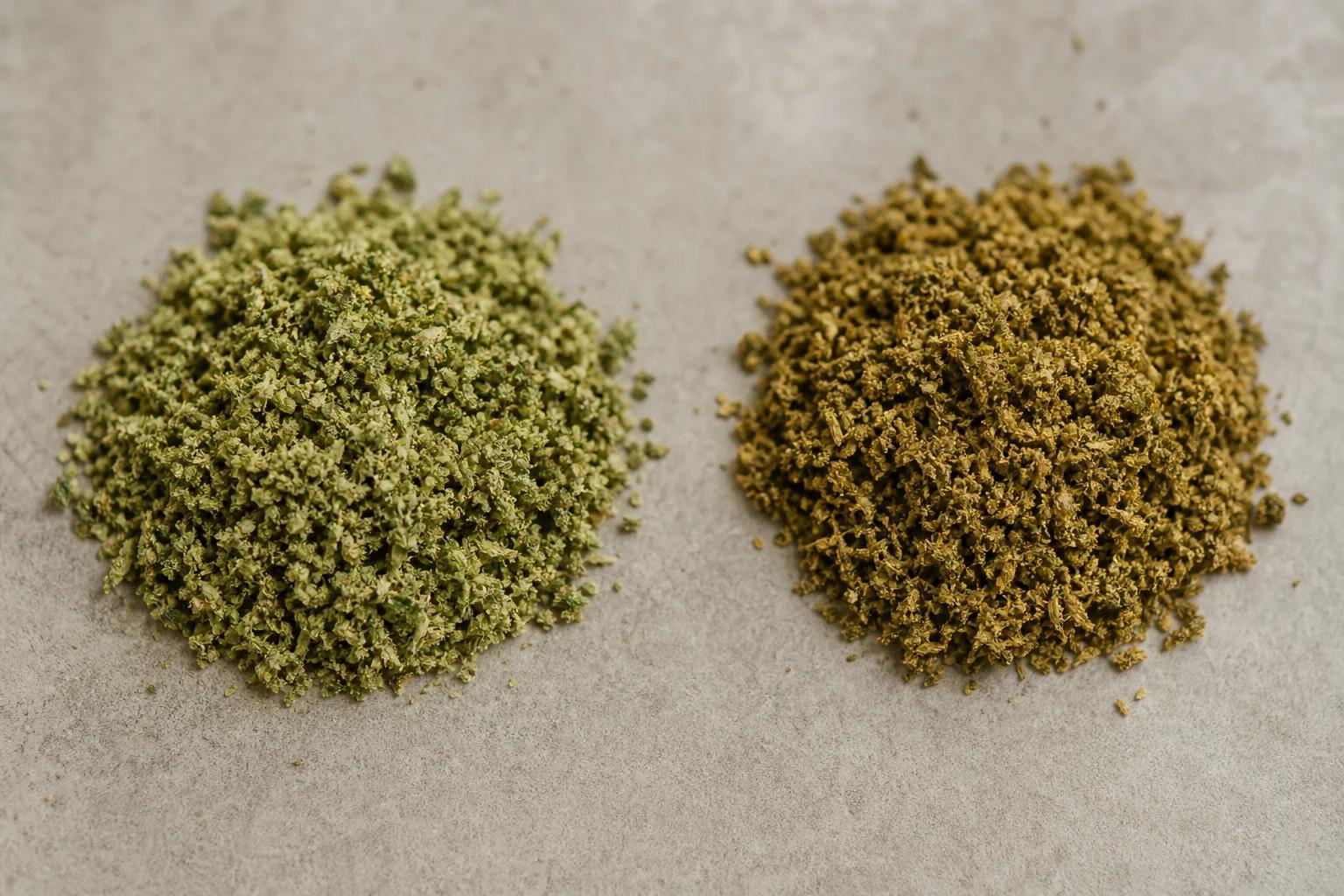
- Set a timer for 30 minutes. At 30 minutes, check the colour. Properly decarbed flower shifts from bright green toward a muted, warm olive or light tan. If the material looks unchanged and smells sharp and raw, extend by 10–15 minutes.
- Transfer immediately to a sealed glass jar while still warm. As the jar cools, terpene vapours that rose off the material during decarb condense back against the flower and partially reabsorb. Let the jar reach room temperature before opening — approximately 20–30 minutes. Your flower is now infusion-ready.
Does Grinding Cannabis Before Decarbing Matter?
Yes — grind consistency directly affects how evenly the decarb reaction proceeds. Coarsely broken flower exposes more internal surface area to oven heat, driving conversion more uniformly than whole buds, where the exterior can fully decarb while the interior lags significantly behind. Fine powder, on the other hand, loses volatile terpenes faster and is harder to work with in filter-based infusion setups afterward.
A medium-coarse consistency — two passes through a standard four-piece grinder on the widest plate setting, or a manual hand-break to rough pieces — is the practical target. The material should look like coarse dried herbs, not flour and not unbroken colas. The few minutes spent on consistent grinding pay off in more uniform potency across the finished infusion.
Can You Decarb Cannabis Too Long?
Yes — and this is the single most common way home growers silently lose potency from an otherwise excellent harvest. Once the THCA → THC conversion is complete, continued heat begins driving the secondary reaction: THC degrades into CBN through oxidative decomposition. Thermal stability research confirms that CBN formation accelerates above 120 °C (250 °F) but proceeds at measurable rates even at standard decarb temperatures when time is significantly extended.
At 110 °C, a 10–15 minute overrun past the 45-minute mark is unlikely to cause significant potency loss. But doubling the session — running 90 minutes at target temperature — will measurably reduce your THC yield. Running at 135 °C+ (275 °F+) for any extended duration causes simultaneous terpene loss and accelerated CBN formation.
Canada's National Research Council thermal stability data makes this concrete: the degradation kinetics are non-linear, meaning the rate of THC loss accelerates over time rather than remaining constant. The practical rule is simple — once the conversion window is complete, pull the material. There is no benefit to additional time, only compounding downside. Under-decarb is correctable with a short second session; over-decarb is not.
Does Decarboxylation Destroy Terpenes?
Some terpene loss during decarb is unavoidable — and it is an acceptable trade-off, not a reason to skip the step. The most thermally sensitive terpenes (myrcene, limonene, linalool) begin to volatilize above 65–70 °C and are the first to leave at decarb temperatures. On an open baking sheet at 110 °C, meaningful amounts of these lighter terpenes will escape.
The less volatile terpenes — caryophyllene, humulene, bisabolol — have significantly higher boiling points and survive a careful 110 °C decarb with minimal loss. The parchment-cover step during decarb and the sealed-jar cooling method described above both help recover what would otherwise escape as aromatic vapour.
For a complete picture of which terpenes are heat-sensitive and how their boiling points map against infusion temperatures, the Cannabis Terpenes Guide covers the major terpene classes in detail. If terpene retention is the overriding priority, a sous-vide decarb — flower vacuum-sealed in a food-safe bag, submerged in a water bath held at 95–98 °C for 90 minutes — achieves near-complete THCA conversion with substantially better terpene retention than any open-oven method.
Is Decarbing CBD-Rich Flower Different From Decarbing THC Flower?
Yes — meaningfully so, and this distinction is consistently under-served on the SERP. CBDA requires a higher temperature and longer duration than THCA to achieve the same degree of conversion. The decarboxylation activation energy for CBDA is higher, meaning the molecule requires more thermal input before the reaction proceeds efficiently.
For CBD-dominant flower, the recommended protocol is approximately 150 °C (300 °F) for 30 minutes — noticeably hotter than the THC-dominant protocol. At that temperature, volatile terpene loss is more significant than at 110 °C, which is why CBD growers focused on aromatic complexity in finished oils often prefer the sealed-jar or sous-vide method. For most CBD oil, tincture, or capsule applications where maximum cannabinoid conversion is the goal, the higher-temperature oven approach is practical and efficient.
The practical consequence for home growers: Run CBD-dominant flower through a standard THC-protocol decarb — 110 °C for 30–45 minutes — and you'll likely achieve only 60–75 % of the possible CBDA → CBD conversion. Your finished infusion will underperform relative to the starting material's cannabinoid potential. CBD-rich genetics deserve their own dedicated protocol.
Strains with a strong CBDA-dominant profile — such as Harlequin CBD 40:1 Feminized — produce flower with a very different cannabinoid composition than a THC-forward variety, and the decarb chemistry should reflect that difference. For growers wanting to maximise CBDA content at harvest before decarb — including cultivation decisions that affect the final cannabinoid ratio going into the conversion step — the CBD Cannabis Seeds — Grow for Maximum CBD-to-THC Ratio article covers the genetics and cultivation side in detail.
Mixed-ratio flower
For 1:1 or 2:1 CBD:THC strains, a middle-ground protocol of 115–120 °C (240–250 °F) for 40 minutes is the most practical approach. Neither cannabinoid reaches its absolute conversion optimum, but both reach good conversion without sacrificing the other. This is the balanced-protocol row in the temperature table above.
How Do You Know if Your Cannabis Is Decarbed?
Three sensory indicators confirm a successful decarb without laboratory equipment.
Colour shift. Properly decarbed flower moves from bright, saturated green toward a warm olive or light tan. Chlorophyll remains mostly intact, but the carotenoid pigments become more visible as green intensity softens. Flower that looks identical to how it went in — bright and vivid — likely didn't receive sufficient heat to complete conversion.
Aroma change. Raw cured flower has a sharp, complex, resinous smell. Properly decarbed flower smells noticeably more muted and toasty — the most volatile terpenes have left, and what remains is a rounder, warmer aroma. This is expected and normal. If the aroma is acrid or burnt, the temperature was too high.
Texture and friability. Properly decarbed cannabis crumbles easily under light pressure. Seal a small amount in a clean glass jar, press it gently, and it should break apart without compressing into a sticky mass. If it clumps and sticks together, residual moisture is high and decarb may be incomplete — either the cure was insufficient or the oven temperature was too low.
If you're uncertain after these checks, a second pass of 10–15 minutes at temperature is the right call — it will complete borderline conversion without significantly degrading a batch that is already partially activated.
How Do You Calculate Edible Potency After Decarb?
Home potency estimation is approximate by nature. Without laboratory chromatography, any calculation relies on the declared THCA percentage from the genetics specification — which itself carries variance. The formula in wide use, based on the Project CBD approach, is:
Estimated THC (mg) in finished infusion = (flower weight in grams × THCA % × 10 × 0.877) × infusion efficiency
Worked example using a generic 18 % THCA flower — a typical mid-tier profile used illustratively, not tied to any specific tested strain:
- Flower weight: 7 grams
- THCA concentration: 18 %
- Step 1 — total THCA in starting material: 7 × 18 × 10 = 1,260 mg THCA
- Step 2 — apply conversion factor: 1,260 × 0.877 = 1,105 mg theoretical THC after full decarb
- Step 3 — apply home infusion efficiency (60–80 % is realistic for cannabutter; use 0.70 as a conservative estimate): 1,105 × 0.70 = 773 mg THC in the finished infusion
- Step 4 — divide by serving count (example: 48 cookies): 773 ÷ 48 ≈ 16 mg THC per cookie
Two caveats apply to all home potency estimates. First, this formula requires a declared or tested THCA percentage as input — without it, the output is meaningless. Never attempt numerical dosing math with unlabelled or untested material. Second, home infusion efficiency varies based on fat type, temperature, method, and equipment — treat the resulting number as a practical order-of-magnitude guide, not a clinical dose.
Do You Have to Decarb Before Making Cannabutter?
Yes — in almost all practical circumstances. Standard cannabutter recipes simmer at 85–95 °C for 2–4 hours, which is below the efficient THCA decarb threshold. Partial conversion occurs during a long simmer, but it is inconsistent and incomplete — potency per serving becomes unpredictable.
The narrow exception: a slow-cooker infusion running 8–10 hours at its lowest setting (75–85 °C) achieves meaningful partial conversion — sufficient for mild recreational edibles where dosing precision is not critical. For any application where consistent milligram-per-serving potency matters, pre-decarbing is not optional — it is where the potency of your finished product is actually determined.
The 30–45 minutes invested in a dedicated decarb session before infusion pays dividends in every batch that follows. If you're ready to move to the infusion step, the Cannabutter: A Science-First Guide for Canadian Home Cooks (19+) picks up directly from here. From there, the Cannabis Baked Goods: Weed Brownies, Space Cakes & Dosing Basics (19+) carries the process through to finished edibles with per-serving dosing math. The How Long Do Edibles Last? Cannabis Edible Storage Guide closes the cluster with what to do once everything is made.
What Mistakes Do Canadian Home Growers Make When Decarbing?
Growing and processing cannabis at home under the federal four-plant allowance puts every decision on the grower. Without dispensary guidance or packaging-level protocols, these are the errors that most reliably erode the quality of an otherwise excellent harvest at the decarb stage.
Starting with flower that is too moist. The outdoor harvest cycle across Canada — peaking from late September in Toronto to early October in Vancouver — often produces flower with higher residual moisture than a completed cure achieves. Flower still at 15–20 % water activity spends its first minutes of oven time evaporating moisture rather than driving cannabinoid conversion. The fix: extend the cure until the flower snaps rather than bends, or run a low-temperature pre-dry at 50 °C (120 °F) for 10 minutes on the baking sheet before the decarb protocol begins.
Trusting the oven dial. Older residential ovens — common in apartment buildings from Halifax to Calgary — run with thermostat variance of ±15–25 °C. Setting your oven to 230 °F and getting 258 °F is a genuine risk, not an edge case. An oven thermometer eliminates this failure mode entirely and costs less than five dollars.
Skipping the preheat. Placing cold flower into a cold oven warming to temperature exposes the material to a slow ramp through the terpene volatilization range without the efficient cannabinoid conversion that comes from immediate immersion in a stable heat environment. A properly preheated oven — confirmed by the thermometer — is the starting condition, not an optional step.
Grinding too fine. Powdered flower browns faster on exposed surfaces, loses volatiles faster, and is significantly harder to work with in any filter-based infusion setup that follows. Coarse, even breaking consistently outperforms fine grinding for decarb quality.
Over-decarbing out of caution. The intuition that more time means more activation is wrong past the conversion window. If you're uncertain about your oven's accuracy, the answer is an oven thermometer — not extra time at elevated temperature. Extended heat converts your newly formed THC into CBN, and that cannot be reversed.
FAQ
What temperature do you decarb cannabis at?
A: For THC-dominant flower, 110 °C (230 °F) for 30–45 minutes achieves effective THCA → THC conversion. CBD-dominant flower requires approximately 150 °C (300 °F) for 30 minutes because CBDA's decarboxylation activation energy is higher than THCA's. For mixed-ratio strains, 115 °C (240 °F) for 40 minutes balances both cannabinoids. Always verify temperature with an oven thermometer — the dial is not a reliable reference. ---
How long does it take to decarb cannabis?
A: At 110 °C (230 °F), decarboxylation of THC-dominant flower is effectively complete in 30–45 minutes. Well-dried, coarsely ground material converts in 30 minutes; denser or loosely broken flower needs the full 45. Do not extend past 45 minutes at standard temperature — continued heat converts newly formed THC into CBN through oxidative degradation, reducing effective potency. ---
Does decarboxylation destroy terpenes?
A: Some volatile terpenes — myrcene, limonene, linalool — begin to volatilize above 65 °C and are partially lost during any oven decarb. Higher-boiling terpenes such as caryophyllene and humulene survive a careful 110 °C session reasonably well. Covering the pan with parchment and cooling in a sealed jar recovers some aromatic loss. If terpene retention is the overriding priority, sous-vide decarb at 95–98 °C for 90 minutes in a sealed bag is the better method. ---
Can you decarb cannabis too long?
A: Yes. Once THCA is fully converted to THC — around 30–45 minutes at 110 °C — continued heat begins converting THC to CBN through oxidative degradation. NRC Canada thermal stability research confirms this degradation is non-linear: the rate of THC loss accelerates with time rather than remaining constant. Pull your material at the end of the conversion window — there is no gain from running longer, only compounding loss. ---
Do you have to decarb before making cannabutter?
A: Yes, in almost all practical scenarios. Standard cannabutter simmers at 85–95 °C — below the efficient decarb threshold — so infusion alone does not achieve complete THCA → THC conversion. Pre-decarbing for 30–45 minutes before infusion is where the potency of your finished product is actually determined. Any recipe where consistent per-serving dosing matters requires pre-decarbed flower. ---
How do you decarb CBD flower differently from THC flower?
A: CBDA requires approximately 150 °C (300 °F) for 30 minutes to achieve conversion comparable to what THCA reaches at 110 °C. Running CBD-dominant flower through the THC protocol (110 °C / 30–45 min) produces only 60–75 % of possible CBDA → CBD conversion, resulting in a significantly underperforming infusion. For 1:1 or 2:1 mixed-ratio strains, a balanced protocol of 115–120 °C (240–250 °F) for 40 minutes achieves good conversion for both cannabinoids without sacrificing either.
19+ | Educational horticulture only.