Every Part of the Plant
Cannabis Plant Anatomy
Cannabis Leaf Anatomy: How to Identify a Real Weed Leaf
How to identify a real cannabis leaf: finger count, serration, fan vs sugar leaves, and what lookalikes get confused for weed in Canada.
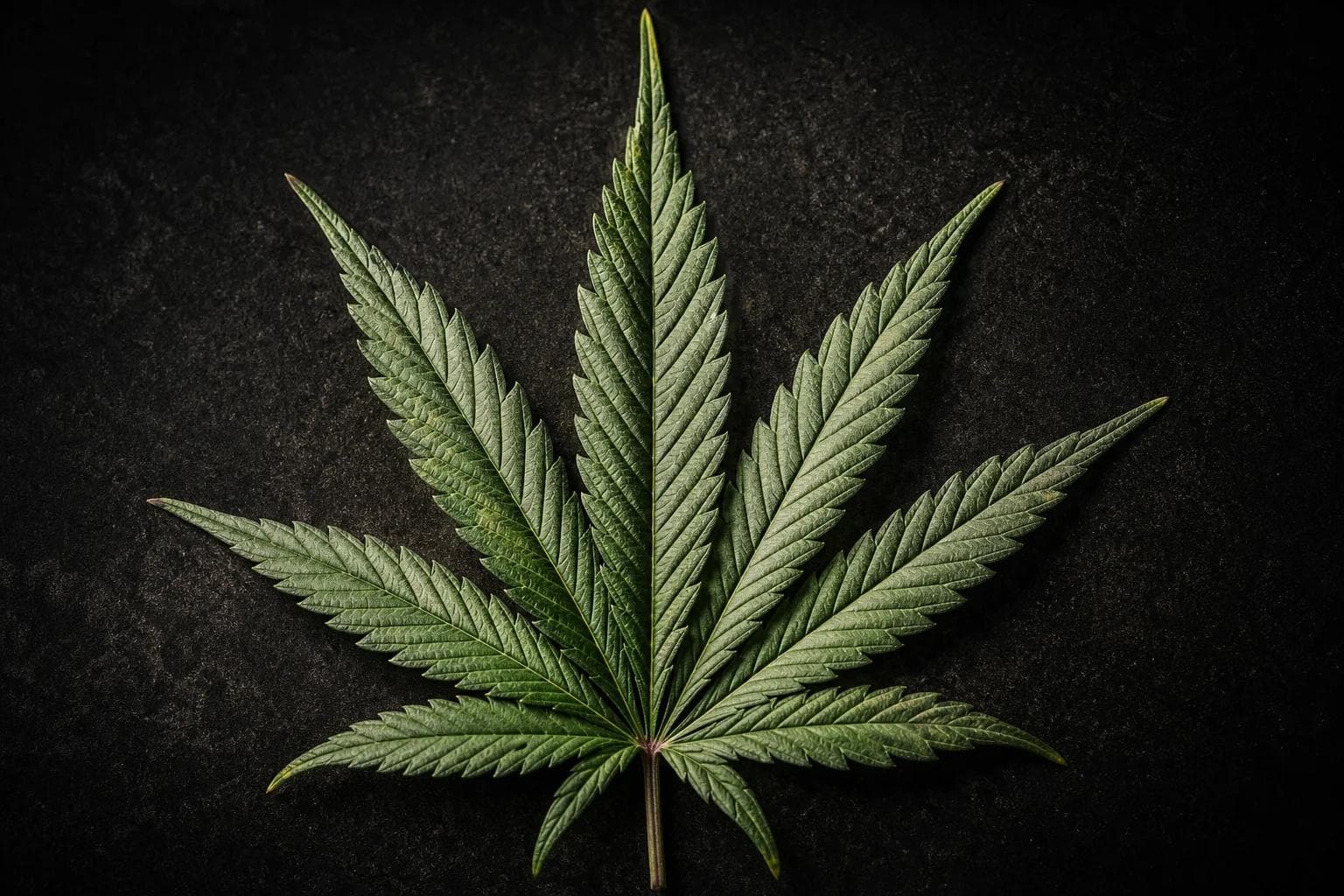
A cannabis leaf is a palmately compound leaf with 3–13 serrated leaflets radiating from a single petiole. Most mature plants display 7–9 leaflets at peak vegetative growth. Leaflet count shifts throughout the plant's lifecycle — seedlings start with 1–3 leaflets and mature plants reduce back to 1–3 near the apex at late flowering.
Cannabis is one of the most recognized plant shapes in the world, yet plant-ID forums are flooded daily with photos of Japanese maples, kenaf, and cassava posted as "is this weed?" — people who can't identify a genuine weed leaf when they see one. The confusion runs both ways — beginners staring at their own plants in week two can't always explain what they're looking at. This guide covers cannabis leaf anatomy from the ground up: what a real weed leaf looks like, its named parts, why leaflet count changes across the lifecycle, how indica, sativa, and autoflower leaves differ, and how to rule out the six plants most commonly confused with cannabis.
What Does a Real Cannabis Leaf Look Like?
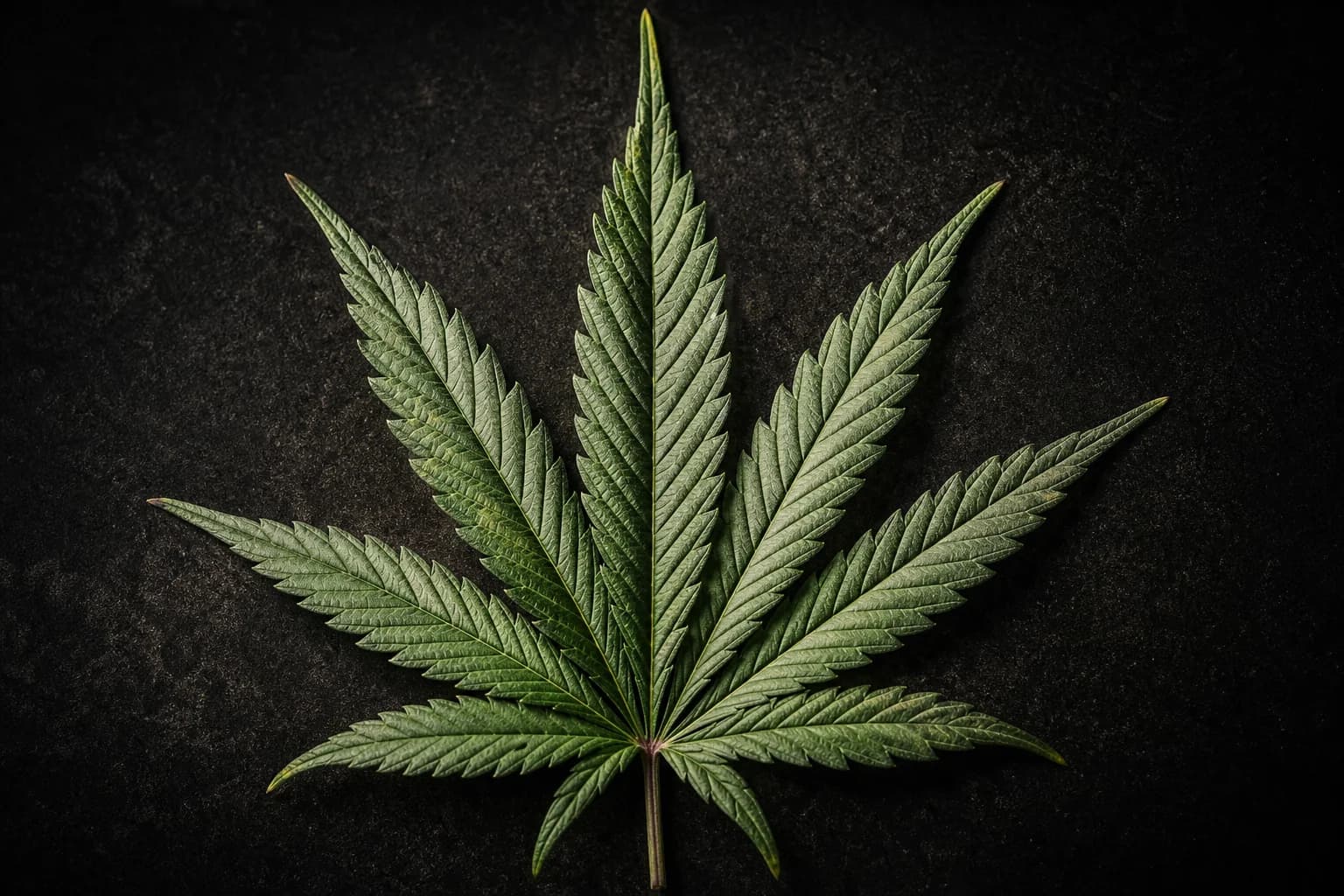
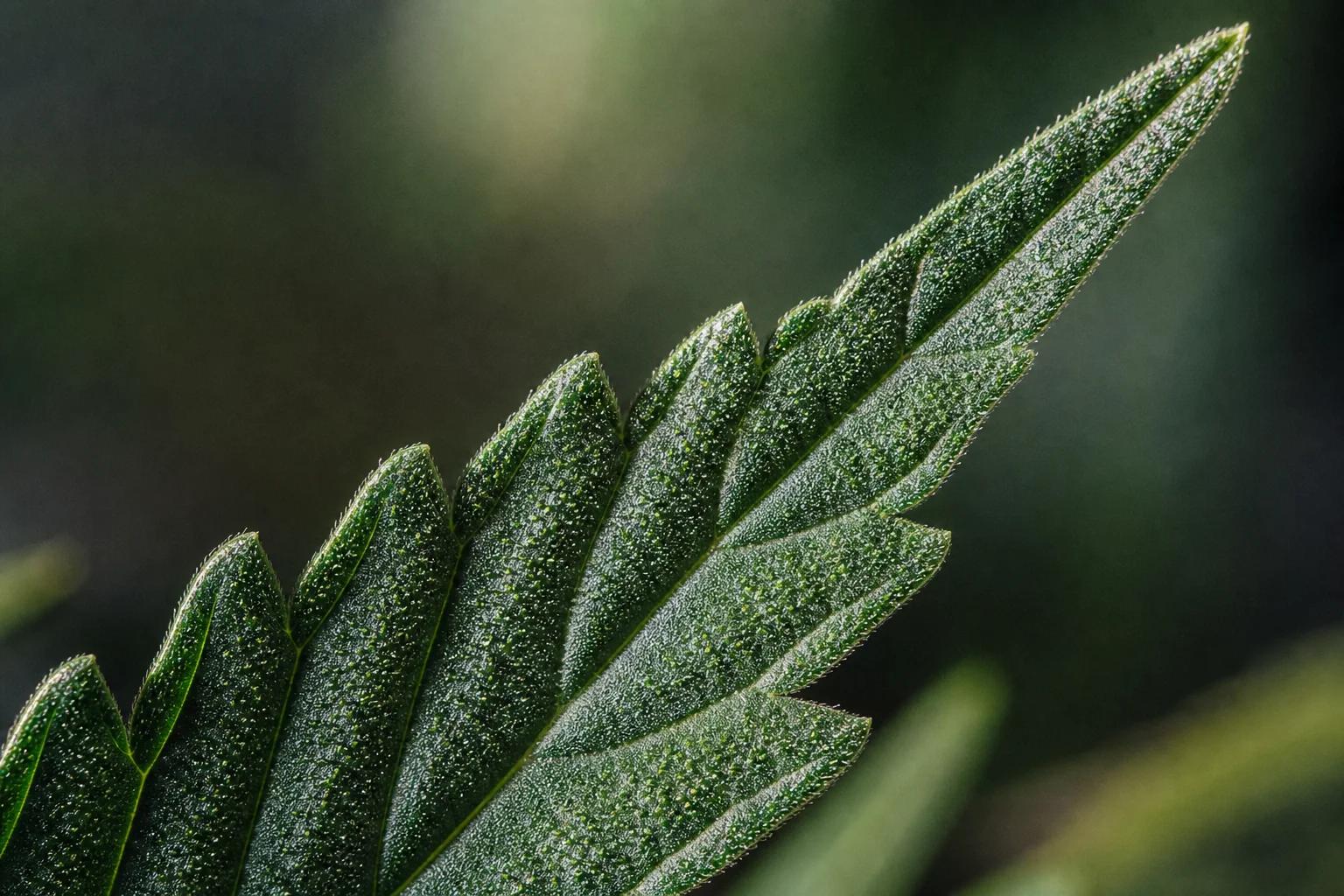
A real cannabis leaf is a palmately compound leaf — several elongated leaflets radiating from a single point at the top of the petiole, like fingers spreading from a palm. Each leaflet has deeply serrated margins, a pointed tip, and prominent veining. The upper (adaxial) surface is darker green; the underside (abaxial) is lighter and carries fine trichomes visible under a loupe. The whole structure is symmetrically fan-shaped, which is why they're universally called fan leaves.
The weed leaf silhouette is the plant's primary light-collection surface — large, flat, and positioned to intercept maximum light per unit of canopy space. Fan leaves are fundamentally different from sugar leaves, the much smaller, trichome-dense leaves that emerge directly from bud sites during flowering. Sugar leaves are the resin-rich byproduct of flower production; fan leaves are the photosynthetic engine. Knowing which is which matters the moment you start trimming.
Three visual markers reliably distinguish a cannabis leaf from most lookalike plants:
- Separate leaflets: each blade attaches by its own small stem (petiolule) rather than fusing at the base
- Deep asymmetric serration: pronounced, irregular teeth run the full length of every leaflet edge
- Trichome presence: fine, resin-tipped hair-like structures visible on the underside — see Cannabis trichomes guide for a full breakdown of trichome types and maturity stages
What Are the Parts of a Cannabis Leaf?
The six named anatomical parts of a cannabis leaf are the petiole, leaflets, petiolules, midrib, serration, and stipules. Knowing these terms matters practically — grower guides and diagnostic resources use them consistently, and identifying the stipule on a weed leaf in particular can settle a plant-ID dispute faster than anything else.
Early in vegetative growth, cannabis leaves emerge in opposite pairs — one leaf on each side of the node simultaneously. As the plant matures and approaches flowering, this phyllotaxy shifts to alternate arrangement, with each new leaf appearing on alternating sides of the stem. That phyllotaxy shift is one of the earliest visual cues that a plant is transitioning toward flower — it often shows up before any response to light schedule change.
How Many Leaflets Does a Cannabis Leaf Have?
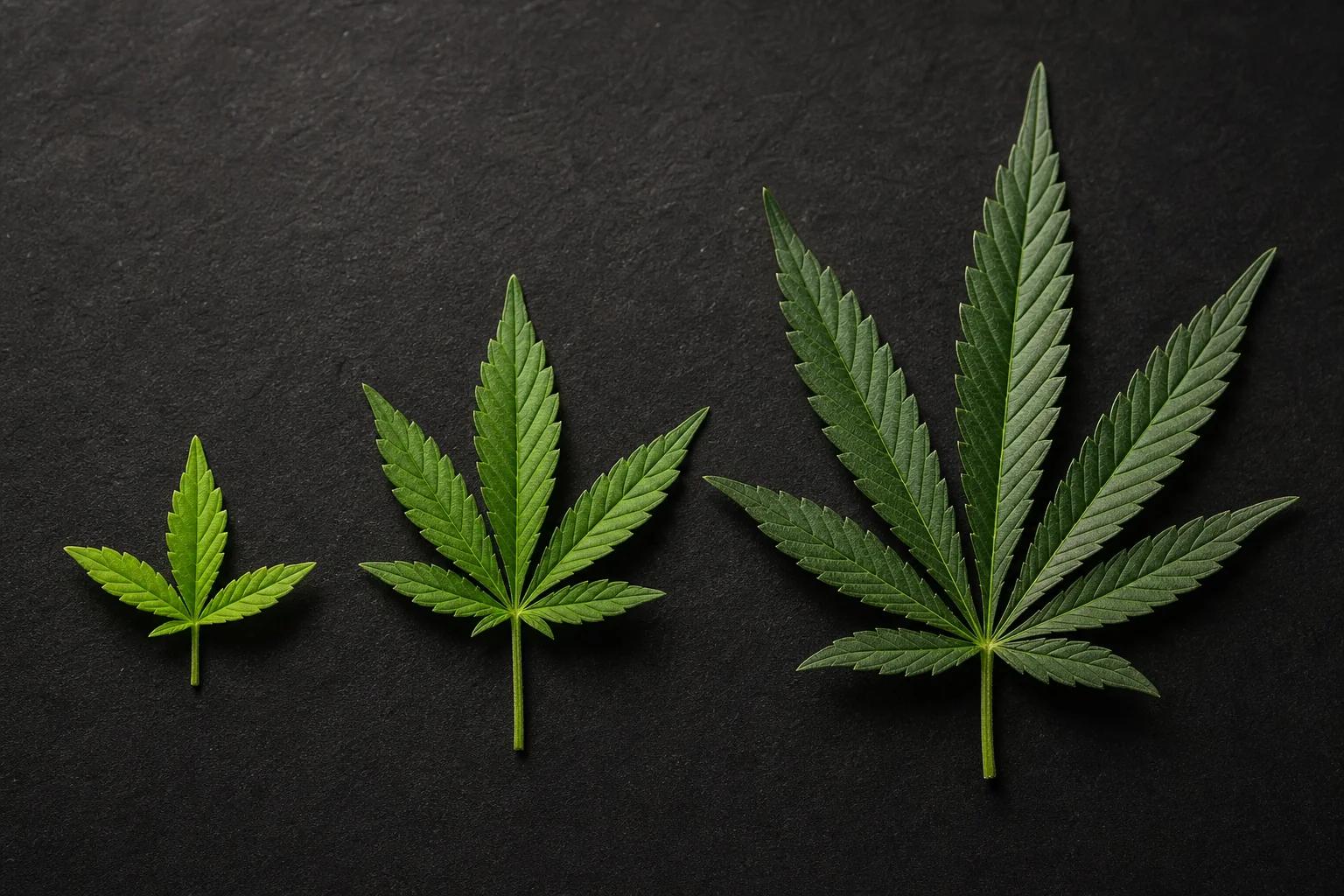
A typical mature cannabis fan leaf has 5 to 9 leaflets, with 7 being the most common count on a healthy plant at peak vegetative growth. The full range across the species is 1 to 13 leaflets, depending on the plant's developmental stage, genetics, and growing conditions.
The 5-to-9 range is what most people associate with the iconic weed leaf silhouette. Counts below or above that are normal at specific life stages — which is why leaflet count alone is a weak ID tool without developmental context.
Why Does My Cannabis Plant Have 3 Leaves Instead of 5?
Three-leaflet leaves at specific growth stages are completely normal cannabis development — they do not indicate disease, stress, or a problem with your genetics. Cannabis follows a predictable node-by-node leaflet progression that every grower benefits from understanding, and most beginner confusion about "why only 3 leaves" stems from not knowing this sequence exists.
Node-by-node developmental leaflet progression:
The late-flowering reduction is the most commonly misread stage. Growers in their first harvest cycle often notice that fan leaves near the top of a mature, flowering plant have reverted to single or trifoliate structure and immediately suspect a deficiency. It isn't one. As the plant shifts energy allocation from vegetative tissue to flower development, the upper growing tip generates simplified leaves — this is normal Cannabis sativa L. ontogeny, not a sign something went wrong. Cannabis flowering stage guide
In the seedling direction: a 10-day-old plant showing 3-leaflet leaves isn't stunted. The 5-to-7-leaflet phase hasn't arrived yet. Expect it around nodes 4 or 5 under healthy conditions.
One real exception worth knowing: persistently low leaflet counts across multiple mid-vegetative nodes — especially combined with narrow, distorted, or abnormally small leaves — can indicate a genetic anomaly such as whorled phyllotaxy, or environmental stress affecting meristematic tissue. If leaf simplification is widespread during active mid-veg growth rather than concentrated at the apex or seedling stage, look at your grow environment before chalking it up to normal development. Cannabis growing problems
How Do Indica, Sativa, and Autoflower Leaves Differ?
Leaf shape is suggestive, not diagnostic. That's the single most important qualifier in this section. Modern cannabis genetics are deeply hybridized — the vast majority of commercially available strains carry both broad-leaf and narrow-leaf ancestry, and individual plants from the same seed batch can express different leaf morphology depending on phenotype. Sativa vs Indica botanical differences
That said, three recognizable morphological tendencies exist and are worth knowing:
Broad-leaf drug (BLD) / indica-dominant morphology Wide, dark green leaflets with shorter internodal spacing. Peak vegetative leaves typically show 7–9 leaflets broad enough to overlap. Stockier overall plant structure. Growers running a 4x4 tent in a Montreal apartment — where vertical space is limited — tend to favour indica-dominant genetics partly for this reason. Indica seed catalog
Narrow-leaf drug (NLD) / sativa-dominant morphology Long, thin leaflets with wider spacing between individual serrations. Paler green, often with a slight yellow-green cast. More open, taller canopy structure. Leaf width is a real indicator, but it's routinely overridden by hybridization — a strain marketed as sativa-dominant may still produce moderate-width leaflets on most phenotypes. Don't over-rely on it. Sativa seed catalog
Ruderalis / autoflower morphology Smaller fan leaves overall, typically reaching 5–7 leaflets at peak rather than 7–9. Leaflets are rounder and less elongated than pure sativa morphology. The leaf texture is noticeably thicker — a trait inherited from wild Cannabis ruderalis populations adapted to the short, harsh growing seasons of northern latitudes. That same cold-tolerance adaptation is why autoflowers dominate outdoor grows in Winnipeg and Edmonton, where the usable summer window is tight. Autoflower seeds
The hybrid reality: claiming a strain is indica or sativa based on leaf width alone is unreliable in a market where most genetics are multi-generational hybrids. Leaf shape reflects population tendencies — not a reliable individual-plant classifier.
A brief note for growers following polyploid breeding: triploid and tetraploid cannabis can produce notably wider, waxier leaves with a distinct robust texture that reflects the additional chromosome sets affecting cell size and structure. Triploid and polyploid cannabis
What Plants Look Like Cannabis — And How Do You Tell Them Apart?
At least six common plants are regularly confused with cannabis in online identification forums. Most share the palmate silhouette — several lobes or leaflets radiating from a central point — but diverge in specific anatomical details that become obvious once you know where to look.
- ✅ Are the leaflets fully separate from one another, each attached by its own petiolule? (Cannabis: yes — maple, okra, kenaf: no, lobes fuse at the base)
- ✅ Is the serration deep and asymmetric along the full edge of each leaflet? (Cannabis: yes — cassava: smooth margins)
- ✅ Are stipules visible at the base of the petiole where it meets the main stem? (Cannabis: yes — most lookalikes: absent or clearly different)
- ✅ Are there trichomes (tiny hair-like resin structures) visible on the underside under a loupe? (Cannabis: yes — lookalikes: absent)
- ✅ Does the leaf produce a distinctive resinous scent when gently rubbed? (Cannabis: yes, from terpenes — lookalikes: no or a clearly different odour)
Can You Tell Hemp from Marijuana by the Leaf Alone?
No. Hemp and marijuana are both Cannabis sativa L., and their leaves are visually indistinguishable by any characteristic — leaflet count, shape, colour, trichome density, or serration pattern. The distinction between hemp and marijuana is chemical and legal, not botanical or visual.
In Canada, hemp is defined as cannabis producing no more than 0.3% THC by dry weight — a threshold established by Health Canada under the Cannabis Act. A plant at 0.2% THC and a plant at 22% THC are leaf-identical. In Quebec specifically, cannabis retail operates exclusively through the SQDC under stricter provincial rules, with a minimum purchase age of 21+ compared to 19+ in most other provinces — but nothing about the plant itself signals its cannabinoid profile or legal classification.
Any guide claiming that leaf shape, width, colour, or trichome coverage can reliably identify legal hemp from high-THC marijuana is wrong. Laboratory testing is the only method that works.
What Do Healthy vs Stressed Cannabis Leaves Look Like?
A healthy weed leaf is flat, deep green, uniformly coloured, with crisp serration, a taut surface, and a flexible (not limp) petiole. No curling, yellowing, spotting, or powdery coating. Trichomes on the underside are clear and intact under magnification.
Leaf symptoms and what they typically signal:
- Yellowing from the bottom up — nitrogen deficiency, the most common cannabis deficiency; older lower leaves yellow first and the pattern moves upward
- Interveinal yellowing on new growth — iron or magnesium deficiency; green veins with yellowing between them on younger leaves
- Upward curling (canoeing) — heat stress, low humidity, or windburn; common during summer grows in Vancouver where day/night temperature swings can be sharp
- Downward curl / clawing — nitrogen toxicity or overwatering
- Brown spots or necrotic patches — calcium deficiency, fungal infection, or light burn depending on location and pattern
- Purple or reddish colouration — anthocyanin expression from cold nights (below approximately 15°C) or genetics; a regular sight for outdoor growers in Halifax and Quebec City as temperatures drop in late September; not a problem unless other symptoms are present
Fan leaves are also your primary canopy management tool during flowering. Strategic removal improves light penetration and airflow — directly reducing bud rot risk in dense canopies. Timing and technique matter significantly. See Cannabis defoliation guide before pulling leaves.
Can You Smoke or Eat Cannabis Fan Leaves?
Fan leaves contain very low concentrations of cannabinoids and are not useful as a smoking material. The THC content in fan leaves is negligible — concentrated in the trichomes on the surface, which are sparse on fan leaves compared to flower tissue. Attempting to smoke fan leaves produces harsh, acrid smoke with essentially no psychoactive effect. This is not a practical use of cannabis material.
Sugar leaves are a different story. The small, trichome-coated leaves emerging directly from bud structures during flowering carry enough resin to justify processing into concentrates, hash, or infused butter — and routinely get used that way in home grows. See Cannabis trichomes guide and Cannabis pistils explained for context on what makes flowering-stage plant material resin-rich.
Fan leaves in raw form contain THCA — the non-psychoactive acid precursor to THC that requires heat (decarboxylation) to activate. Eating raw fan leaves doesn't produce intoxication. They've been used in juicing and as wraps in culinary applications, but this is a niche use. From a cultivation standpoint, fan leaves are primarily photosynthetic and diagnostic tools — not a cannabis product.
FAQ
Are cannabis leaves and hemp leaves the same?
Yes. Both hemp and high-THC marijuana are *Cannabis sativa* L., and their leaves are visually identical. The 0.3% THC threshold that separates legal hemp from marijuana in Canada is a chemical and regulatory distinction — no visual characteristic of the leaf, including shape, trichome density, or leaflet count, can reveal which side of that line a plant falls on. Laboratory testing is the only reliable method.
Why is my weed leaf turning yellow?
Yellowing most often signals a nutrient deficiency. Nitrogen deficiency (the most common) causes older lower leaves to yellow first, with the pattern progressing upward. Iron or magnesium deficiency causes interveinal yellowing — green veins with yellowing between them — on newer growth. Overwatering, root problems, and pH imbalance outside the 6.0–7.0 range can also produce yellowing. See [LINK: Cannabis nutrients feeding guide | /en/articles/cannabis-nutrients-feeding-guide] for a full deficiency chart.
Why do some cannabis leaves turn purple?
Purple colouration is produced by anthocyanin pigments, triggered either by genetics or by cold nighttime temperatures — typically below 15°C. Outdoor growers in Calgary and Quebec City frequently see purple-shifted leaves and colas as nights cool in late September. Some genetics express purple colouration reliably regardless of temperature; others only colour under cold. Purple leaves are not a problem unless accompanied by other stress symptoms such as curling, spotting, or stunted growth.
Why are my cannabis leaves curling?
Upward curling (canoeing) usually indicates heat stress, low humidity, or windburn. Downward curling or nitrogen claw typically points to nitrogen toxicity or overwatering. Check your environment — temperature, VPD, and root zone moisture — before adjusting nutrients. Physical stress (fans blowing directly on leaves) can also cause curling without any nutritional component. See [LINK: Cannabis growing problems | /en/articles/cannabis-growing-problems-and-fixes] for a systematic diagnostic approach.
Should I remove fan leaves during flowering?
Strategic defoliation during flowering can improve light penetration and airflow through the lower canopy, reducing bud rot risk — especially in humid indoor environments and in outdoor grows in Toronto and Montreal during the humid August window. However, timing, technique, and strain matter significantly. Overly aggressive defoliation at the wrong stage can stress the plant and reduce final yield. See [LINK: Cannabis defoliation guide | /en/articles/cannabis-defoliation-guide] for a stage-by-stage approach before removing leaves.
Are cannabis leaves edible?
Raw fan leaves are edible but contain THCA in non-psychoactive form — consuming them raw does not produce intoxication because decarboxylation (heat activation) hasn't occurred. They have been used in juicing and raw culinary applications. Sugar leaves from buds carry more resin and are more commonly used in concentrates, infused butter, and hash. Neither fan leaves nor sugar leaves are cannabis products in the conventional consumption sense.
19+ | Educational horticulture only.