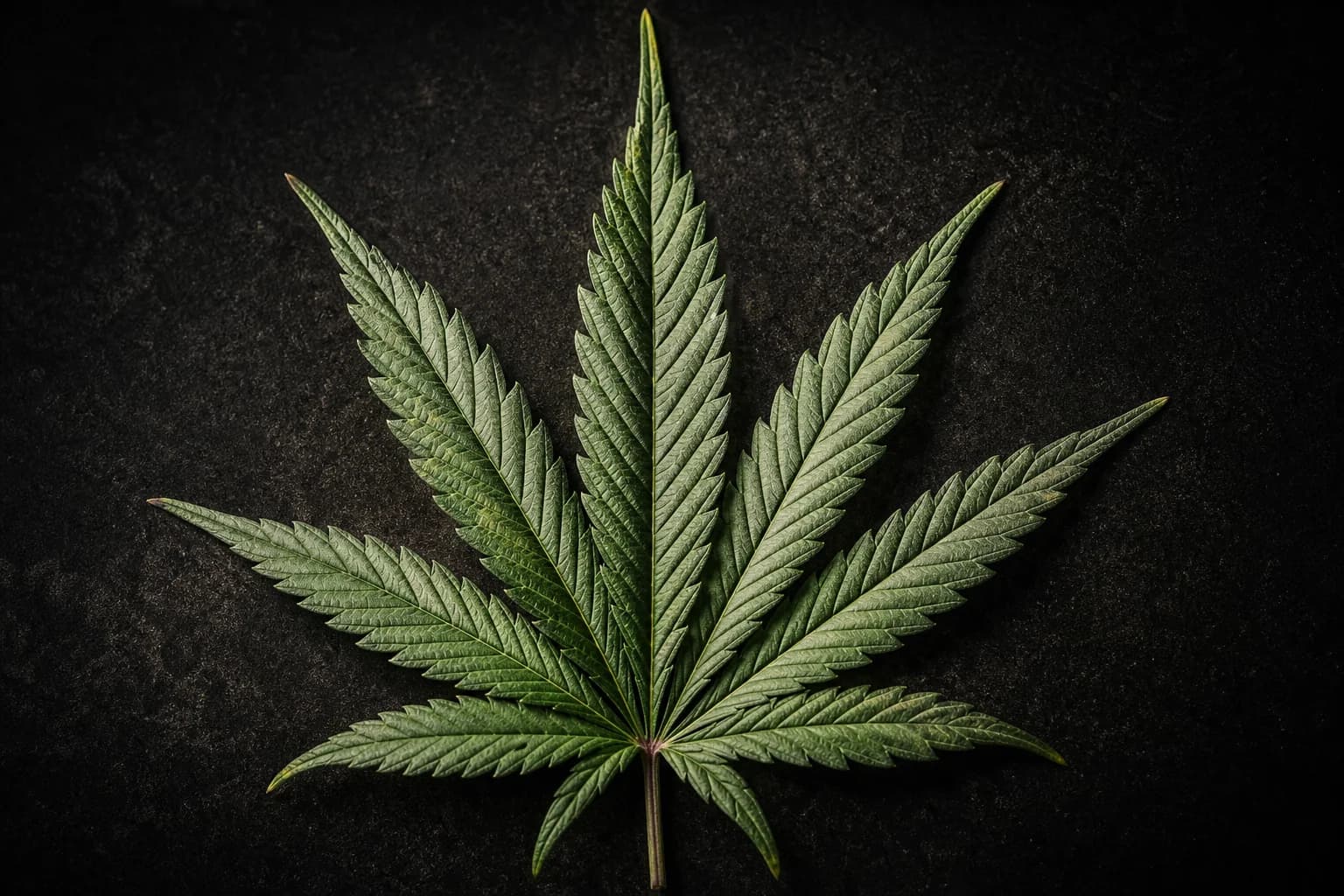
Every Part of the Plant
Cannabis Plant Anatomy
Sativa vs Indica Plants: Botanical Differences for Canadian Growers
Sativa vs indica plants compared botanically: morphology, flowering time, effects, and which is right for Canadian growers. The full plant-level guide.
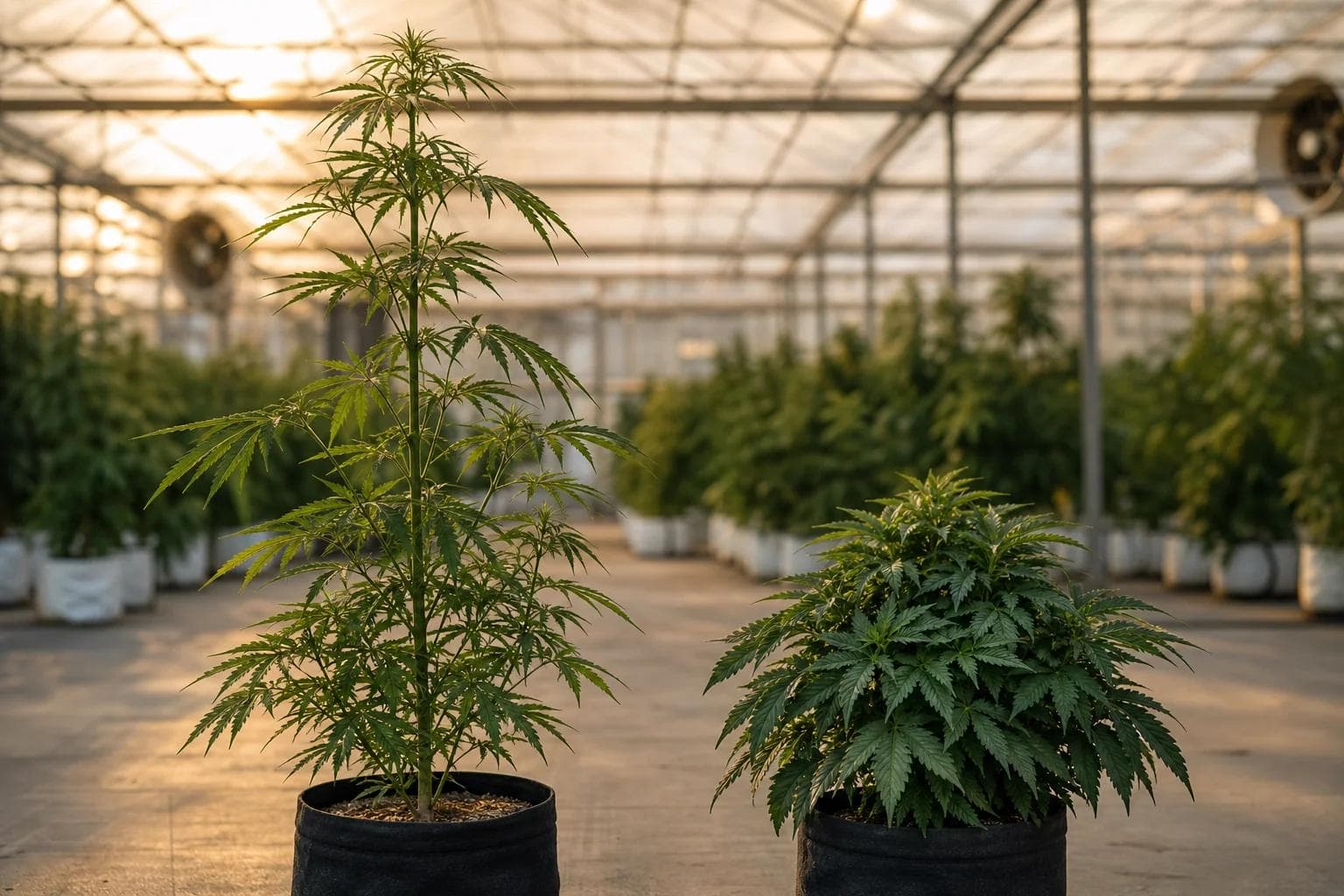
Cannabis sativa plants grow tall and narrow with a 10–14 week flowering window; Cannabis indica plants are short and dense with a 7–9 week finish. Morphologically distinct, genetically intertwined — this article covers every difference that actually matters when choosing seeds for a Canadian grow, including a province-by-province outdoor decision matrix.
Sativa vs Indica — Plant Structure
The botanical differences that actually matter for growers
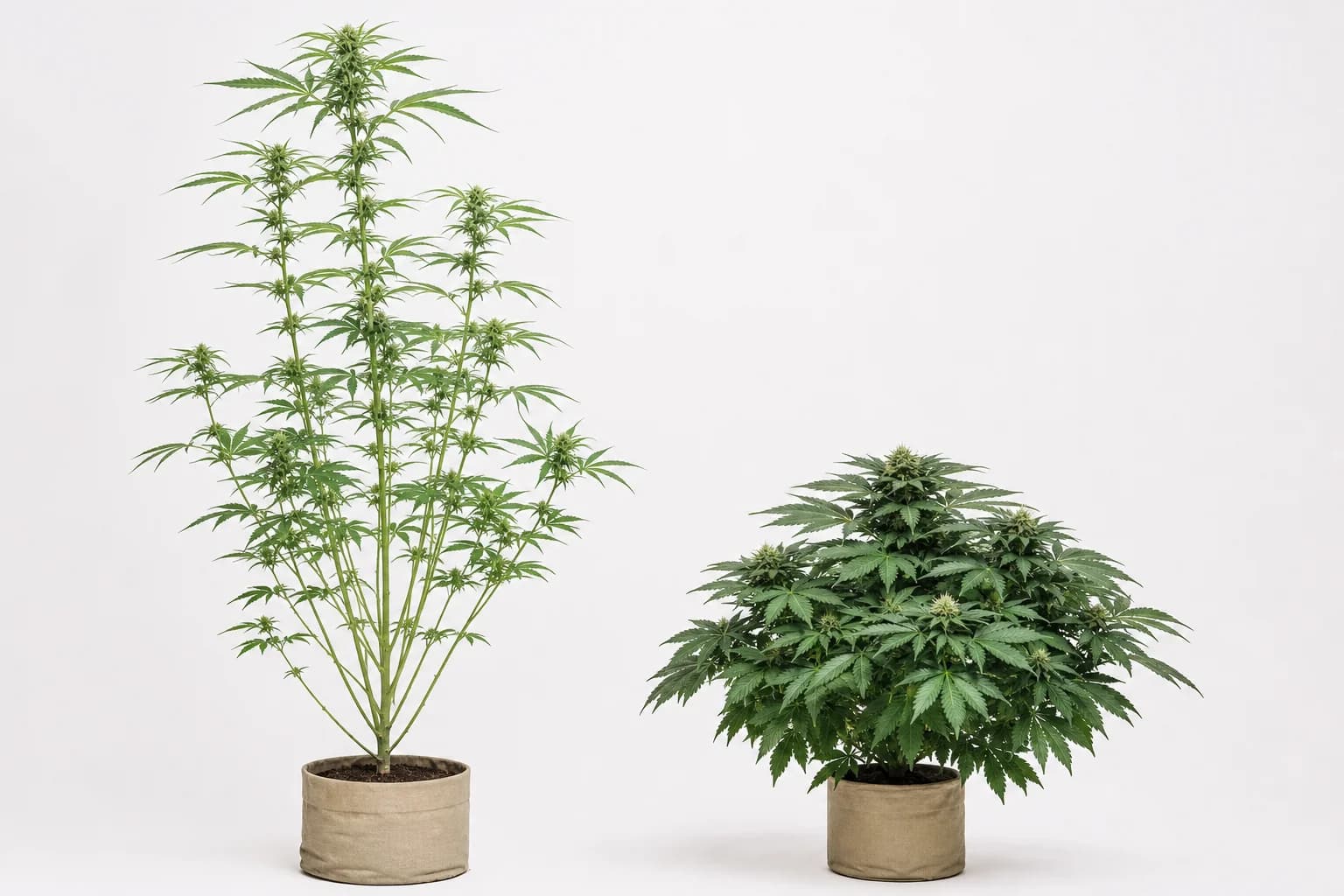
Sativa
- •Tall, open structure
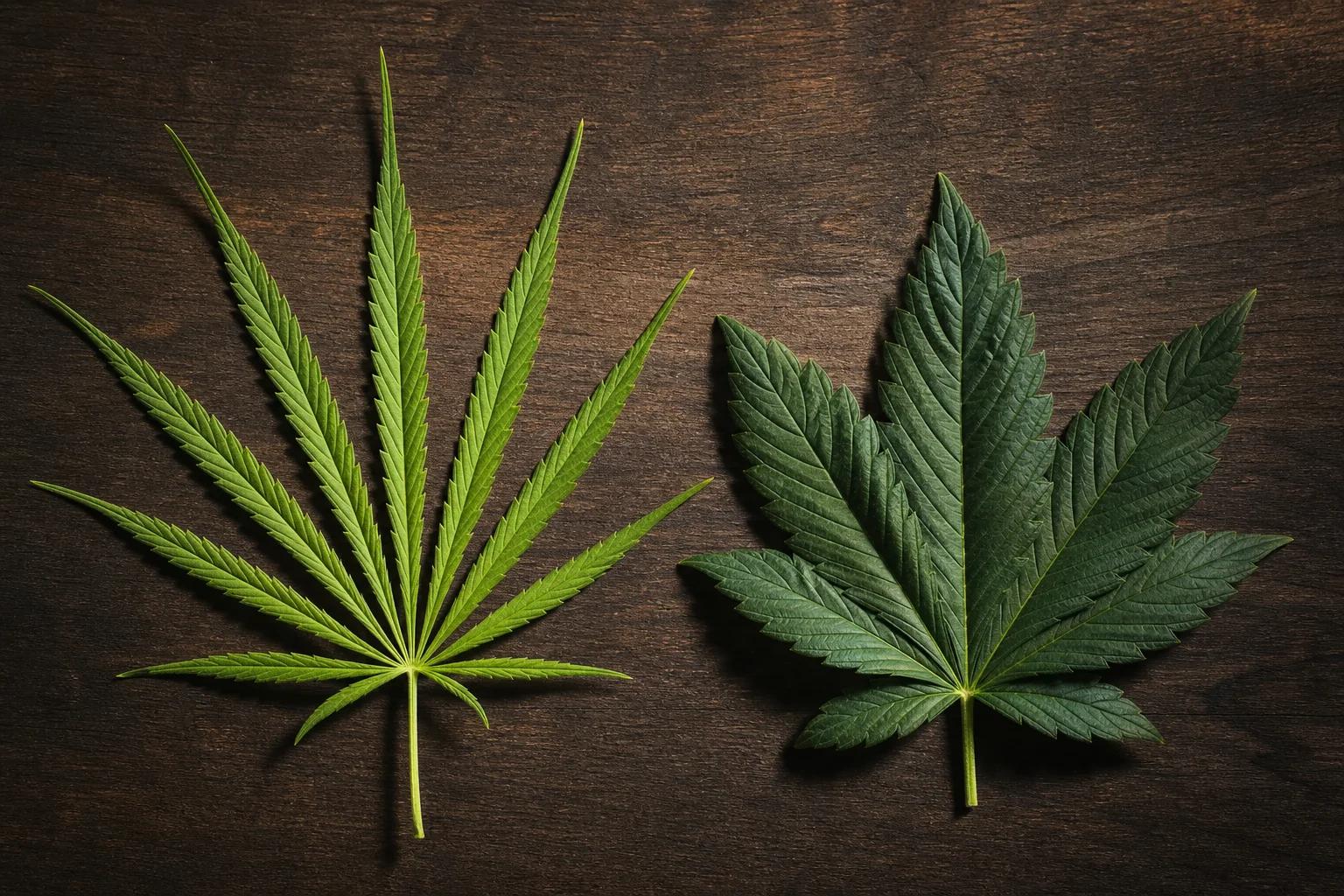
- •Narrow leaves, 9–11 fingers
- •Longer flowering (10–14 weeks)
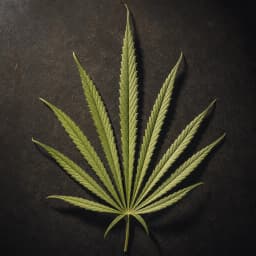
Indica
- •Short, bushy structure
- •Broad leaves, 7–9 fingers
- •Faster flowering (7–9 weeks)

The sativa vs indica divide is the oldest shorthand in cannabis growing — and one of the most misunderstood. Most buyers comparing sativa vs indica plants encounter the split through effect claims: energising versus relaxing, cerebral versus body. That framing is increasingly contested by researchers. What is not contested is the morphology: sativa vs indica plants look different, grow differently, flower on different schedules, and respond differently to training, climate, and stress.
For growers working with a four-plant home cultivation limit under the Cannabis Act, getting this choice right matters more than people think. A sativa-dominant plant that takes 14 weeks to flower will not finish outdoors in Montreal before October frost. An indica-dominant plant with dense bud structure may fit a 1.2 m tent perfectly — and still be your highest mould-risk plant during a humid Maritime August. This guide covers both the science and the practical decision.
What is the actual botanical difference between Cannabis sativa and Cannabis indica?
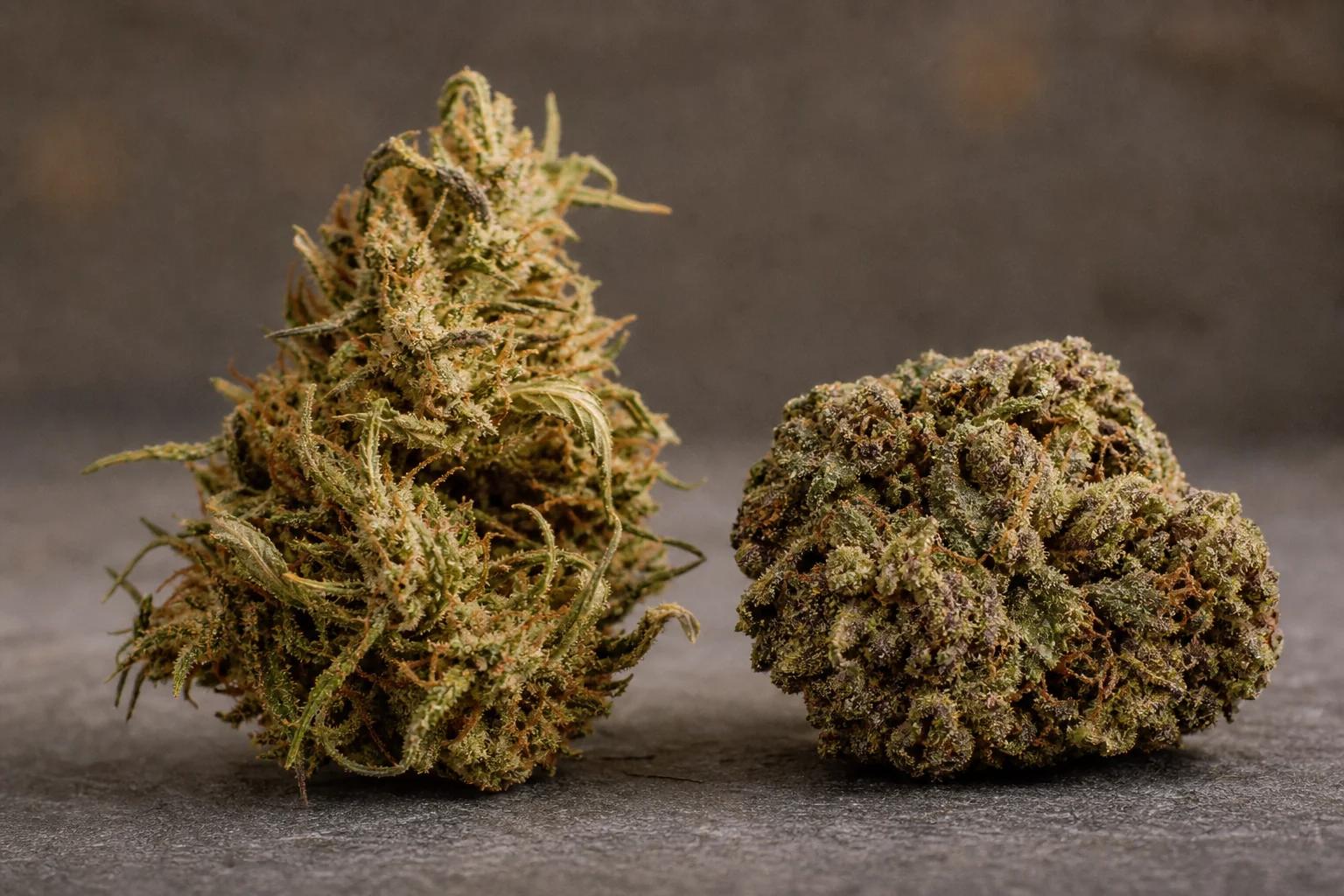
Cannabis sativa and Cannabis indica are two botanical growth forms within a single, highly variable plant species. The differences are structural: sativa plants grow tall (2–4 m outdoors), with narrow leaflets, wide internode spacing, longer flowering times, and airy bud structure. Indica plants grow compact (60–150 cm), with broad leaflets, tight internodes, faster flowering, and dense bud clusters.
For a deeper visual breakdown of leaf morphology, see cannabis leaf anatomy.
How can you tell a sativa plant from an indica plant just by looking?
Growers can identify growth type at seedling stage — internode spacing, leaf shape, and stem stretch become visible by week 2 of vegetation. By mid-flower, the difference is unmistakeable in plant height, bud structure, and cannabis pistils distribution across the flowering sites.
What does a sativa plant look like?
A mature Cannabis sativa is tall, open, and loosely branched, with buds forming as elongated spear-shaped clusters along extended lateral branches. Foliage is sparse between nodes. Indoors, sativa-dominant plants routinely push into the light canopy during the first three weeks of flowering — the stretch ratio is a hard logistical constraint, not just a curiosity.
The stretch is real and it can catch new growers off guard. A plant sitting at 60 cm when you flip to 12/12 may reach 150 cm or taller by week 4 of flower. That has direct implications for tent height planning, and for outdoor finish windows in short-season climates like Toronto where the grow window typically closes by mid-October.
What does an indica plant look like?
A mature Cannabis indica is compact, wide-topped, and densely branched, with tight rounded bud clusters — often waist height or shorter by harvest. Standard 1.2 × 1.2 m indoor setups were practically designed around this growth habit.
Outdoors, the compact architecture makes transportation, staking, and discretion significantly easier than managing a 3 m sativa. Indica phenotypes also concentrate their cannabis trichomes in a tighter surface area, which makes reading harvest readiness more straightforward — you're assessing a dense, compact structure rather than a sprawling open canopy.
How do leaf shape and leaflet count differ?
Sativa leaves carry 9–13 long, narrow leaflets with a lamina width ratio (leaflet width to length) often below 0.3. Indica leaves carry 7–9 wide, short leaflets with a ratio above 0.5. Cannabis ruderalis — the genetic base for autoflowering cultivars — carries even fewer leaflets with very small lamina overall. In polyhybrid cultivars, leaflet morphology falls somewhere between both archetypes and varies plant-to-plant within the same seed batch.
The fastest visual diagnostic in the garden: sativa leaflets are long and finger-like; indica leaflets are wide and paddle-shaped. Most modern commercial cultivars show an intermediate shape that leans one way or the other depending on which parent traits dominated during stabilisation.
Where did sativa and indica originally come from?
Cannabis sativa is native to equatorial and tropical regions — Southeast Asia, Central Africa, and South America. Cannabis indica originates from the Hindu Kush mountain range spanning Afghanistan and northern Pakistan. These environments are climatically opposite, and that origin directly accounts for every morphological difference between the two growth forms.
Why do sativas grow taller?
Equatorial environments maintain consistent 12-hour light cycles year-round with no urgent seasonal pressure to rush flowering. Cannabis sativa landraces evolved in dense jungle undergrowth where wide internode spacing maximised light capture, and a 10–14 week flowering period was never a liability — the season doesn't end. The result is a plant optimised for long, warm, stable growing seasons with no frost pressure to speak of.
In practical terms, that origin means sativa plants are structurally mismatched with climates that have early first frosts. In Toronto, where most outdoor grows need to wrap by mid-October, a 14-week sativa started in late June simply doesn't have enough runway. That's not a genetics problem — it's a climate mismatch between an equatorial plant and a continental northern grow zone.
Why are indicas shorter and bushier?
The Hindu Kush region offers a short, intense summer followed by an early, harsh autumn. Cannabis indica landraces evolved to complete flowering in 7–9 weeks before mountain winters hit. Compact architecture is an adaptation to cold, windy, high-altitude conditions where tall open plants suffer wind damage and shed heat fast through exposed leaf surface.
For Canadian growers, this origin story is immediately useful: indica genetics are biologically tuned to short-season climates. Quebec City's last spring frost falls around mid-May, and the first autumn frost typically arrives in late September or early October — a growing window that closely mirrors the Hindu Kush seasonal rhythm. That's not a coincidence. It's 10,000 years of environmental selection compressed into a seed.
Why does sativa take longer to flower than indica?
Sativa flowers in 10–14 weeks because its genetics evolved under stable equatorial photoperiods where the internal flowering clock calibrated to gradual, subtle seasonal light changes. Indica evolved under sharp, fast seasonal transitions in the Hindu Kush and developed a compressed 7–9 week flowering response. Both types are photoperiod-sensitive — they switch from vegetative to reproductive growth when daily light drops below roughly 12 hours — but sativas need significantly more time to complete the reproductive process once triggered.
Outdoors, that timing gap touches every Canadian province differently. A sativa flipped on September 1 in Halifax will still be developing and filling calyxes when the first frost arrives in late October. Knowing the full cannabis flowering stage week-by-week is essential for timing this correctly in any climate.
For indoor growers, the sativa timeline goes beyond the calendar — vertical space becomes a hard constraint. A plant sitting at 60 cm when you flip to 12/12 can push 150 cm or taller by week 6. Tent height sets a ceiling on which genetics are actually viable in your setup.
Fast Version feminized seeds are a direct breeding response to this exact problem: indica genetics are introduced into sativa-leaning cultivars to shorten the finish window by 2–4 weeks without gutting the terpene profile or eliminating the growth habit entirely. For growers in intermediate climate zones, they're usually the most practical path.
Do sativa and indica actually cause different effects?
Not reliably. The common claim — sativas are energising, indicas sedate — is a cultural heuristic, not a pharmacological fact supported by current research. The actual drivers of effect are cannabinoid ratio (primarily THC and CBD concentrations) and terpene profile, which are distributed across both growth forms with no consistent correlation to the sativa/indica label.
This doesn't make the labels useless — it means they're being asked to do a job they weren't designed for. "Indica" and "sativa" describe plant morphology and grow behaviour with reasonable reliability. They describe the subjective experience of the person using the flower unreliably, because that experience is driven by the chemovar — the specific combination of terpenes (myrcene, limonene, pinene, caryophyllene, and dozens of others) and cannabinoids in that specific cultivar — not by whether the plant grew tall or short.
High-myrcene cultivars, regardless of whether they're labelled indica or sativa, tend toward sedative-adjacent profiles. High-limonene and high-pinene cultivars trend brighter and more activating. Many indica-dominant cultivars are high in limonene. Many sativa-dominant cultivars are high in myrcene. The terpene chemistry is the signal that matters, not the morphology label. See the cannabis terpenes guide for a full breakdown.
For growers selecting seeds with end-use in mind, the most actionable data on any seed listing is the terpene profile and cannabinoid ratio — not the sativa/indica classification.
Are sativa and indica even separate species?
Botanically, they are not considered distinct species under current scientific consensus — they are ecotypes or growth forms within Cannabis sativa L. The terms describe morphological archetypes and geographical origins that are phenotypically meaningful but do not represent a clean genetic boundary.
The SQDC — Quebec's government cannabis authority — acknowledges directly that the sativa/indica classification system is not scientifically rigorous and does not map reliably onto effects. The labels persist because they give buyers a shorthand most people already understand — and because they do correlate meaningfully with morphology and grow behaviour, even when they fail to predict effects.
The genetic picture gets even messier when you consider centuries of cross-pollination, selective breeding, and commercial hybridisation. Most cultivars on the market today are polyhybrids with both sativa and indica ancestry at the genotype level. polyploid cannabis genetics add yet another layer of complexity to what "pure" genetics actually means in modern breeding programmes.
What do scientists call the new classification system?
Researchers and clinicians increasingly use the term chemovar — a cultivar classified by its chemical composition (cannabinoid ratios + terpene profiles) rather than by morphology or geography. Under the chemovar framework, plants are Type I (THC-dominant), Type II (balanced THC/CBD), or Type III (CBD-dominant), with terpene sub-profiles overlaid. This system predicts experience profiles far more reliably than sativa/indica labels and is the framework used by medical cannabis producers, pharmacologists, and the peer-reviewed research community. It is gradually being adopted by the premium-genetics sector as consumers grow more sophisticated in their expectations.
Where do hybrids fit in?
Modern hybrids are the dominant commercial category — the vast majority of cultivars on the market carry genetics from both sativa and indica lineages. A hybrid is not a watered-down compromise; it is a cultivar that expresses a phenotype spectrum depending on which parent traits were dominant and how the breeding line was stabilised across F1 and subsequent generations.
What does "70% sativa 30% indica" actually mean on a seed listing?
It means the breeder has stabilised the cultivar to express predominantly sativa-type traits: taller growth, wider internode spacing, longer flowering, airier bud structure, and a pronounced stretch response. It does not predict the terpene or cannabinoid profile — those depend on the specific parent genetics, not on the ratio number. The 70/30 figure is a phenotype-expression guide, not a chemical-content guide.
In practical terms: a "70% sativa" listing tells you to expect meaningful stretch in flower, a longer finish window than a comparable indica, and less dense bud structure. It tells you relatively little about the terpene experience. When evaluating a hybrid listing, prioritise the stated flowering time in weeks, the stretch description, and any available terpene notes — the percentage ratio is supporting context, not the primary data point.
Blue Dream Feminized is a widely-grown sativa-dominant hybrid that illustrates this well: the genetics lean sativa in growth habit, but the terpene profile delivers a markedly different character than an equatorial landrace sativa. The ratio alone doesn't capture that distinction.
Which is easier to grow outdoors in Canada — sativa or indica?
Indica is easier to grow outdoors across most of Canada. Indica genetics complete flowering in 7–9 weeks — finishing by late September in most climate zones — and their compact structure handles short-season conditions more reliably than a plant that needs 10–14 weeks of flower and can reach 3 m tall. Sativa-dominant cultivars require greenhouse intervention or an unusually long warm autumn to finish across most of the country.
outdoor cannabis growing in Canada covers the full outdoor planning framework for every major grow zone.
Which provinces favour indica-dominant outdoor grows?
Essentially all of them — though the reasoning differs by region. The combination of a compressed outdoor season, cold autumn nights, and early first frost in Quebec City, Halifax, Winnipeg, and Edmonton makes indica-dominant or indica-leaning hybrid genetics the lowest-risk choice for outdoor cultivation under the Cannabis Act's four-plant limit. Losing a plant to early frost before it finishes is a significant cost when you only have four tries.
Northern Light Feminized is a classic example of an indica-dominant cultivar optimised for exactly this kind of compact, short-season outdoor grow in any Canadian climate band.
Where can sativa-dominant grows finish in Canada?
The best outdoor zones for sativa-dominant genetics are coastal BC — Greater Vancouver and Victoria — and, for greenhouse growers, interior BC and southern Ontario. The Greater Vancouver area benefits from a frost-free window that can push into November, providing enough runway for a 10–12 week sativa-leaning hybrid started indoors in late April. greenhouse cannabis in Canada explains how an unheated structure can add 4–6 weeks to any outdoor season, pushing sativa finishing windows into viable territory even in marginal zones.
Montreal and Toronto outdoor growers who want sativa genetics are not without options. Fast-version sativa hybrids with a 9–10 week finish, started indoors before May 15, can complete before October frost in a good year. The margin is thin and weather-dependent. Moby Dick Feminized — a sativa-dominant cultivar with high resin production and a structured flowering schedule — is one example where careful planning rewards the extra effort.
How does mould pressure affect the indica vs sativa choice?
This is the factor most growers overlook. Indica's dense bud structure — the same trait that makes harvest efficient and visually impressive — is also the primary vector for Botrytis cinerea (bud rot) in humid conditions. Maritime provinces and coastal BC face the highest ambient humidity during late-season flowering, precisely when dense indica buds are most vulnerable to internal moisture accumulation.
A Calgary outdoor grower in the dry Prairie climate faces low bud rot risk with indica genetics — the aridity works in your favour with dense-budded cultivars. A Halifax grower running the same cultivar through an August humidity spike above 80% is looking at genuine crop-loss risk in the final two weeks before harvest. bud rot prevention covers the full prevention and triage protocol.
For high-humidity grow zones, consider sativa-leaning or hybrid cultivars with airier bud structure, or commit to rigorous airflow management and strategic defoliation with indica-dominant plants. The density trade-off is real and climate-specific — it's not a reason to avoid indica genetics, but it is a reason to plan for it before you plant, not after the mould appears.
Do sativa and indica need different training methods?
Yes. The difference in stretch ratio, internode spacing, and plant architecture means sativa and indica genetics respond differently to training — applying a technique designed for one growth type to the other produces consistently suboptimal results. Understanding the morphology tells you exactly which approach will serve each plant. cannabis training techniques covers the full toolkit with application notes.
Why do sativas benefit from SCROG and topping?
Sativa plants produce a dominant central cola with long lateral branches that reach aggressively for light, creating a Christmas-tree structure where lower nodes are shaded and produce minimal yield while top buds monopolise the canopy. SCROG (Screen of Green) forces horizontal growth by weaving branches through a horizontal net during late vegetation, exposing lateral nodes to direct light and building a flat, even canopy across the full grow footprint.
Topping — removing the apical meristem — splits the dominant cola into two, converting the single-peak structure into a more even multi-top profile. Combined with SCROG, a well-trained sativa-dominant plant can produce excellent surface-area yield from a single grow space. Without training, that same plant in a 1.2 m tent will be burning on the light by week 3–4 of flower while the lower third sits dark and unproductive.
Why do indicas respond better to defoliation?
Indica's dense canopy and tight internode spacing create airflow problems — fan leaves overlap and shade lower bud sites, creating humid microclimates where mould pressure builds during late flower. Strategic defoliation — removing large fan leaves that block bud sites, particularly in early flower and at mid-flower — opens airflow, reduces surface humidity, and redirects the plant's energy toward bud development rather than leaf maintenance.
Indicas don't need to be restructured by SCROG the way sativas do. Their natural lateral branching already creates a manageable canopy. The primary training priority is airflow and light penetration, not height control. In dense-canopy environments like Vancouver or the Maritime provinces during August, that distinction is the practical difference between a clean harvest and a mould loss in the final two weeks.
Should I buy sativa, indica, or hybrid seeds?
When you're weighing sativa vs indica plants for your next grow, answer three questions before ordering. This framework applies to both indoor and outdoor growers, and it is more reliable than choosing based on effect labels alone.
1. What is your actual finish window? Outdoor growers: count backward from your expected first frost date. If you have 9 weeks or fewer of reliable warm weather after the summer solstice, you need indica-dominant genetics with a stated 8-week or shorter finish. If you have 12 or more weeks in your grow zone (coastal BC, greenhouse southern Ontario), fast sativa hybrids with a 10–11 week finish become viable. Indoor growers: ceiling height matters as much as timing. Under 1.5 m tent height, you need indica-dominant genetics. With 2 m+ and proper SCROG training, sativa-dominant hybrids are manageable.
2. What is your humidity and mould risk? High-humidity climates — Maritime provinces, coastal BC, Montreal's August baseline — call for airier bud structure: sativa-leaning hybrids, or indica cultivars with a demonstrated mould-resistance rating from the breeder. Dry climates — interior BC, the Prairies, Calgary — can accommodate indica density without the same risk profile. Be honest about your environment before you choose based on aesthetics.
3. Which growth traits do you actually need? Rapid finish plus dense yield in compact space: indica cannabis seeds. Tall structure, longer season, airier buds, specific terpene profiles: sativa cannabis seeds. The best-performing cultivars for most growers — particularly those new to cannabis cultivation — are indica-leaning hybrids with flowering times under 10 weeks, clearly stated stretch ratios, and known mould-resistance characteristics. best beginner strains in Canada narrows this down further with specific cultivar recommendations.
Once you have identified your phenotype preference, the next decision is seed type. feminized vs autoflower vs fast version covers how photoperiod feminized, autoflower, and fast-version seeds each handle the sativa/indica timing question differently — and which is the right choice for your specific setup.
FAQ
Is sativa stronger than indica?
"Stronger" is not a meaningful category in botanical terms. THC and CBD concentrations are independent of the sativa/indica classification — high-THC cultivars exist across both growth types, as do low-THC varieties. Potency is determined by specific genetics, breeding selection, and growing conditions, not by whether the plant grew tall or short. Compare cannabinoid percentages listed for specific cultivars rather than using growth type as a proxy for potency.
Does indica really cause couch-lock?
Not reliably, and not because of its indica classification. Sedative effects are more consistently correlated with high myrcene concentrations and specific THC/CBD ratios than with the indica label. Some indica-dominant cultivars with high limonene and low myrcene produce bright, activating profiles. The chemovar — the full terpene and cannabinoid composition — predicts the experience far more accurately than plant morphology. The SQDC's educational materials reflect this position directly. [CITATION: SQDC — Indica, Sativa & Hybrid educational page | https://www.sqdc.ca/en-CA/learn-about-cannabis/indica-sativa-hybrid]
Can a sativa finish outdoors in Canada?
Yes, in specific zones and with proper planning. Coastal BC — Vancouver and Victoria — offers the longest frost-free window in the country. Sativa-dominant hybrids with a 10–12 week finish can complete outdoors with a late-April indoor start. Interior BC and southern Ontario growers using unheated greenhouses can extend the season by 4–6 weeks, making sativa-leaning hybrids viable in those zones as well. In Quebec City, Halifax, Winnipeg, and Edmonton, pure sativa genetics will not finish before first frost — fast-version or indica-dominant genetics are the practical choice in those climates.
Are sativa and indica different species?
Under current scientific consensus, no — they are not considered distinct species. They are growth forms or ecotypes within a single species, *Cannabis sativa* L. [CITATION: Bedrocan — no genetic distinction between sativa and indica | https://bedrocan.com/international-research-shows-no-genetic-distinction-between-sativa-and-indica-cannabis/] The terms describe morphological archetypes and geographical origins — equatorial versus Hindu Kush — that are phenotypically meaningful for growers but do not represent a clean genetic boundary. Most commercial cultivars today are polyhybrids containing both ancestry lines, making any claim of "pure sativa" or "pure indica" genetically approximate at best.
Are autoflowers sativa or indica?
Autoflowering genetics derive primarily from *Cannabis ruderalis* — a third botanical type originating from Central Asia and Russia that evolved to flower based on age rather than photoperiod. Modern autoflowers are ruderalis × indica or ruderalis × sativa crosses, with the ruderalis trait providing the automatic flowering trigger. The resulting plant is typically compact (reflecting ruderalis × indica influence) with a seed-to-harvest window of 8–10 weeks, making autoflowers one of the most reliable finishing options for Canadian outdoor growers across most climate zones — particularly in short-season regions like Quebec City, Halifax, Edmonton, and Winnipeg where even fast-version photoperiod genetics can run close to the frost window.
What does "indica-dominant hybrid" actually mean for my grow?
It means the cultivar has been stabilised to express primarily indica-type traits: compact stature (typically under 120 cm indoors), tight internode spacing, an 8–10 week flowering window, and dense bud structure. Expect moderate to low stretch in flower, manageable height in standard indoor setups, and a faster finish than a balanced or sativa-dominant hybrid. The key trade-off is humidity sensitivity — dense bud structure requires proactive airflow management and strategic defoliation, especially in humid late-summer outdoor conditions or in enclosed grow tents with insufficient ventilation. Factor this into your setup before selecting, not after you spot the first signs of mould.
19+ | Educational horticulture only.