Grow Under the Open Sky
Outdoor Growing Guides
Protecting Cannabis Plants From Frost Through a Freezing Night
Protect cannabis from frost: water at the right time, cover without smothering, pull back the mulch and bring pots in. Moves that save a harvest.
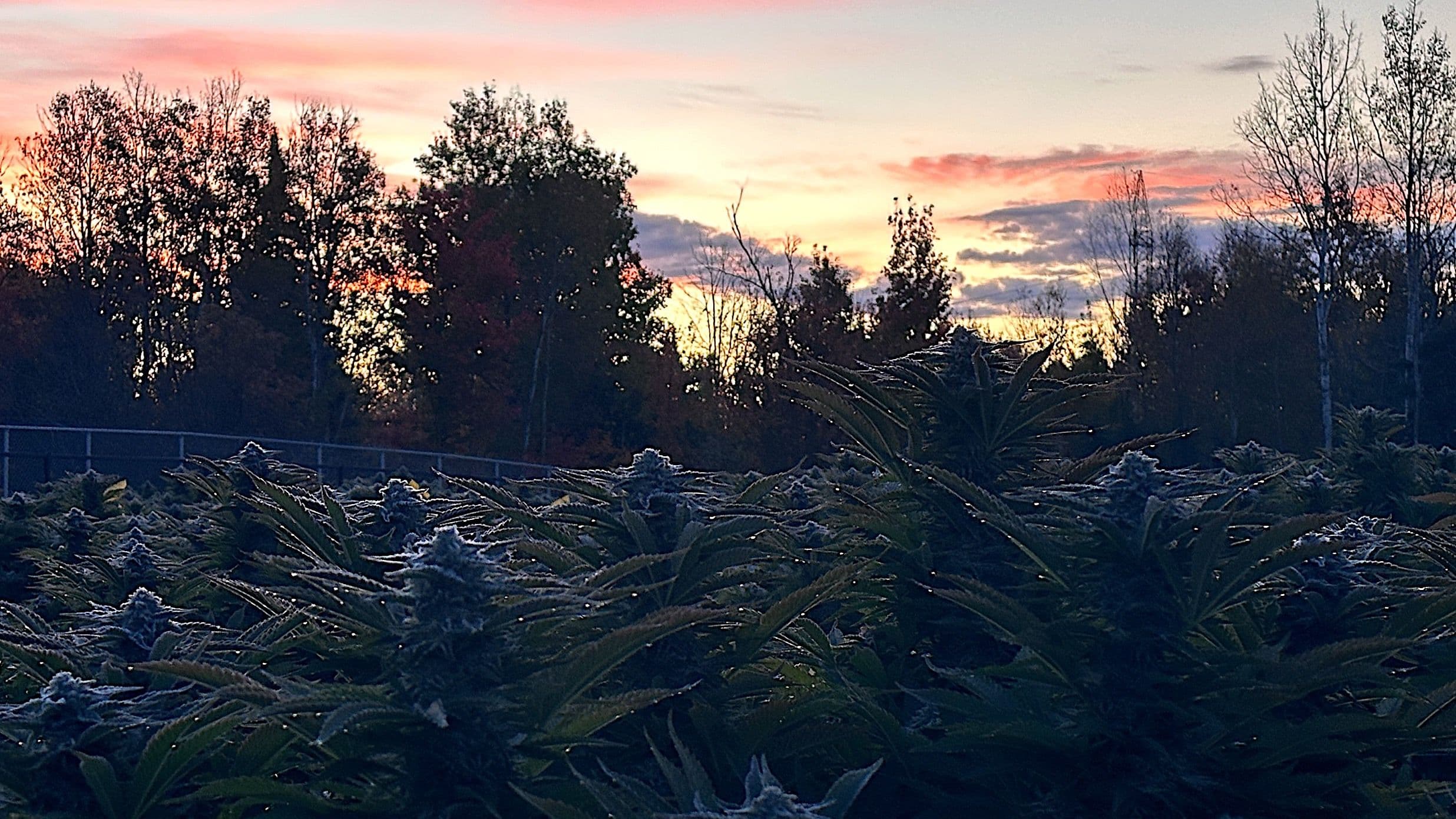
To protect cannabis from frost, water the soil deeply one to two days before the forecast freeze: moist soil conducts and stores heat, then gives it back to the foliage overnight. Then cover in the late afternoon with a breathable fabric that reaches the ground without touching the leaves, and pull it off at sunrise. Rake mulch back and bring pots inside.
Key takeaways
- To protect cannabis from frost, water the soil deeply one to two days before the forecast freeze: moist soil conducts and stores heat, then gives it back to the foliage.
- Cover in the late afternoon with a fabric that reaches the ground without touching the leaves, and pull it off at sunrise.
- Never let plastic touch the foliage: condensation freezes onto the leaves.
- Rake mulch back as soon as frost is forecast: it keeps the soil from storing the day's heat.
- Bring pots inside: an unheated garage beats any cover.
Why water the soil to protect cannabis from frost?
Because moist soil conducts and stores far more heat than dry soil, then gives it back to the foliage overnight. According to the FAO, the ideal is soil that is moist but drained when the frost arrives, so water deeply one to two days before the forecast freeze. It is the simplest move you have.
Many growers worry that adding water before the cold makes things worse. For the soil it is the opposite: the heat stored during the day rises back toward the plant at night, and dry soil has almost nothing to give.
Doing it right
- Water deeply one to two days ahead, so the excess has time to drain
- If the frost is forecast for tonight, water the soil as early in the day as you can
- Soak the ground, never the foliage: water on the leaves freezes right onto them
- In containers, watering does little: the soil volume is too small, so bring the pot inside instead
How do you cover cannabis plants against frost?
With a breathable material, put on in the late afternoon, running all the way to the ground without touching the leaves. The goal is to trap warm air rising from the soil, not to insulate the plant from the cold. According to the FAO, a row cover gains from 1°C with thin plastic to 5°C with thick plastic.
The rules that matter
Put it on in the late afternoon, before the ground heat dissipates. A cover thrown on at midnight traps air that is already cold.
Run the cover all the way to the ground. Warm air rises out of the soil, and a cover that stops partway down vents it out the bottom.
Hold the material off the foliage with stakes, tomato cages or a light frame. Wherever fabric touches a leaf, the cold goes straight through.
Rake mulch back from the stem as soon as frost is forecast. According to the FAO, a vegetative mulch keeps the soil from storing the day's heat and makes crops more frost prone. It protects the roots, not the foliage.
Take it off as soon as the sun hits the plants. A cover left on into the morning turns into a greenhouse: the temperature spikes and burns foliage that is already stressed.
For container plants, bring them into a garage or unheated shed. Our comparison of pots versus in-ground growing covers the other end-of-season differences.
Should you brush snow off your plants?
Usually not: a light snowfall does no harm on its own, and knocking it off frozen tissue breaks it. Clear it gently only when it is heavy enough to bend branches. But do not count on snow to shield the colas from the cold of the night. The melt is what needs watching.
What to do:
- Leave light snow in place
- Clear heavy, wet snow gently when it bends or breaks branches
- Never knock a frozen plant around: the tissue is brittle and snaps at the slightest impact
- Watch the melt: water seeping into dense colas invites bud rot
What happens inside the plant when it freezes?
Under natural conditions, ice forms first between the cells, and it is dehydration that kills the tissue. Ice inside the cells themselves mostly happens with very rapid cooling. In hemp, hardening to the cold depends a great deal on the variety.
Ice forms first between the cells
As the temperature drops below freezing, ice first appears in the spaces between the cells, where the fluid holds fewer sugars and salts than the cell contents and so freezes sooner. According to Pearce in the Annals of Botany, this extracellular ice dehydrates the cells, and damage sets in when that dehydration exceeds what they can tolerate.
- Ice forms outside the cells and the crystals grow
- It pulls water out from inside by osmosis
- The cells dehydrate and their solutes concentrate
- If the membrane gives way, the cell contents leak and oxidize
Cold acclimation
In plants generally, a few days of cool but frost-free temperatures trigger a preparation for cold. In hemp, that capacity depends on the variety: of 9 varieties freeze-tested as whole plants, those that acclimated best survived best (Mayer et al., McGill University, 2015). On flowering CBD hemp, however, 10 days at 10°C brought no benefit and even lowered THC and CBD (Galic et al., Cornell University, 2022).
What we see in resin under cold
What we have seen over thirty years of growing in a northern climate, field experience and not a lab measurement: under the freezing nights at the end of the season, plants visibly put out more resin, and the aroma profile beats what a warm-climate grow produces.
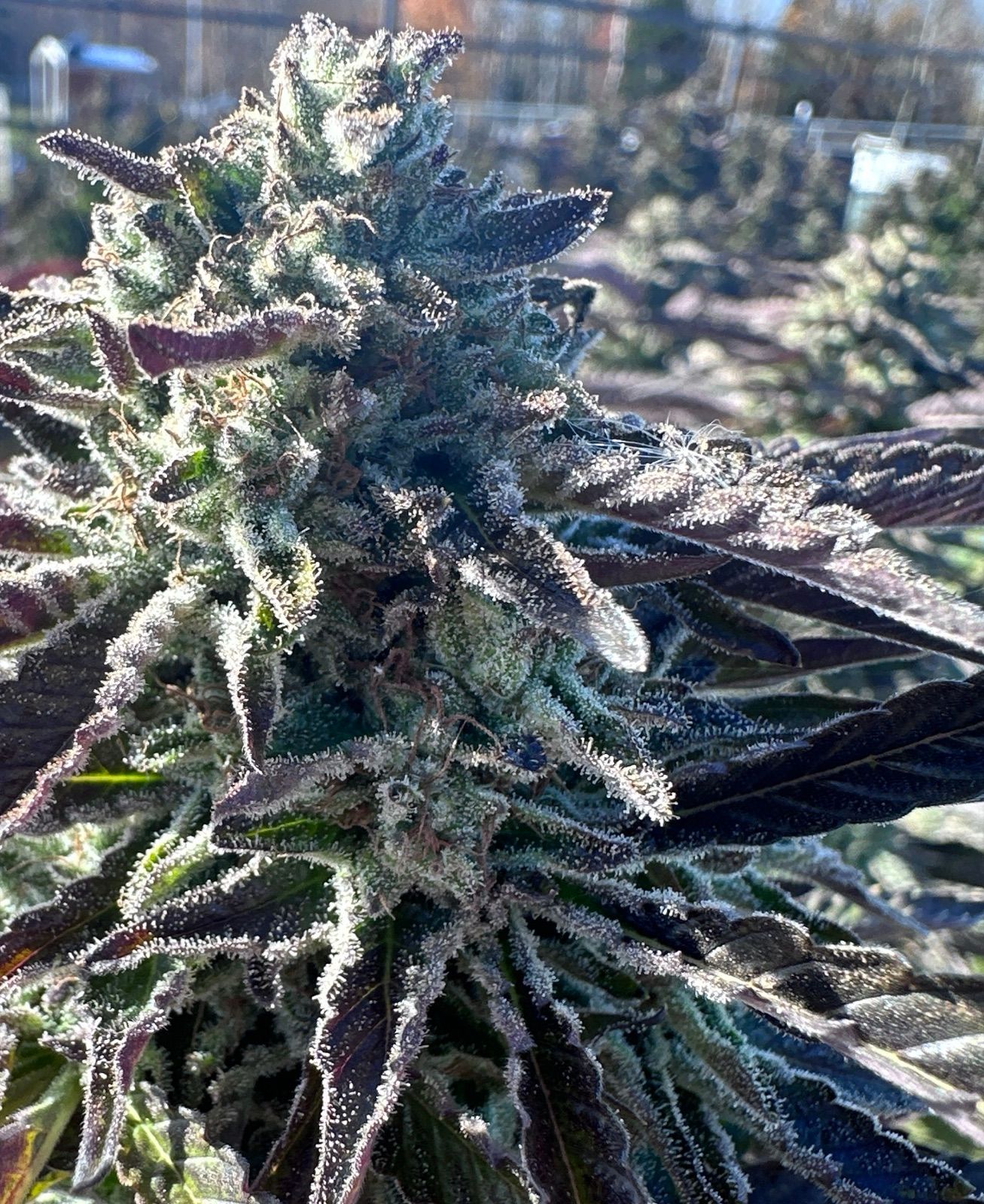
A cola coated in resin at the end of the season, after cold nights.
One idea to qualify: UV. A 1987 study (Lydon et al.) measured a rise in THC under UV-B, but a recent indoor University of Guelph study (Rodriguez-Morrison et al., Frontiers in Plant Science, 2021) measured no increase in cannabinoids under UV-B, and even lower yield in one variety.
Protect cannabis from frost or harvest: how do you decide?
Protection buys a night, not a season. If the trichomes are not ready, protect. If they are mostly cloudy and freezing nights keep coming, harvest. When in doubt, let the humidity decide: a cold, wet autumn does more damage through bud rot than through frost.
What is this guide based on?
Pre-frost watering, the effect of mulch, covers and site selection come from the FAO chapter on passive protection methods; frost types are described in its introductory chapter, and sprinkling in its chapter 7. The hemp frost study is Galic et al. (2022), the effect of cold on cannabinoids from Hahm et al. (2025), UV from Lydon et al. (1987), and variety-dependent hardening from Mayer et al. (2015). Extracellular ice is described by Pearce (2001), Annals of Botany. The resin observations are our own.
What should you read next?
Timing the end of the season is the other half of this problem: late harvest in a northern climate covers how far you can realistically push into October.
Damaged tissue after a frost is an open door for rot, and the complete guide to fungal diseases covers what to watch for in the days that follow.
A greenhouse changes the whole equation: our guide to greenhouse growing in Canada covers extending the season.
One structural fix for next season: our autoflowering seeds can be timed to finish ahead of the first freezing nights.
FAQ
Can cannabis survive frost?
Usually, if it is one light frost. In our experience, a plant takes a brief frost down to about -2°C at the leaf with marked fan leaves and nothing worse. What kills is depth and duration: several hours below -4°C at the leaf, or freezing nights back to back. Do not count on plant age: a Cornell study on hemp found no advantage in older plants.
Can cannabis survive cold nights?
Yes. Nights down to 5°C slow growth but do not harm a mature plant. The risk starts when the leaves themselves reach freezing, which on a clear, calm night can happen while the forecast still reads 2 or 3°C: air at ground level can be up to about 5°C colder than at station height.
How cold can weed plants get at night?
By our field benchmarks: from 5 to 0°C a plant slows down but takes no damage. Between 0 and -2°C at the leaf you get a light frost and marked foliage. From -2 to -4°C the damage is visible, and below -4°C it turns serious. A Cornell study on hemp leaves also found far more damage at -8°C than at -2 or -4°C.
How do you protect plants from frost at night?
Water the soil deeply one to two days ahead, then cover in the late afternoon with a frost blanket, row cover or old bedsheet that reaches the ground and is held off the leaves by stakes. Rake mulch away from the stem so the soil can release its heat. Pull the cover off as soon as the sun hits the plants.
Does watering plants before a frost help?
Yes, and it is the simplest move you have. Moist soil conducts and stores far more heat than dry soil, then gives it back to the foliage overnight. The FAO recommends soil that is moist but drained at frost time, so water deeply one to two days before the forecast freeze. Soak the ground, never the leaves.
How do you protect potted plants from frost?
Bring them inside for the night if you can: an unheated garage or shed is enough, and it beats any cover. A pot freezes from every side at once, and its small volume of soil stores too little heat to protect the plant. Carry it back out once the sun is up so it does not lose a day of light.
When should you cover plants for frost?
In the late afternoon, while the ground is still giving off the day's heat, because the point is to trap that warm air. A cover thrown on at 11 p.m. just seals in air that is already cold. Take it off as soon as the sun reaches the plants, or the trapped heat will scorch foliage that is already stressed.
Does mulch protect plants from frost?
Not on a frost night. It protects the roots but exposes the foliage: according to the FAO, a vegetative mulch keeps the soil from storing the day's heat and makes crops more frost prone. Rake it back from the stem as soon as frost is forecast, so the bare soil can recharge in the sun during the day.
Does snow protect plants from freezing?
Not the colas. Snow insulates the ground, but it does not shield buds from the cold of the night. A light snowfall does no harm on its own, and knocking it off frozen tissue breaks it, so leave it unless it is heavy enough to bend branches. Watch the melt: water seeping into dense colas invites bud rot.
What are the best cold weather weed strains?
Short-flowering strains bred for the north, and autoflowers timed to finish before the freezing nights. Most growers report that indica-leaning strains handle a light frost better, but no study has measured it, and the indica and sativa labels reflect genetics poorly. When a strain finishes matters more than its label.
What should you do when a frost advisory is issued?
Treat it as a countdown. Bring pots inside, get covers and stakes out, and rake mulch back from the stems. At dusk, check the sky and the wind: a clear sky and calm air mean you cover. And remember the advisory is about air at station height, about 1.5 metres up: your foliage will be colder than that.
19+ | Educational horticulture only.