Grow Under the Open Sky
Outdoor Growing Guides
Best Time of Day to Harvest Cannabis: Why We Cut at Night
The best time of day to harvest cannabis? At night, before dawn. What a 2025 study found on aroma, why a cold harvest pile stays intact, and green light.
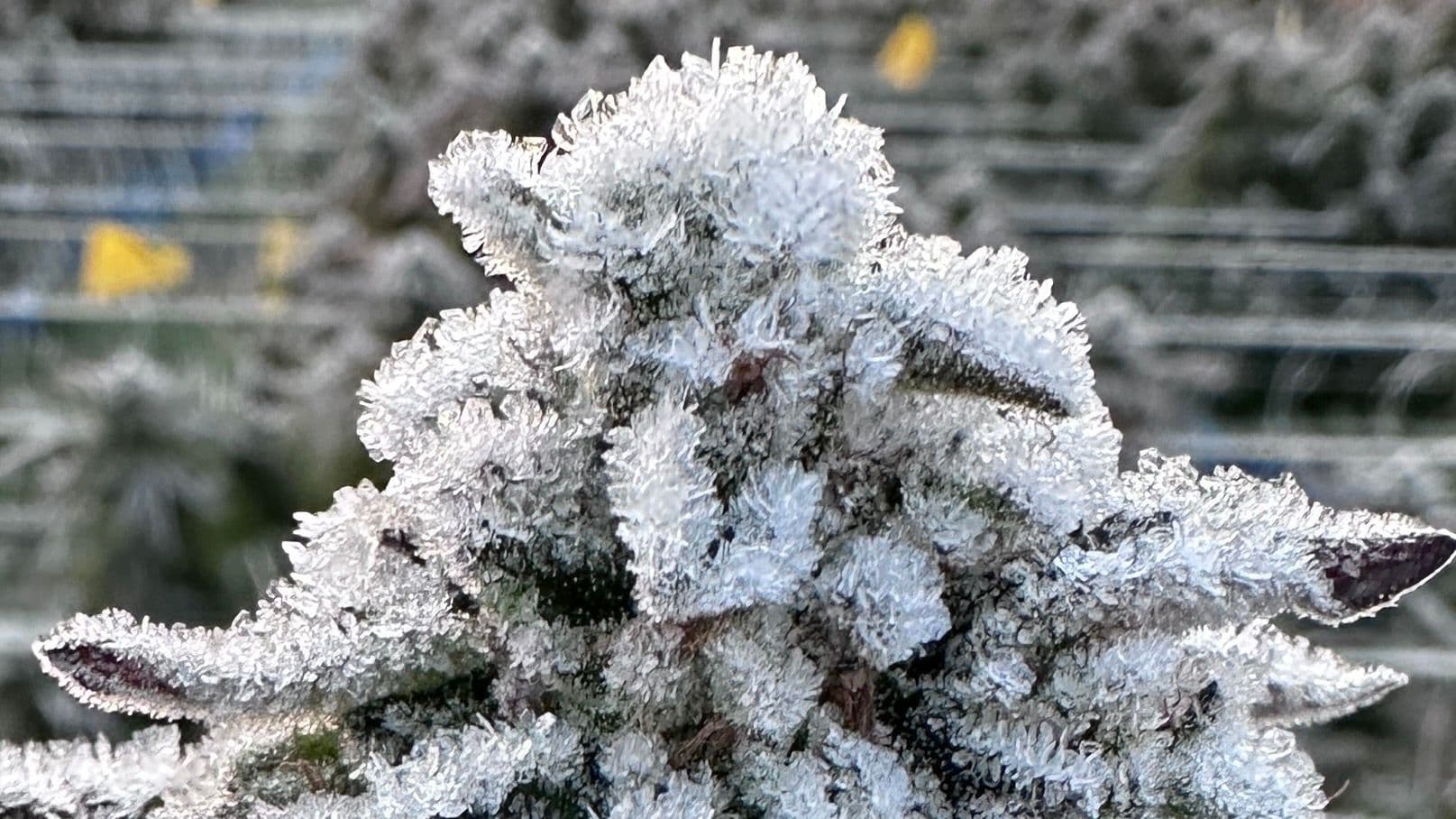
We harvest cannabis at night, between midnight and first light, as late as possible before the sun reaches the buds. A 2025 study measured a 31% drop in flower sesquiterpenes from the start to the end of the day. And in our experience, branches cut cold do not heat up once stacked in bins for the trip to the drying room, while a pile cut in the sun warms up and the resin suffers.
Key takeaways
- The best time of day to harvest cannabis, up north, is at night: between midnight and first light, as late as possible before the sun reaches the buds.
- A 2025 study measured a 31% drop in flower sesquiterpenes from the start to the end of the day: at the start of the day (lights-on, in the study), these aromas are at their peak.
- In our experience, branches cut cold do not heat up once stacked for transport; cut in the sun, the pile warms up and the resin suffers.
- Of all work lights, green light disturbs the plants' night the least.
- Handle frozen buds by the stem, without shaking: frozen trichomes are brittle.
- Why is night the best time of day to harvest cannabis?
- Morning, evening or night: what is the best time of day to harvest cannabis?
- Do you need darkness before harvest?
- How do you organize a cannabis harvest at night?
- What if the buds are frozen or wet when you cut?
- FAQ — Harvest timing
Here is why, what the science supports, what it qualifies, and how to work when it is -2°C in the field at four in the morning.
Why is night the best time of day to harvest cannabis?
For three reasons: aroma, the heat of the harvest pile, and the state of the plant. At the end of the night the flower has not yet spent a day in the sun, and the cut branches stay cold on the way to the drying room. Research points the same way for aroma; for cannabinoids, it rather favours the afternoon.
1. Sesquiterpenes peak at the start of the day
In 2025, a team at Southern Cross University in Australia measured the aromas and cannabinoids of cannabis flower (the top 10 cm of the buds, dried) at the start, middle and end of the day (Dimopoulos et al., Journal of Experimental Botany):
The limits, worth knowing: one cultivar (Hindu Kush), grown indoors, sampled on day 42 of flowering. The study's "start of day" is lights-on, around 9:15 a.m.: applying it to a natural dawn is our extrapolation. The study does not report caryophyllene or humulene.
How we read it: cutting at the end of the night means choosing the sesquiterpenes. Monoterpenes stay stable through the day. Cutting in the afternoon might gain a few points of cannabinoids, at the cost of part of the sesquiterpenes and a flower warmed by the day.
2. A pile of cut branches heats up, unless it is cold
To get the harvest to the drying room, you stack branches in bins. But freshly cut plant material keeps respiring, and respiration produces heat. Without cooling, the heat speeds up respiration, which produces more heat: a cycle that leads to deterioration (Postharvest Management of Vegetables). Every 10°C rise doubles or even triples the respiration rate (eOrganic, University of Wisconsin).
What we see in the field: a pile cut in the sun warms up fast, the resin turns sticky and degrades. Cut at 0°C at the end of the night, the same pile stays cold all the way to the drying room, and the flower arrives intact.
3. The plant is full of sap
At night the plant barely transpires and rehydrates: we find it full of sap at the end of the night, which fits plant physiology. The colas are firm, and under the cold of late-season nights we see them covered in heavy resin, which we read as the plant's defence against the cold.
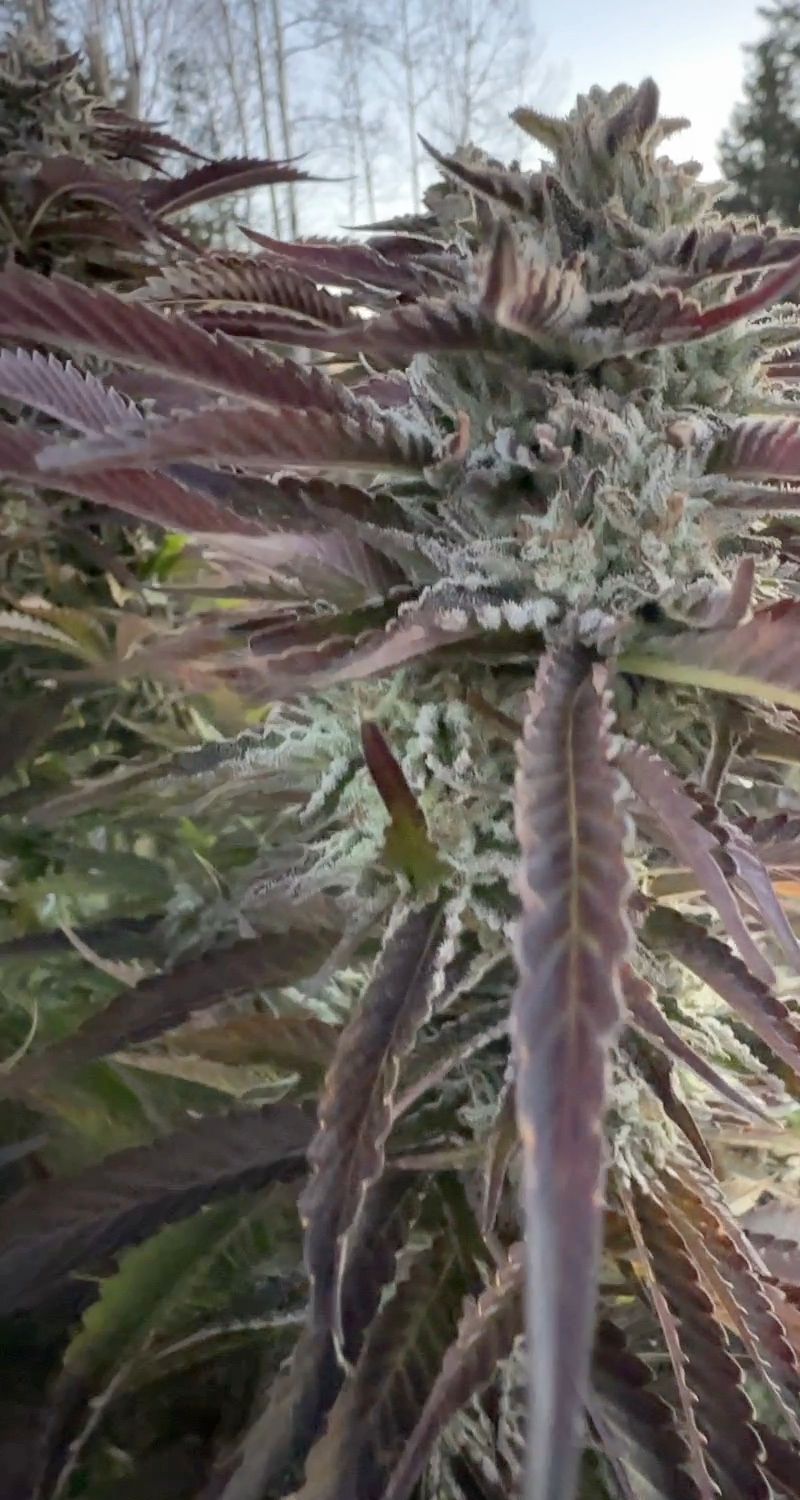
A purple cola at daybreak, the night of our October 22, 2024 harvest.
Morning, evening or night: what is the best time of day to harvest cannabis?
The hour of the cut mostly changes aroma and flower temperature. Cannabinoids shift only slightly over the day, and rather in favour of the afternoon. Sesquiterpenes fall clearly from the start to the end of the day, while monoterpenes stay stable, and the flower warms up as soon as the sun rises.
The market consensus is "early morning, at sunrise". We go one step further: before sunrise. Up north in October, dawn comes late and the last hour of night is also the coldest.
Do you need darkness before harvest?
Outdoors, the night takes care of it. From late September on, nights run longer than 12 hours in Canada, and a plant cut at the end of the night has already come out of a long natural dark period. Indoors, many growers leave the lights off for 24 hours before the chop, with no published study behind it yet.
The figure you often see, up to 30% more THC after 72 hours of darkness, comes from Dutch trials that were never published in a scientific journal.
One caution for outdoor growers: extending the dark would mean tarping a ripe plant in October, trapping moisture around dense colas, which is exactly what bud rot needs.
How do you organize a cannabis harvest at night?
Everything gets set up the day before, so the cut goes fast and finishes before daylight. The drying room is ready, the gear is gathered, and every branch you cut goes straight into a bin, then to the drying room while it is still cold.
- Get the drying room ready first: a dark, cool, ventilated space with lines or racks already in place.
- Gather the gear: clean, sharp pruners, gloves (resin sticks), clean bins or crates, and sheets to cover them while you carry them in.
- Work with a green headlamp: both hands stay free, and of all colours, green light least disturbs the night of the plants you are not cutting yet. One research caveat: left on for hours every night, even dim green light can delay flowering in some short-day plants (Meng and Runkle, Michigan State University). Keep passes brief and the lamp dim.
- Cut branch by branch, holding each one by the stem, and lay them in the bins.
- Get everything into the drying room before sunrise, while the harvest is still cold.
- Stop cutting when day breaks: finish carrying out what is cut, and leave the rest for the next night.
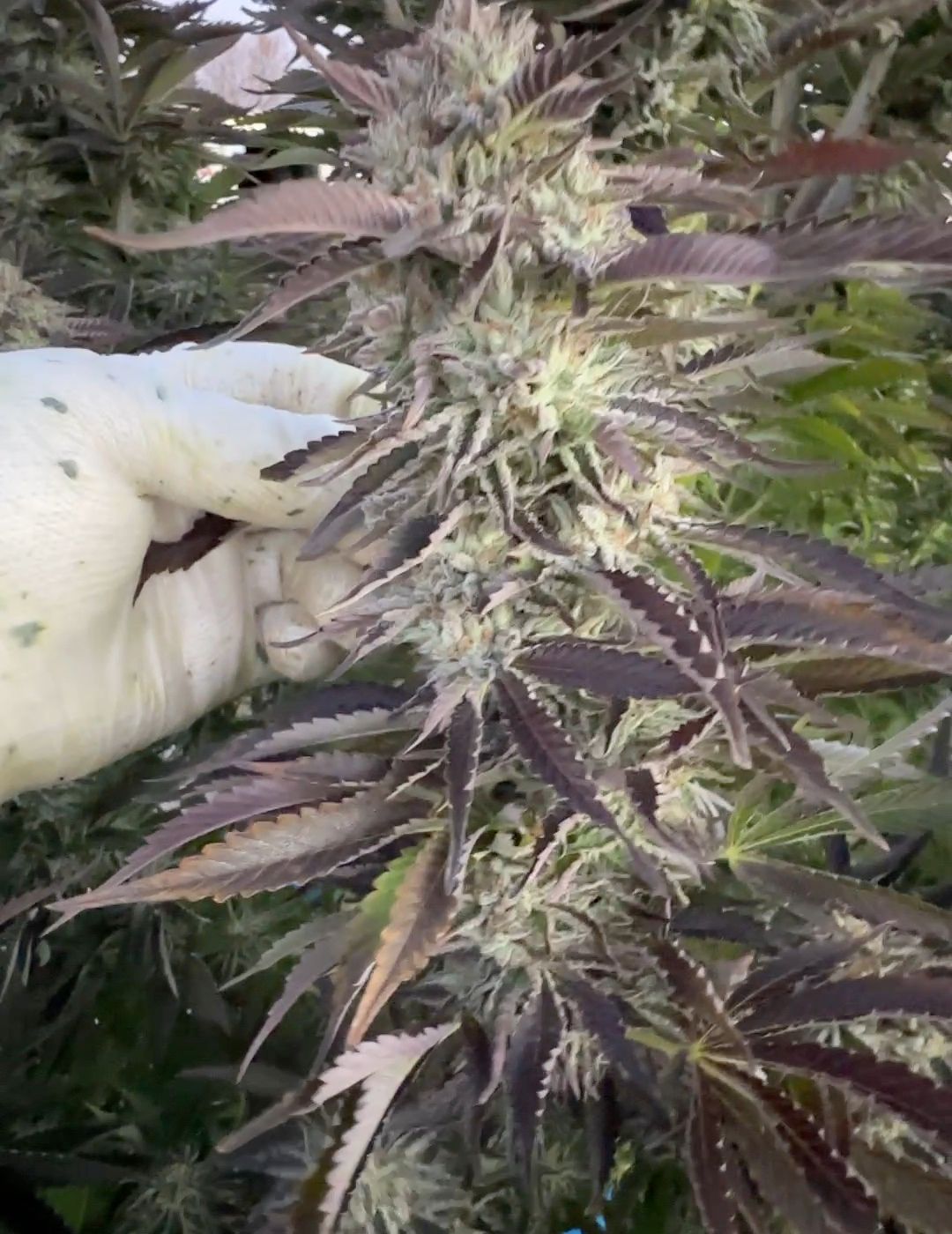
October 22, 2024, 6:54 a.m.: day is breaking, time to stop cutting. Field photo.
To know whether a plant is ready before you think about the hour, our guide to clear, cloudy and amber trichomes shows what to look for under the loupe.
What if the buds are frozen or wet when you cut?
Cut anyway if the plant is ready, but change how you handle it. A frozen trichome is hard and brittle: hold each branch by the stem and trim nothing until it thaws. Buds wet with dew dry best hanging without crowding, with good air movement for the first hours.
Frozen buds. A frozen trichome breaks off at the slightest knock, and that is resin you lose. Hold each branch by the stem, shake nothing, and never trim a frozen bud. Let it thaw in the drying room before you handle it.
Buds wet with dew. On a clear night, dew or frost settles on the buds. Hang without crowding and run good air movement for the first hours, so surface water clears before it feeds mould.
Mushy, water-soaked buds after a hard frost. That tissue is gone: remove it before hanging the rest, so it cannot contaminate healthy buds.
If harvest is close and frost is coming, our guide to late harvest in a northern climate helps you choose between a few more days and cutting now.
What is this guide based on?
The night-harvest method is our own, from thirty years of growing in a northern climate. The flower measurements come from Dimopoulos et al., Journal of Experimental Botany (2025), terpene losses after harvest from a 1996 study cited by Bueno et al., Journal of Cannabis Research (2020), the respiration heat of harvested plants from Postharvest Management of Vegetables and the University of Wisconsin, and the effect of green light from Meng and Runkle.
What should you read next?
For the rest of the harvest, our guide on when and how to harvest cannabis covers drying, and curing and storing cannabis buds explains how to keep the aroma you harvested at night.
For a season that finishes before the freezing nights, our autoflowering seeds can be timed to wrap up ahead of the first hard frosts.
FAQ
What is the best time of day to harvest cannabis?
At night, as late as possible before the sun reaches the buds. We cut between midnight and first light. A 2025 study measured a 31% drop in flower sesquiterpenes from the start to the end of the day. And in our experience, branches cut cold do not heat up once stacked for the trip to the drying room, so the flower arrives intact.
Is it better to harvest cannabis at night or in the morning?
At night, as late as possible before sunrise. Most guides say early morning, which gets close. The difference is the first sun on the buds: it warms them, and in our experience a warm pile of freshly cut branches keeps heating itself up. Cutting in the last dark hours means the harvest goes to the drying room cold.
Why harvest at night?
Three reasons. In a 2025 study, flower sesquiterpenes fell 31% from the start to the end of the day. Freshly cut plants keep respiring and produce heat, and we see that a cold harvest pile stays cool while a sun-warmed one heats up. And we find the plant at its most hydrated before dawn, which fits plant physiology.
Does 48 hours of darkness before harvest work?
No published study shows it yet. Many indoor growers give a dark period before the chop and report good results, but the figure you often see, up to 30% more THC, traces back to Dutch trials never published in a scientific journal. Outdoors, tarping a ripe plant in October traps moisture around dense colas, which is a real bud rot risk.
24 or 48 hours of darkness before harvest?
Outdoors, neither is needed. From late September on, nights are longer than 12 hours, so a plant cut at the end of the night has already come out of a long natural dark period. Indoors, many growers leave the lights off for 24 hours before the chop; no published study has compared the two durations.
Is green light OK for plants at night?
Of all work lights, it disturbs the plants' night the least, and it is the one we have always used to water, treat and harvest in the dark. One research caveat: left on for hours every night, even dim green light can delay flowering in some short-day plants. Keep your passes brief and your headlamp dim.
Can you harvest frozen buds?
Yes, if the colas are firm and healthy, but change how you handle them. Frozen trichomes are hard and brittle and snap off at the slightest knock. Hold every branch by the stem, do not shake anything, and never trim a frozen bud. Let it thaw in the drying room before you touch it. Mushy, water-soaked buds are lost.
Can you harvest wet buds?
Yes, if the plant is ready and the weather is not improving, but drying has to make up for it. Hang without crowding, run good air movement for the first hours to clear surface water, and keep the room cool. After real rain, gently shake each branch before bringing it in, unless the buds are frozen.
Should you harvest the whole plant or branch by branch?
Branch by branch in a damp autumn. A whole hanging plant dries slowly, which suits dry climates. Up north, that slowness gives bud rot time to set in. Separate branches dry more evenly, take less room and can be checked one at a time.
Wet trim vs dry trim: which is better?
In a cool, damp autumn, wet trim. Removing the leaves right after the cut exposes the buds and speeds drying, which shortens the window for mould. Dry trim, hanging buds with their leaves on, slows drying and suits dry climates. If the buds are frozen, wait until they thaw before trimming, or the trichomes will snap off.
Do terpenes evaporate after harvest?
Yes, continuously. A 1996 study, cited by Bueno and colleagues in 2020, measured terpene losses of 31% after one week of drying, about 45% after a month and 55% after three months. That is why we keep the harvest cold on the way to the drying room and keep the drying room cool.
19+ | Educational horticulture only.